

“It was a large, handsome stone building, standing well on rising ground, and backed by a ridge of high woody hills.”
– Pride and Prejudice, Jane Austen, 1813
No other estate of my acquaintance has such presence. Some houses are larger – the frontage of Wentworth Woodhouse in Yorkshire is said to be the longest in Europe; some are grander – nothing outdoes Blenheim Palace in Oxfordshire, gifted to the Duke of Marlborough by Queen Anne on behalf of a grateful nation in 1705 – and yet there is an indefinable quality about the setting of the ‘Palace of the Peaks’, which has always exerted a hold over me and caused my spirits to rise and my heart to flutter.
I sound like Elizabeth Bennet. Maybe it is because, as a dedicated Jane Austen fan, I recalled, on first seeing the house from that snaking road that approaches it through the rolling Derbyshire countryside, the effect that the first sight of Pemberley – itself situated in Derbyshire – had on the heroine of Pride and Prejudice. She journeyed by carriage with her aunt and uncle, the Gardiners, to that fabled residence – the country seat of Mr Darcy – across similar terrain until:
“… the eye was instantly caught by Pemberley House, situated on the opposite side of a valley, into which the road with some abruptness wound. It was a large, handsome, stone building, standing well on rising ground, and backed by a ridge of high, woody hills; and in front, a stream of some natural importance was swelled into greater, but without any artificial appearance. Its banks were neither formal, nor falsely adorned. Elizabeth was delighted. She had never seen a place for which nature had done more, or where natural beauty had been so little counteracted by an awkward taste … They descended the hill, crossed the bridge, and drove to the door …”
There is a moment, on the journey north from London, when one is suddenly aware that the landscape has changed. Much of the journey is a relatively featureless sweep of sporadic industrialisation, interspersed with unremarkable agriculture. But then, beyond Chesterfield, the terrain alters; it becomes more undulating. There is a certain richness to the rolling landscape; it begins to cradle you in its sylvan embrace and there are copses and woods framing the view.
The roads are narrower now and more snaking – up hill and down dale, through overhanging oak and ash trees – until signs appear bearing names like Calton Lees and Edensor. The road rises in front of you, then dips, then swings around to the left and you are gazing upon Miss Bennet’s view: you have arrived at the ‘Palace of the Peaks’.
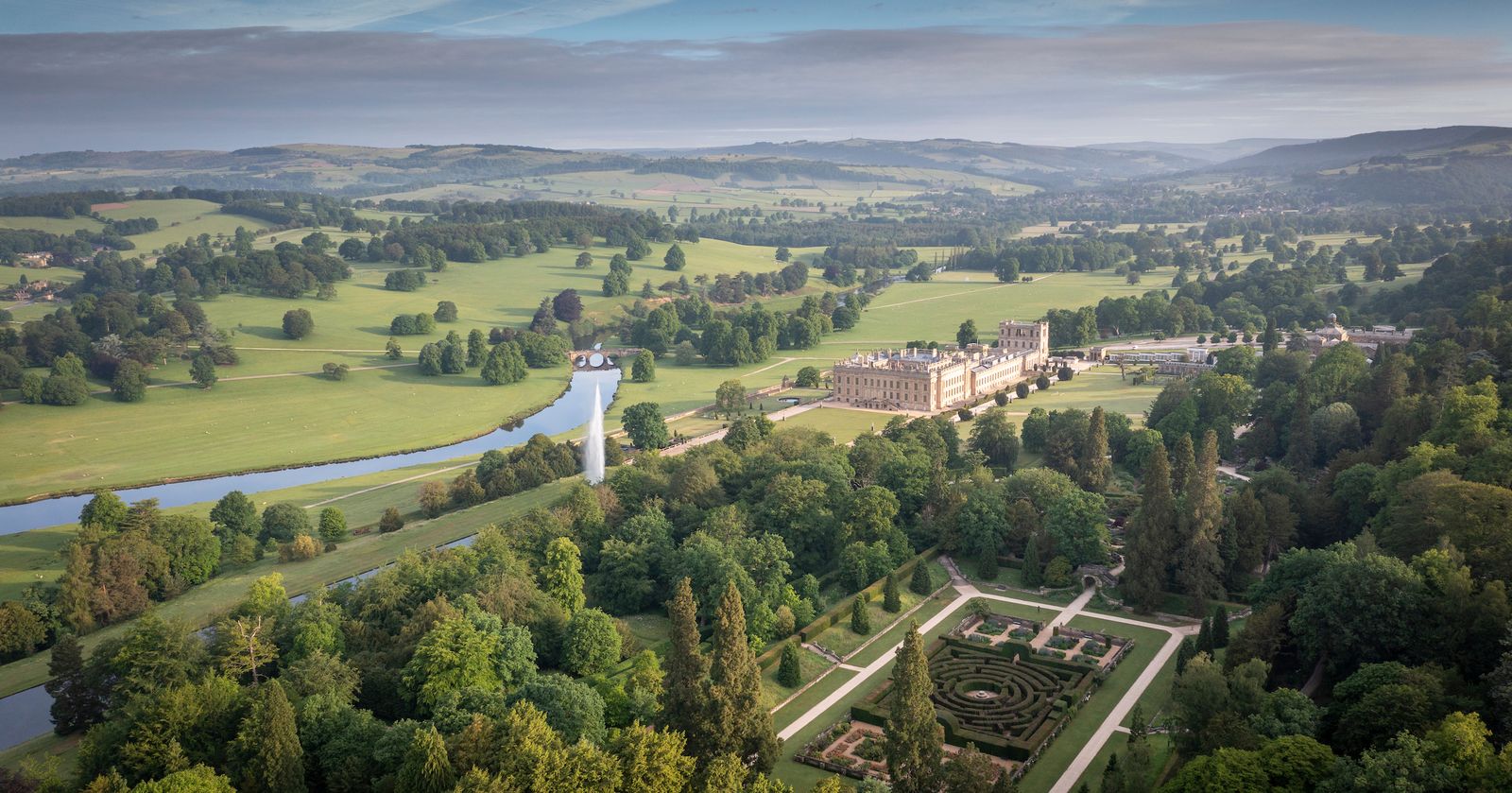
The house, garden and landscape have held me in their thrall ever since the 1980s. I, too, passed through the massive front door of Chatsworth – heavy, oaken and twice as tall as I am – with awe and trepidation, until greeted by the then duchess, Deborah Devonshire, in the stone-floored hallway. It was flanked by gigantic equestrian portraits and decorated with log baskets, dog leads, water bowls, a basket of eggs and a seemingly endless phalanx of wellington boots.
The atmosphere was warm, and so was the welcome; both have persisted in the five decades during which I have been lucky enough to have been a frequent houseguest. While the intimidation I felt on approaching Chatsworth all those years ago has completely disappeared, my love, respect and admiration for the house, the 105 acres of garden, the estate – and for the family – have grown immeasurably; feelings due in no small part to the fact that the Devonshires, both past and present, actually enjoy sharing this special part of the Derbyshire Dales with visitors from the county, the country and indeed the entire world.
I am a great believer in atmosphere, both inside a house and out. The atmosphere at Chatsworth has every right to be intimidating simply by virtue of its scale – there are massive, newly re-gilded finials atop its roof, for goodness’ sake, and gilded windows that dazzle in the westering sun – but at every turn there are reminders that this is a family home as well as a grand house. The garden and the immediate landscape are of a scale that complements the property, but which exude a kind of friendliness. There are no ‘Keep Off The Grass’ signs, and when one visitor on a hot summer’s day complained to the late Duchess that people were actually paddling in the waters of the great Cascade, her response was: ‘Yes; isn’t it lovely!’
This is an edited extract from ‘Chatsworth: The Gardens and the People who made them’ by Alan Titchmarsh and Jonathan Buckley. The book is out now, published by Ebury Spotlight.


