

The joy of spring is the scented, fleecy blossom that clings to the branches of the hedgerows and the trees, before the wind finally lifts it and swirls it through the air like confetti. In the countryside, the show begins early, in February, with cherry plum and ends in May, with hawthorn. Likewise, in the small garden, a variety of compact ornamental trees will provide a continuum of pastel and white blossom for months, including early and late flowering cherries. But productive blossom trees will also fit into the tiniest of gardens if the correct rootstock is purchased – for instance, dessert apples grown on M27 rootstock will only grow to 2-metres tall and can therefore be enjoyed in containers or even trained into low stepover fencing. As well as fruit, small blossom trees can provide nectar for wildlife and lure insects for birds, and many blaze with fiery leaf colours in the autumn, giving you interest throughout the year, as well as a dazzling mass of fluffy blossom in spring.
Blossom to cover walls and fences
Training fruit trees vertically is an easy and attractive way to squeeze more blossoming plants into a small outside space. Apples and pears can be coaxed into a series of horizontal tiers known as an espalier, which looks elegant, especially in winter when the shape is in full view. And many fruits – including cherries and apricots – can be trained in a fan shape; both fans and espaliers require a good portion of wall or fence or the side of a house. Cordons – which are usually grown as single stems at a 45° angle – take up a lot less room. Train fruit trees yourself year by year or purchase them ready-trained.
What is the best blossom tree for pots?
Compact blossoming shrubs are great to enjoy in containers or at the back of a border. The 2.5-metre Fuji cherry (Prunus incisa) 'Kojo-no-mai' has single white or very pale pink flowers on spindly branches in early spring, as well as good autumn leaf colour. Even smaller, the Japanese apricots Prunus mume 'Beni-chidori' (hot-pink) and 'Omoi-no-mama' (pale peach pink) flower on bare stems in February; the dwarf Russian almond Prunus tenella 'Fire Hill' is coated in lipstick-pink single flowers in April, and the miniature crab apple Malus Cinderella produces white flowers in mid-spring, followed by golden berries and autumn leaf tints.
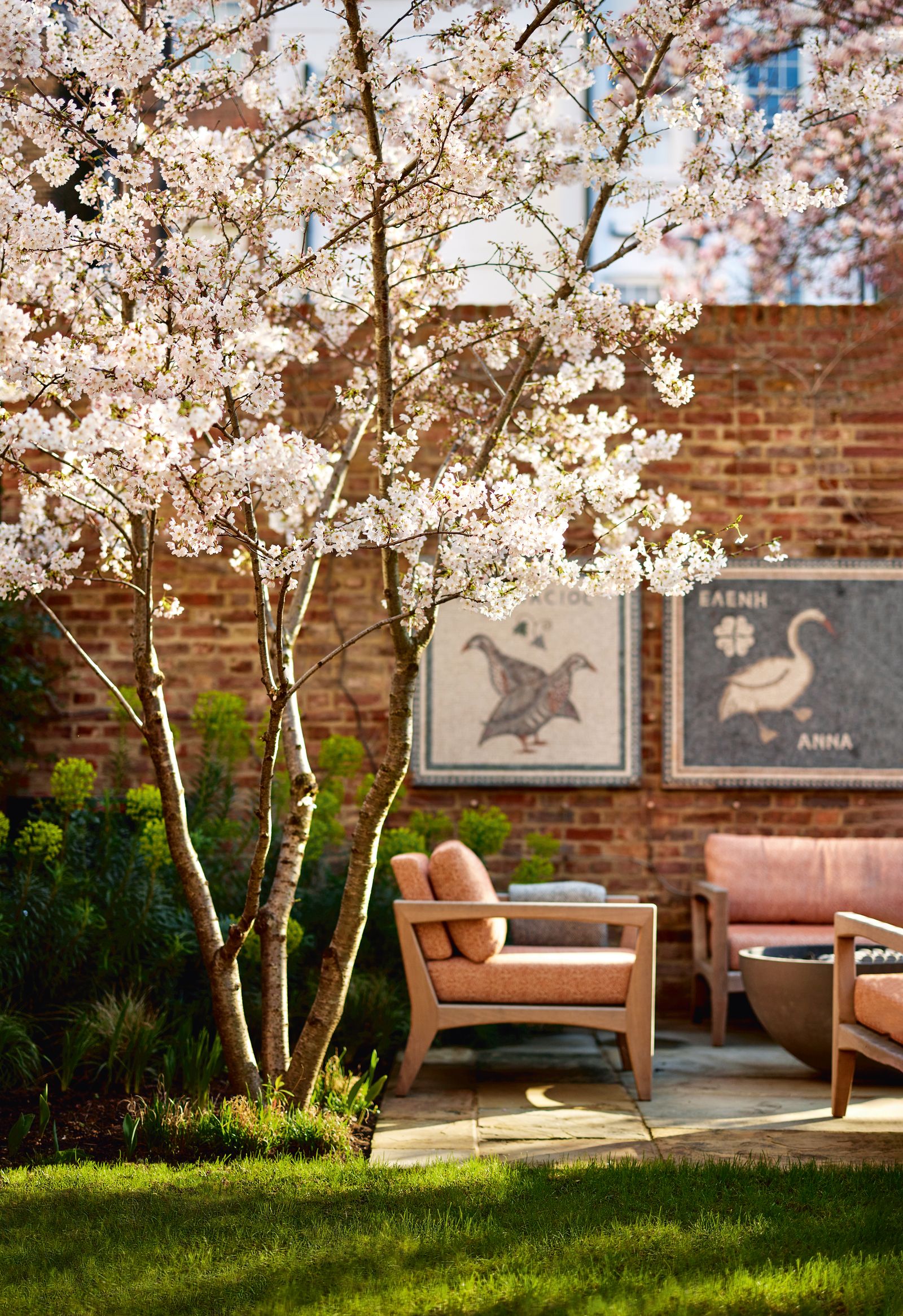
Blossom plants for a small garden
Trees that have a columnar habit are an excellent way to save space, since they don't demand much elbow room. For example, the flowering cherries Snow Goose (white) and 'Amanogawa' (ballet-pink) both have pretty blossom in April and grow in a flagpole shape.
There are also more traditional-shaped flowering cherries that remain fairly compact, only growing to around 3 to 4-metres tall and 2 to 3-metres wide. Some of the best are Prunus 'The Bride' (elegant, large white flowers with a raspberry centre), P. incisa 'Mikinori' (soft-pink semi-double blossom that fades to white), P. incisa 'Oshidori' (powder-pink frilly blossom), 'Collingwood Ingram' (superb carmine-pink single flowers), and 'Starlight', which has gorgeous starry white blossom and won RHS Plant of the Year in 2024.
Blossom in a mixed hedge
One of the cleverest ways to squeeze more blossom into a small garden is to grow it in a wild-mix hedge. There is a wide range of wildflower candidates to choose from, flowering at different times: cherry plum (Prunus cerasifera) is the first to get going in February, followed by blackthorn (Prunus spinosa) in March, which looks very similar: both are a mass of small white flowers, although the cherry plum can occasionally bloom pale sugar pink, and an excellent source of early nectar for bees. Then in April, it is the turn of the wild cherry (Prunus avium) and the wild pear (Pyrus communis), which have beautiful white blossom, and the crab apple (Malus sylvestris), which blooms pink and white. And, of course, the Mayflower, hawthorn (Crataegus monogyna), brings up the rear with its densely packed white flowers, which resemble a bank of snow when it is grown as a hedge and fill the air with scent in late spring. If you have room, grow a mix of these plants for a continuous show of flowers.

Which small blossom plants help wildlife?
Blossom plants with a single or semi-double flower shape are the best ones to help bees and other pollinators and also create a contemporary naturalistic look. Those that produce berries or have spines (such as hawthorn) are also excellent for birds, offering them food and shelter from predators.
When to plant blossom plants
Ideally, plant when the tree is dormant during autumn, winter, or early spring. At this time, most blossom trees are available to buy bare root (without soil), which means they are cheaper and establish better. Plant as soon as possible after they arrive. However, container-grown trees are also available to buy and can be planted at any time of year. If planting during hot, dry weather, ensure the tree is watered regularly.


