
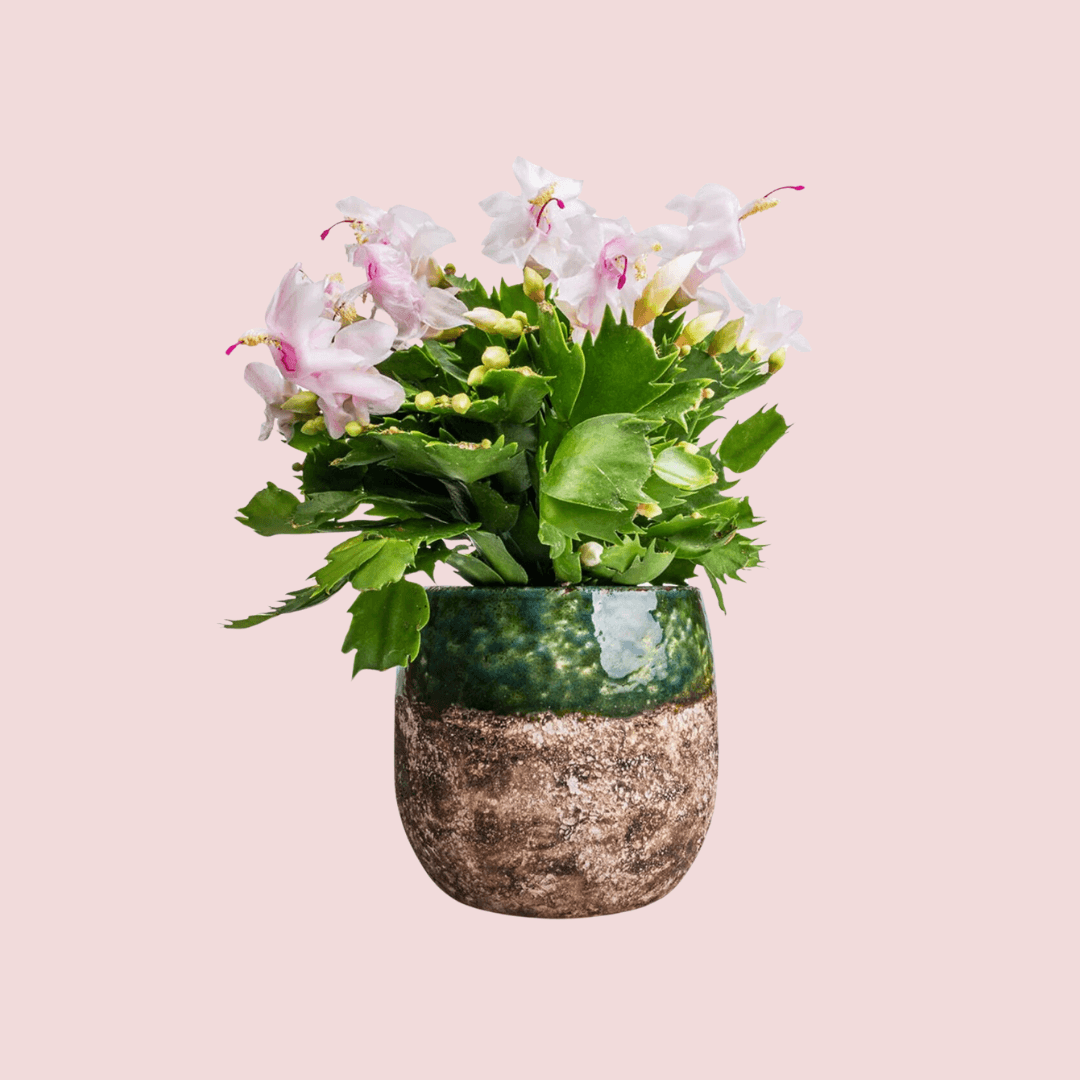
| Christmas cactus | Information |
|---|---|
| Botanical name: | Schlumbergera x buckleyi |
| Family: | cacti (Cactaceae) |
| Type: | forest cactus |
| Flowers: | November to January |
| Height: | 40-50cm (16-20in) |
| Spread: | 40-50cm (16-20in) |
| Aspect: | medium to bright indirect light |
| Humidity: | average to high |
| Temperature, winter to summer: | average |
| Temperature in autumn: | cooler |
| Hardiness: | H1B |
| Difficulty: | average |
Possessing more character than poinsettia, but producing just as much punchy colour during the festive period, the Christmas cactus (Schlumbergera x buckleyi) is a much-loved houseplant. It has a very particular seasonal routine, but once this has been grasped, it is an easy plant to grow.
The genus is said to have been named after French botanist Frédéric Schlumberger, who had a collection of cacti at his château near Rouen in the 19th century. There are seven species of Schlumbergera, which hail from the Serra do Mar (sea's ridge) and Serra da Mantiqueira (weeping mountains) regions of coastal southeast Brazil. The latter is known as weeping because it has so many springs, streams, and waterfalls and the air is usually damp with mist. Unlike most cacti, Schlumbergera are epiphytic and epilithic (grow on trees or rocks) and enjoy indirect light, humidity, and relatively cooler temperatures at heights of 700 to 2,100 metres (2,300 to 6,900 feet). They are pollinated by hummingbirds, which are attracted to the bright colours of the flowers.
The winter-flowering Christmas cactus (S. x buckleyi) is supposedly the offspring of the autumn-flowering S. truncata and the spring-flowering S. russelliana; though some experts believe that a natural hybrid, rather than S. russelliana, was the parent. The cross was made in London at Rollisson's nursery in Tooting in the 1840s by Wilbraham Buckley, and the resulting flowers were a neon shade of hot purple-pink. Today, there are some 1,400 cultivars of Christmas cactus with attractive red, pale pink, purple-pink, and white forms available, as well as orange, yellow, and two-tone varieties.
When young, the flat stems – which are linked together like bones – stand upright. Then, as they grow, these arms of stems grow longer and become pendulous, making them ideal for a hanging container or a pot atop a shelf. This cascade of stems produces a mass of magenta flowers during the festive period. Kept well, Christmas cacti can live for a very long time, lighting up the house every winter with cheerful colour.
How to grow a Christmas cactus
The plants enjoy a seasonal routine of winter and spring indoors and summer outdoors, followed by a stint of autumn beauty sleep in a relatively cooler, darker indoor room. This autumnal dormant phase stimulates flower buds to form.
Once your Christmas cactus has developed flower buds, move it to a brighter, warmer room in the house. Never place the plant in direct sunlight – instead, medium to bright indirect natural light is best. Water sparingly and with consistency, not allowing the compost to dry out completely.
After flowering, cease watering for a fortnight, and don't feed until the plants begin to grow again in April.
Once the temperatures go up in April or May (depending on where you live), move your plant outside to a spot in semi-shade or dappled shade, and protect from slugs and snails. If keeping it indoors, a room with an average to warm temperature is ideal. Water regularly, so that the compost doesn't dry out too much, but never let the plant sit waterlogged (for example, after rain, if it is sitting outside). Feed once a month.
Before Jack Frost begins to bite, bring the plant inside and place it in a room that has relatively cool temperatures (around 13-15°C/56-59°F) and long hours of darkness (at least 13 hours) – for example, a spare bedroom that you don't heat and don't put the lights on in; make sure there aren't street lights glaring into the room. Give a very minimal amount of water until buds develop.

How to care for the Christmas cactus
Medium to bright indirect light levels are best for Schlumbergera x buckleyi. Never put it in direct sunlight on a south-facing windowsill.
These Brazilian forest cacti like humidity, making them perfect for a kitchen or bathroom. In a room with lower humidity, they can be sat on a tray of pebbles and water. They should not be placed right next to a radiator.
Some ventilation (abeit not cold, strong draughts) is vital.
Keep the compost moist, but never waterlogged. Water when the surface feels dry (usually once a week) and the pot's weight feels like it is at around one third moisture. Water more during spring and summer and less during autumn and winter. If possible, use rainwater or tap water with a drop of white vinegar. A porous pot (such as unglazed terracotta) is a good idea if you are prone to overwatering.
Once a month, in spring and summer, give diluted nitrogen-rich fertiliser.
If the plants look too leggy, remove some of the segments in spring.
Schlumbergera enjoy a tight pot, so when re-potting (roughly every 3 years in spring), use a container the same size or slightly bigger. The optimum potting mix is leafmould, loam, and sand, in equal amounts, but, if that is not readily available, a general potting compost mixed with sand or grit will suffice. The container should have good drainage. If you can't be bothered to re-pot, simply mulch the compost surface instead, using old tea leaves or leafmould.
Christmas cacti often start dropping buds as soon as we bring them home from a shop. This usually relates to the temperature changes experienced during the move (hence the old wives' tale that you should never move a Christmas cactus) or it may have been subjected to excessive watering in the garden centre (avoid purchasing plants with saturated compost). Bud drop can be reduced by giving them their preferred winter conditions of medium to bright indirect light and scant (but regular) watering. As Frank Supplie and Dick van der Zee stress on autumn care in their book on the genus, 'A well fed and well watered plant will not flower.'
How to grow an Easter cactus
The Easter cactus (Rhipsalidopsis gaertneri) comes from Brazil and looks very similar to the Christmas cactus, but blooms later, in spring, and has scarlet flowers that close at night. It likes the same seasonal routine as its Christmas cousin, but at different times. Bring it back indoors in autumn and sit in bright indirect light. Its dormant period (in a cool, dry place) should be in winter, rather than autumn.
Schlumbergera and Rhipsalidopsis pests and diseases
These cacti are rarely problematic, but they can be affected by mealybugs, red spider mite, scale insects, and fungal diseases.


