
Sloping ceilings and restricted height – two things commonly but not exclusively found in attic rooms and loft conversions – can feel like problems to work around when you're planning a decorating scheme. But there are those who see their challenging nature as an opportunity. Awkward walls don't necessarily render a space useless – quite the opposite. What you may lack in grandeur you gain in cosiness, and these cocooning spaces actually can be manipulated to not just look pretty, but provide comfort too. If you're feeling stuck, take a look at the approaches below, which range from leaning into the room's restrictions to using clever tricks to distract from them.
Embrace the nooks
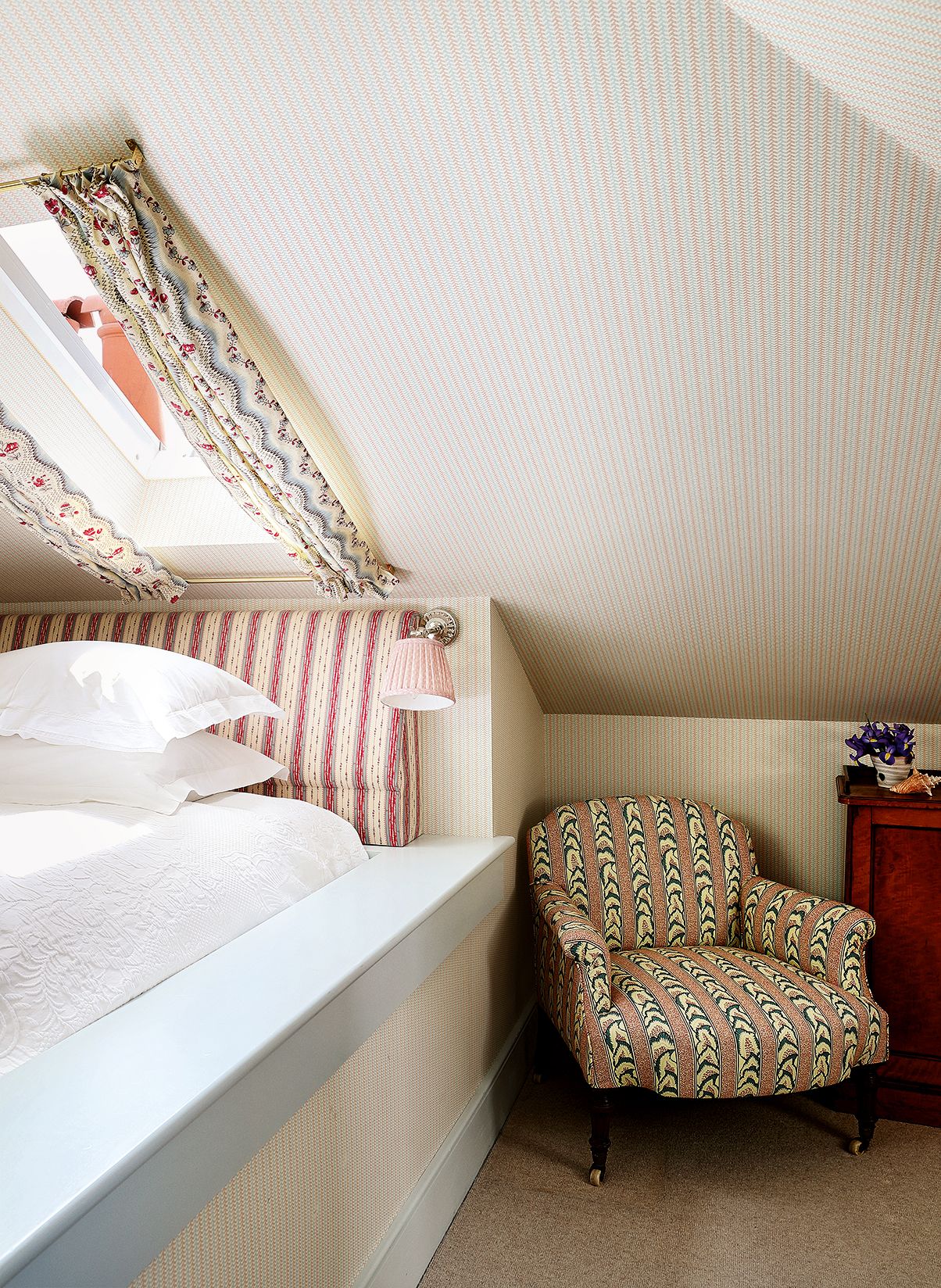
The interior designer Rebecca Hughes is certainly one who embraces a slanted wall and low ceiling, though she does acknowledge the ‘unique design challenges’ they create. ‘I think it’s important to consider balance, which is truly essential when designing spaces with sloping ceilings. There is a natural asymmetry which invites creative solutions that can be transformative. For example, placing taller furniture along the higher wall creates a natural progression that complements the ceiling's angle. Meanwhile, the lower side can accommodate items like reading nooks, low storage, or seating areas that feel intentionally cosy rather than cramped', she says.
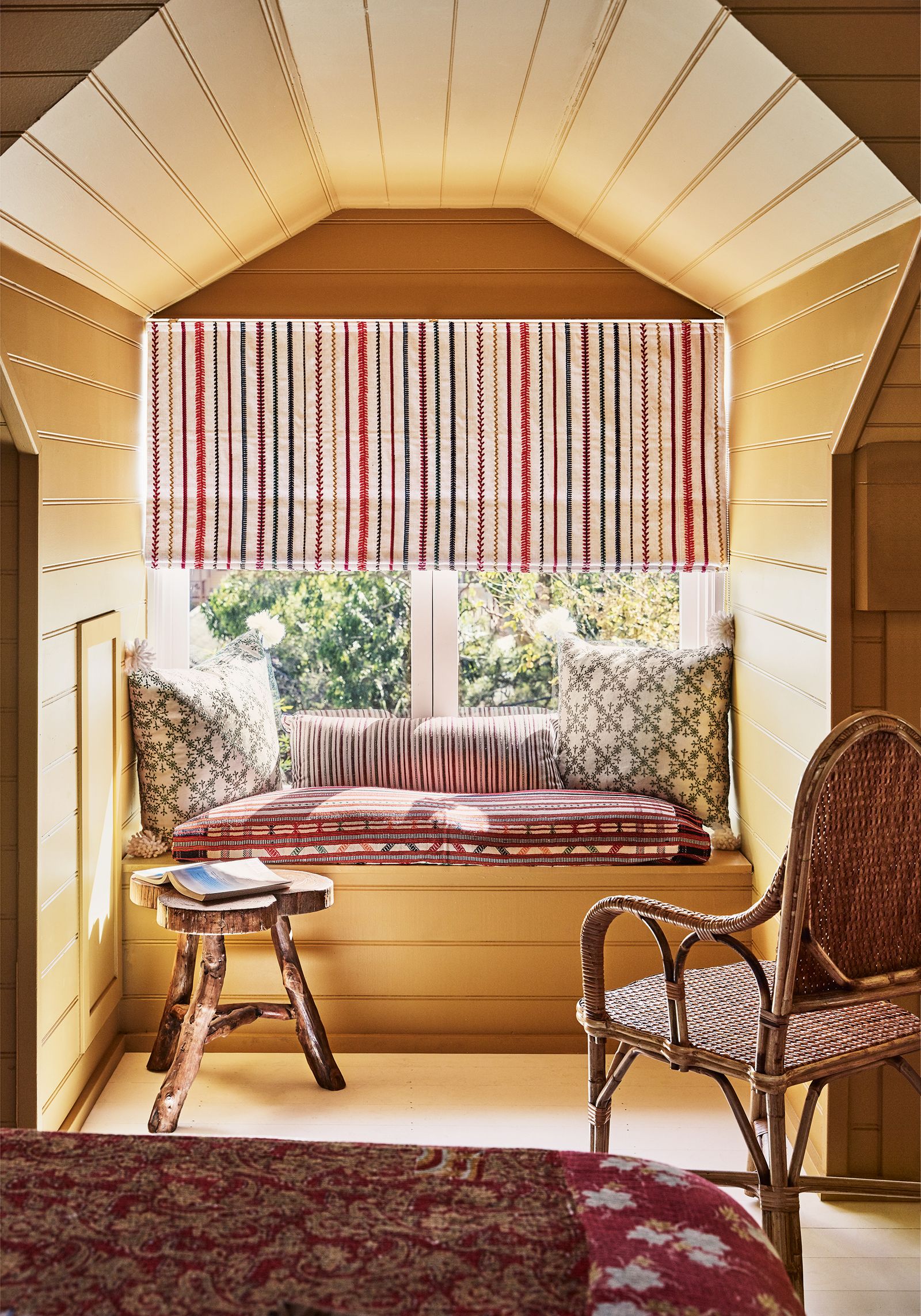
Cosiness is one of the key things that both sloping walls and low ceilings can create. It is for the reason that they lend themselves so well to a built-in bed, offering a ready-made nook for maximum comfort. It is a trick that designers turn to again and again (among them is Victoria Von Westenholtz, who has built a bed into the tiny attic room pictured above to magnificent effect). If you have no need for an extra bedroom, try incorporating a desk along the wall with the highest ceilings instead. The space under the sloping walls, meanwhile, would be a great place for storage, which can also be tucked under a window, as demonstrated by Lisa Burdus in the image below. In this Sydney project, an awkward and narrow space has been transformed into a deeply inviting, vibrant spot to read a book.
Create harmony with colour (and pattern)-drenching
When it comes to choosing fabrics, wallpapers and colour for a space with low ceilings and slanted walls, you'll want to think about the fact that there are many angles and joins in the room, and several contrasting materials, patterns and finishes might be visually jarring. It is perhaps for this reason that so many designers decided to pick just one and stick to it. The designer Joanna Plant opted to envelope the bedroom below in pretty floral prints. The effect is harmonious and joyful.

Something less decorative and slightly more neutral can be found in the simple but effective addition of tongue and groove panelling. When faced with the prospect of relatively low ceilings and tangental walls in a recent cottage project in Pembrokeshire, the interior designer John McCall clad the entire thing with the wooden panelling, which, alongside the stone wall, adds a sense of depth and character to the historic space, while maintaining a feeling of airy openness.

Similarly, enveloping a room in one colour can help to reduce the number of visual breaks there are in a space, making it feel more infinite. It is more commonly known as colour-drenching, and is, according to Patrick O’Donnell, Brand Ambassador at Farrow & Ball, a practical solution for smaller rooms. ‘You are creating less distraction and contrast but will still get decorative interest by mixing up the finishes, such as emulsion on your walls and eggshell on woodwork’ he says.

Trick the eye
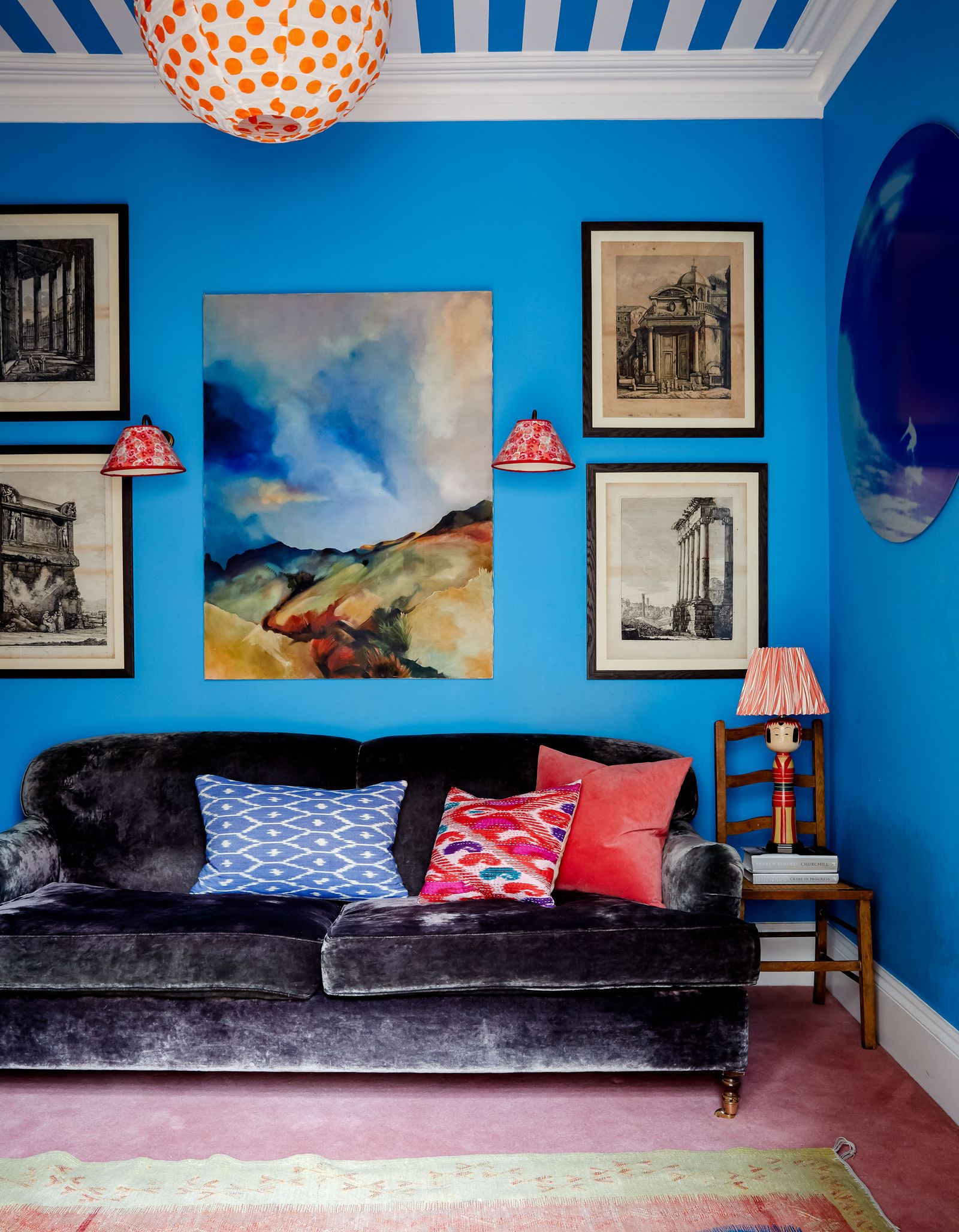
“Painting your ceiling can give a sense of spaciousness to somewhere quite low-ceilinged,” as the brilliant designer Lucy Hammond Giles of Sibyl Colefax & John Fowler puts it. It is a decorative trick that interior designers turn to again and again. Depending on how you use it, paint can either create the illusion of height, or at least distract you from its diminutive proportions. If it is the latter which appeals to you, look no further than the wonderfully playful snug below, created by lighting designer Rosi de Ruig. Here, vertical stripes stretch from the door to the far wall, distracting the eye from the fact that the ceiling is actually rather low.
When it comes to the colours, you may be tempted to opt for something light and airy, though according to the interior designer Nicola Harding - this would fool very few people. ‘Your eye naturally settles on the lightest thing in the room, so if your ceiling is a very light colour, it’ll draw attention to it', she says. Consider a dark colour, as in the space below, designed by Nicola.

Optical illusions - of which tenting tends to be the most popular choice to extend the height of a ceiling - can be created with relatively little ease. The motif is made up of several stripes which begin where the ceiling joins the wall and meet at the central point in the ceiling, their narrowness increasing as they reach the central point, is to trick the eye into thinking that, much like a tent propped up by poles, that the ceiling has a convex, cathedral-like shape. For the interior designer Veere Grenney, who often adds a tented ceiling to his project to ‘add a sense of theatre’, he says, adding ‘it’s not just theatre that it brings. It’s warmth and cosiness and beauty’.

Ultimately its all about how creative you are willing to get, and your mindset. Instead of ‘low ceilings’, think ‘bijoux proportions’, and slanted walls are not a 'nuisance' but an ‘opportunity’. Whether you're cladding them in smart panelling, painting a motif or dressing them up with a pretty fabric, there is nothing stopping these spaces from being just as considered and useful as those in the rest of your house. You just need to know what to do with them.


