

A friend once commented that the best piece of ‘art’ at my parent’s house is the fridge. Indeed, covered in magnets bought over decades in museums and souvenir shops across the world – from Denmark to Donegal – hardly an inch of the original surface is still visible. When I reach for the milk, I often get distracted by all the shapes, colours and words, and forget why I came over in the first place.
This is proof, if it were needed, that the best domestic art is not necessarily the most valuable. Whether you're doing a renovation or looking for something to add onto a jarringly blank wall, there is a temptation to run towards the quick fix: throwing money at the problem with an expensive piece or opting for a generic landscape from a high-street interiors brand. Or, if you are starting an art collection, it's easy to justify the artist or medium that promises financial returns. However, art, particularly in a homes – should be there to create contemplative corners that reflect your personality, taste and stories. So, to inspire you, we spoke to the experts on how to create an art collection with soul (and style).
Invest in up-and-coming artists

"It’s really important to do your research, to get into the mindset of the artist and understand them – find out how a piece was made, visit their studio, talk to them. It’s not just about what is on the wall. The process is a huge aspect of a work and it will add to the narrative. Talk closely to the gallery you are buying from. There are no stupid questions and artists generally like speaking about their work. If you collect more than one piece you can see how a particular artist evolves over time, that narrative will run through your house. It’s not just about buying something for yourself – you’re supporting an artist’s career, too.
Often people don’t know how to describe what art they like, but they know it when they see it. I suggest going to galleries and collecting postcards from exhibitions. If you’re drawn to Matisse then it shows you like colour and form and the body. You can use those search terms for your own research and look for artists who use that style – in galleries, on Instagram or Pinterest.
If you’re on a budget then limited edition prints are a great place to start. It’s not always size that matters the most. A smaller scale can help you get up close and personal. There are ways you can stretch your budget, too. Mixing exhibition posters and family photos with original art that has cost you a bit more. For cheaper artworks, too, if you buy a great frame people will assume it’s more expensive.
Whatever the reason you want to buy art – whether it's investment or for a renovation – the rule I always give is to buy what you love – you need to have a connection with it in some way. There’s no guarantee that it will have a return financially. So if you love it, there will always be a value."
Stick to a certain theme
The best way to create an art collection is by staying true to your interests, by identifying themes, topics, and positions that one is personally drawn to and keeping an eye open for that. It is easy to get lost otherwise. For instance, that could be ecological, feminist, or about materiality, the body and human form. What is rewarding is that it allows a thread of discovery and pursuit and opens one up to different perspectives centered around that theme. Alternatively, you can develop a collection based on a medium, such as drawings, or ceramics. What I find meaningful in helping my clients develop their collections is the process of learning and exchange. Art is there to inspire, to help us grow and expand.
Look out for second-hand gems

Most of the art I’ve bought is from auctions or vintage shops – there are very few living artists in there. It started when I was 18 I found an oil painting of a still life from a junk shop. I was decorating my room and I was very proud that I’d bought my first piece of art, that it belonged to me. I couldn’t believe how no one else could see how wonderful it was.
I take a scatter gun approach when it comes to collecting. You just have to start anywhere and never think about value. Everything we sell on Tat could potentially be worth nothing in 10 years. Everything I bought before I was 30 was under £100. There was a beautiful silk portrait of a parrot which cost me £5 which I have had for 15 years and then I’d also buy more expensive oil paintings which turned out to be fake. Collecting is about learning and making mistakes. You will inevitably buy a lot of rubbish. But it’s the same as buying a pair of jeans that you won't wear next year. You can always give it back to a charity shop because it might be perfect for someone else.
I love going into junk shops or charity shops. I can’t go past one without going in. Whilst I was in Grantham for a wedding I found four 1960s Glasgow School of Art paintings by the same artist in a second-hand shop and took them back on the train with me. In the window of an Oxfam in Bath I saw these immaculate portraits in the window. It turned out a lady had died and her son had given the whole collection to Oxfam. I was so surprised no one had take them. But the trick is not to doubt yourself. You shouldn’t assume that because it’s there it is worthless or not good. You build on this kind of knowledge with practice but you have to trust your eye. And it’s your collection so it’s about what makes you feel good. But I also love showing people what I’ve found and making them jealous about how clever I've been.
Think of the art in your home as a biography
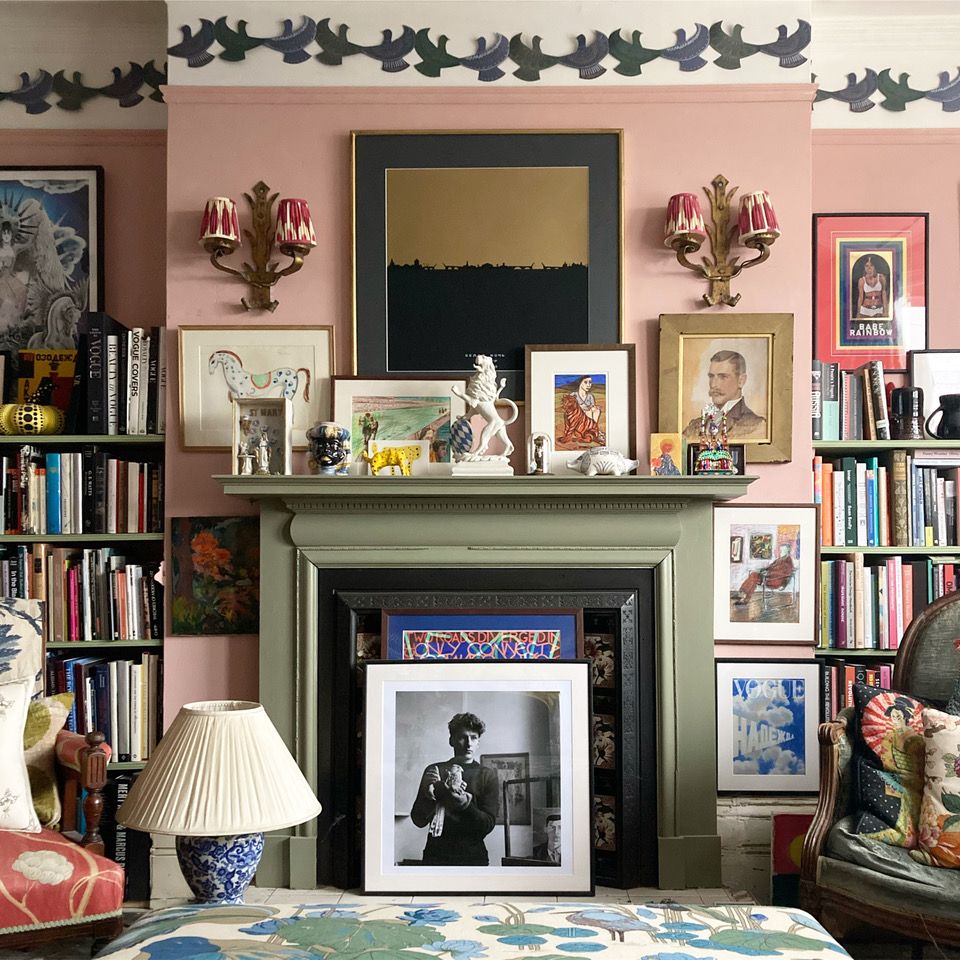
“A good art collection is biographical, just as an interior is biographical. You’ve got a lamp which you bought at a certain age, or a vintage painting you went on holiday. That’s where the meaning is brought in. When I started my art collection I didn’t realise it was an art collection. I wrote my masters dissertation on 20th-century Russian art, and then when I worked for Vogue Russia I met some of the artists. I bought a Timur Novikov silk screen after my grandfather died after my grandfather died and I received some money. There are so many different stories when I look at that silk screen: of my student days, of being in Russia, of my grandfather. The piece holds all of those layers. I also have art I’ve inherited like a portrait of my great great grandfather. It’s something I’ve seen all my life. I like being surrounded by the past but once it is mixed up with all the rest of my art it looks fresh. My sitting room wall is an intense pink – unlike the more anaemic white wall of my grandparents's house.
I don’t really go out and look for art – it just sort of happens! I have been fortunate to meet a lot of artists. I have a print by Eileen Cooper which was an out-of-series. Then one year at the Serpentine Summer Party when I was 28, I didn’t know anyone and Grayson Perry and his wife Philippa Perry took pity on me, and later I bought one of his Money Pigs. It’s non-numbered so technically not that valuable, but it reminds me of how kind he was to me that evening.
With children’s art – I try to control which elements of it go on the wall. Not all of it is lovely. A lot goes in what I call ‘the archive’ – a box in the attic. I have a pinboard that comes with me wherever I go – with postcards of work I could never dream of owning – which is in public collections. But it isn’t about value, it is about personal memories – postcards I bought when I was 15 and remind me of the epiphany I had when I first saw a Degas girl brushing her hair. My children have these too so they can explore what inspires them.
Don't exercise caution. Even if you are renting and don't have space for it, buy the art! I am haunted more by what I didn’t buy than what I did. There was a photograph by Noémie Goudal at her graduate show and I didn’t get it because I had to buy a buggy. I stand by my decision – but I always wonder what that print would have looked like on my wall.”


