

These embroidered ornaments are stuffed with wool roving and made with a combination of coloured fabric and stitches. Textile objects always have a lovely texture and feel and are perfect to decorate with, or make a set to give as a gift.
- Templates (below)
- Low tack tape
- 25 cm (1⁄4 yd) of cotton quilting weight fabric (in a variety of colours)
- Water-soluble fabric marker
- Embroider hoop (optional)
- Stranded cotton embroidery thread (floss)
- No. 3 embroidery needle
- Snips and scissors
- Water spritzer
- 1.8 m (2 yd) of cotton string for hanging ornaments
- Sewing machine and matching thread
- Wool roving or fibrefill for stuffing
- Chopstick or small stick
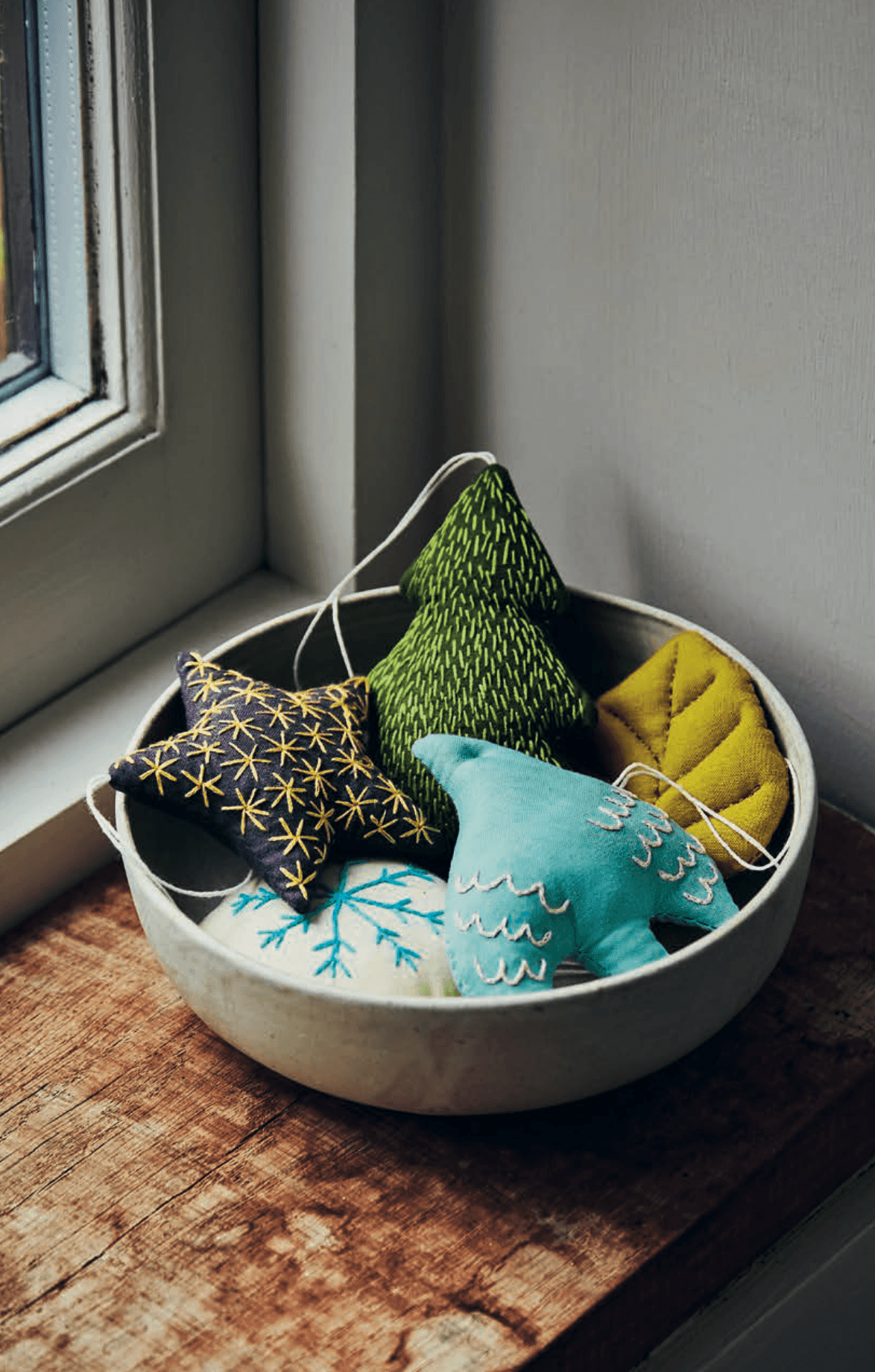
- Tree: long seed stitch (2 strands of thread)
- Bird: split stitch (6 strands of thread)
- Round: split stitch (6 strands of thread)
- Star: straight stitch (3 strands of thread)
- Leaf: back stitch (3 strands of thread)
Note that the leaf ornament was sewn together and stuffed first before it was embroidered so that it has a puffy look. Work steps 3 to 5 first, then embroider.

Copy one of the templates and then tape it onto a light source, and place the fabric on top. Trace the template with the water-soluble marker onto your fabric. You can also draw the design freehand. Remember to leave some fabric around the shape to add the seam allowance later.
Once you’ve traced the design, embroider inside the shape by either using a hoop or holding the fabric in your hand. To use a hoop, place the inner hoop underneath the fabric and the outer ring on top with the fabric in between. Tighten the hoop while pulling the fabric down all around until it is taut.
Once you finished embroidering the pattern, spritz the surface with a little water to make any visible drawn lines disappear and wait until it dries before sewing. Then, cut around your shape making sure to add a 1 cm (3⁄8 in) seam allowance all around. Cut a second piece the same size for the back.
Place the back on top of the front with right sides together. At the top of the ornament place a loop of cotton string in between the layers with the loop side on the inside and the ends extending out by about 2.5 cm (1 in). Cut the string however long you want it to be; I keep mine 38 cm (15 in) long.
Sew around the edge with a 1 cm (3⁄8 in) seam allowance, leaving an opening around 5 cm (2 in) on one side to turn right side out. Before you do this make sure to snip the seam allowance along any curves to avoid any puckering in those areas.
Turn right sides out and stuff with wool roving or fibrefill. Use a small stick, such as a chopstick, to push out and fill the small areas with stuffing. Use a blind stitch to close the opening. Repeat these steps for all the designs.


