
- Common names: mahonia, Oregon grape
- Botanical name: Mahonia
- Family: barberry (Berberidaceae)
- Type: evergreen shrubs
- Flowers: autumn, winter, or spring
- Planting time: all year
- Height: 90cm-4m (3-13ft)
- Width: 90cm-4m (3-13ft)
- Aspect: light shade
- Hardiness: H4 to H5
- Difficulty: easy
Mahonias are woody evergreen shrubs and the best of them flower in winter. In the past, they were regarded as something to shove in the shady corner or, even more insultingly, as car park plants. But now – thanks to the demand for architectural foliage – they are having their moment in the sun . . . or, rather, their moment in light shade, which is where they prefer to be.
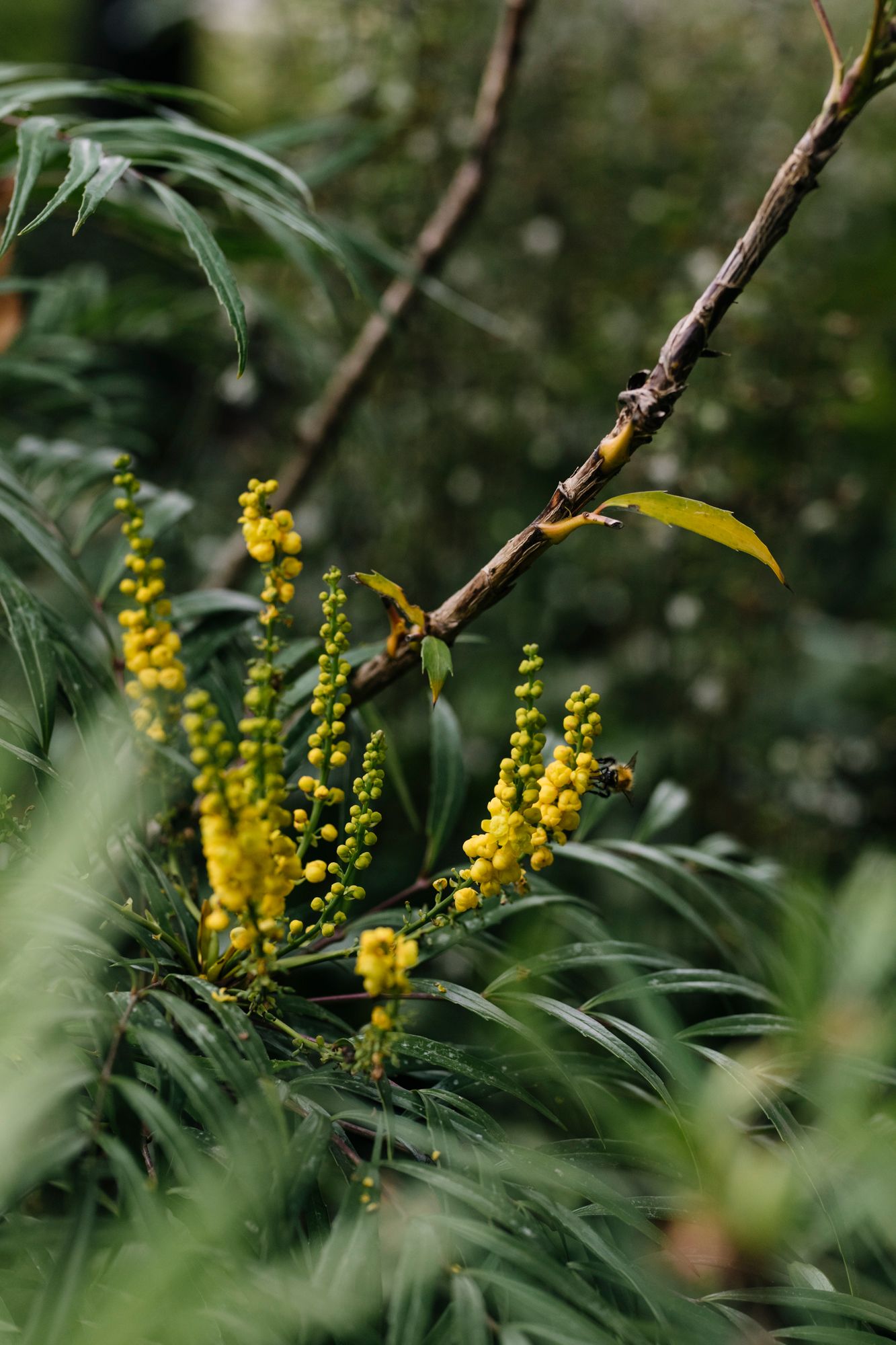
The main garden forms are the Mahonia x media varieties. Their pinnate leaves are sharp and glossy and grow around the branches like Elizabethan ruffs. With a little choice pruning and shaping, these shrubs' natural architectural look can be amplified, so that the whorls of leaves grow in beautifully spaced tiers, adding wonderful structure to the garden.
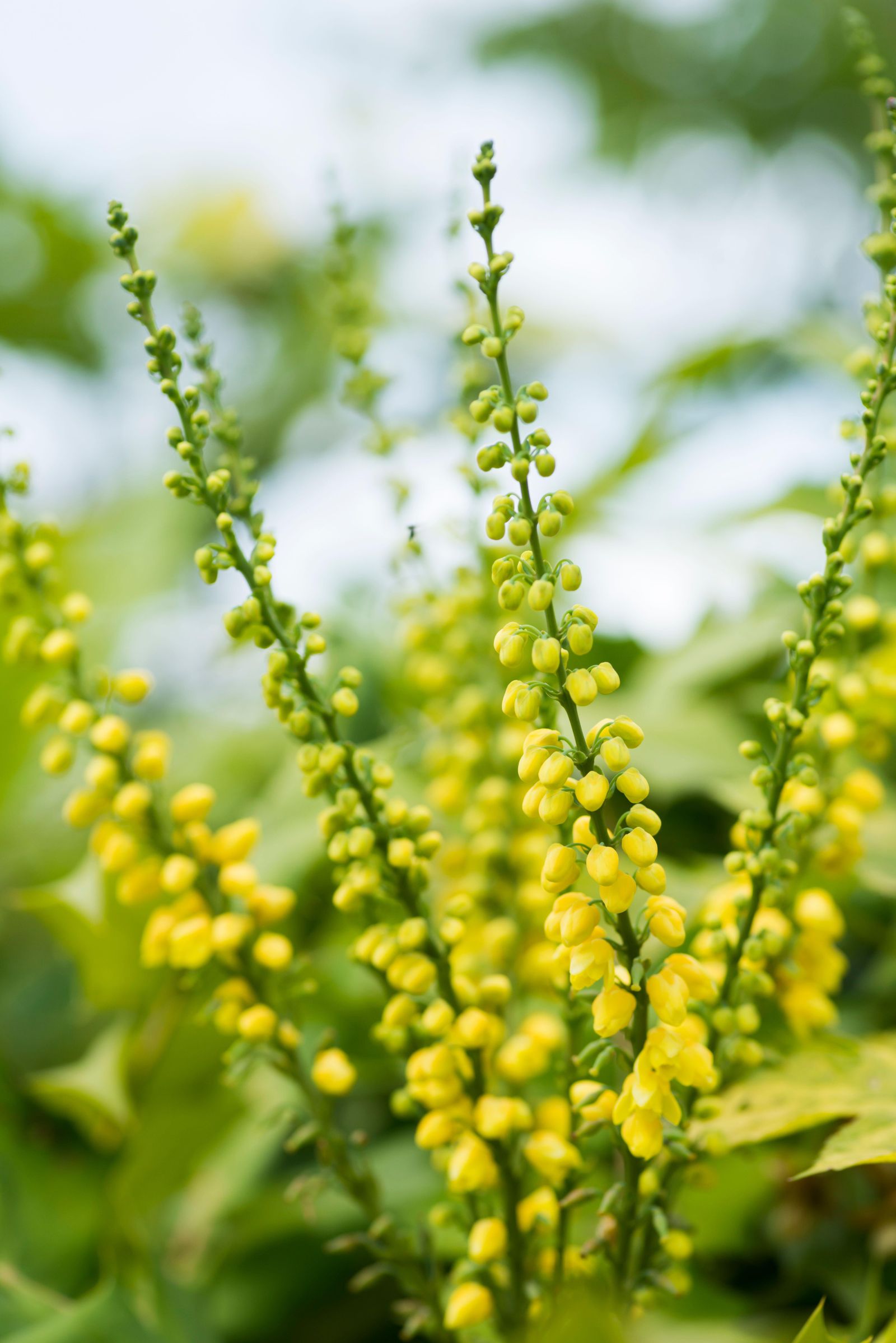
Atop and amongst the green collars of leaves, clusters of long poker-shaped flower racemes bloom like bright-yellow flames throughout the winter months. As well as adding cheering colour, they exude a delicious scent that is reminiscent of lily of the valley and hangs in the air on still winter days. Being laden with nectar, they are one of the main food sources for the buff-tailed bumblebee, which is increasingly seen foraging in winter as a result of our warming climate. The plant also provides for birds by producing blue or black berries.
The M. x media cultivars are crosses between M. japonica (highly scented) and M. oiwakensis subsp.lomariifolia (very architectural with sun-yellow flowers), which – like most garden mahonias – hail from Asia. The exception is of course M. aquifolium (Oregon grape), which comes from the western coast of North America and is widely grown as shrubby ground cover, although its flowers are not scented. The genus is named after the Irish-American horticulturist, Bernard McMahon, who wrote the most influential gardening book in the US in the first half of the 19th century. But some authorities choose to strip mahonias of that old genus name and refer to them all as Berberis instead. Whatever we call them, they are some of the best plants to brighten and perfume the winter garden.
Which mahonia to grow
The iconic winter-flowering large woody shrubs are forms of Mahonia x media (including 'Charity' and 'Winter Sun'). They are architectural, tough, scented, and great for wildlife. One of their parent plants, M. oiwakensis subsp. lomariifolia, is incredibly elegant with excellent structure and slightly scented bold-yellow flowers; although it is not as hardy as M. x media, it will do well given a sheltered spot in most gardens. Much smaller, but producing pale-yellow fragrant flowers at the same time (from November to March) is M. bealei; it is a hardy evergreen shrub to around 1.5m.
Those winter gems aside, there are mahonias that flower at other times of year. For some of us, this is akin to having strawberries at Christmas, but for anyone who wants mahonia in flower outside of winter, there are plenty to choose from. M. aquifolium 'Apollo' is a small, spreading form with unscented yellow flowers in March and April. Compact M. x wagneri 'Pinnacle' is another spring-flowering mahonia that offers bronze new growth and unscented yellow flowers. The next group are in flower from late summer into late autumn and, again, suit the smaller garden. M. nitens 'Cabaret' produces unscented orange blooms, while the splendid M. eurybracteata subsp. ganpinensis 'Soft Caress' (unscented yellow flowers) and 'Volcano' (unscented orange flowers) are unique, having spine-free foliage, which – unlike other mahonias – doesn't scratch and stab your arms. For this reason, they make superb pot plants for the terrace.
If you fancy something more unusual, Crûg Farm has a good collection of rarer mahonias that they and other plant hunters (such as Roy Lancaster) have brought back from Asia. These include the very graceful M. gracilipes (a small shrub from the Himalayas, which has red autumn flowers and large red-tinted leaves with white undersides), as well as forms of M. oiwakensis, which bear wand-like racemes of scented sun-yellow blooms above incredibly long (almost 1 metre) leaves.
Most mahonia flowers are moreish to bees, and blackbirds often take the berries.
How to plant a mahonia
Mahonia will grow in sun or deep shade, but they are happiest in light shade.
Moist, well-drained moderately fertile soil is essential, so fork in organic matter (such as peat-free compost) before planting.
Most garden mahonias are hardy in the majority of the UK; M. oiwakensis subsp. lomariifoliaand M. eurybracteata subsp. ganpinensis are not quite as tough, but will cope in most regions. The main thing that will test their robustness is cold or drying wind, so shelter is important. All mahonias enjoy being shielded by other shrubs, hedging, trees, or walls.
How to care for mahonia
In spring, after flowering, prune your mahonia, if necessary. At the same time, mulch around (but not against) the base of the plant with well-rotted manure or peat-free compost.
How to prune and shape a mahonia
The best time to prune and shape a large mahonia is straight after flowering in spring.
Annual pruning is not necessary, and mahonia grow at an average to slow rate. But, in a small garden, regular pruning will keep the shrub compact.
Some large branching mahonias (such as varieties of Mahonia x media) are capable of growing into wonderful architectural shapes, and pruning is a way of optimising this. Clip to create elegant tiers of rosettes, removing the less impressive leaf sets that block the view of the better whorls. You can also create more space between the stems using strong twine to pull them apart, tied to the branches above and below, but not so tightly that you harm the plant; remove the string after a few months. At Archictectural Plants in West Sussex, optimised branching is achieved by using sheets of balsa wood (with a V cut in each end) to push some of the stems apart; again, these are removed after a few months.
Over time, the larger mahonias will become bare at the base, which creates the look of a small tree; this is arguably attractive, but if you dislike it, the plant could be revived by cutting it back after flowering to 30 centimatres above the ground.
Mahonia problems
Some mahonias are sharp, so wear gloves and goggles when pruning. These shrubs are generally fuss-free, but can be affected by rust or powdery mildew. Prevent mildew by planting in light shade, ensuring there is some air flow (albeit not strong, cold wind) around the plant, pruning to create an open structure, watering well in drought, and mulching annually.


