

A family of five had owned the top floor and terrace of a two-floor converted factory space in Shoreditch for some time before coming into possession of the floor below; when they did, they turned to Charles Tashima and his team at Studio Tashima to adapt the large, deep space while retaining the period elements that made it so special in the first place. What followed was a project of modernisation and subdivision, respecting the history of the building and its materials in line with the studio’s ethos of reuse and reinvention.
The first question was how to structure the large main space, which now incorporates several discrete areas including a reading snug, an TV corner, a freestanding grand piano and a kitchen and dining area. Studio Tashima’s aim was to create a feeling similar to that of a mixed-use hotel lobby – albeit more homely and characterful – where one might sit in a specific area (in a bar, say, a bay window or by a fireplace) and experience a diversity of use despite the open-plan format.

The building was once a furniture factory, and Studio Tashima sub-divided it cleverly; aptly, lots of the family’s own furniture was used as the starting point. Many of the pieces in the flat were inherited from one of the clients’ mothers, and Studio Tashima began with an inventory of it all, before finding places for it in the main living room and the rest of the flat. The colour of a sofa was used to inform the joinery which held the television, for example, somewhere between a dark aquamarine and teal. Rugs on the floor, in particular, further helped to define each loose “zone” of the large room.

Throughout, there was a balance between the extant and the totally new. Studio Tashima built a bespoke staircase from scratch out of oak, leading to the newly acquired downstairs area, which before was only accessible by a communal staircase outside the flat. An original structural cast-iron column had to stay in situ, but was then used to inform the boundary of the otherwise open kitchen and its island. Teak doors used on storage spaces were repurposed to enclose the boiler cupboard and another cupboard, while the original floors were left untouched, as was the brickwork at the kitchen end of the space.
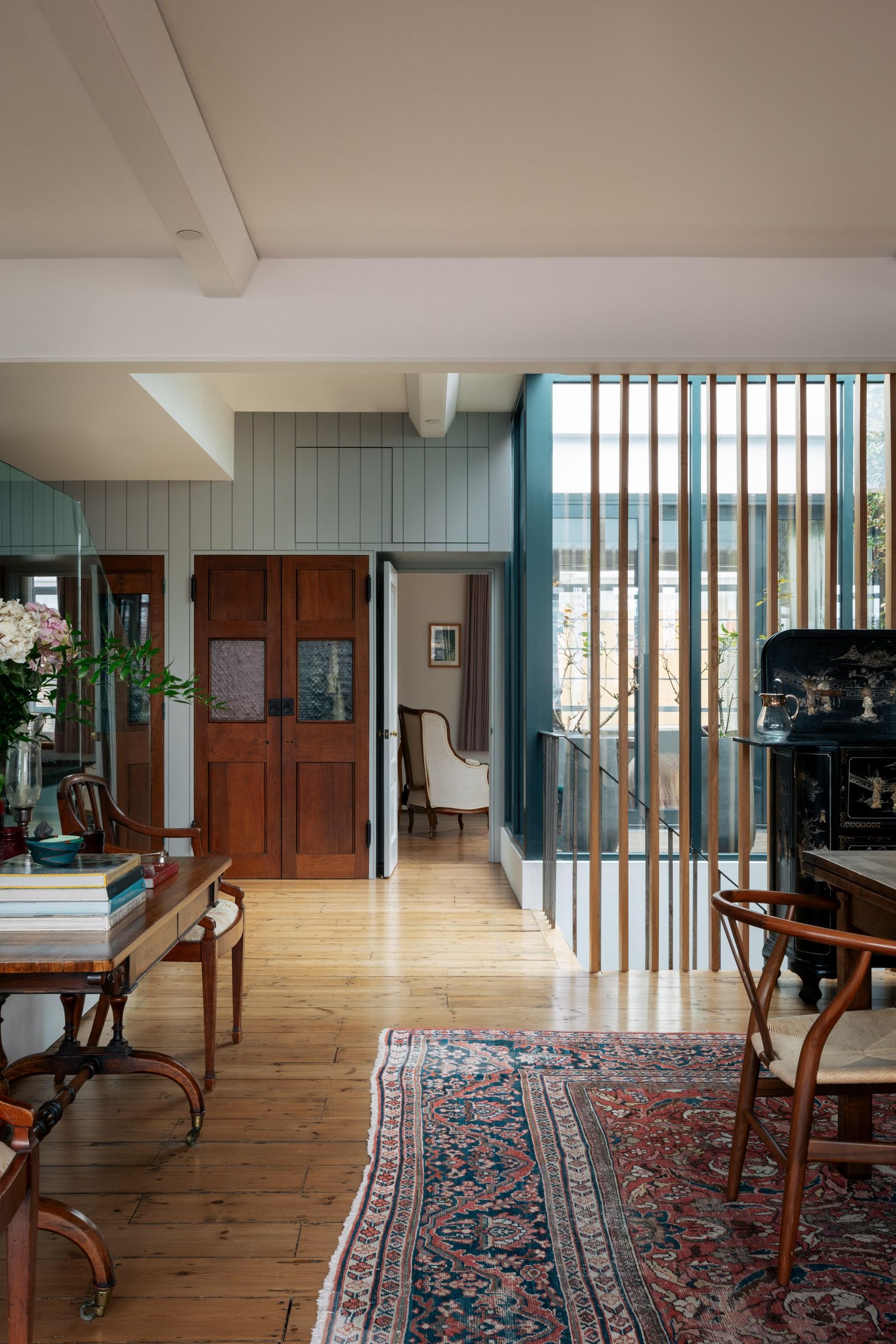
Light was key, too, and a light well on the side of the room beside the new staircase was combined with a punctured timber screen for some privacy and, again, to maintain the internal hierarchy of space. In other places, the decisions were already made for Charles and the team – in the reading corner beside the staircase up to the outdoor terrace, for example, niches had been built into the plaster wall by a previous owner, and these were retained. However, a timber screen was built to give the corner of the room a little more privacy and spatial definition.
The effect is one of unity but also diversity of use within the same area of the building, resulting in a liveable, holistically designed family home.
.png)


