

'Don't treat storage as an afterthought' says Henriette Von Stockhausen, ‘I always make a point of thinking ahead - not just to current needs, but to how the family might grow or change. Storage should support the rhythm of the house and enhance its beauty, never fight it’. Even if you do think ahead, storage can be tricky to get right: too much, and you look like you live in a disused storehouse, with curated displays of largely empty shelves being a hallmark of a contrived interior, but too little and it can feel like you live in chaos. When done right, your house can be a serene and well-organised haven, and it's therefore crucial to give plenty of consideration to what kind of storage you need, and how much, before doing much else to a room. We have asked a handful of interior designers what the most common storage mistakes are in the hopes that you might be able to avoid them.
Not choosing multi-purpose furniture
You don't need to just choose furniture whose sole purpose is to provide storage. Instead, make your life easier by choosing hybrid pieces - a storage bench is a good example, or an ottoman with a lid that can be lifted. Among the Jessica Buckley's favourites is a skirted table to store things out of sight such as a vacuum cleaner or wifi routers. ‘Scumble Goosie makes inexpensive round tables with storage cubbies underneath which then can be covered with a circular cloth in whichever fabric you choose. I have one which holds the cushions for my garden furniture when not in use and it works a treat’, she says.
Versatile joinery also falls under a similar category, and some clever designers choose to install adjustable shelves for just such a reason. For Henry Prideaux, these are a must: ‘if wardrobe shelves are too tall, piles of clothes can topple over. And shoe storage shelves don’t need much space between each one, which can help to maximise storage. You can adjust the height and number of shelves as your collection grows or shrinks,’ he says.

Too much joinery
‘Enough storage is vital, but there’s a point where it becomes "too much". I love to see the form of a building and not have every empty space shrouded in joinery’, says the interior designer Nicola Harding. She is not alone in thinking that there is such a thing as too much storage. Jessica in particular finds that only too often houses are filled unnecessarily to the brim with 'fitted furniture such as enormous banks of wardrobes or kitchen units. Interminable stretches of cabinetry can look very dull, I think, and can deny opportunities for more decorative storage solutions (albeit perhaps a touch less efficient), such as antique wardrobes and dressers'. Jessica points out that as well as being visually dull to have endless built in shelves, ‘enormous bookshelves for non-existent libraries happen all too often and it just ends up looking sad and rather empty’, and thus to avoid such a depleted display, it is important to really consider what you own now and what you're likely to own in the future. This can also save you money, as you're not forking out to buy expensive joinery that you will never use.
Like Jessica Buckley, Jessica Summer finds endless built-in storage problematic, not least because it can't travel with you from house to house: ‘I like to make sure there are furniture pieces as well, such as freestanding bookcases and wardrobes’, she advises. ‘These will add character to rooms and allow them to ‘breathe’ rather than filling up wall to wall with built in cabinets. And one can take these with them if they move homes!’
Designing storage that only works for ‘now’ rather than the future
‘Frequently, especially when working with young families, people plan for the ‘now’ without considering the future. For example, I recently had a request for specially labelled “school bag storage drawers”. While it can feel like the school run will last forever, in reality, children grow up quickly, and those drawers can become obsolete,’ says Laura Stephens. Storage that can adapt with your needs is of course a necessity, but an easy one to forget. As Laura explains, ‘I encouraged the client to opt for larger, unlabelled drawers that can be used more flexibly in the future; for sports kits, tech storage, even household admin. Designing storage with both present and future use in mind is essential, especially given that bespoke joinery isn’t cheap. You want it to grow with the family and be adaptable across different life stages’.
Open storage in hallways

Hallways, particularly in London terrace houses, are notoriously tricky when it comes to storage. Space is tight and traffic is high, so it needs to work hard and look good. ‘One common mistake is installing open cubby holes for shoes. In reality, children never quite manage to put their shoes neatly in them, and it ends up looking messy and cluttered’, says Laura, offering ‘a far more functional and elegant solution’ in the form of a built-in bench with a hinged lid or pull-out drawers beneath. ‘It creates hidden storage for shoes, boots, bags or even school items, and doubles as a seat for putting shoes on. It’s the sort of multi-functional solution I’ve used in my own home and recommend time and again’.
Planning kitchen storage without thinking about how you actually live
Being one of the most used rooms in the house, and one which needs to hold all manner of equipment and ingredients, a well-designed kitchen is an essential addition to any house. Because 'the stakes are high', says Laura, ‘storage mistakes are common in kitchens, especially when you don’t realistically assess how you use your space’. She urges us to be honest with ourselves: 'if you haven’t used that bread maker in the last decade, do you really need to design a cupboard for it now? Prioritise easy, accessible storage for the things you use weekly, not yearly. If, for example, you regularly use a food processor, make sure you plan a deep, under-counter cupboard where it’s easy to lift in and out. These appliances are heavy, and if they’re stored up high, you’ll end up avoiding them altogether. I also recommend integrated bins and pull-out larders where possible as they maximise use of space and help keep surfaces clear, which is key to making a kitchen feel calm and uncluttered'.
Not adding power to storage areas
‘This is a simple requirement that often gets overlooked’, says Brandon Schubert. ‘I like to put a power point in storage areas where it makes sense to do so. Maybe there’s no foreseeable need for it, but it is so difficult to add power to cupboards down the line. I especially like to place power points where they will be useful within the cupboard. So for instance if there is a high shelf that might be a useful internet point, we might put a plug socket there. If there is a space where a rechargeable hoover might be stored at some point, we’ll make sure the power is appropriately positioned’.
Not integrating built-in joinery with the rest of the room

Few things stick out more than a giant row of plain shelves in the middle of a wall which is otherwise beautifully decorated. To ensure that your joinery is harmonious with the rest of the room, take a leaf out of Jessica Summer's book: ‘Joinery should be functional on the inside and attractive on the outside, so I try and design and detail any built-in shelving in the same way I would a piece of furniture. This way it feels really considered. One way of doing this is to bring the cornice and skirting in front of it, so it blends with the surrounding walls’.
On runs of fitted wardrobes, Henry – who describes undecorated ones as ‘uninspiring’ – suggests ‘breaking them up with mirrored doors or breakfront joinery where you have deeper sections and shallower sections. Your deepest section of wardrobe space is for hanging, but shoes and folded clothes need less depth. This design solution allows an opportunity to soften the run of wardrobe doors by having some step back’.
Forgetting about everyday objects
'Storage of laundry hampers is often overlooked', explains Jessica Summer. ‘You end up with a large basket lingering in a lovely bathroom or bedroom, getting in the way’. Indeed, we've all found ourselves shimmying around a laundry bin to get into bed, or retrieving it from an inconveniently tucked-away corner in order to put a wash on. Instead, think about where it will live during the initial stages of designing a room. Jessica suggests ‘a pull-out hamper from Hafele integrated into the tall drawer or cupboard in the bedroom or dressing room - it’s super neat!', she says.
Another often overlooked but irritatingly bulky household item is the suitcase, which is frequently found tilting on top of other items in a cupboard under the stairs or shoved under the bed. According to Brandon, the best way to tackle storing suitcases is ‘to leave space at the top of a storage cupboard or built-in wardrobe so that they can sit up as high as possible, out of the way until you need them’. Brandon also reminds us that ‘if you have a family, the number of hard-sided suitcases can multiply quickly, and they can occupy a large footprint, so account for future suitcases too!’.
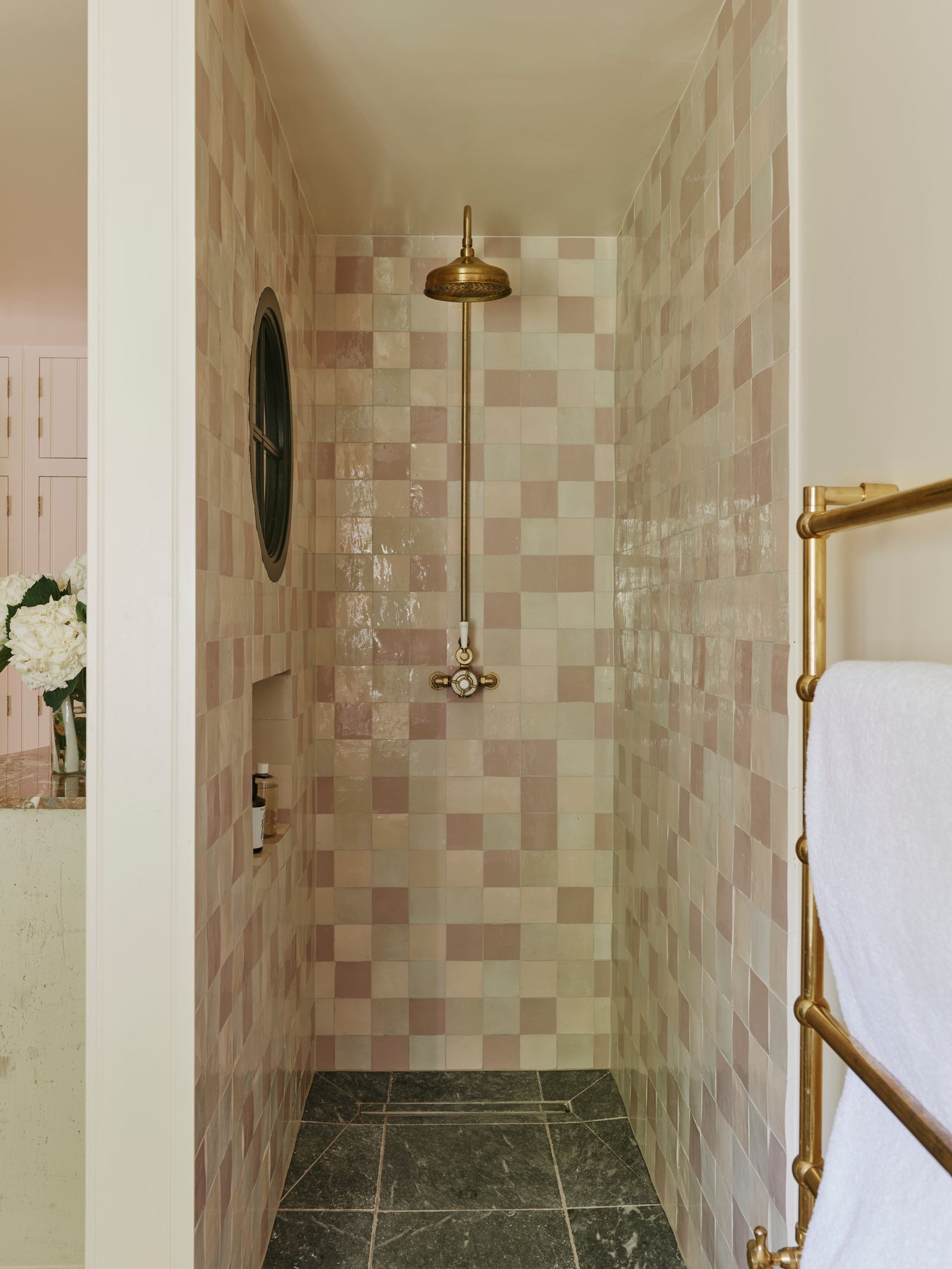
In a similar vein, bathrooms can be made or broken depending on how practical their storage solutions are. ‘Relying solely on a mirrored cabinet above the basin is rarely enough', says Romanos Brihi, co-founder of interior design studio Studio Vero. 'One simple yet transformative detail is a recessed shelf, built into the wall above the bath or within the shower. If tiled seamlessly it becomes almost hidden and avoids the clutter of caddies and keeps surfaces clear, while introducing a subtle architectural rhythm to the space.' If she's after something really hidden, Jessica Summer makes a ‘jib cabinet’ which has push-open doors and sits flush with the wall. Though relatively shallow, ‘it’s often just enough for one layer of bathroom bottles and cosmetics - it’s discrete and looks sweet with a tiny pull and little hinges’, she says.
Neglecting garden cushions
'Plan to store garden furniture and their cushions appropriately', instructs Henry. ‘The garden shed is not always the most suitable place to store items that need to be kept dry, so perhaps an interior storage solution is needed, for the cushions at least’. For those who have a built-in banquette in their dining area (and particularly if said dining area is close to the garden), this can be a brilliant and out-of-the-way place to store cushions.


