


We at House & Garden have long been advocates of the transformative power of panelling – it can add so much visual interest to a blank expanse of wall, give a sense of a particular period, and provide a helpful way of differentiating spaces. No type of panelling is more beloved by the designers who feature on our pages than tongue and groove, the simple style of interlocking boards that we see again and again in every room of the house. “I think it's really the combination of it being easy to use, highly durable, and yet inexpensive to install,” says Anna Haines. “ And all the while it creates such a warm, textural aesthetic in a room. It’s really quite impactful.”

The durability of tongue and groove is a major part of its appeal, and indeed we most often see the panelling being used in what one might term functional rooms: kitchens, bathrooms, and utility rooms. “I often use it in a bathroom,” explains Anna. “The interlocking panels create a very stable surface on your bathroom wall so it is particularly robust. I also love it in utility and boot rooms, as it offers up a protective layer against the scuffs and scrapes in a hard-working space." Interior designer Emma Sherlock, who clad the walls of her kitchen in Hampshire in tongue and groove, agrees. “It is unbelievably useful for adding texture to rooms where wallpaper would be impractical, and I like using it around baths instead of tiles. It is a softer look than tiles but can still be very practical.” Part of its practicality comes, as Laura Stephens explains, in the fact that “it works really well acoustically in rooms which have a lot of hard finishes, like bathrooms. It serves to soften the acoustics and you can buy moisture-resistant panels that are good for kitchens and bathrooms.” She also often uses it for children's bedrooms, painting it in a wipeable eggshell finish.


The sense of warmth and cosiness that tongue and groove brings is another significant reason to use it. “It lends itself to that cosy cabin feel,” explains Laura Stephens, “so it can be a great material for making a bed nook." Lining the walls and ceiling in panelling, as is often done with bed nooks, can make a space feel wonderfully enveloping. For that reason, Anna Haines also recommends using it in attics and rooms with sloping ceilings. “Full height tongue and groove creates a cocoon-like effect,” she says, “especially when wrapped around the ceiling. Loft spaces where the ceiling height and angles are somewhat compromised are great for tongue and groove, and it is quite forgiving in awkward junctions between a wall and sloping ceiling.” Anna also finds it a helpful solution for creating warmth in other awkward spaces. “I find that cocooning effect particularly welcome in a windowless bathroom, and the full height panelling also creates the illusion of higher ceilings when you don’t have them!”


Although it might summon up a pleasingly rustic image, we see tongue and groove being used just as frequently in city houses as in country ones, and it can offer a totally different aesthetic depending on the configuration of the boards. “A finer, neater board tends to lend itself more to elegant townhouse properties,” says Anna, “whereas we have used a more generous width rough hewn board in a country house mud room for a more industrial feel. We like to use panels of varying widths which can add more character, or a V-groove which feels a bit more traditional when working in historic buildings." Anna also points out that the boards do not have to be arranged vertically. “It's worth considering cladding the tongue and groove horizontally in a room. This a good trick to visually widen a narrow space.”
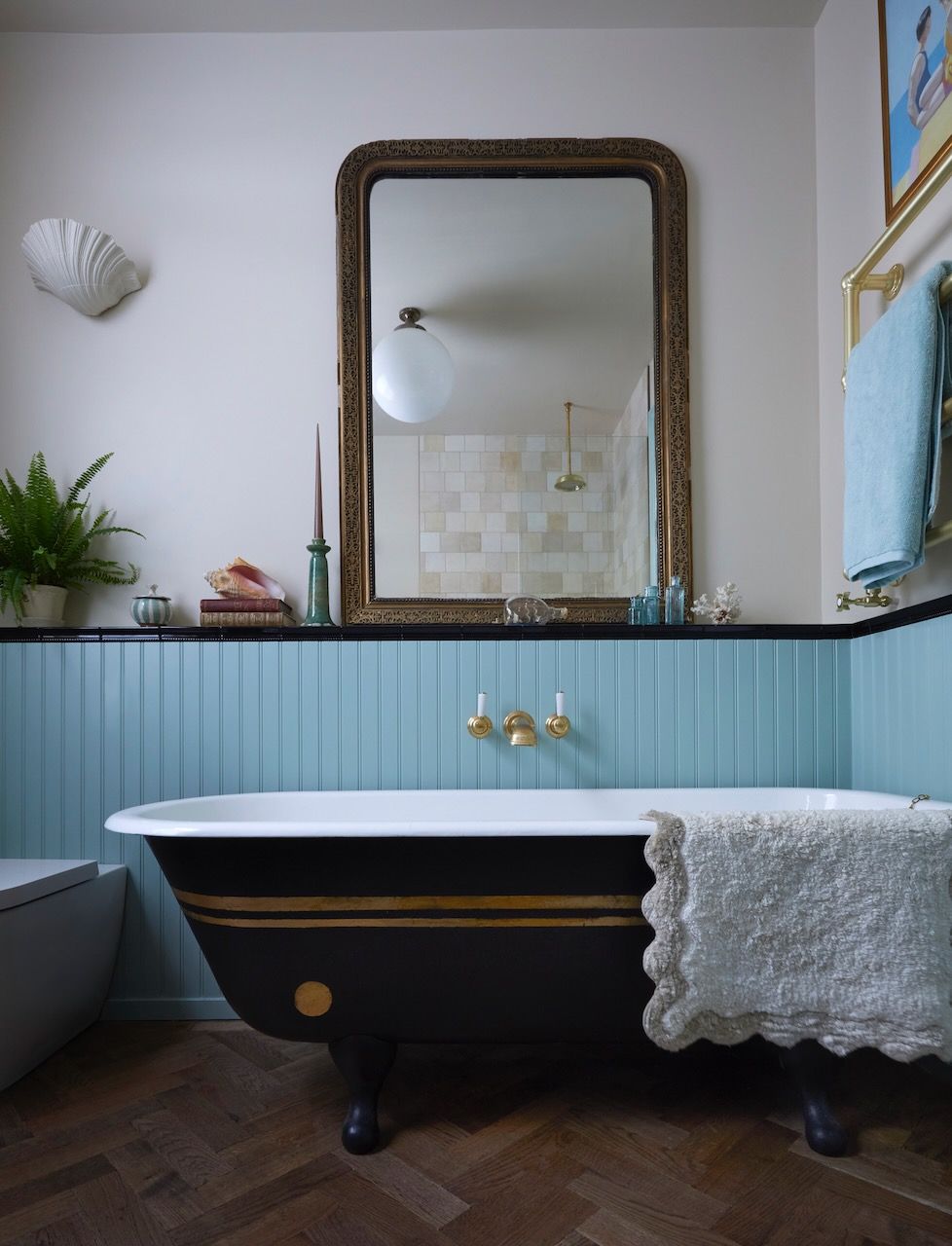

When it comes to decorating around tongue and groove, the style's versatility means that there are few limits. Laura notes that highly patterned fabrics and wallpapers can work beautifully with it: “they don't fight and the panelling provides a great backdrop to show off lovely pattern.” Anna Haines likes to use half-height tongue and groove with a bold wallpaper, as she has done in the loo of a family house in Hampstead (above). Half-height panelling also means you can add a decorative edge or a shelf to enhance the look and add space for display. “I often finish the top of a panel with a shelf and simple, utilitarian brackets as a nice way to finish the top,” says Laura. “I also like to add a decorative tile to the top of it as a way to finish it (instead of beading) which is a nice touch in bathrooms and allows you to continue the panelling into wet/tiled areas.”
For a more traditional country look, pair it with appropriately rustic fabrics and patterns. “As we tend to use it in more hard wearing spaces or attic bedrooms,” Anna notes, “I lean towards more robust fabrics and antique textiles. There is something very comforting about an attic room wrapped in tongue and groove with a colourful, chunky Welsh blanket on the bed.”


