

Wildside is a giant experiment in naturalistic, site-specific planting – and also a beautiful and atmospheric space. Twenty-one years ago, Keith Wiley began the transformation of a flat, three-acre field into the most astonishing garden, changing the site’s topography to create a series of banks, ponds, hillocks and quarry-like dells, and offering varying ecological conditions for different plant groups.
Keith’s wife Ros, who died from cancer in 2019, was an artist who captured the nuances of the garden in her paintings, while Keith treats the garden as his canvas, creating a constantly evolving artwork. Rather than setting out to re-create or emulate natural plant communities, he seeks to capture the essence of wild landscapes he has visited: ‘Every one of us can look at a landscape and interpret it in a different way in a garden setting, so the possibilities of this style of naturalistic planting are endless.’
A walk through Wildside is an exciting, immersive experience. It is not at all about the Devon landscape that surrounds it: it is about a series of imagined landscapes. One minute you are on a Mediterranean hillside, the next in a bosky Cornish valley and then onto the flower meadows of Namaqualand, which Keith and Ros visited on one of their plant-hunting trips together. The latest addition is a South African valley garden Keith is developing as a tribute to Ros. It seems extraordinary that plants from South Africa are thriving in Devon, where the average annual rainfall is more than 150cm. But, by manipulating soil conditions, Keith is able to broaden his plant palette infinitely. The natural subsoil here is shale (known locally as shillet) and he has used it to shape the banks and canyons that form the contours of the garden, to create a free-draining, low-fertility base for the planting. In some areas, he has added topsoil or sand to provide different growing conditions, with each plant community finely tailored to its place in the garden and therefore needing no extra water or food.
‘All the plants have to be resilient, but they are naturally hardier and tougher because they’re not pumped up with nutrients,’ observes Keith. ‘You can grow 12-foot delphiniums in this country if you want to, but you can also see them in the wild in the Rockies, where they are only four feet high. It’s a different kind of beauty, a more subtle beauty. One is wow and the other is spirit affirming.’

Most of the plants here are perennials that need little maintenance other than an annual cut-back. His list is based on late-summer-interest plants that are tolerant of both wet and dry conditions and are hardy down to about -12°C. Some of them will seed themselves around in the right circumstances. The gladioli and roscoeas will crossfertilise to provide their own hybrids, for example. ‘The very definition of resilience is that the plant is going to persist,’ says Keith. ‘Of course, the other side of resilience is that a plant can spread too vigorously so you have to be prepared for that.’
Some plants are used for structure, such as the long-lasting ornamental grass Chionochloa rubra, or for shelter, like the New Zealand lacebark, Hoheria angustifolia, which is tough enough to withstand wind and rain. ‘I try to take the spirit of a natural landscape and re-create it,’ concludes Keith. ‘It’s difficult to put into words, but I hope the garden taps into the emotional connection that we, as humans, have with nature.’
10 hardy plants for summer

This tough, versatile grass from New Zealand grows in sun or in shade. It has bronzy-brown, needle-like fronds and graceful, arching flowers with seed heads that are illuminated with water droplets in autumn. At Wildside, Keith uses them as a structural element, repeating them through the garden.

A really good Mediterranean plant for full sun and well-drained soil, this forms a low, sprawling mound. It is covered in a mass of pretty pink flowers during the summer months.

This lovely plant blooms for a long time from July to September, with delicate, palest yellow flowers held on wiry stems above fine, ferny foliage. It likes a sunny position and well-drained soil.

Bees love the bottlebrush flowers of this charming plant with blooms in variable shades of pale and darker pink, and white. Piet Oudolf popularised the form known as ‘Hummelo’ with bright lavender-pink blooms. An easy-to-grow Alpine plant, it will thrive in full sun and moist but well-drained soil.

This easy-to-please aster grows in sun or semi shade, forming large clumps even in poor soil. It is a wild-looking aster with white daisy-like flowers on tall stems, which will mix in with other tall perennials.

Smothered in pretty white flowers during August, the New Zealand lacebark forms a small tree that can be shaped gently by pruning the lower stems to raise the crown. It is used as a windbreak at Wildside.

A strong form of the South African species, this seems to be fully hardy and will multiply if it is happy in full sun and in well-drained soil. At Wildside, it is grown in loamy soil with a gravel mulch.

This is one of Keith’s star plants and a stalwart of August. A woodland-edge plant originating from the Himalayas, it is a member of the ginger family, but from more mountainous regions, so it is more hardy. It has beautiful flowers in shades of red, purple and lilac. Keith has bred new forms, including a purple-leaved, white-flowered variety, called ‘Ros Wiley’.
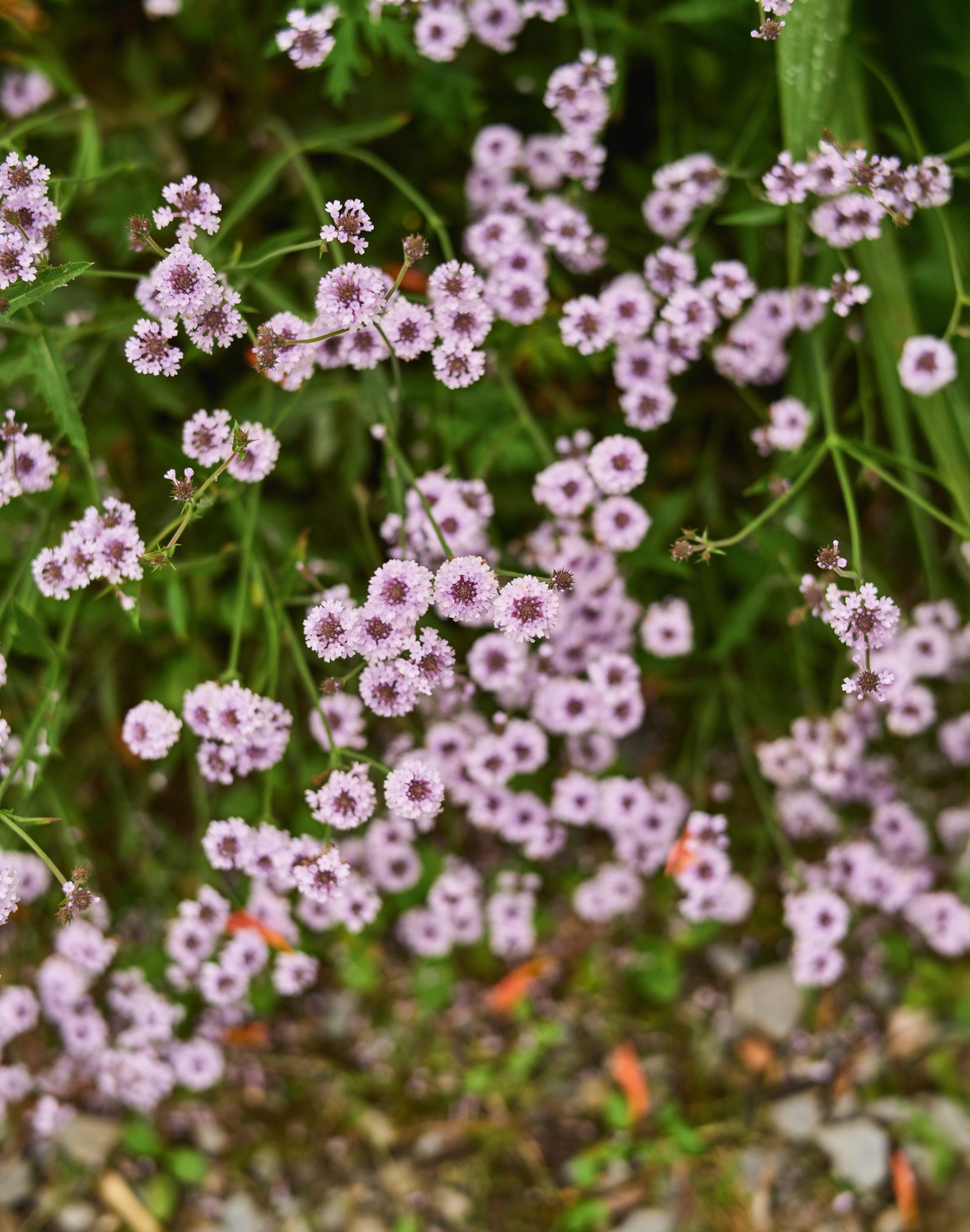
Native to South America, this slender vervain is often seen as tender, but when it is grown in Devon, it is perennial and flourishes. ‘Polaris’ is a pale mauve variety that comes true from seed. ‘Because it is a softer colour than the species, it is a good mixing colour,’ explains Keith.

‘This plant needs it as lean and as mean as possible,’ says Keith. It grows on rock faces and has evergreen, slightly spiny leaves and bright orange daisy-like flowers in August and September. ‘Whatever the weather throws at it, it will survive – the harsher the conditions, the better’
Wildside, Buckland Monachorum, Devon PL20 7NP, is open on certain days from April to November; visit the website for details: wileyatwildside.com


