
A writer's classic New England house artfully dressed for Christmas

Being asked to write about one’s own home decorated in Christmas finery is rather like drawing a map of a familiar place: you are so used to seeing it that, when you start, you are not quite sure how to go about it.
Yet, it has been over two decades that we’ve had this house in Westport, Connecticut, and Christmases here are very familiar, with a huge tree in the barn, dressed with treasures that our kids made and other ornaments we’ve gathered over the years. Festive decorating is a sentimental journey for me. In early December, we pick the tallest tree we can find, carry boxes up from the basement and hoist it all up, along with garlands, wreaths and mistletoe. The colour is on the tree, but function follows form for the rest, with greenery dressing the architecture.

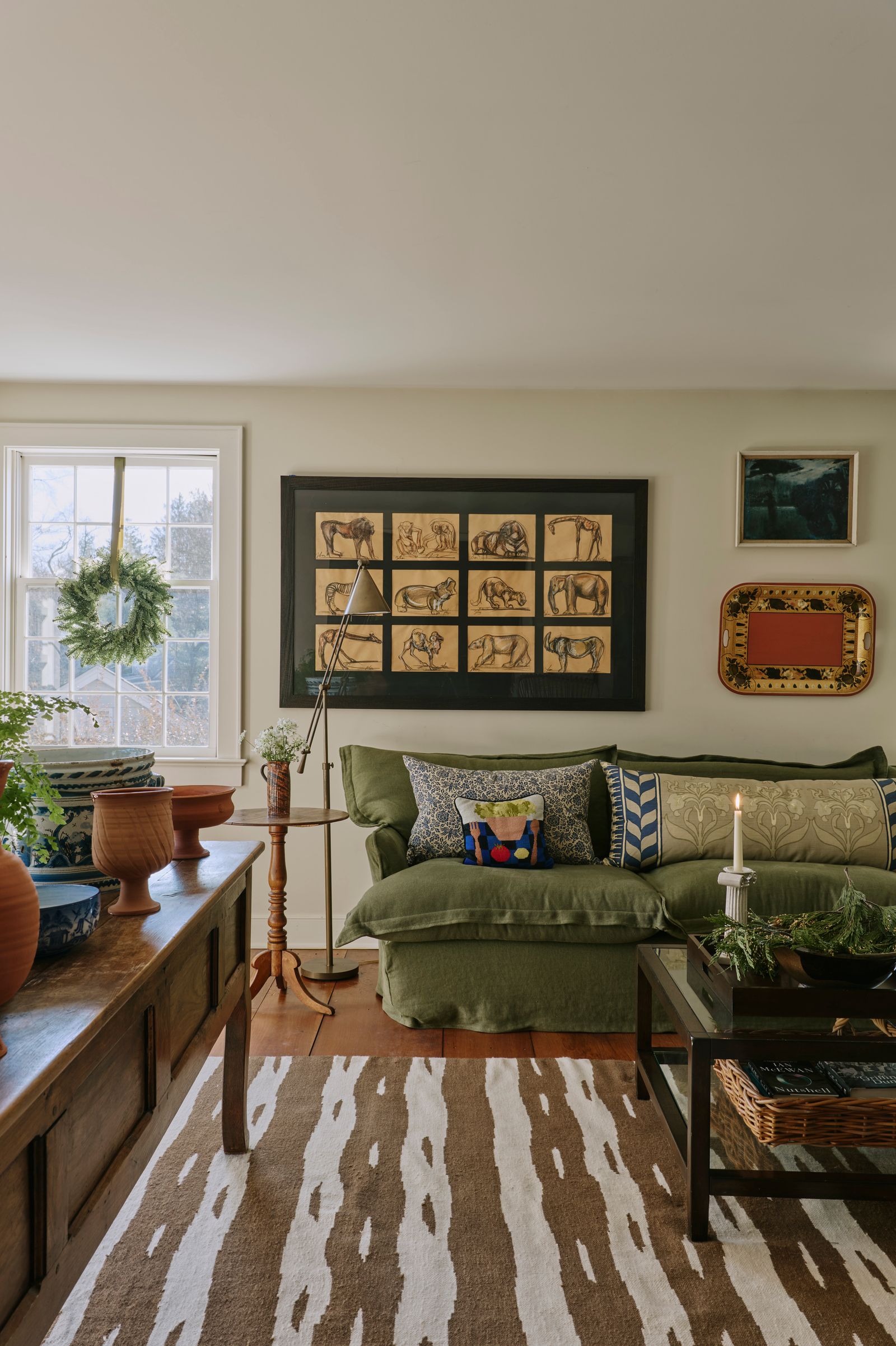
The reason we now live in an old house in America onto which we bolted a 19th-century, three bay wagon barn from South Pomfret, Vermont, is because we once lived in England. In the late 1980s, my husband Jim and I were New York City newlyweds who moved to London for his job at Ralph Lauren. I’d left my editorial role and bumped around London for a bit until I got an assignment at this very magazine as its decorating editor.
What we thought would be two years in London turned into five and then 10 and, as we were approaching 15 years with sons Will and Ned in tow by then, we began to think about moving back to the US. The New York antique dealers Tom Woodard and Blanche Greenstein were visiting us and they had started renovating houses in the Hamptons with The Barn People’s Ken Epworth – a specialist in finding, dismantling, restoring and reassembling vintage New England timber-frame barns.

We became obsessed – we’d need an old New England house onto which we could attach an antique barn. Soon after, I was in Westport, my home town, when my mother told me that friends were selling their house – an old blacksmith’s forge. I rang Jim, who was in London. ‘It’s perfect,’ I said. We signed contracts and, a few weeks later, Jim flew over to see our ‘new house’. He rang from the driveway, concerned by its size and its ability to stand up to our plans. But the deal was done and we’d found Deirdre O’Farrelly, a local Irish-born architect, and also a contractor who specialised in old houses. We knew it would be complicated linking an antique barn to the original house, with all the new construction in between acting as the glue.
But Deirdre understood the classic New England vernacular of domestic architecture: if another room was needed, the farmer added one to the end of the house, which explains the interior windows between the original house, the barn and all the new parts. This supported the principle of her design – that you consider the line of sight to create an enfilade of spaces opening out to a distant view. The original forge was built into a hill, so differing floor and ceiling heights were unavoidable, but we’d have an old New England barn to live in. The build took a year; the cottage was stripped back to the wooden frame and steel beams arrived to give strength to the original structure, so it could withstand the work required to connect it to the barn.


Although I work in interiors, this didn’t guarantee me any superior understanding of what we would want in a house in America. So we did what others did then and ripped pages out of magazines when we saw things we loved. Jim and I thought about the houses we’d visited and the three London houses we had lived in, and what we had admired – and what we had not. Deirdre was gracious as we delivered this analogue Pinterest board and she gave us a version of our London life in Connecticut, skilfully creating a dichotomous drama between a former blacksmith’s cottage and a barn.
Broad pine floorboards in varying widths balance the deep hall, which runs the length of the house and connects all the rooms. A single New England-style painted floor decorates the original house’s sitting room, which was briefly a dining room until we realised this house was much more kitchen supper than formal affair. The kitchen is in what was three rooms of the original cottage and has the lowest ceiling in the house. A pair of painted beams was installed to give an extra two inches by creating a firmer platform for the new ceiling to rest upon. Across the wide hall that spans the length of the building, knitting together all the elements, is the family room and at its end, through a framed opening, is the barn.

On Christmas Eve, our growing family and best friends come for drinks and supper by the fire. Christmas Day is relaxed in the barn and we’ve held fast to celebrating Boxing Day, too. Then, shortly after New Year, we unwind it all; the boxes come up from the basement and we dismantle the tree, wrapping ornaments in the tissue we’ve had forever. We drag the tree out the way it came in, with it dropping half its needles. We take everything down – wreaths, garlands, pine cones. It’s just the ‘Paper White’ narcissi in pots that see us through January, when the days start to lengthen. For a week or so after the tree is gone, we walk into the barn and notice how wide open and fresh it all feels, until the next Christmas, when we’ll do it all again.
 CHRISTOPHER HORWOOD1/5
 CHRISTOPHER HORWOOD2/5
 CHRISTOPHER HORWOOD3/5
Glassware and ceramics fill the shelves above the Vermont Soapstone sink and countertops. The porcelain and brass ‘Posy’ flush ceiling light is from The Urban Electric Co
 CHRISTOPHER HORWOOD4/5


 CHRISTOPHER HORWOOD5/5
Walden, a German shorthaired pointer, sits on the steps down from the barn to the terrace with a Solo Stove firepit and chairs from Summer Classics. Period Lighting Fixtures’ lanterns flank the doorway.


