
Arne Maynard's design for a Devon garden that slowly melts into its rural landscape

South Wood Farm gathers its gardens around itself like protective shawls, with old walls, barns and outbuildings lending shelter to a series of enclosed and immaculately planned spaces. The thatched house, restored in 1655 but medieval at its core, has a stone-flagged passage that runs straight through from the front to the back. There is a little parterre in the rear courtyard on the west side and, from here, you have a direct view through the house to the yew topiary in the front garden to the east. It lends great intimacy to the place, the way the house sits within these encircling delights, deeply rooted in its 60 Devon acres.
A visiting professorship at the University of Exeter first brought Clive Potter to South Wood Farm, set 900ft up in the Blackdown Hills. That was 14 years ago. ‘What I took on was a place with no garden, no structure and a yard of crumbling concrete,’ says Clive, who responded immediately to the possibilities of the place. He felt he could make a garden of intricate delights, as well as transform the surrounding fields by planting trees, restoring hedges and bringing wild flowers back into the grassy pastures. Landscape restoration is one of his principal areas of research at Imperial College London, where he is a professor at the Centre for Environmental Policy.
Just a year after he arrived, Clive called in the designer Arne Maynard to pull together the scattered elements of the property into a cohesive design. ‘I wanted to celebrate the house with a garden that slowly melts into the landscape, with swathes of wild flowers, fruit trees and mown pathways to explore,’ explains Arne. His scheme is entirely sympathetic to the vernacular buildings, but at the same time has a sharp and sometimes unexpectedly modern edge. Beech topiary plays a prominent part in the outer- most part of the garden – cones and domes and pillars, crisp and fox-brown in winter. In spring, the grass is scattered with hundreds of camassia, Narcissus pseudonarcissus and the occasional splash of red from the tulip ‘Red Hat’.
From the yard, where cobbles have replaced the cracked concrete, a path leads up to the front court, which is dominated by a central dome of clipped bay. ‘The bay was here when I came and the design was organised around it,’ Clive explains. Lavender lines the path to the stone porch of the house, along with handsome cubes of clipped yew. The crab apple ‘Evereste’, pleached to create a tall screen that encloses the courtyard to the south, gives a mass of white blossom in spring.
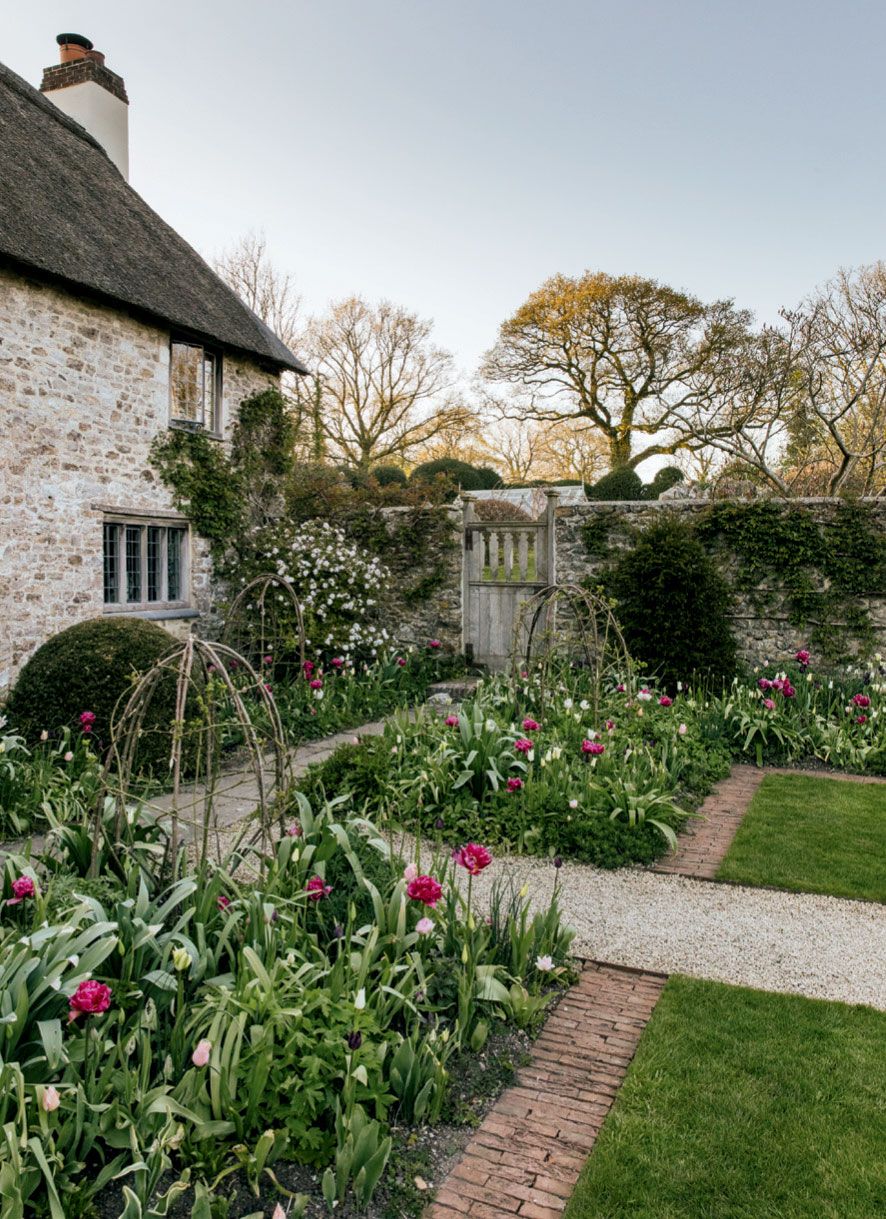
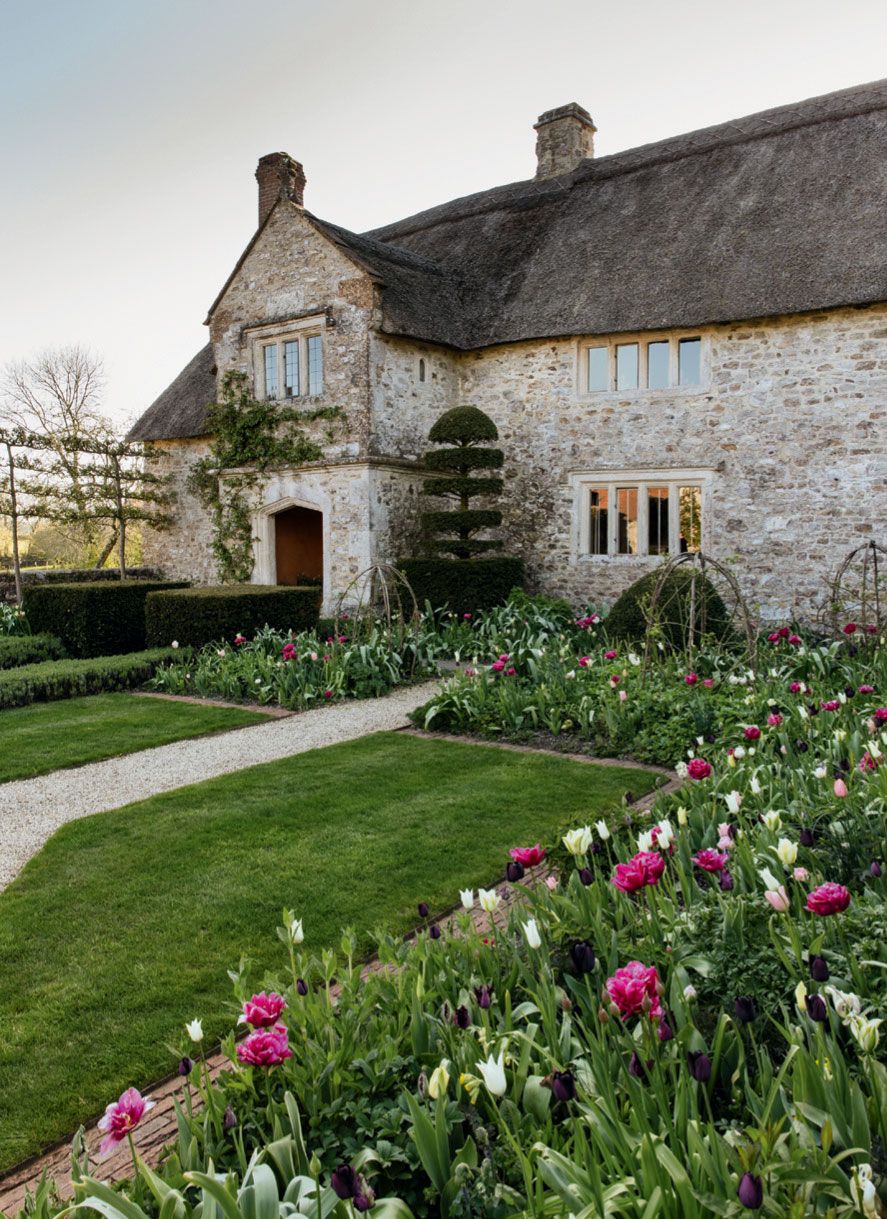
Long herbaceous borders run parallel with the central path, where catmint and violas mingle in front of a backdrop of old- fashioned roses – pink ‘Cécile Brünner’, mossy ‘William Lobb’ with its magenta-blue blooms, ‘Félicité Parmentier’ and cluster-flowered blush-pink ‘Bloomfield Abundance’, which is a particular favourite of Clive’s. Recent work has focused on remaking these flower borders, re-introducing the elements of repetition and succession that were integral to the original design. ‘Some of the herbaceous stuff had done too well – we needed to rebalance the colour palette,’ says Clive. In spring, the borders are flooded with pink and white tulips, including ‘Angelique’, ‘Spring Green’ and the fat pink double early ‘Chato’.
MAY WE SUGGEST: The beauty of spring at Dan Pearson's Somerset garden
One of the many charming things about South Wood Farm is the way the house and garden talk to each other so intimately. ‘I wanted the garden to keep something of the farming aesthetic. Restrained, not too pretentious,’ says Clive. The front court has the handsome east front as its focus. The splendid kitchen garden is overlooked by the north front and closed off at the back by a holly hedge clipped in rolling billows. The soil here is shallow and thin, which is why the layout is dominated by more than 20 raised beds, filled with decent soil and edged with oak planks. This is an astonishingly productive area, used not only for fruit and vegetables, but also to raise the wallflowers, sweet Williams, foxgloves and sweet rocket (Hesperis matronalis) that head gardener Lewis O’Brien grows to fill the herbaceous borders.
The three-quarter-span greenhouse is where Clive most likes to be. One of his favourite jobs, he says, is pricking out seedlings to grow on in trays, ‘It’s very satisfying to give all those baby plants fresh growing space.’ In front of the greenhouse, two small decorative fruit cages provide protection for strawberries, blackcurrants and gooseberries. All these extras – including the handsome garden seats and benches of English oak – were designed by Arne and made in the joinery workshops at Haddon Hall in the Peak District.
A stone bridge over a ditch leads through to a nuttery and the beginning of the wilder areas of the garden. The grassy slope here, scattered in spring with pheasant’s eye narcissus, gives tantalising glimpses of the small rear courtyard adjoining the house, with its formal parterre of clipped osmanthus and yew. From here, you can also just see the linear gravel garden that leads off the rear court, planted with miscanthus, Stipa gigantea and sedum.
At the bottom of the slope is a stone-edged circular pool, hidden by tall trees from the curving line of the entrance drive beyond. Clive likes the reflections it provides, but they are not enough. ‘I’m planning something much bigger,’ he explains. ‘Something more like a traditional horse pond, with an extensive reed bed.’ This will be in a boggy piece of pasture beyond the park railings that skirt the drive. Arne has been called in to advise on the design of this feature.
Clive talks of this pond as his last big project, but being as engaged and passionate about the place as he is, this seems unlikely. He has recently acquired several fields to increase his holding at South Wood Farm and there is talk of establishing a wood pasture of black walnuts to add to the orchards of apples and cherries he has already created. The best gardens never stand still.
South Wood Farm will open under the National Garden Scheme on April 29 and 30 (ngs.org.uk) | Arne Maynard: arnemaynard.com
 Eva Nemeth1/7
An inviting mown grassy path meanders down a landscaped bank towards the walled courtyard in front of the house. In early spring, the meadow grass is studded with yellow cowslips and the nodding purple chequered flowers of snake’s head fritillaries, to be replaced by blue camassias later in the season.
 Eva Nemeth2/7
In the front courtyard, tulips cluster in the herbaceous borders in spring, with the double magenta ‘Chato’ contrasting with pale pink ‘Angelique’ and white ‘Spring Green’.
 Eva Nemeth3/7
Neatly clipped yew and box topiary act as a foil to the froth of flowers, while gravel and brick paths intersect areas of lawn.
 Eva Nemeth4/7
A parterre of clipped osmanthus and yew has recently been planted above the cobbled rear courtyard, where more yew topiary and an early-flowering amelanchier give the area a simple intimacy.


 Eva Nemeth5/7
A stone-edged, circular pool invites reflection in the wilder reaches of the garden.
 Eva Nemeth6/7
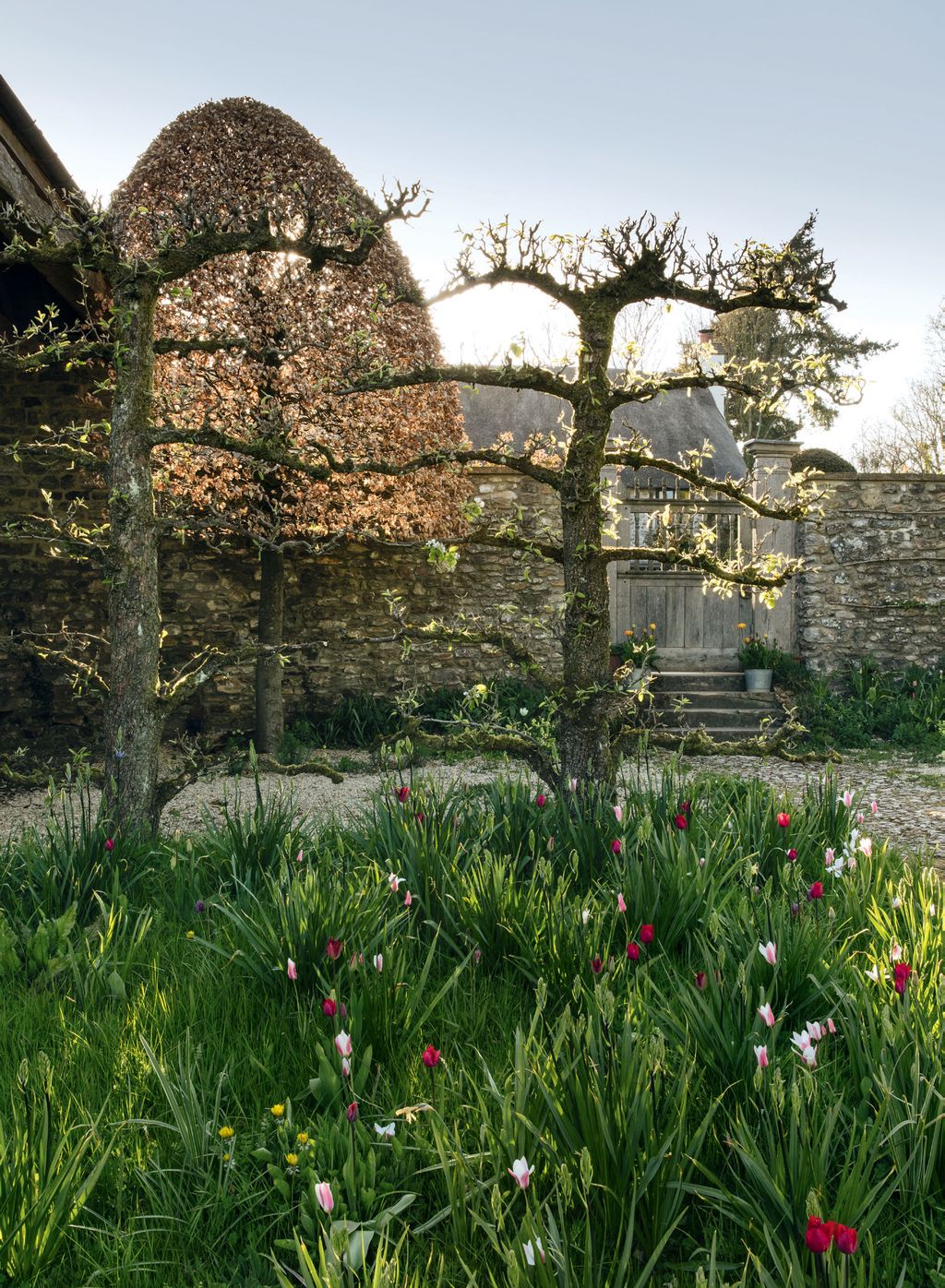
Just outside the front court, a cobbled area gives way to a charming meadow where Tulipa clusiana ‘Peppermintstick’ and Tulipa ‘Red Hat’ nestle in the long grass, and these will soon be followed by camassias to provide eye-catching dashes of colour. A screen created by wonderfully gnarled espaliered pear trees divides the two areas, and the early spring sunlight catches the coppery brown foliage of a beautiful domed beech growing beside the wall of the courtyard. The contrast between clipped, formal topiary and soft swathes of meadow flowers is perfectly balanced in Arne Maynard’s stylish scheme.
 Eva Nemeth7/7
The attractive kitchen garden is as ornamental as it is productive, with stepover apple and pear trees edging the beds, which are softened with clouds of purple honesty in early spring. Backed by a tall, billowing holly hedge cut into undulating shapes, the three-quarter-span greenhouse is used for raising seedlings, and housing tomatoes and other tender plants. Arne designed the oak raised beds and elegant oak-framed fruit cages, as well as some of the furniture dotted round the garden, all of which was made in the joinery workshop at Haddon Hall in the Peak District.


