
Chester Jones and his son Toby collaborate on a handsome country house in Oxfordshire
From Shakespeare to Succession, the tension between older and younger generations as power is transferred is the stuff of clashes and recriminations, tears and tantrums. But as Chester Jones, one of Britain’s greatest interior designers – and the recipient of House & Garden’s first Lifetime Achievement Award in 2020 – hands over to his son Toby, life does not follow art. Chester, a man of strong views and vast design knowledge, is now 85 and is happy to relinquish the reins, while keeping a guiding eye on the progress of the firm. And, as Toby says, ‘I’ve been working for – and then with – my father for some 25 years.’ He, and his brother Ben, who works on the textiles side of the business, could not have had a better teacher or guide than Chester.

This is evidenced by their collaboration on a project in Oxfordshire for a couple with three teenage children, who were moving from a larger house and wanted to stay in this part of the county. While the clients loved the modest charm of this early-19th-century cottage – and its private setting was ideal – they felt it was too small for the visits of their extended family, when they needed, on occasion, to accommodate 16 people. Chester had already decorated several houses for the family and Toby – working with the architect Christopher Smallwood and with some valuable input from his father – further enlarged the cottage by just under 50 per cent.
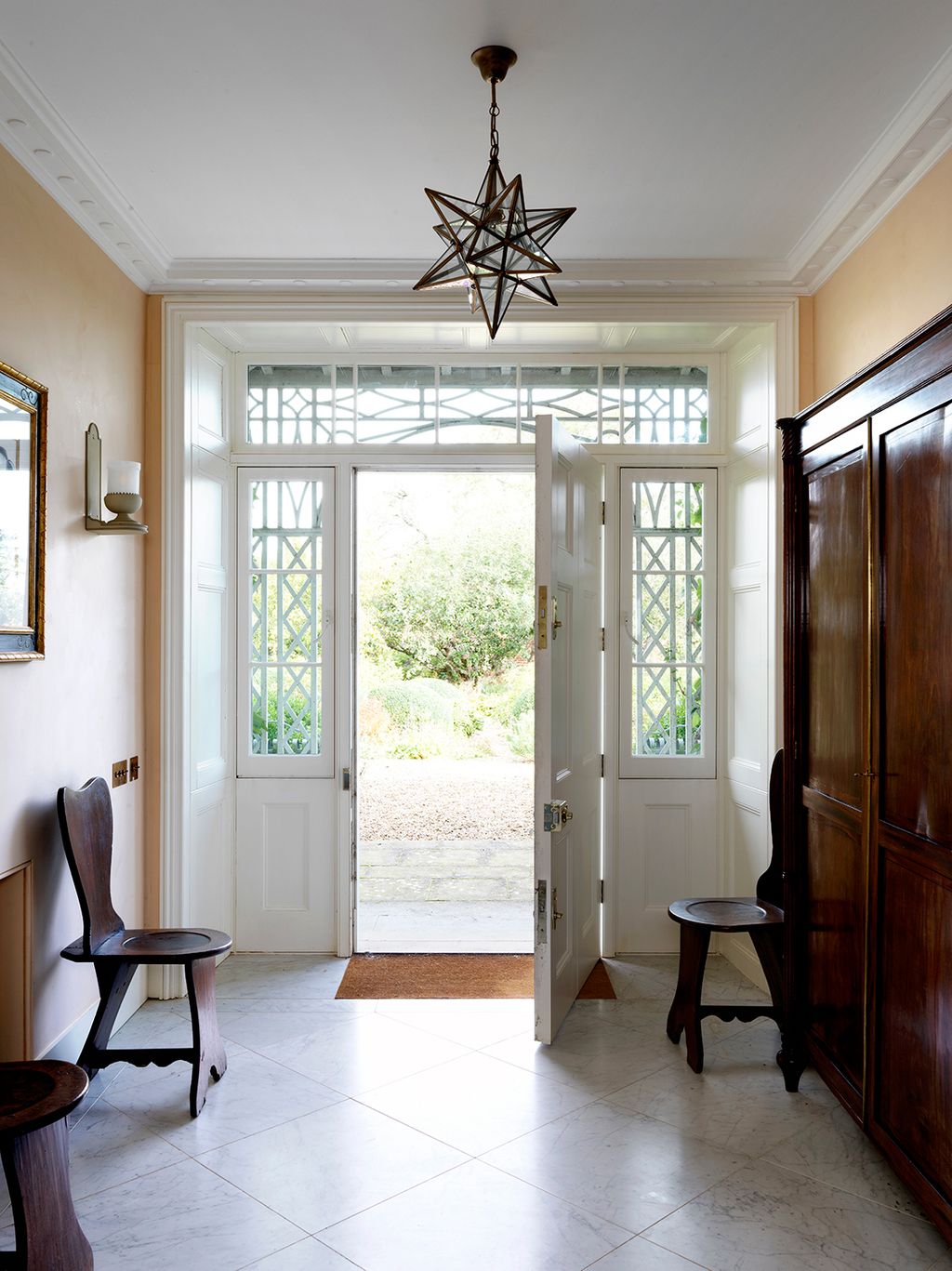
Christopher also changed the orientation of the house, so the back door is now the front door. Chester designed a charming cottage porch, complete with a curvy zinc roof and pretty trelliswork. Open the door, though, and a vast space opens up, Tardis-like. A long corridor stretches ahead with, at its crux, a green Continental-style neo-classical console, guarded by a pair of huge 18th-century ceramic lions. ‘It is a real wow moment,’ says Toby. ‘The console comes from the clients’ previous house, but that enfilade is all Chester – it’s part of his genius.’ He has broken up the long corridor with a top-lit, barrel-vaulted space, defined by pilasters with simple capitals, with the imposing console at its centre.
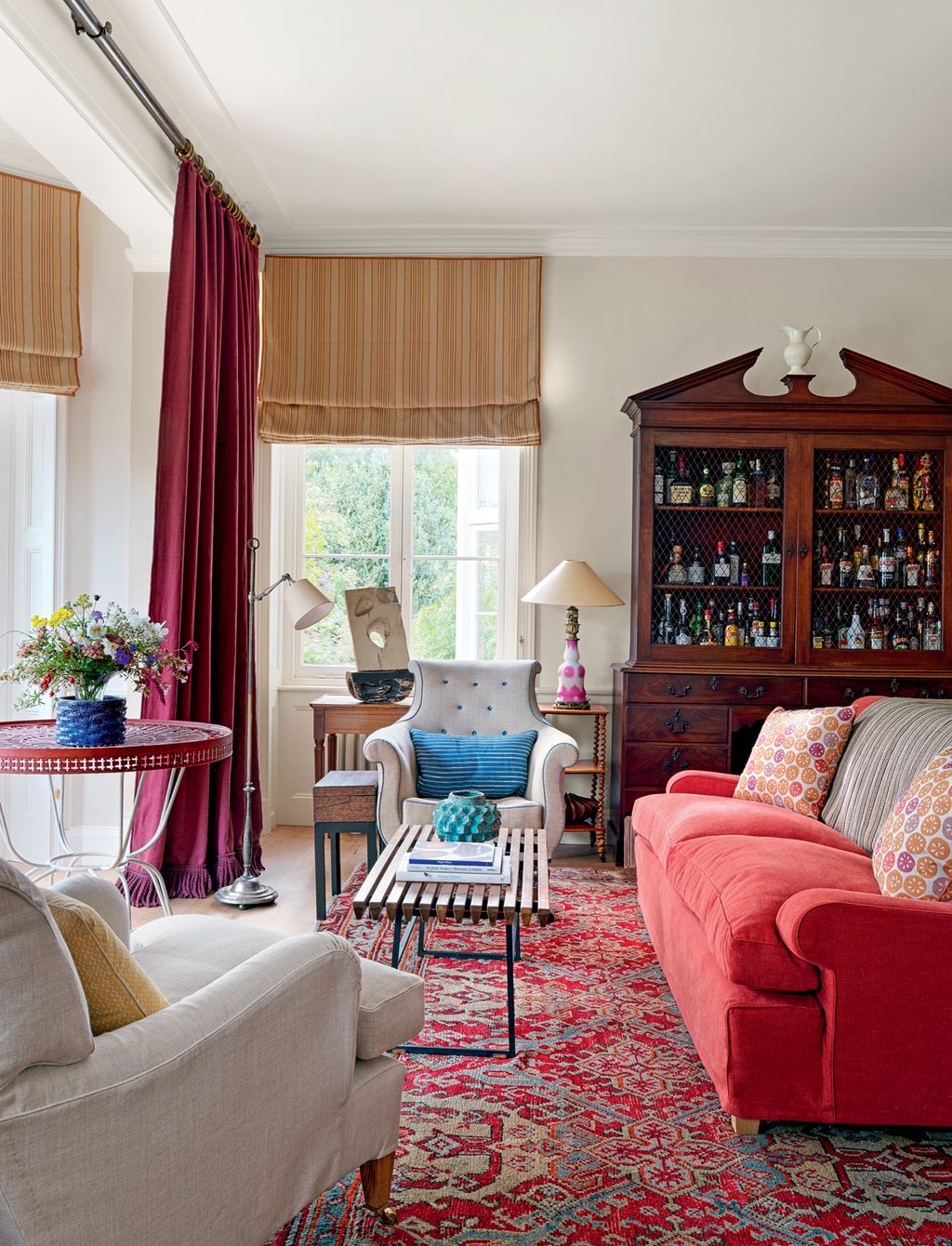
The double drawing room opposite is of similarly impressive dimensions, but is so cleverly arranged into seating areas that its atmosphere is one of calm and com-fort. On one side, a beautiful Oushak carpet defines the space, with a pair of back-to-back sofas. One of these faces a mid-century metal table in the bay window, with a handsome 18th-century mahogany secretaire to the side, which serves as a drinks cupboard.
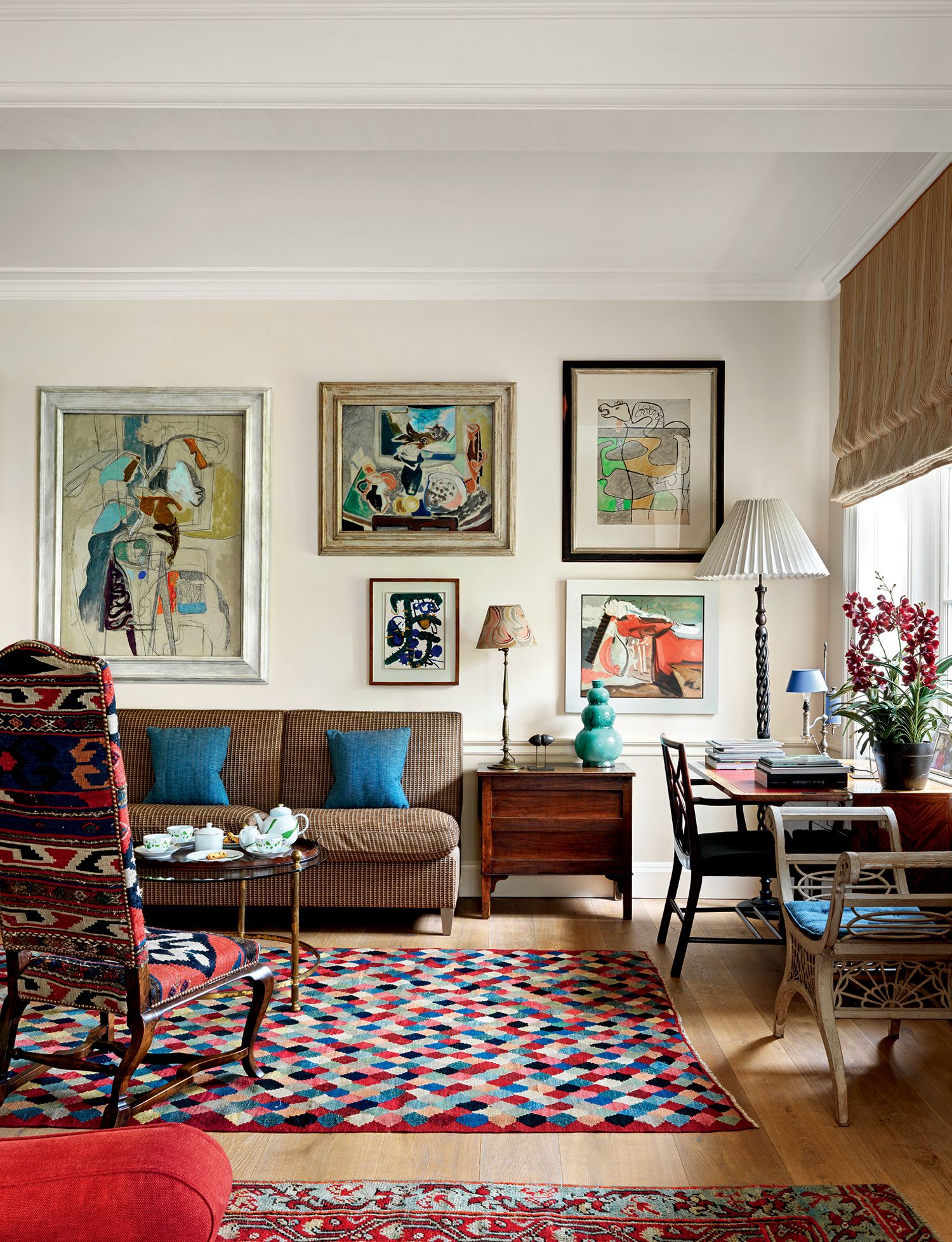
Chester has always championed the mixing of eras in a room and, here, Toby shows how well it can be done. The other sofa faces a Jamb chimneypiece with, above it, the panelling, curved ceiling and plasterwork of the original cottage. ‘We added the dado rail to create a contained space for pictures,’ explains Toby. And there are some marvellous pictures, including works by Patrick Heron and Ivon Hitchens in the other part of the room, where 17th-century chairs covered in antique kilims sit on an early-19th- century Bihar kilim, which looks strikingly modern.
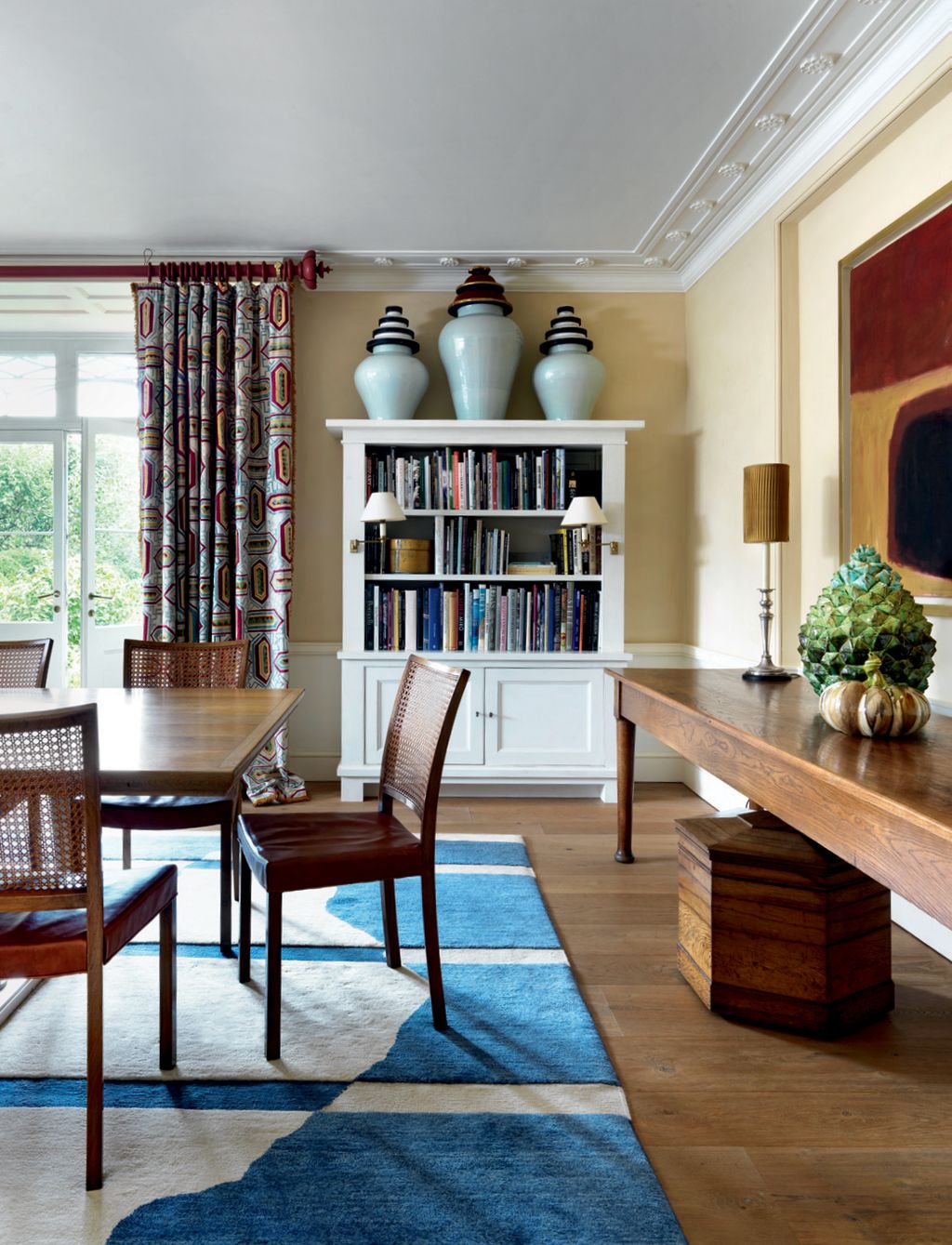
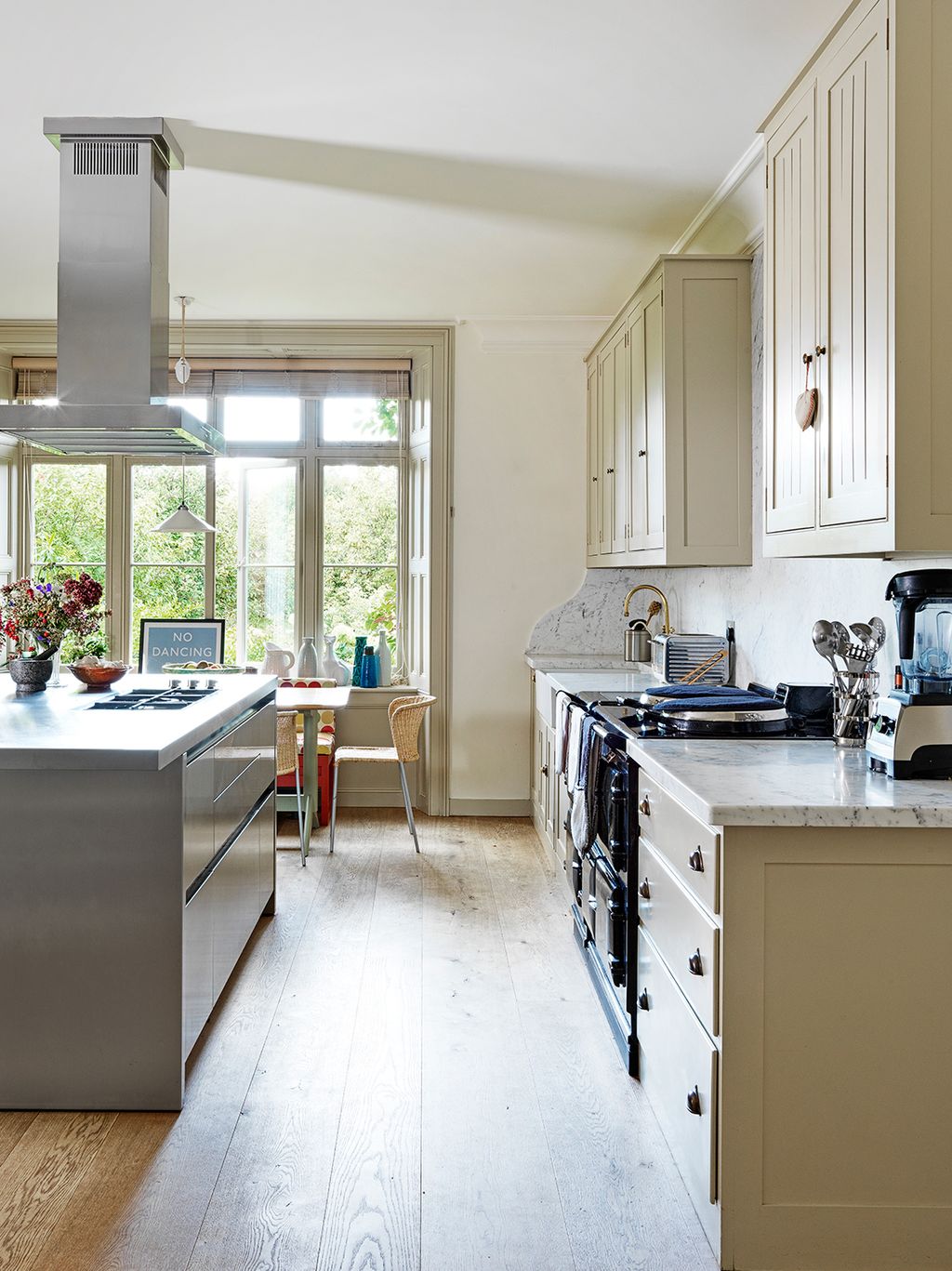
These carpets came from Afridi Gallery, while some of the others are by Sandy Jones – Toby and Ben’s mother, and a celebrated rug designer. In the dining room, one of her rugs in shades of blue provides a cooling presence in a space that contains a vibrant painting by Gillian Ayres, curtains made from bright suzani panels and a sombre William Scott painting. The kitchen nearby, more sub-dued in colour, is another example of a mixing of styles. Around the walls are Plain English cupboards – painted a putty colour, with marble tops – and an Aga, while the central island is stainless steel by Bulthaup.
At the far end of the corridor is the new staircase, designed by Christopher. On the floor above, the chimney-piece of the bedroom that was opened up to accommodate the stairs, remains in place on the landing. ‘We have kept all the little details,’ says Toby. ‘You don’t want to destroy the history of a place.’ In the main bedroom, a barrel vault was inserted into the ceiling, which gives the room extra height. Soft green walls and a monochrome fabric from Claremont on the headboard and curtains create a peaceful atmosphere. It is a beautiful room.
MAY WE SUGGEST: From the archive: a stylish London house by Chester Jones (1998)
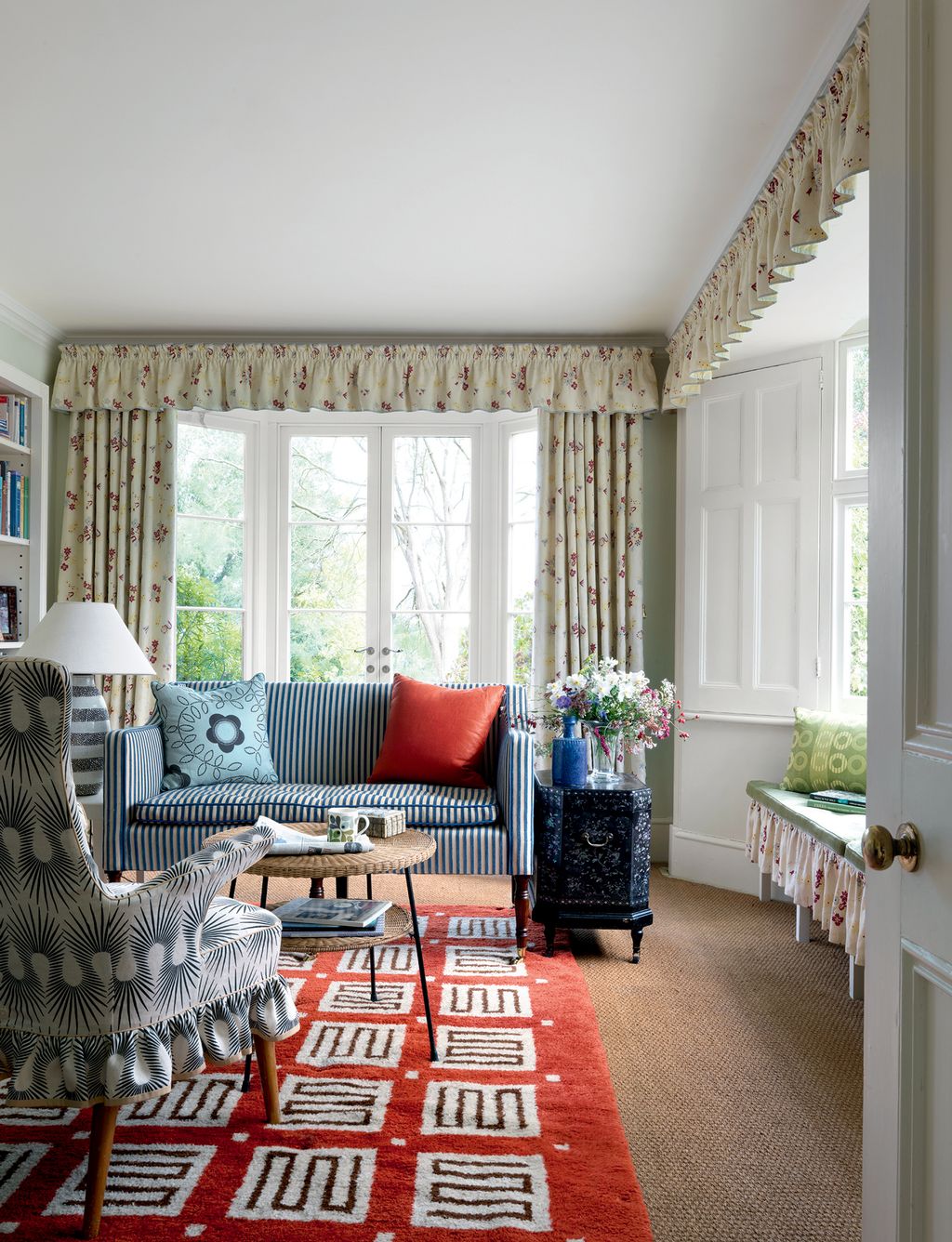
According to Toby, ‘The definition of luxury is the ability to do the same activity in many different settings in the same house.’ One of the smallest rooms – the wife’s study – is particularly charming. It has a flouncy pelmet at two of the windows, a neat 18th-century sofa in blue ticking and, from the mid-century, an orange Swedish rug, a wickerwork-topped table and an armchair loose-covered in a striking Neisha Crosland fabric. Toby has designed a cottage with intimate private spaces such as this, but which can also calmly and luxuriously accommodate 16 when required. Chester Jones Ltd is in safe hands.
 Simon Brown1/17
The entrance hall.
 Simon Brown2/17
A series of Oushak runners lines this long central corridor. Two faience ceramic lions flank a green neo-classical console. The lantern is from Charles Edwards.
 Simon Brown3/17
Two rugs from Afridi Gallery mark out different areas within this room. On one side, a Bijar kilim is teamed with a kilim-covered 17th-century chair and paintings by Ivon Hitchens and Patrick Heron, among others.
 Simon Brown4/17
On the other side, an Oushak rug tones with a custom-made sofa – one of a pair – upholstered in Alton-Brooke’s ‘Prelle Toile Barbare’. The 20th-century tole table is from Howe. Tissus d’Hélène’s ‘Amalfi Stripe’ was used for the blinds.


 Simon Brown5/17
A second custom-made sofa faces a chimneypiece from Jamb with two spoonback chairs, also designed by Chester Jones, on either side. The painting is by Sandra Blow.
 Simon Brown6/17
Curtains and pelmets in Claremont’s ‘Daisy’ print fabric frame a view of the garden. The 18th-century sofa is upholstered in a specially woven blue striped fabric by David Humphries. A mid-century armchair is covered in ‘Hedgehog’ printed linen by Neisha Crosland. The Swedish mid-century rug is from Afridi Gallery.
 Simon Brown7/17
The walls are painted in ‘French Sienna’ by Rose of Jericho. Sandy Jones designed the rug and the curtains are made from suzanis from Robert Kime.
 Simon Brown8/17
Plain English units are teamed with a Carrara marble splashback.


 Simon Brown9/17
The ‘Santa Lucia’ chairs were designed by Herbert Hirche for Richard Lampert.
 Simon Brown10/17
The staircase was designed by the architect Christopher Smallwood.
 Simon Brown11/17
 Simon Brown12/17
This room has a barrel-vaulted ceiling, with lower panelled areas on either side. ‘Calico’ print fabric from Claremont was used for the curtains and headboard. At the foot of the bed, a Japanese armour chest conceals a television.


 Simon Brown13/17
The walls are painted in Rose of Jericho’s ‘Verona Green’.
 Simon Brown14/17
 Simon Brown15/17
 Simon Brown16/17
The back door.


 Simon Brown17/17
A sculpture by Antony Gormley stands in the meadow outside the house.


