
A derelict Cotswolds garden revived with enchanting, naturalistic planting

Eyeing a derelict barn as a potential house is a natural human instinct, particularly when it is on a hill with uninterrupted views. In the Cotswold borders, where the wolds no longer sustain vast numbers of sheep, this sort of thing is commonplace. Riding by on her horse one day, a friend of the landscape gardener James Alexander-Sinclair looked across a field to see just such a lonely barn. This soon came to be known as the ‘shack up a track’, as she and her husband – with the help of James – turned the property into a dwelling.
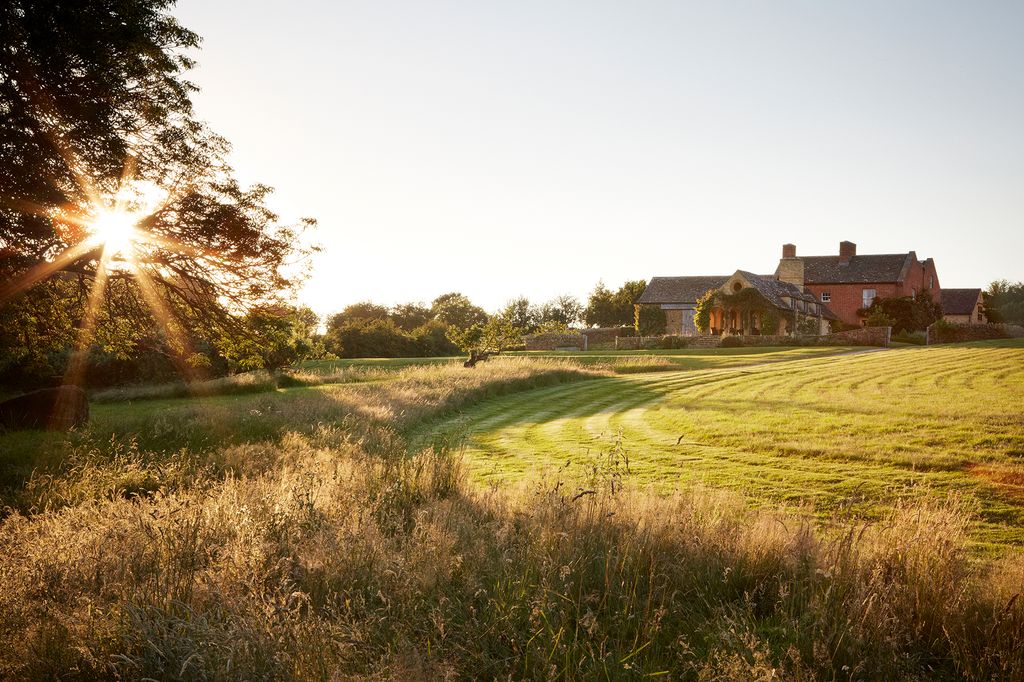
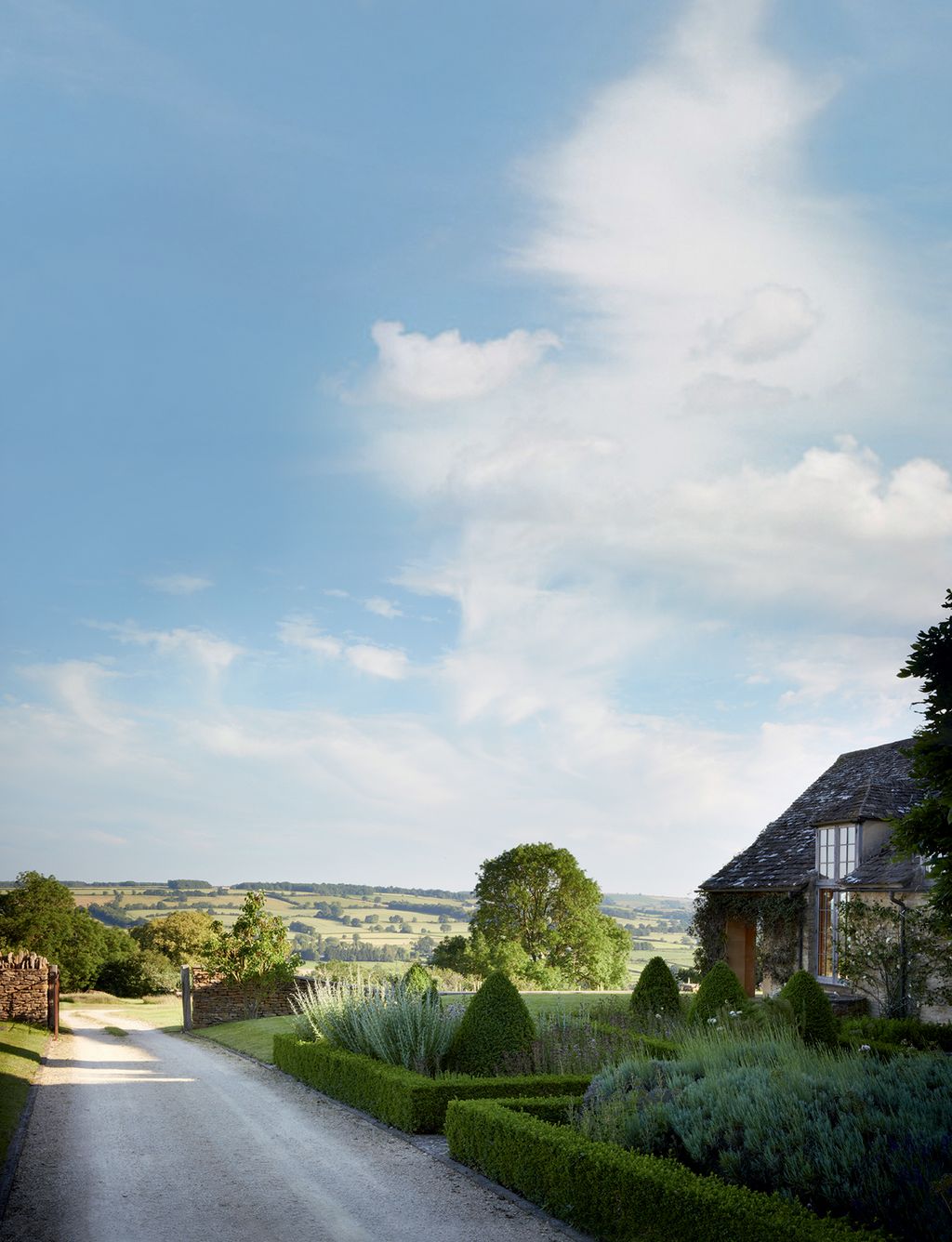
The track itself is precipitous in a car and would be better managed on four legs. In other ways, however, it is like a traditional drive that winds through estate parkland, with well-placed native trees to catch the eye and wildflowers crowding the long grass. The summit is crowned not by a shack but by a three-sided neoclassical loggia, surveying the panorama from east to west. Visitors do not park here, instead continuing past a formal herb garden sited under exceptionally tall kitchen windows.
The initial landscaping was developed at the same time as the house. ‘This is invariably the best way to do things,’ says James. ‘The garden usually comes second – people feel for some reason that they need plumbing before they need plants.’ Being high up and buffeted by wind, the former sheep field was designed as a series of garden shelters, while a house gradually emerged from an agglomeration of buildings (including the old barn), which look as though they have rubbed along together for considerably longer than a dozen years.
MAY WE SUGGEST: A garden on the Devon coast in tune with nature, ecology and its surroundings
‘Almost everything here is artificial,’ says James, indicating a perfectly natural-looking pond to the east, fringed with wild natives such as flowering rush and purple loosestrife. Reflecting the sky, the pond sits on the edge of an escarpment – ‘like an infinity pool in the Maldives’. It should be noted, at this point, that the original owners sold the property after a couple of years. It is their successors who have developed the garden, seeking something less casual and more structured in the herb garden, pond and tree-rich landscape. James was the obvious collaborator, and he was fortunate to find in his new clients a family who enjoy their garden and have been keen to take it further.
Too often, James observes, ‘people buy places, then become frightened of the garden and turf it’. A big view can also be quite unsettling, unless well orchestrated. Here, the calming of the garden and the surrounding scenery underpins the success of the property’s often eccentric vernacular – part rectory, part barnyard, part French rustic. However, the real essence of the garden is distilled in a hidden courtyard enclosed on four sides. When the heavy wooden doors are closed against the elements, the change to this quietly buzzing micro-climate is both surprising and mesmerising.
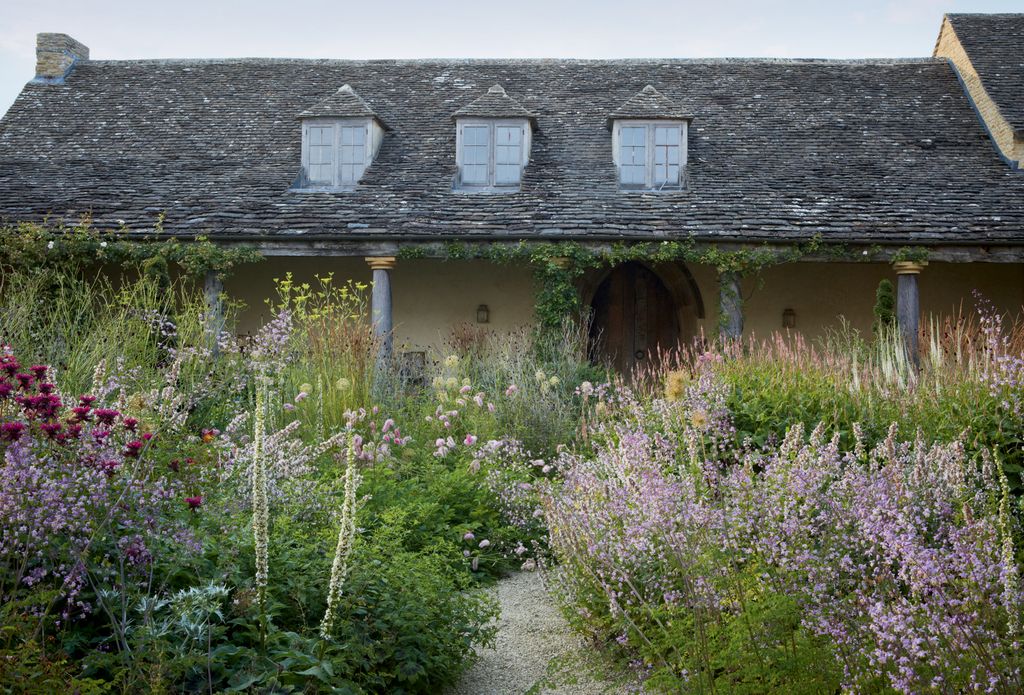
Looking down on it from the higher north end, the courtyard’s layout reveals itself as a gravel garden, with rhythmic planting separated by paths of pea shingle. In spring, it is a sprightly concerto of mauve and chlorophyll green, with alliums and Geranium phaeum hovering over euphorbias and the emerging foliage of persicaria and Geranium ‘Brookside’. Later on, the magenta geranium ‘Ann Folkard’ will scramble over its neighbours ‘like a mountain goat on a mission’. At this point, the only way to get round the garden is by pushing your way through.
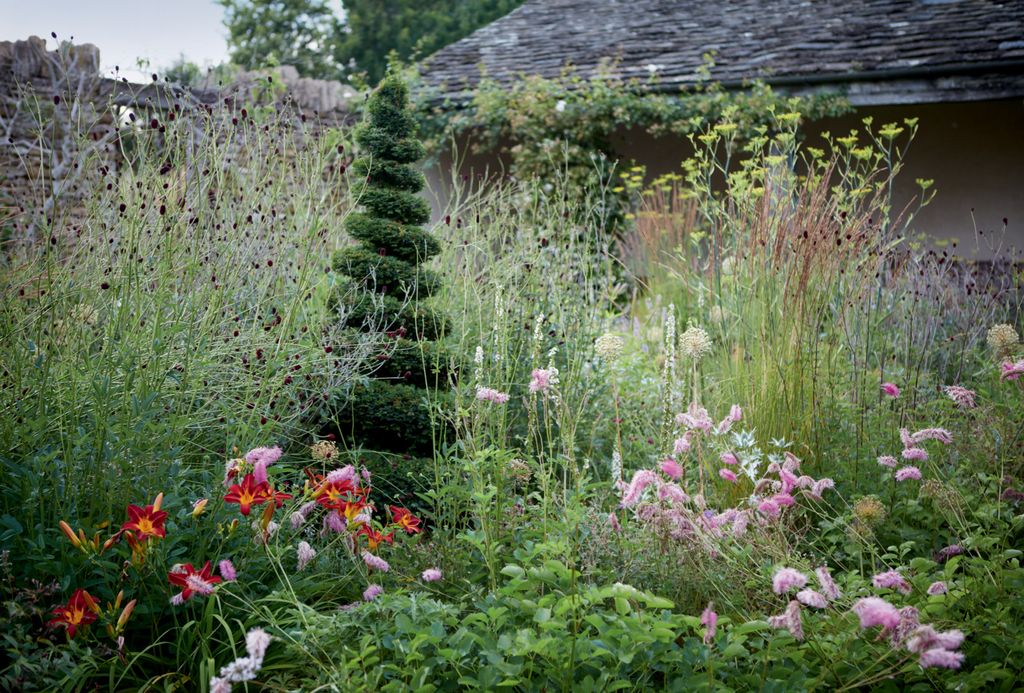
‘The idea was to make a garden that looked like it had just blown in off the hill – to have a random mix of plants that just do their stuff,’ says James. Accordingly, plant communities that naturally thrive together are found in all their variety here, with at least three types of persicaria, monarda and nepeta. The fluffy pink Sanguisorba obtusa should clash horribly with the intense red and bright yellow of the daylily Hemerocallis ‘Stafford’, but colour is not an issue by late summer, with so much vitality, shape and texture. The semi-formal note struck by several corkscrews of topiarised yew – prominent throughout winter and spring – is roughed up in summer by a fog of Sanguisorba officinalis, while purple fennel (Foeniculum vulgare ‘Purpureum’) leaves behind its youthful froth to become another wild character.
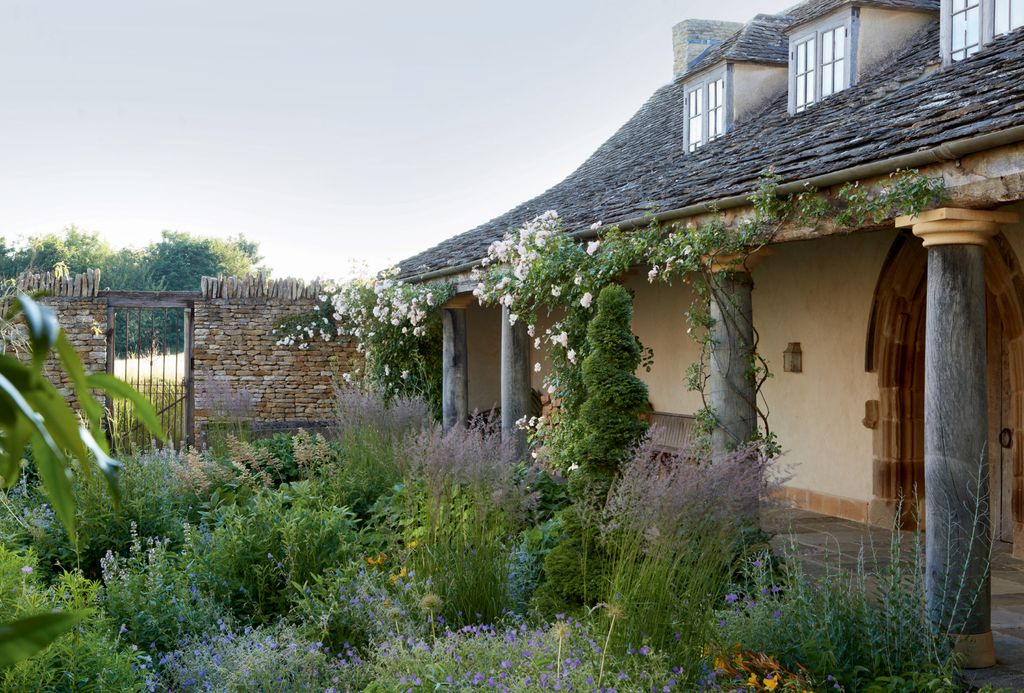
It is a hot garden, with light settling at the end of the day near a stone fireplace from the Dordogne, which is occasionally lit in the evening. A romantic colonnade, adorned with scented Trachelospermum jasminoides and ‘Madame Alfred Carrière’ roses, intensifies the enchanted atmosphere. With its low, steep roof, this part of the courtyard looks like a medieval building of Périgord origin. And it might well be, since it was bought in its entirety and shipped over from France.
MAY WE SUGGEST: The garden of a former abbey combining ecclesiastical symmetry with informal planting
A simple wrought-iron gate in the dry-stone wall on the left gives a glimpse of the wilderness outside and a spinney – the first trees to be planted 12 years ago. They were soon followed by some gnarled, ancient apple trees. Sourced by the local landscaper and former circus master Toti Gifford, they are the native equivalent of statement olives, their stout girths unperturbed by the wind. Since then, James has planted dozens of oaks, rowans and groups of amelanchiers (with maintenance help from Alex Calado of Oxford Lawns and Gardens) as well as espaliered fruit trees around a swimming-pool garden that sits on the next tier above the courtyard.
It is a garden that has become an old friend to James and he is delighted when he sees a thriving tree that he has known since it was a stick. ‘The first thing to do when you start a new garden is to plant trees,’ he says. ‘If you leave it a year, then you will need to live another year in order to see them do anything.’ Citing the Chinese proverb that says that the best time to plant a tree was 20 years ago, he adds, ‘The second best time is not just now but this afternoon’.
James Alexander-Sinclair: jamesalexandersinclair.com
 Britt Willoughby Dyer1/7
The site was formerly grazing land for sheep, which James cleared of gorse, replacing it with dozens of native trees, including oaks and rowans
 Britt Willoughby Dyer2/7
An open loggia with a southern European flavour is host to Clematis montana ‘Elizabeth’. The steps are flanked with clipped holly, Verbascum chaixii ‘Album’ and Geranium ‘Brookside’.
 Britt Willoughby Dyer3/7
An enclosed gravel garden is overlooked by an ancient building shipped from France, its wooden columns draped with fragrant ‘Madame Alfred Carrière’ roses.
 Britt Willoughby Dyer4/7
Purple Monarda ‘Scorpion’, soft pink Persicaria amplexicaulis ‘Rosea’ and Veronicastrum virginicum ‘Album’ throng the network of paths.


 Britt Willoughby Dyer5/7
The doors of the original barn can be slid open to reveal views over the Cotswold Hills; in front of it, allium seedheads create a foil for orange Hemerocallis ‘Golden Chimes’.
 Britt Willoughby Dyer6/7
A yew spiral emerges from clouds of maroon Sanguisorba officinalis and pink S. obtusa, with red Hemerocallis ‘Stafford’, while yellow-flowered purple fennel soars skywards.
 Britt Willoughby Dyer7/7
Between the drive and the kitchen, a formal herb garden of box-edged beds encloses yew topiary and a profusion of herbs.


