
Design ideas for house extensions and advice on how to plan one

Planning an extension can be an overwhelming undertaking at the best of times; from obtaining planning permission to the logistics of building, there is a lot to consider. It takes a lot of proper planning to get the right execution and create what you want, not just what everyone else has. We asked an architect and the founder of a construction company to weigh in on how to plan, prepare and start an extension properly.
'As you think about an extension for your home, it’s important to consider the historical context of your home, and how the extension and your current home speak to each other,' says architect Paul Bates. 'That’s not say it has to be the same language, but it does have to marry well. Whether opposites attract or they have many things in common, it all depends on the personality of your home and what you prefer.' When it comes to the financial side, Paul advises 'In my opinion, if there isn’t enough money, then wait until you have the money to do a proper addition to your home. You don’t want something cobbled on to your house that looks uncomfortable. If you plan carefully and think ahead, you can eliminate costly changes in the field while under construction,' he continues, which can throw a tight budget asunder. Additionally, 'make your changes on paper before you start construction. It’s a lot less expensive.' When it comes to drawing up the ideas, Paul says 'It’s very important to have a designer or architect to help you plan, and he or she should be someone that you trust, you should appreciate their work, and you should allow them the freedom to think and make something special for you and your family.'

Tom Corbett-Winder, who owns Blockhouse Build and has extension experience through his own house renovation with wife Matilda Goad, believes that it is useful to use an architect who is familiar with the local area and has a relationship with the planners to help things move along. Once you've looked over some builders' previous and ongoing projects to find someone who might suit, he suggests 'I would always get quotes from two or three builders and really make sure you know exactly what is included within the quote. Your chosen architect should have put together a pretty comprehensive schedule of works and can be on hand to make sure that the contractor has allowed for everything in their quote. Don’t always go for the cheapest quote as you pay for what you get.' Builder choice is the utmost importance, of course, but not just for the obvious reason that they're completing the work. 'You will probably spend more time speaking with the builder than your partner, so the relationship has to be good,' says Tom.
It doesn't stop with planning, once works are underway, you have to keep on top of the process. 'Have regular meetings with the site manager,' advises Tom. 'I like to meet the site manager most mornings to go through everything and then be updated at the end of day with progress. Via WhatsApp, you can always be updated with photos and queries.' It's not just your sanity you have to consider in all of this either, especially with everyone now working from home. Ask your builders to be mindful of your borough's working hours so you can keep your relationship with the neighbours as sweet as possible. A final word of advice from Tom: 'Make sure you hold back money from the builder for snagging (checking a new building for minor faults that need correcting after completion). This figure varies project to project and is dependent on contract size, but it's usually around 5 or 10%.' The reason? 'It’s very difficult to get builders back to fix minor errors once they have been paid.'
Scroll down for design ideas from some of the most striking extensions in London.
 Lucas Allen1/12
Hackett Holland
This extension is attached to a Victorian house in a Notting Hill conservation area, so Hackett Holland used London stock brick to match the original building and created a simple, boxy design. ‘This meant planning permission sailed through,’ explains co-founder Johnny Holland.
A triple-height Crittall-style window introduces dramatic scale and brings in vast amounts of light, even in the basement, which was excavated during the project. The windows are made from W20-type steel, which includes thermal breaks (insulation within the frame) to help the building meet high standards of thermal efficiency – a prerequisite for the planning permission.
Johnny advises, ‘Think big when it comes to extensions – they often become the largest room in the house. Avoid subdividing into bitty spaces and make the most of the natural light. Match one or more of the materials to the original building – a good extension should integrate smoothly into the house and link it to the garden beyond.’
 Lucas Allen2/12
The extension incorporates a double-height seating area, decorated in neutral tones by Suzy Hoodless. Suzy teamed an oak dining table with dark-toned ‘Wishbone Chairs’ by Hans J Wegner for Carl Hansen & Søn. Light floods in through a triple-height window.
 3/12
3/12Gruff Architects
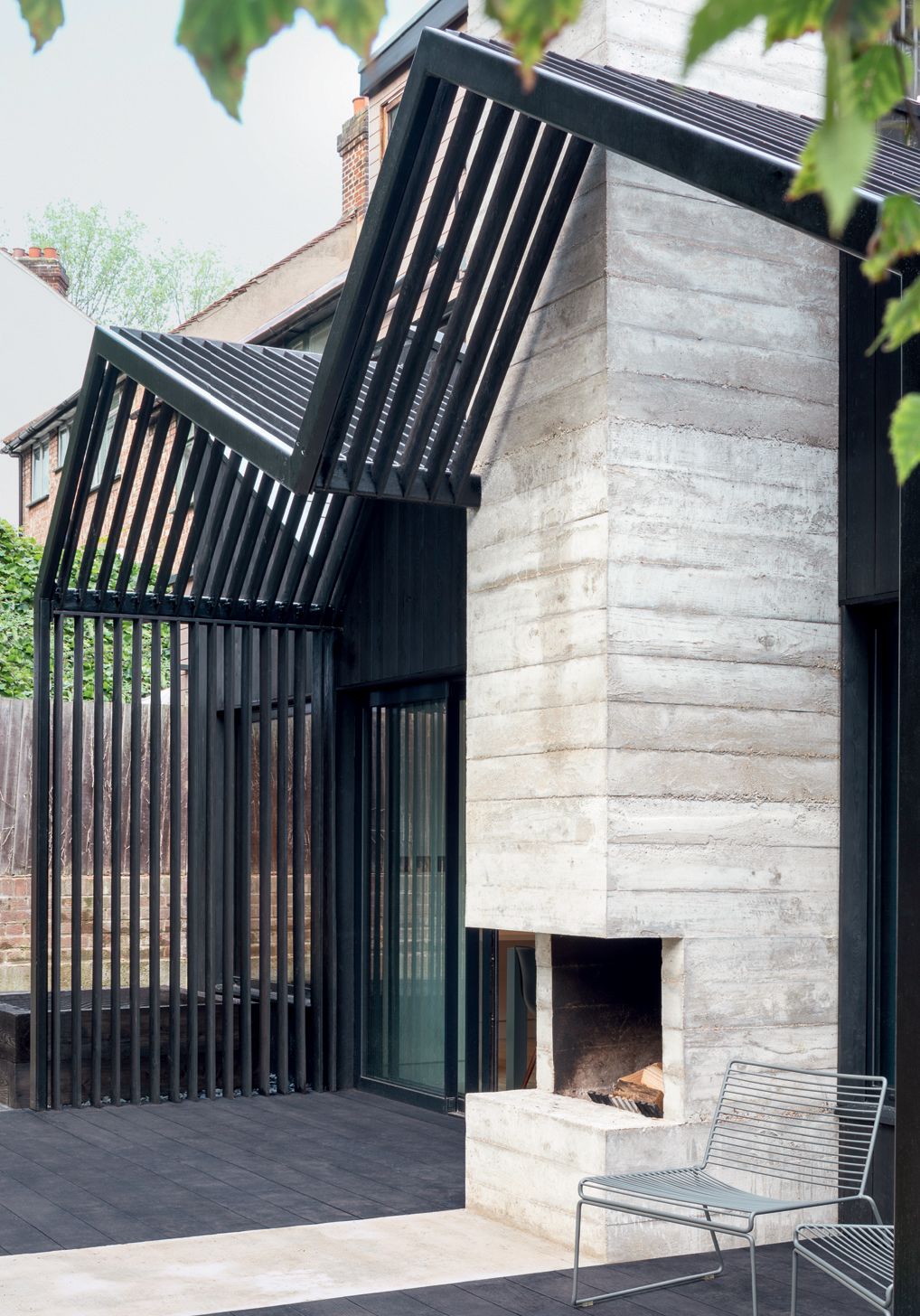
A sawtooth-shaped extension by Gruff Architects is a bold addition to this Victorian house in south London. The charred larch cladding is punctuated by the horizontal lines of the shuttered concrete chimney stack. From the base of the chimney, a matching band of concrete extends across the decking, creating a similar graphic effect. Composite decking from Millboard complements charred larch cladding by Shou-Sugi-Ban. ‘The extension investigates the idea of the hearth as the centre of the home,’ architect Emma Carter explains. The wood-burning outdoor fireplace is mirrored in the sunken seating area inside, in which the ethanol fire is a focal point. The aim was to ‘create a fluid connection between the garden and the house’ by repeating this design detail. Skylights and large sliding glass doors bring light into the extension and allow for easy indoor/outdoor living in the summer months. The owners of the house have had their evenings transformed by the new outdoor hearth – toasting marshmallows on the fire has become a favourite after-dinner activity and the addition of the decking has resulted in the outside space being used far more frequently than it was before.
 4/12
4/12Inside, space has been created for a sitting area, kitchen and dining room, which are differentiated by their flooring, level changes and colour palettes – deep blue in the sitting area and paler neutrals elsewhere. The walls and cabinetry in the sitting area are painted in Farrow & Ball’s deep ‘Hague Blue’.


 5/12
5/12Al-Jawad Pike
Hackney-based architects Al-Jawad Pike designed this west London extension to create space for a young family. To speed up the planning process, applications for the loft and rear extensions were submitted separately. The zinc-clad loft adds a bedroom and en-suite bathroom, while the lower extension encompasses a ground-floor kitchen with an office and bathroom upstairs.
‘We balanced the owners’ need for additional space with the constraints imposed by the site,’ says Al-Jawad Pike’s co-founder Dean Pike. For example, the angled roof on the side return brings light into the kitchen seating area via a large skylight, but does not overshadow the neighbours.
Identical brickwork has been used for each level of the rear extension and Dean explains that ‘a lime mortar slurry was applied across all surfaces to add texture to the clear geometric forms’. Large glass
sliding doors open out onto the garden, where the paving stones blend seamlessly with the exterior walls. 6/12
6/12The interiors are similarly cool, calm and contemporary, with pale terrazzo flooring and a neutral palette that provides a simple backdrop for the large cooking area. The scale and form of this extension make it a unique project that blends elegance with practicality. The kitchen is illuminated by a skylight in the roof of the extension. This was angled to ensure that it does not overshadow the neighbours.
 7/12
7/12Tonkin Liu
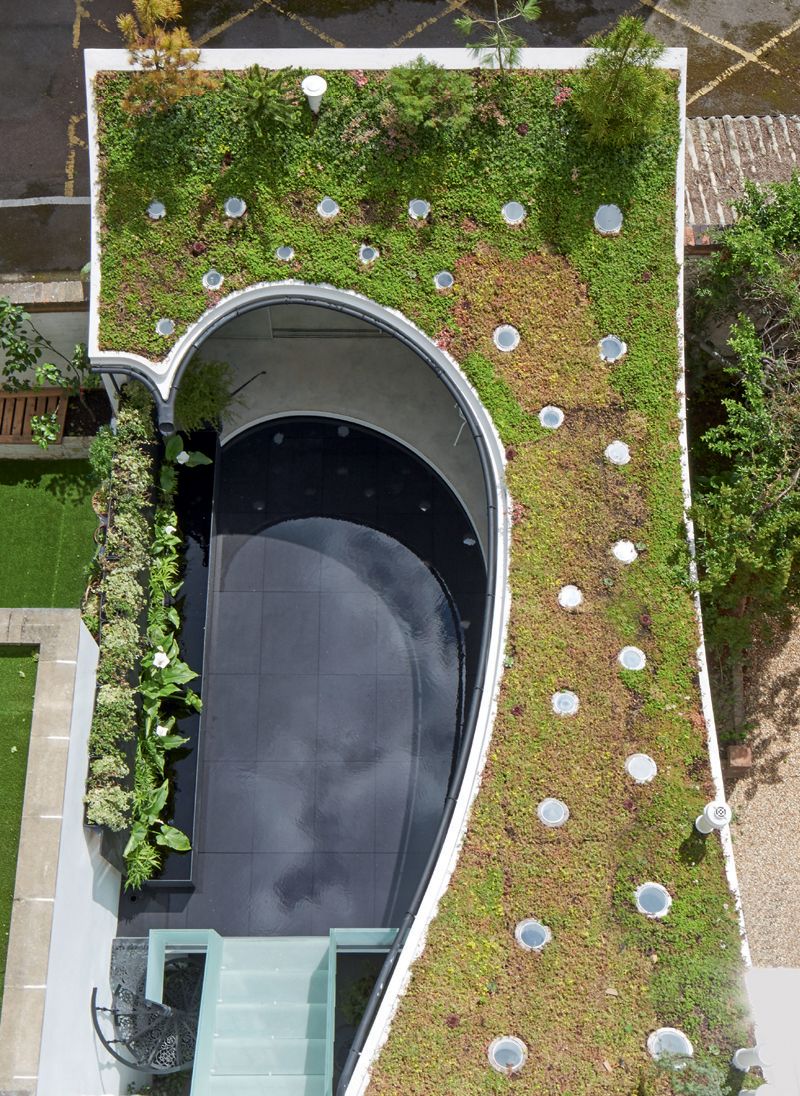
The Sun Rain Rooms project by Mike Tonkin and Anna Liu is a masterclass in urban design and has won a number of prizes, such as the RIBA London Award 2017. Situated behind Anna and Mike’s own Grade II-listed house in Clerkenwell, it provides a new seating area in the form of a narrow corridor overlooking a terrace. Stairs from the ground-floor kitchen lead down to the terrace, which can be used for entertaining or as a water feature, thanks to a pipe that follows the curve of the roof. When it rains, the pipe fills a tank that connects to the courtyard. The rainwater transforms the space into a reflective pool, which can be drained in minutes.
The stressed-skin roof is made from 30 layers of thin plywood. Green roof expert Sky Garden has planted slow-growing pine trees and other vegetation on top, which can be seen from the upper levels of the house. When planning an extension, Anna advises, ‘Consider how you want to live. How much indoor and outdoor space do you want? An extension is your chance to make a poetic connection to the garden and incorporate nature into the house.’
 8/12
8/12The terrace can be filled with rainwater from the long, narrow tank on the right. Slow-growing pine trees on the green roof above are a haven for birds.


 9/12
9/12Nimtim Architects
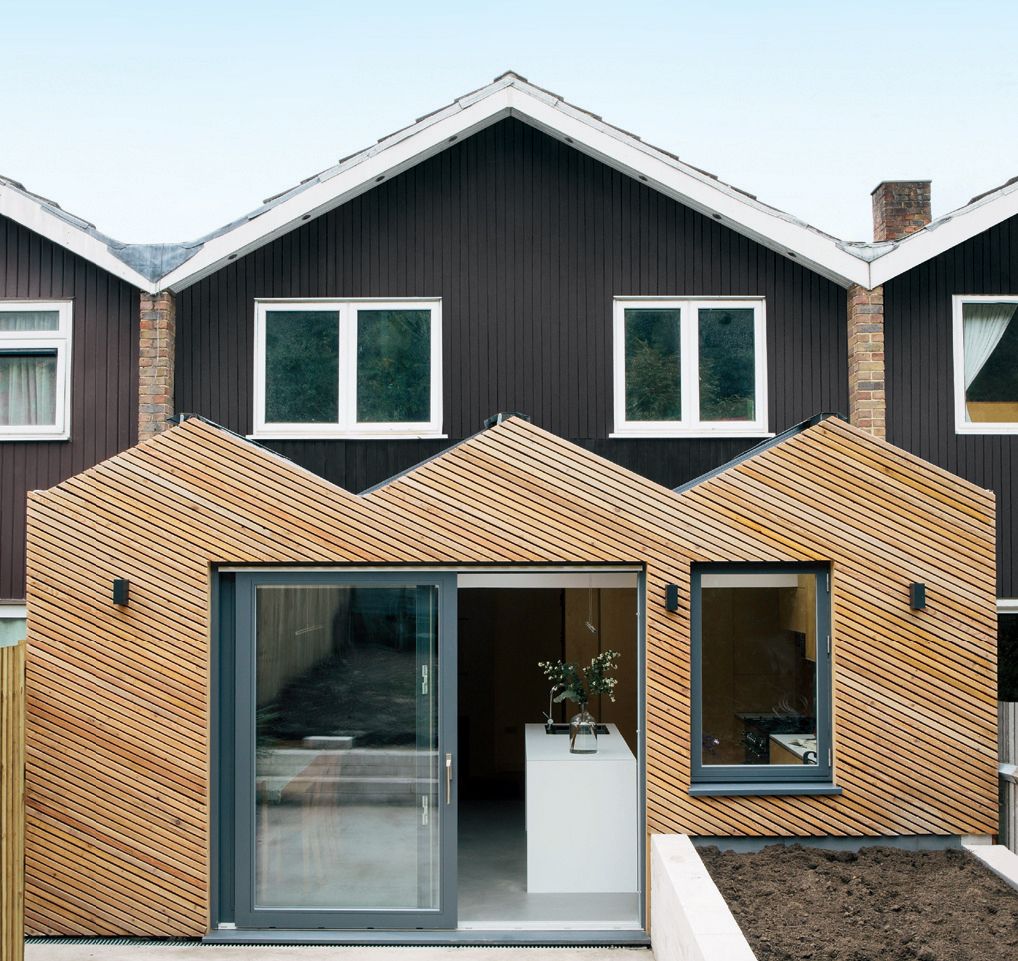
An extension by Nimtim Architects mirrors the zig-zag roofline of this Sixties terrace in south London. The zinc roof incorporates three south-west-facing skylights, which bring sunlight into the kitchen and dining area inside. The shape of the roof was key to the logistics of the project, as it conceals service and drainage routes. Over time, the untreated Siberian larch wall cladding will develop a silvery hue.
 10/12
10/12A simple palette of inexpensive materials was chosen for this dining area, which has an oak table and chairs from Muji. Nimtim’s co-founder Nimi Attanayake worked with project runner Allie Mackinnon on the interiors. ‘We were working to a very tight budget so, rather than spending lots on the decoration, we used inexpensive materials such as birch plywood and left them exposed to create a simple backdrop for the clients’ existing furniture,’ says Nimi. Her advice when it comes to budgeting for an extension? ‘Be realistic about what you can afford and always ask your architect what exactly is included in the cost.’
 11/12
11/12An extension by Paul Bates Architects.
 Yuki Sugiura12/12
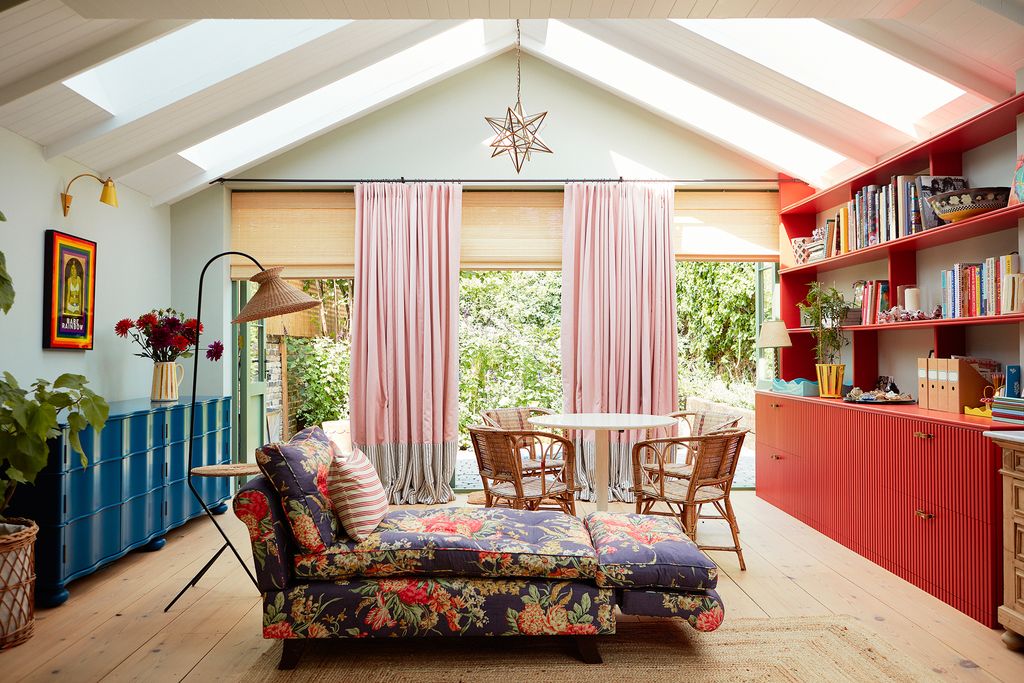
When building an extension onto his own home, Tom Corbett-Winder subverted the normal choice of putting the kitchen in the extension and instead used the space for a light, airy living space.


Comments
Back to Top


