
How to choose the right front door for your house

There is a scene in Alan Hollinghurst’s 2004 novel The Line of Beauty, set in 1986, in which a rising, ambitious Conservative MP prepares for a huge garden party at which he expects to receive Margaret Thatcher. The Iron Lady is in her pomp, imperious and politically unassailable, and her attendance is treated with the same seriousness as a visit by royalty would be. Preparations take weeks and every minor detail of the event is considered meticulously. To better flatter Thatcher, the MP even has the front door of his family house in Notting Hill repainted from a modest green to a particularly High Tory “Conference Blue”.
We’re not saying you should do this if you’re expecting important guests – and anyone who has read the novel will know that said MP is hardly a sympathetic character – but it’s certainly true that your front door is the first thing that will form an impression in your guests’ minds when they visit you at home, beyond the building itself. “Even if painting the whole house is not your thing,” says Rita Konig, “we should at least embrace our front doors as an opportunity to have a bit of fun. This does not mean it has to be garish or ugly, but something more adventurous than the Number 10-style black front door.” Rita’s own front door in London is a yellow from Papers and Paints’s 1950s collection.
So, how to choose a good one? How to tell which size, shape and form to go for? What about windows, knocker, numbers, bell?
How to choose a door material
The first place to begin is with material. Wood is, of course, the most common and the most traditional material, and can be eco-friendly provided you source it from a sustainable forest. Hardwood is generally preferred because it’s, well, hard, a quality which will ensure that your door lasts and won’t be too damaged by the sun, the weather, or anything that might end up hitting it. Oak and walnut are good options, and their grains are beautiful and won’t be lost if the door is sanded back.

That said, wood can require specific upkeep – you likely want to lacquer, oil or paint a wooden door to keep it in good nick. A “raw” untreated door will eventually warp. Consider whether your door is facing north or south; a south-facing doorway which gets a lot of sun is obviously lovely for a house, but its door will fade faster than a north-facing one.
Unplasticized Polyvinyl Chloride, or uPVC, is a durable, rigid form of plastic (despite the name) which is hardy enough to be used in window and door fittings. It certainly has a less rustic feel than a wooden door but is generally a more affordable option, and is just as long-lasting. While they might be typically and historically associated with somewhat ugly bright white tones – giving your front door the look of a Ford Transit van, yuck – they now generally come in a range of tasteful colours from places like B&Q and Just Doors. A uPVC door is probably not the right option for, say, a Georgian townhouse, but on a modern postwar flat it’s certainly a viable door.
Naturally, metal is among the most secure materials for a door (although in reality, it’s hard to imagine many situations where hardwood wouldn’t do the job for you, too). It’s very strong and very durable, and different metals offer a different variety of densities. Steel, for example, is nigh on indestructible, though very heavy, while aluminium can be a lighter-weight option in both areas. These doors are pretty much maintenance-free and can eventually be recycled, should you decide to change material or to replace them. As you might expect, then, aluminium sits at the pricier end of the scale for materials.
Composite, as you have likely guessed, is a melange of a various different materials. In practice, that tends to mean they have a core, often of glass reinforced plastic (GRP), timber or polyurethane foam, and then an outer shell or “skin” of some other weatherproof casing like GRP or uPVC, or sometimes wood. This makes them thermally efficient and low-maintenance, and they are often a mid-priced option for a door. They tend to be a somewhat sturdier alternative to uPVC.
How to choose a door colour
The fun part! On this one, we have very little advice, because it will depend on your personality and taste. Want to stand out and make sure your guests never lose their way even in the thickest of winter fogs? Try a hot pink. Keen to avoid the neighbours? Something like a sombre British Racing Green, perhaps. Bear in mind that dark colours might be better than true blacks, says Rita Konig. “Choosing [a] black is as complicated as choosing white; a very dark, almost black green or blue is often better than a pitch black.”
One thing which is important is to make sure the paint you choose – if indeed you use paint – is appropriate for a front door. Most people use gloss, because it’s very hard-wearing against the elements, and will form a hard sort of “shell” that is impermeable. Eggshell and matte paint are much more vulnerable. Oh – and don’t forget to paint the inside.
If you have a uPVC door then your options are a little simpler, and you can simply choose from the colours on offer. The same rules apply: choose something that you like, though in this case beware that you can’t repaint your door in the way you could a wood one, should you change your mind later. And if you’re opting for metal, then there are a range of treatments you can pick from, including colours. It’s probably best to ask a metal-door expert for the pros and cons of each.
How to choose door fittings, features and glazing
Chances are, you want something on your door beyond a keyhole. How do you want people to request access to your house? Hardware including door knockers can be found in literally hundreds of finishes, from chrome to brushed steel to brass, and often adds flair to your door. Naturally, it’s important to match this hardware to the colour of the rest of your door. Something warm will often benefit from similarly warm finishes, while a glossy black (for example) looks very upstanding with polished chrome (if you don’t mind a passing resemblance to 10 Downing Street). Shinier handles and fittings tend to look good with gloss, rather than matte finishes. If you have a letterbox, our recommendation would be to ensure it matches the rest of the hardware on the door.
Beyond these, it can be a lot of fun to trawl flea markets, antique shops and car boot sales to find unique, vintage pieces to mount on your door. There are few things more characterful than a verdigris-ed Victorian cast metal door knocker. On the other hand, you could go fully modern, and choose a smart doorbell, if you’re concerned about safety or crime, or simply want the option of confirmation that your post has been delivered when you’re not at home.

As for glazing, a window can be invaluable if your front door opens into an otherwise dark hallway or vestibule, as often can be the case. A larger window will be less heat-efficient but can also be a good sun trap if your door faces south, while something higher up will give more privacy. We’d suggest considering frosted or textured glass if you live somewhere where there will be high footfall outside your door, such as on an external walkway in a block of flats. Stained glass can be another somewhat curveball option if you want that extra injection of character into a door.
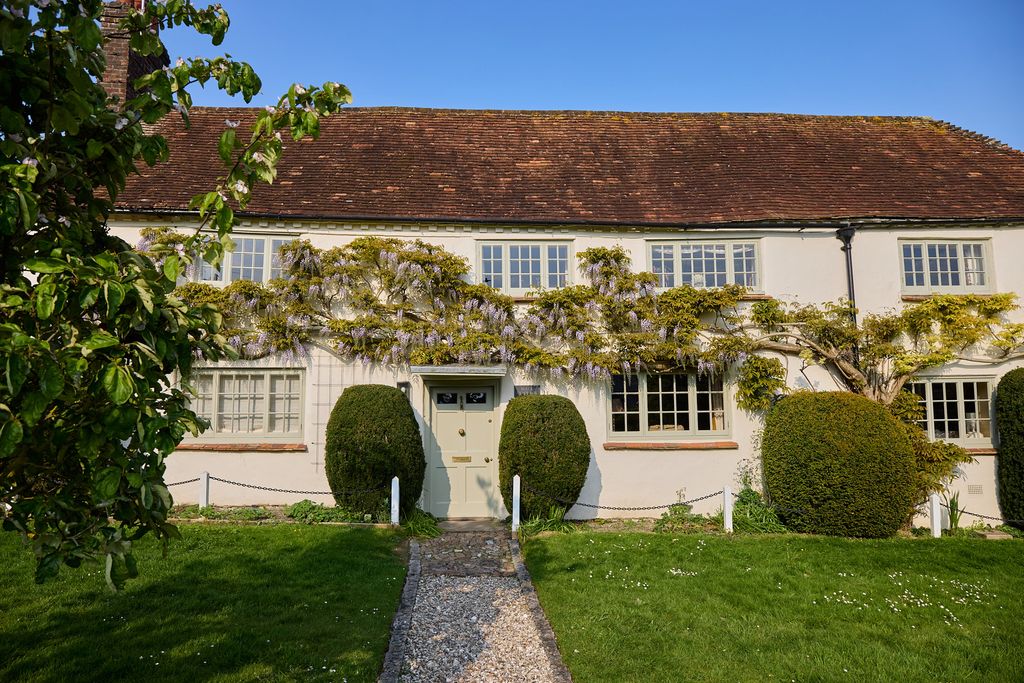 Boz Gagovski1/4
A front door doesn’t have to stand out, if there are other features which might be better served by the limelight. In the case of this Wiltshire cottage decorated by Brandon Schubert, the door and window frames are muted and not dissimilar in colour to the exterior plastering of the house, all the better to let the extensive wisteria chine.
 Ngoc Minh Ngo2/4
This beach house in the Hamptons by Steven Gambrel has a Dutch front door – i.e. a split door with upper and lower halves – which is painted for effect in two different tones on front and back. On the front is a distinctive brass door knocker with an avian design.
 Øivind Haug3/4
In an unusual but inspired move, Ptolemy Dean moved an old wooden internal door from the kitchen of a Kent rectory to its front entrance, giving a suitably old-fashioned, rustic feel.
 Taran Wilkhu4/4
In Zoe Zimmer’s flat, it was the unusual curved front door which first caught her eye; she later enhanced the sense of drama in the hallway by painting both the door and its surroundings black.


