
A perfect balance of practicality and sophistication at a London flat by Hugh Leslie

What a relief that the days of beige, greige and all those nothings in between are over. Colour, in all its infinite variety, is back and those designers adept in its use are revelling in the chance to open the door and let in the light. Certainly, the interior designer Hugh Leslie is very much into colour, as is illustrated in his transformation of this garden-square flat in central London, commissioned by an owner who loves colour almost as much as Hugh does.
A perfect flat is one that is cocooning to the owner and welcoming to guests at the same time. A perfect flat is also one where there is a place for everything and every-thing in its place – but with all the boring bits out of sight. In other words, the perfect flat is like this one, of which the owner says, ‘It works perfectly for us – Hugh is brilliant at the management of space.’
This is a lateral conversion that stretches across two buildings. It is, however, still relatively compact, with two bedrooms, a practical and comfortable sitting room, and a chameleon-like kitchen-cum-hall. Originally, the front door opened directly onto a narrow corridor that ran the length of the flat, with the kitchen, shower room and bedroom on one side, and the sitting room and main bedroom leading off the other, garden-square side.

‘It was dismal,’ declares the owner, ‘but Hugh has transformed it.’ He did this with a simple but game-changing solution, which was to remove the corridor wall and completely open up the space, in effect creating a hall/kitchen that flows through into the sitting room. He panelled the newly created space in warm European oak, installed a chic breakfast bar, and banished kitchen necessities to behind the panelling, as well as to a self-contained pantry. He also laid wide oak floorboards that run through the whole flat and unify the space.
The open-plan room is a space for living, where the owner can eat and relax, with separate areas connected by a rug from Sandy Jones. In one corner, there is a high-backed banquette as well as an oval walnut dining table. A new chimneypiece is framed in green onyx with a marble mosaic inset. Across the room is a capacious sofa fronted by a coffee table topped with white ebony.

The sitting room perfectly illustrates Hugh’s talents: he thinks of his work as interior architecture rather than simply interior decoration and the term is fitting as, like so many architects of the 18th and early 19th centuries, he also designs much of the furniture. When Hugh was training as an interior designer in New Zealand in the Eighties, furniture design was part of the course and it has become a large element of his work today. ‘Every piece is made in this country by craftsmen and I use traditional materials that work with both the period of the building and the owners’ style,’ explains Hugh. ‘Obviously there is a practical reason for each piece, but I also love the fact that there’s such a wealth of materials to draw upon. You can be much more specific when you design furniture and every project is different – being able to tailor-make each piece is a delight.’
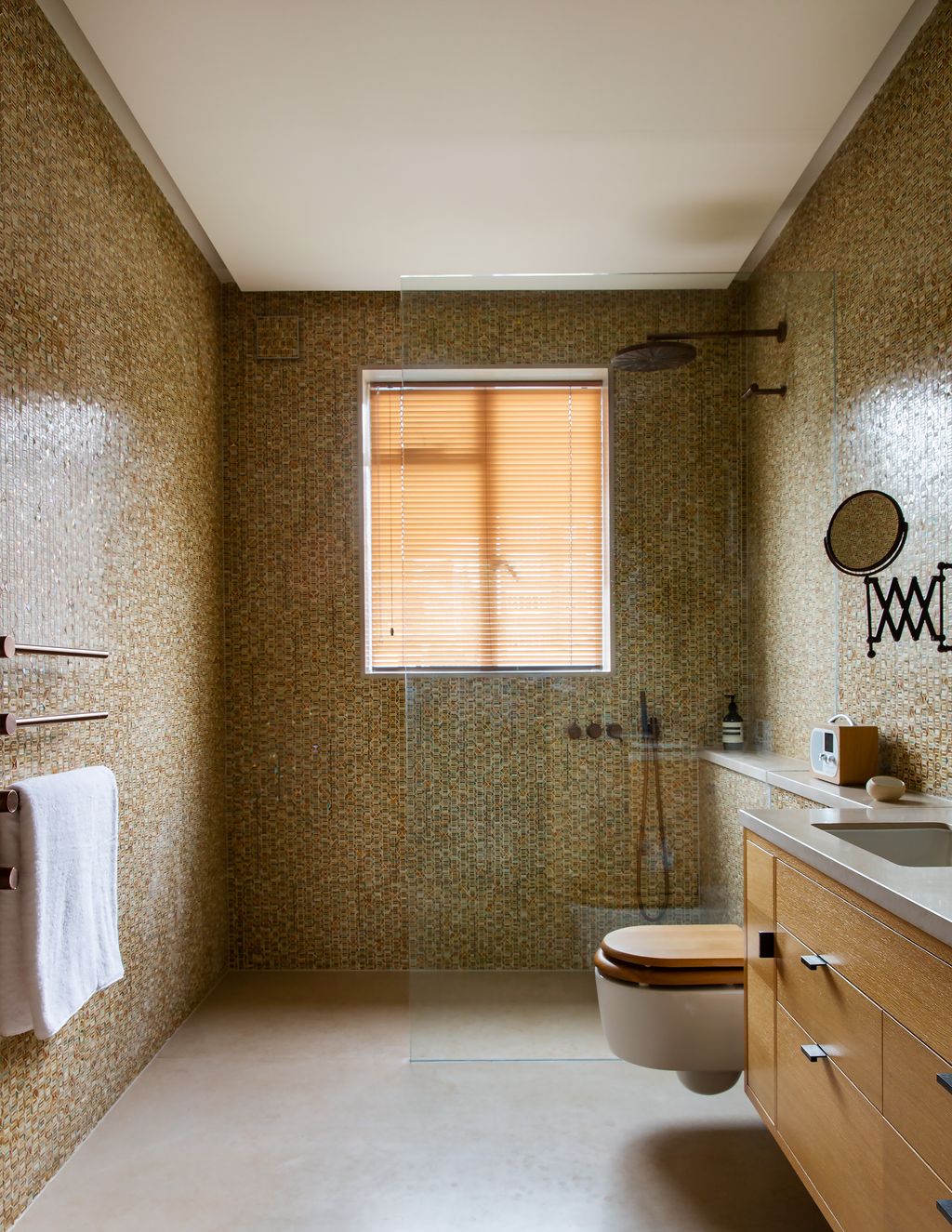
Beyond the open-plan room is the calm main bedroom. An antique Japanese paper screen hangs above the bed and, on the other side of the room, there is an inviting chaise longue in toffee-coloured corduroy, emphasising the vibrant tones of the Alan Davie painting behind it. Another Sandy Jones rug, which looks like water flowing on sand, ripples over the oak floor. The bedside tables, chest of drawers and bookcase table were all designed by Hugh specifically for the room – again balancing the practical and the sophisticated. The main bathroom is equally considered, with walls clad in a bespoke mosaic design that echoes the tribal art hung throughout the flat.

Hugh is also brilliant at the hidden, behind-the-scenes details: doors seem to disappear into walls; and awkward corners have been transformed into storage. This is what design is about and it is unsurprising he is so good at it as, before starting his own business in the early 2000s, he worked with three of the best designers in Britain: John Stefanidis, from whom he learned ‘to be bold and courageous’; David Mlinaric (‘who taught me to appreciate the historical sense of every project’); and Chester Jones (‘who showed me that you can never put too much effort into a project, nor is there such a thing as overthinking’). Little wonder the owner is so happy with the results: ‘Whenever I come into the flat, it puts a smile on my face,’ she says, contentedly.
 Owen Gale1/6
Walls panelled in European oak showcase two abstract artworks by Debbie Loftus above the breakfast bar in the kitchen.
 Owen Gale2/6
The breakfast bar is teamed with a vintage orange stool from 1stDibs and a ‘Chester’ wall light in satin copper from Original BTC.
 Owen Gale3/6
 Owen Gale4/6
Flexform’s ‘Evergreen’ chaise longue in Etro corduroy sets off the Alan Davie painting on the far wall of the bedroom.


 Owen Gale5/6
Hugh has concealed useful storage behind doors with striking cut-out designs, which tone with the walls in Farrow & Ball’s ‘Oval Room Blue’. A custom-made Scandinavian tufted-back chair, which matches those in the sitting room, stands on the new oak floorboards below composite photographs of Pisa (top) and Reims cathedrals, with a Noguchi lantern above.
 Owen Gale6/6


