
A fashion designer's art-filled house on the Dutch coast

When Dutch fashion designer Jackie Villevoye first set foot in her Zeeland townhouse on the west coast of the Netherlands, she almost burst into tears. But then, she is a woman of extremes: ‘Either I think something is beautiful and my heart beats fast, or it’s ugly and I can’t be near it.’ But this was the first house she had viewed while looking for a new home and, feeling that it was ridiculous to make an offer 15 minutes into the task, she dutifully looked at half a dozen more. ‘But I knew I’d found it,’ she admits.
The decision to move came at a turning point in her life. Her five children had flown the nest (as far away as Texas, Greece and Japan) and her husband had recently died. She was living in their large family home further inland in Breda and felt the house was weighing on her. It was the quality of light on the Zeeland peninsulas that first caught her imagination. On holiday the year before, she had marvelled at the sunsets and the dazzling effect of the waters. It brings to mind Venice, and – like Venice – the region is precarious, having to defend itself against tidal surges from the North Sea.
The area benefits from a certain amount of intergenerational wealth stemming from its colonial history: in the 17th century, its capital, Middelburg, was second only to Amsterdam as a centre for the Dutch East India Company. And so Zeeland shares elements of the architectural style of Amsterdam – tall terraced houses with expressive roof profiles, arranged in rows along canal fronts. Jackie’s home is a fine example of its type.
The house is one room wide and three deep, set over four storeys and arranged around a central courtyard, which brings light into the internal rooms. The rooms in front of the courtyard were traditionally called the voorhuis and would have been dedicated to work and public life, whereas the rooms beyond form the achterhuis or private living quarters. ‘It’s a 500-year-old work of genius,’ Jackie enthuses. Aside from removing a pantry on the ground floor and converting the attic into an apartment for her children, she made few changes.
The atmosphere of the ground floor is dictated by the courtyard, in which a fig tree flourishes. From the sitting room, one looks ‘out’ of the window, which really means looking through the courtyard to the achterhuis beyond. ‘I liked the fact that I could look from one house into another – and that they were both mine,’ says Jackie with a smile. However, she did not like the idea of looking from the sitting room straight into the kitchen. So she installed a wall to screen it off, essentially creating a corridor to nowhere, flooded with light and hung with pictures. Now, the view from the sitting room window is of the fig tree and a vibrant display of art beyond.
Despite her success with these improvements, Jackie’s first two years in the house were blighted by problems. When some internal cladding was removed, the entire house was found to be damp. In 2020, Covid kicked in and it was a nightmare to find contractors. But Jackie persevered and eventually the decorating could begin.
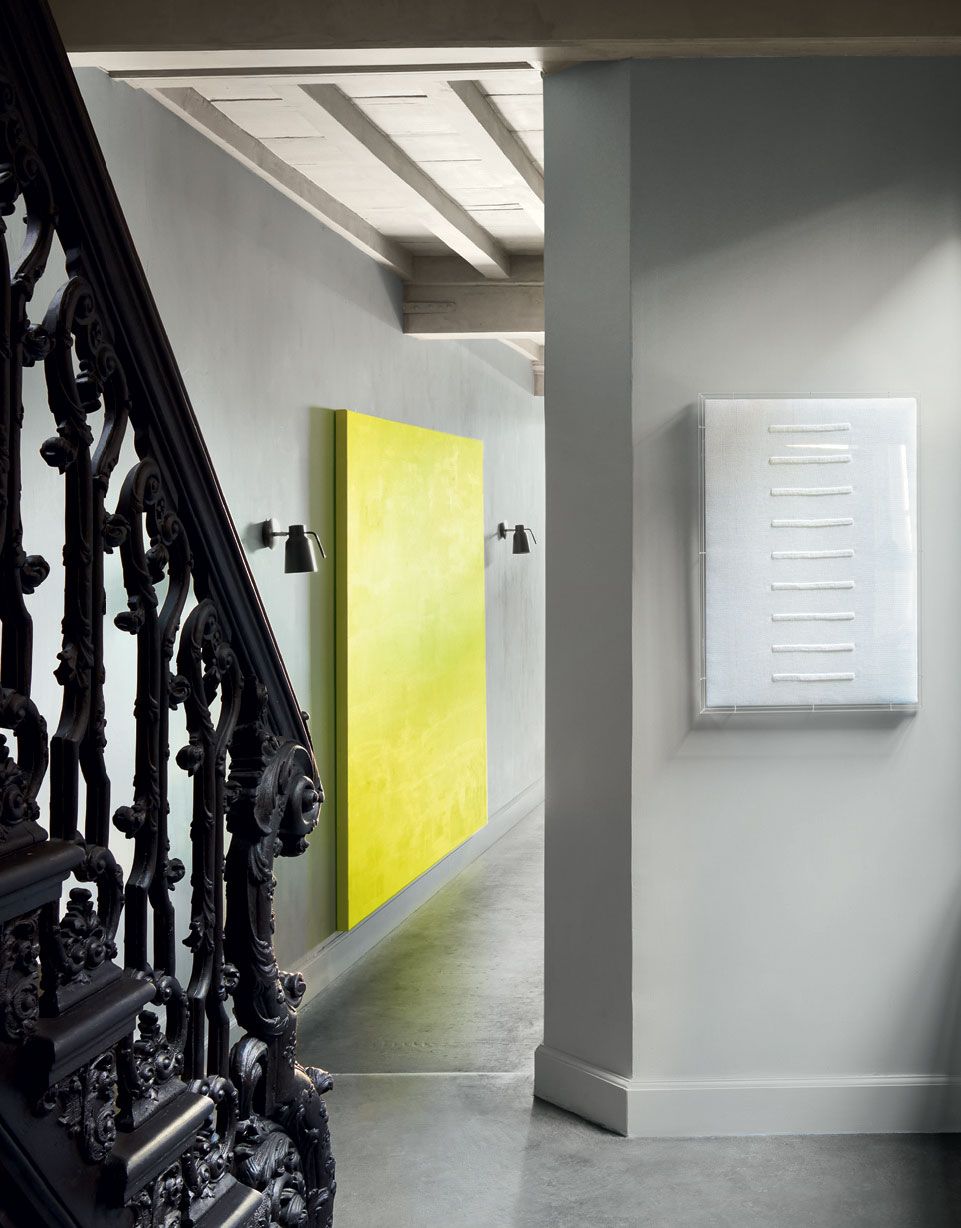
The inspiration for the interiors came from three of Jackie’s passions: colour, art and her own embroidery designs. The paint colours are all bespoke: ‘I spent two days at a specialist mixer in Ghent, working away until I had my colours,’ she explains. She created a grey for the hall and a sandy tone for the sitting room, giving it a cave-like feel, which is subverted by bold stripes of sherbet pink and gold. The kitchen is breezier, with barely-there violet and apple green. All the paints are traditional lime distempers, which feel suitable for the age of the house and allow the walls to breathe.
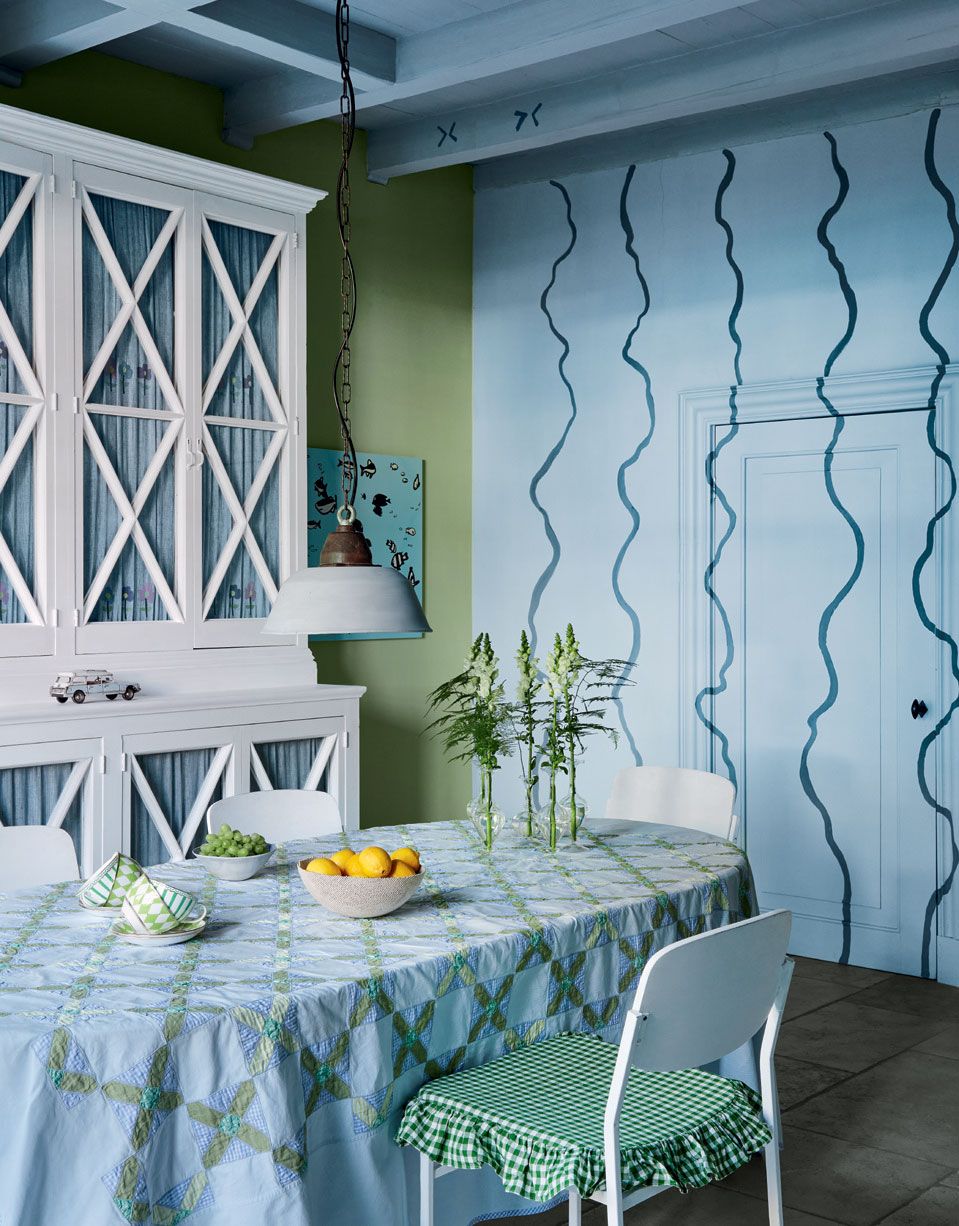
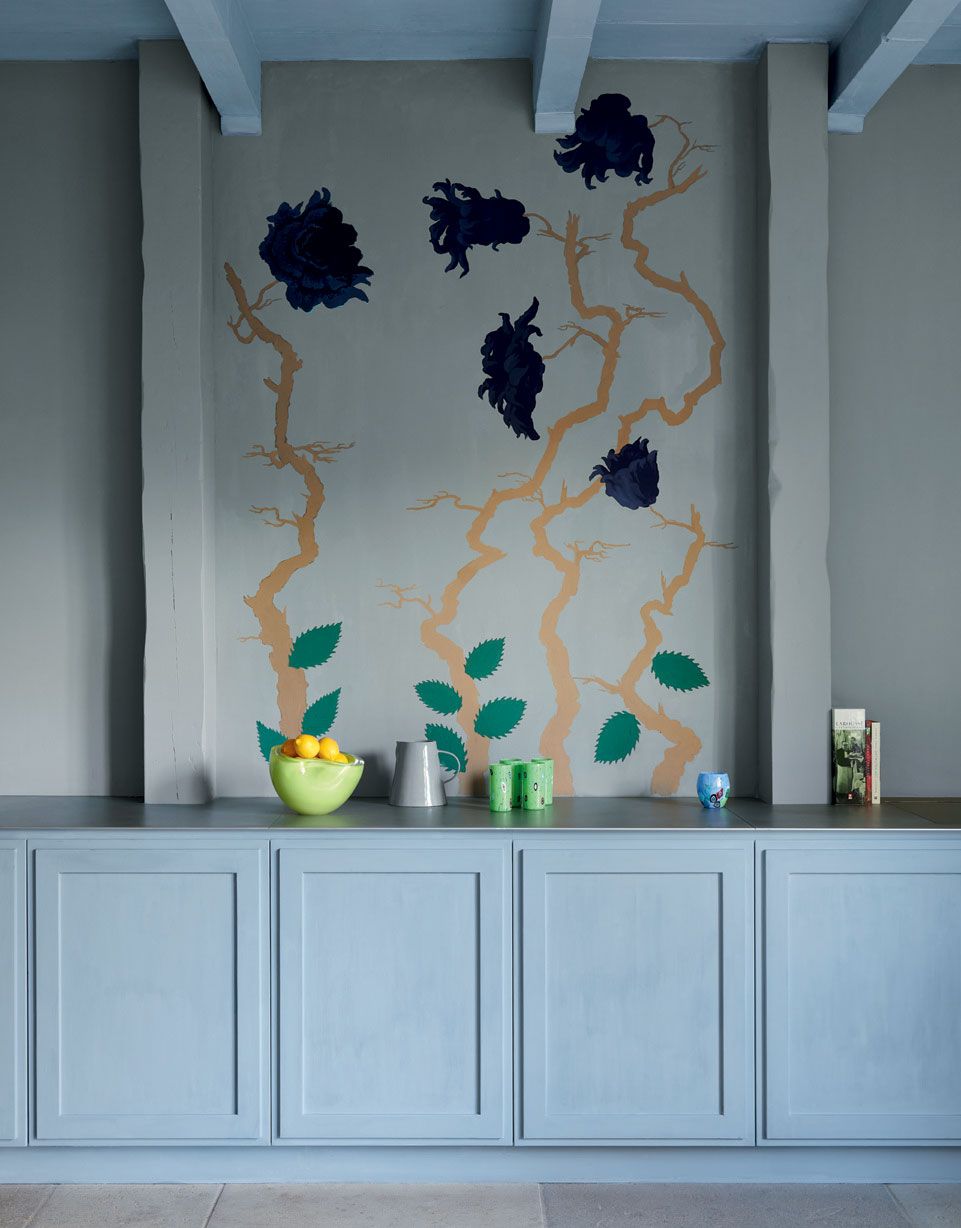
Jackie is a passionate art collector and, while her husband was alive, they would go on an annual trip to Basel, New York or Japan, with the goal of taking home one work of art. Not everything moved with her when Jackie downscaled, but the pieces that did came to define the colours for each room. A giant portrait by Brian Calvin was the starting point for the sand and pink scheme of the sitting room, while a Julian Opie portrait dictates the black, white and red mood in the basement office. Her favourite pieces? The rocky resin sculpture in the kitchen – Trashstone by Wilhelm Mundt – which her grandchildren clamber over barefoot and which she says she will never sell; and the murals in the kitchen, painted by her nephew, depicting stylised flowers that spring from the countertop, coupled with painted purple ribbons that run from floor to ceiling.
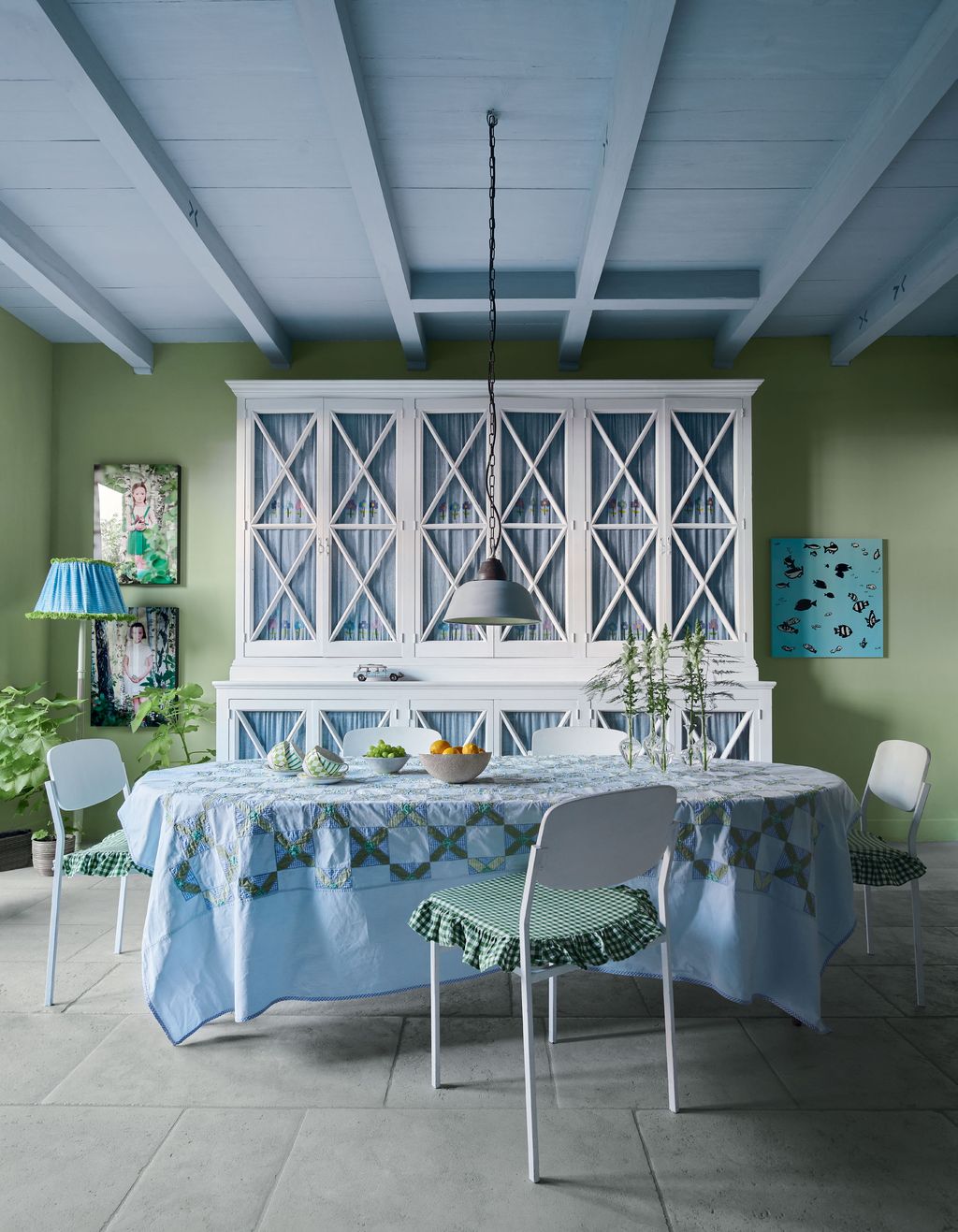
The final ingredient is Jackie’s textile designs, seen in every room, on lampshades and bedding, upholstery and tablecloths. Jackie founded her fashion label, Jupe by Jackie, in 2010 and, in 2019, she branched out into homeware, producing everything from fluffy mohair throws embellished with daisies to chairs upholstered in hand-embroidered fabrics. The house also includes pieces commissioned by Jackie, such as the flower-embroidered fabric panels behind the glazed doors of the dresser in the dining area and the monochrome motifs that elevate the chairs in the basement.
I express my admiration that Jackie has been able to achieve all of this, on her own and in a new town, in just three years, and wonder whether she has found any time to relax. ‘You know, I moved here for the beach and the sunsets on the shore,’ she says. ‘But I’ve been so busy that I haven’t managed to get there once.’
Jupe by Jackie: jupebyjackie.com
 Kasia Gatkowska1/11
The portrait by Brian Calvin was the starting point for the colour scheme in this room, which has walls in a custom sand-coloured lime distemper. The brown ‘Laika’, pink ‘Boomerang’ and yellow and pink ‘Campaign’ chairs are examples of Jackie’s eye-catching designs for her brand Jupe by Jackie, as are the (from left) ‘Sol’, ‘Soleil’, ‘Darbres’ and ‘Terra’ cushions on the sofa
 Kasia Gatkowska2/11
A vintage pendant light hangs above the table, which is covered in a cloth appliquéd by Jackie
 Kasia Gatkowska3/11
Stylised floral embroidery adds decorative detail to the fabric panels lining the dresser doors. The striking ribbon mural is by Jackie’s nephew
 Kasia Gatkowska4/11
Hand-painted abstract marks on the ceiling beams pick up on pieces in her art collection, including three unusual portraits and Wilhelm Mundt’s Trashstone sculpture


 Kasia Gatkowska5/11
Sogni Di Cristallo’s Murano glassware is displayed on the worktop below a flower mural by her nephew
 Kasia Gatkowska6/11
The inspiration for this red, black and white scheme was the large Julian Opie portrait, Rosie, Businesswoman 1. It is flanked by reupholstered vintage armchairs from Jackie’s Sitting Ducks collection – ‘Inga’ and ‘Fringe’, with her space age-influenced ‘Iso’ in the foreground. The fabric motifs are embroidered in India before being shipped to the Netherlands, where the upholstery is done, and each one is designed to suit a specific chair shape
 Kasia Gatkowska7/11
Jackie perches on her cocktail-style ‘Fringe’ chair. She painted the tally marks ‘on a rainy Sunday’ on the edges of the shelves housing her collection of books, which are ‘all treasured, especially those by photographers’
 Kasia Gatkowska8/11
This ‘corridor to nowhere’ is lined with art, including Chris Levine’s portrait of the Queen, which hangs on the end wall above a blue Jupe by Jackie ‘Tubular’ armchair


 Kasia Gatkowska9/11
 Kasia Gatkowska10/11
A yellow canvas painted by Jackie stands out on walls in a custom-mixed grey lime distemper
 Kasia Gatkowska11/11
Jupe by Jackie’s ‘Lapalud’ linen cushion rests on the windowseat behind antique chairs upholstered in one of her designs


