
A surprising Victorian terraced house which combines 1930s glamour with layers of texture

Stand in front of a Victorian terraced house and it is not hard to imagine what lies behind its brick façade - a long narrow hallway, a double reception room on the ground floor, and perhaps, if you are lucky, cornices and ceiling roses that resemble royal icing. In the case of this handsome 1840s house in west London, however, quite the opposite greeted interior designer James Mackie when he arrived there in 2022 to meet his new clients.
The whole raised ground floor was one large, open-plan sitting and dining room, with an imposing contemporary black staircase on one side of this space and another flight of stairs at the front of the house, immediately on the left as you enter, leading down to the open-plan basement kitchen. Then there was the fact that there was not a single original feature remaining: the floors were stained black, while the basement kitchen was all hard lines and marble. 'It was certainly a very different proposition on the inside to what it looked like outside,' recalls James.
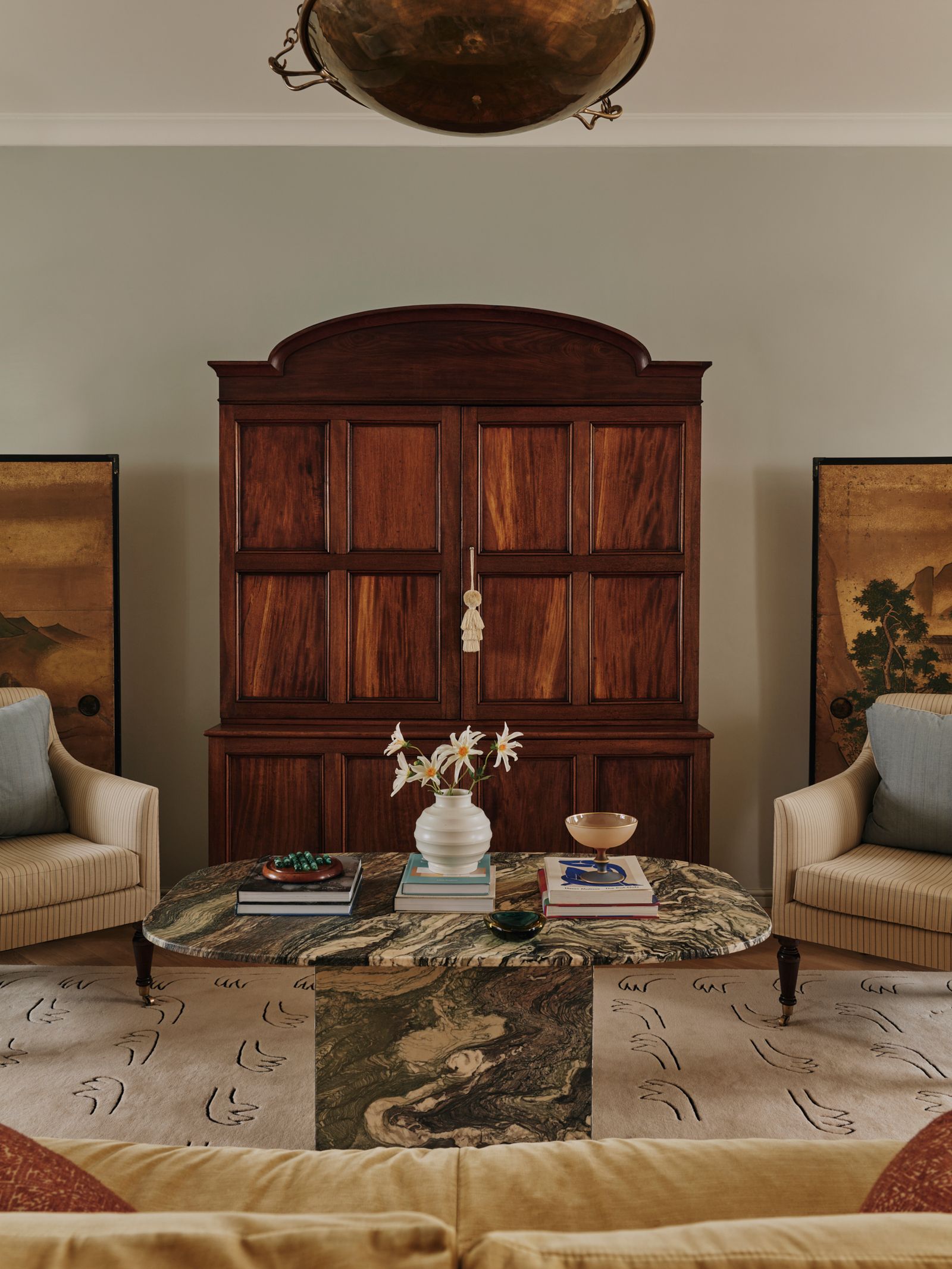
Did this present a challenge for a designer who studied architectural history and firmly believes in respecting context and letting that guide his approach? 'Actually, it was exciting to have a blank canvas,' says James, whose clients gave him the brief of creating a comfortable, sophisticated space. His solution was to devise a visual language for the house inspired by the understated glamour of early-20th-century Modernism. 'Looking at interiors by designers like Syrie Maugham and the Austrian-Moravian architect Josef Hoffmann felt like a way to crack it and marry the bare bones with the brief,' he explains. 'We needed to get rid of the extraneous, tough materiality and then introduce a softness. It quickly became evident that it would all be about the pieces we chose, rather than any big architectural changes.'
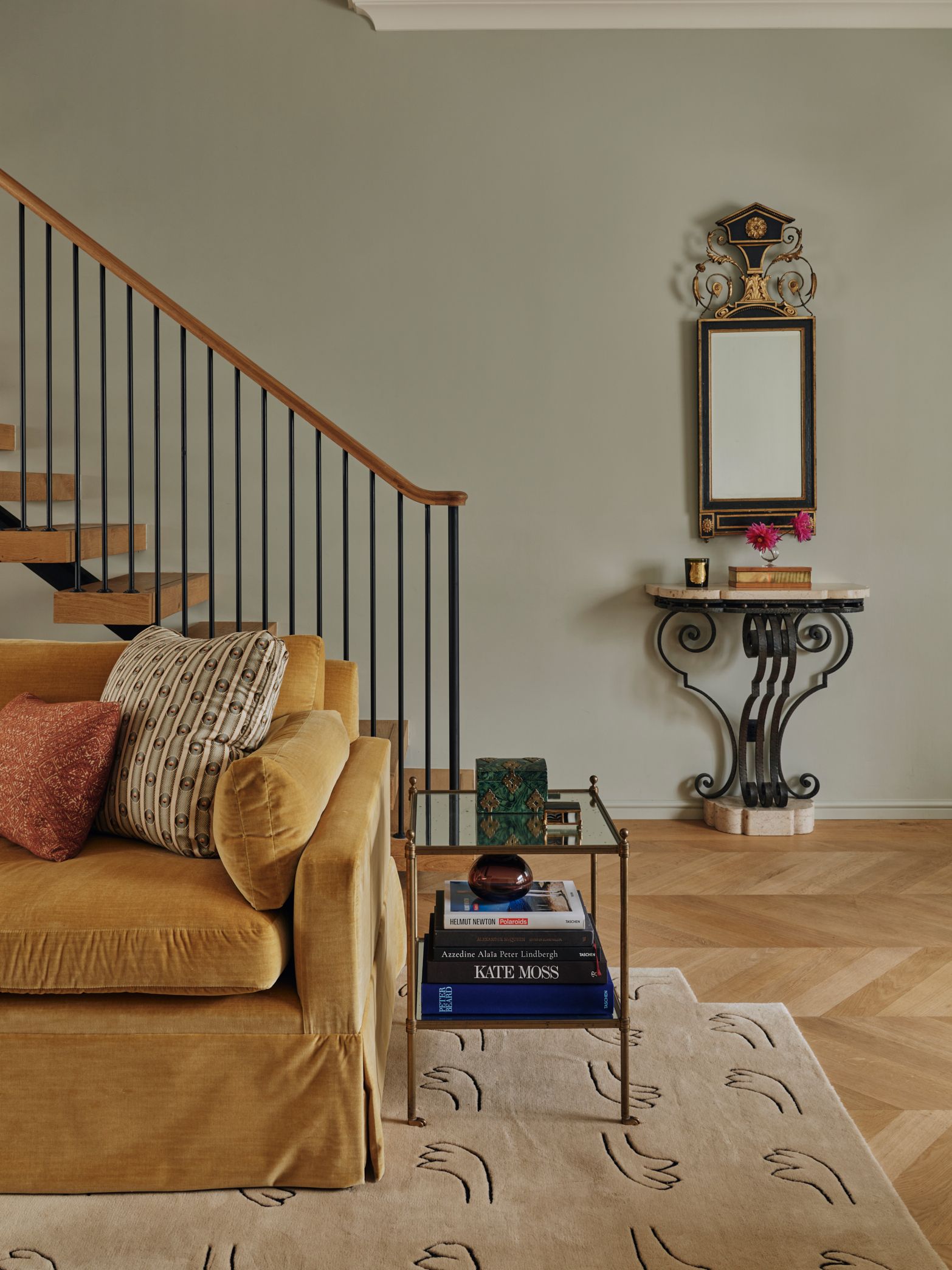
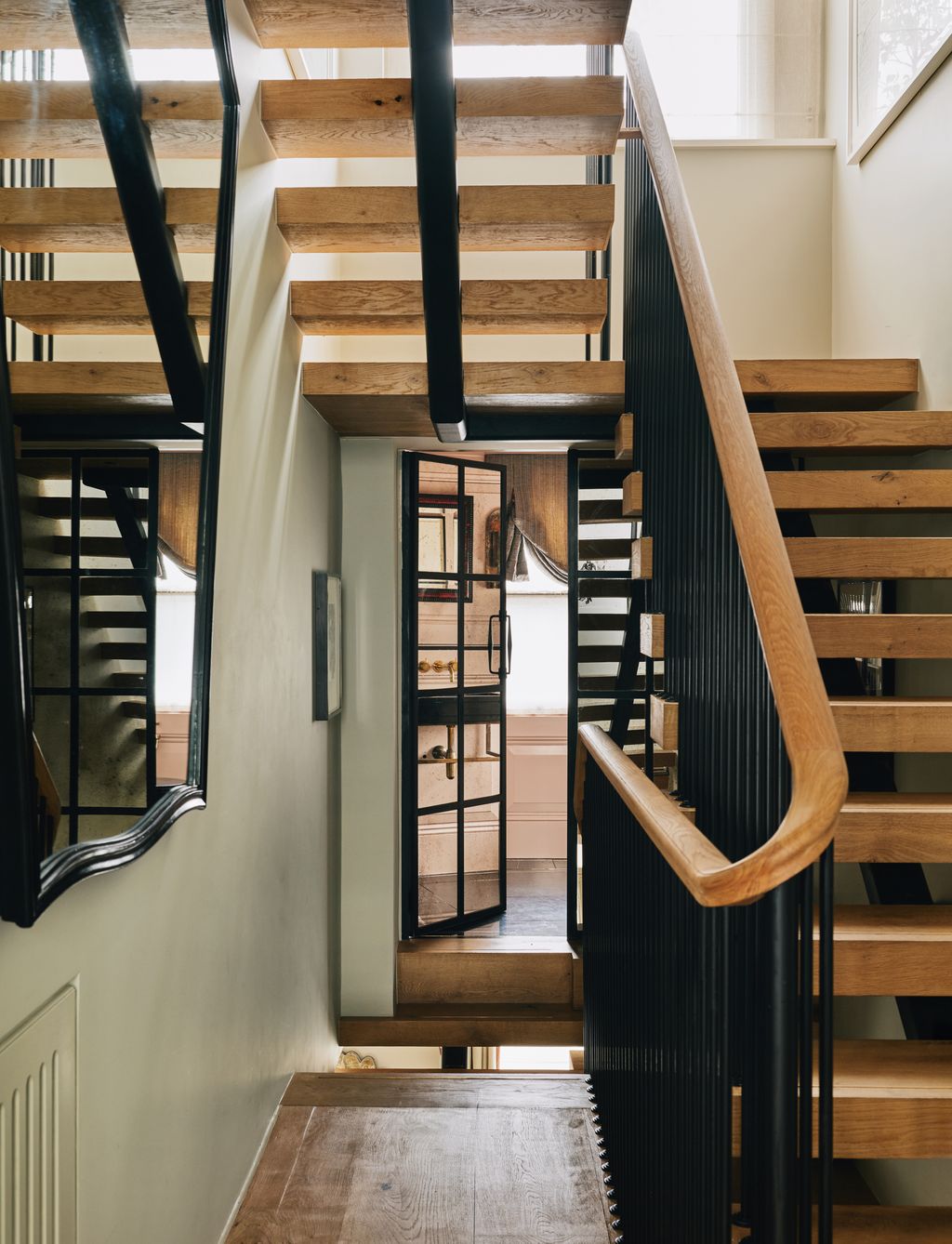
The only exception to this was the staircase. Having enlisted SKC Projects - 'an amazing contractor' - to do all the building work, James decided to retain the superstructure, but he had the black stain stripped off the stairs to reveal wooden treads and the elaborate gold grilles replaced with simple bronze spindles. Key to bringing in a softer feel was a sinuous oak handrail that flows all the way up through the house's five floors. 'Now the staircase blends into the space,' James observes.
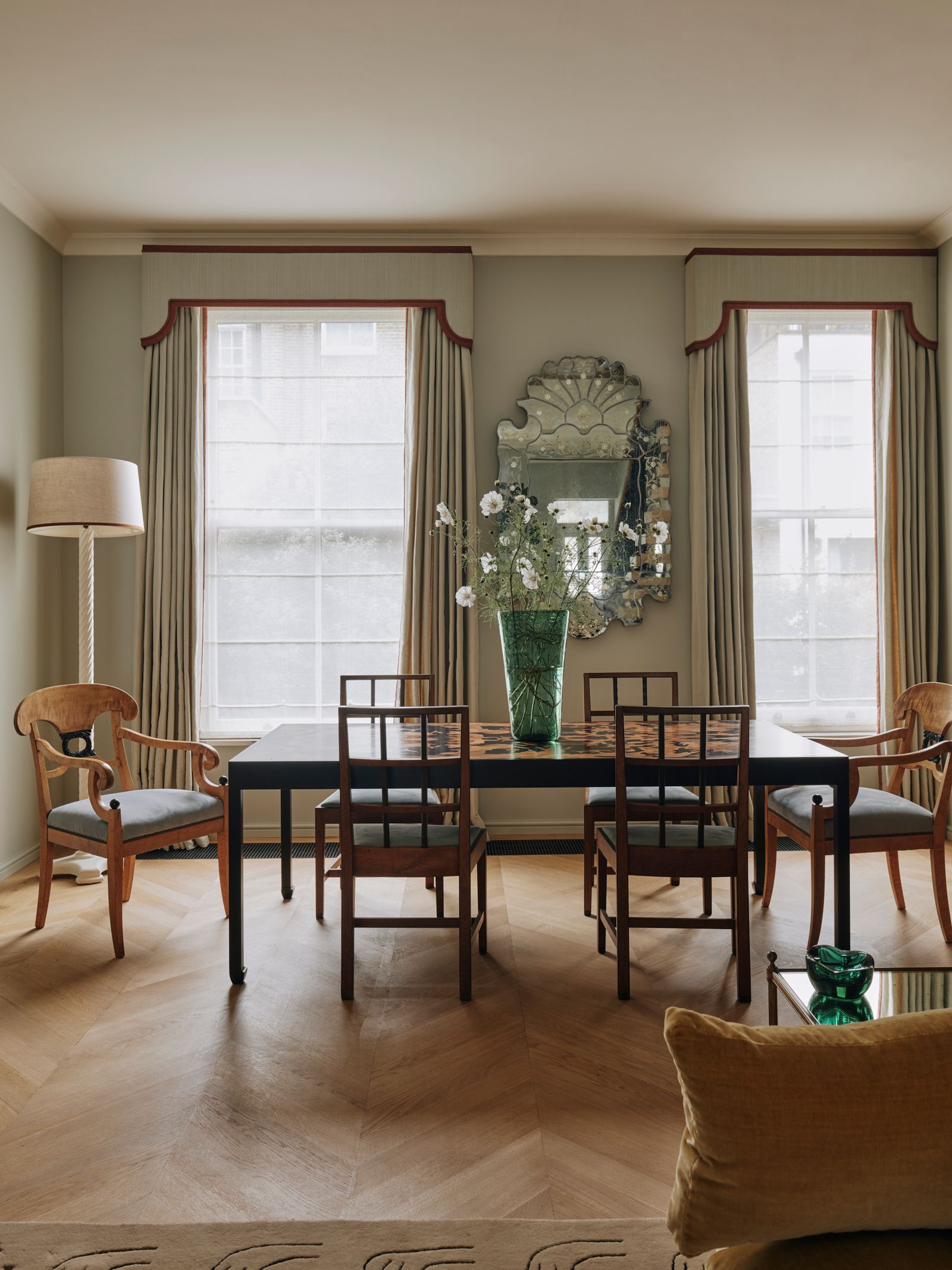
What was to be more prominent, however, was the furniture, which James selected carefully to counteract all the straight lines in the sitting room. As this performs the functions of an entrance hall - since the front door opens directly into it - as well as a sitting and dining room, James wanted it to 'read as one space, while having different atmospheres'.
A large curve-topped estate cupboard, from Hawker Antiques, provides a focal point where there might otherwise have once been a fireplace, serving to conceal the television and giving the room an anchor. 'I wanted to use curves and create some movement through the pieces,' he explains. These subtle shapes define the room, from the central marble coffee table to the tailored, rounded pelmets on the two tall windows. Even the sofa, upholstered in a shimmering mustard velvet from George Spencer Designs, has a sense of movement.
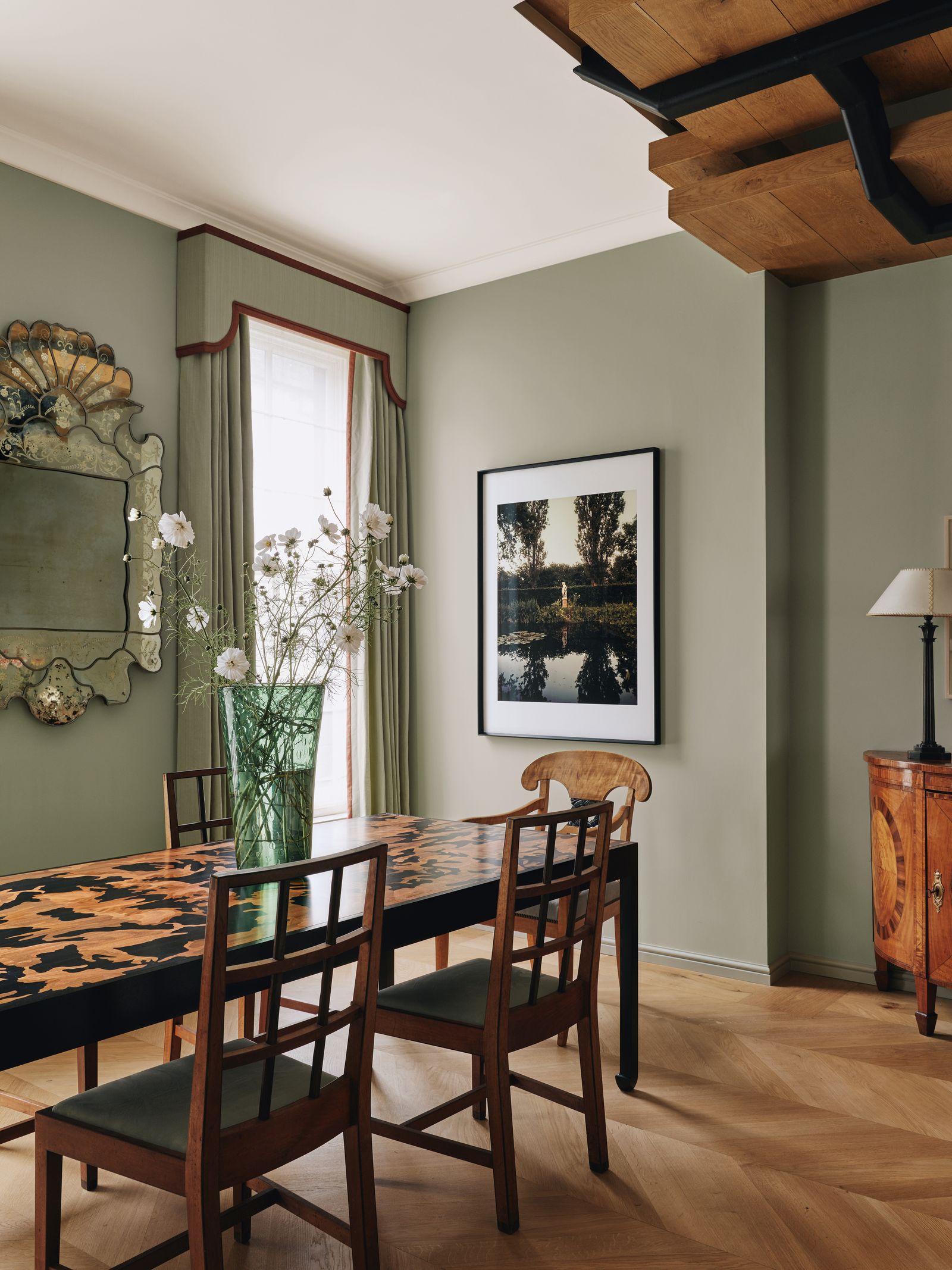
'It was all about creating a dynamic energy in the space,' James continues, gesturing to a pair of scenic screens on either side of the estate cupboard. Many pieces blur the line between art and function, including an extraordinary marquetry dining table, made in 2015 by Danish designer cabinetmaker Morten Hoeg-Larsen, which runs along the back of the room. 'We didn't want the expanse of a plain wooden table top, so finding this was a key moment in it all coming together,' he says.
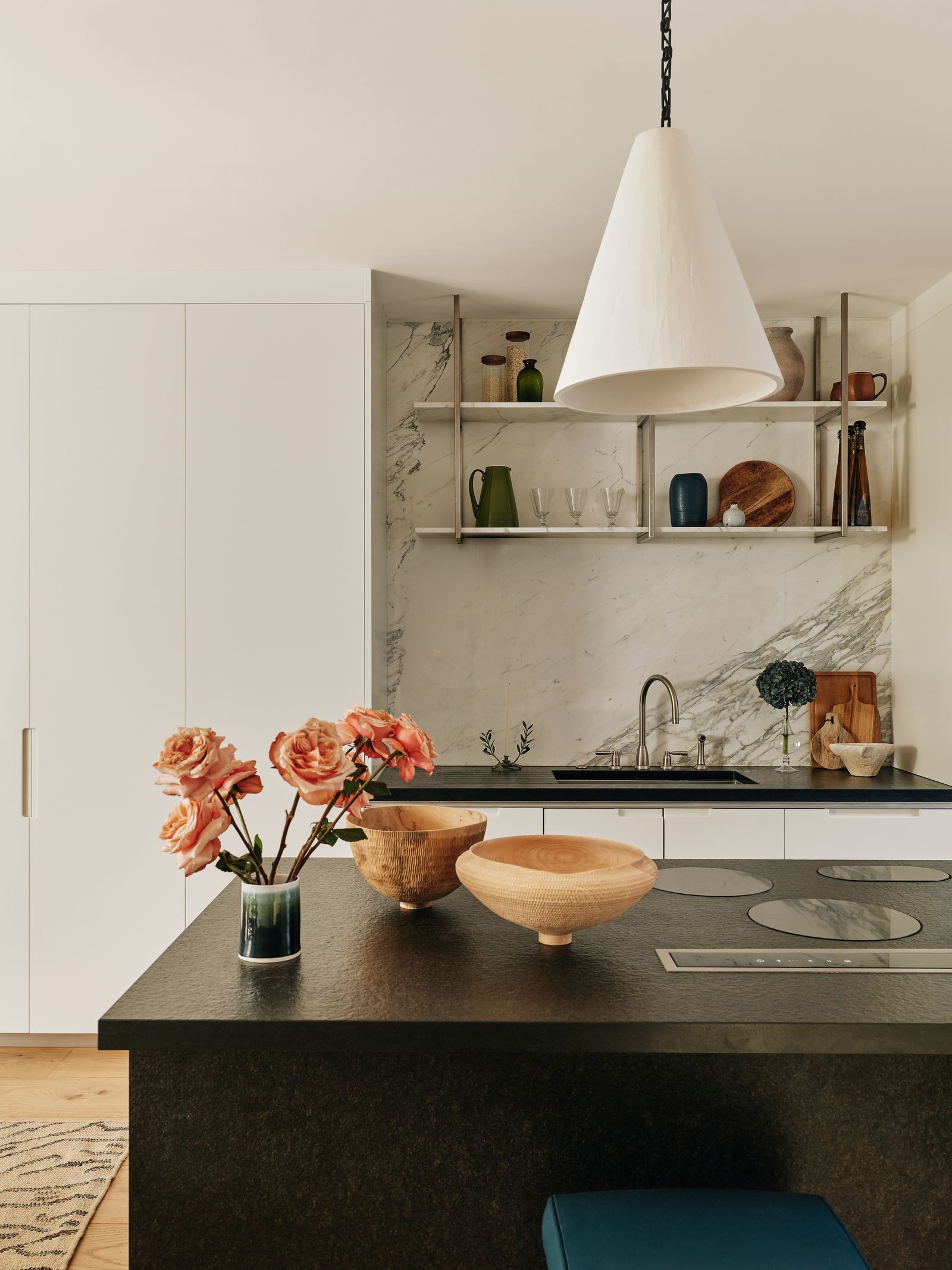
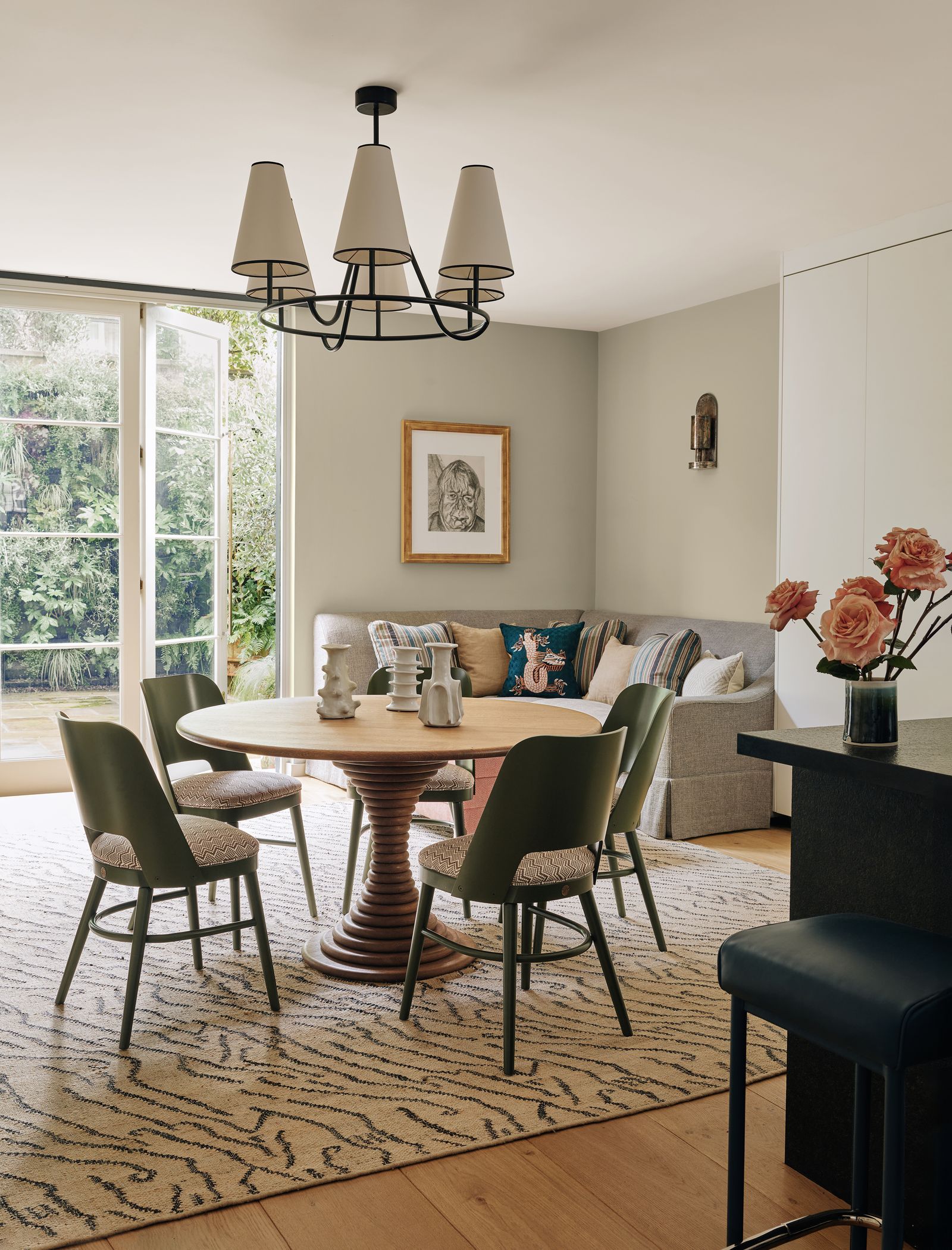
Downstairs, in what James describes as the 'glamorous space-ship' kitchen, the cabinetry was retained, but he embarked on a 'softening' mission. Marble floors were swapped for wood, while an enormous crystal chandelier above the island was replaced with plaster cone lights from Rose Uniacke, chosen to provide some all-important texture. Pieces like the circular breakfast table and Howe's 'Camembert' chairs introduce yet more curves, as does a gently rounded, bespoke banquette. 'All these elements counter the hardness that we started with,' he notes.
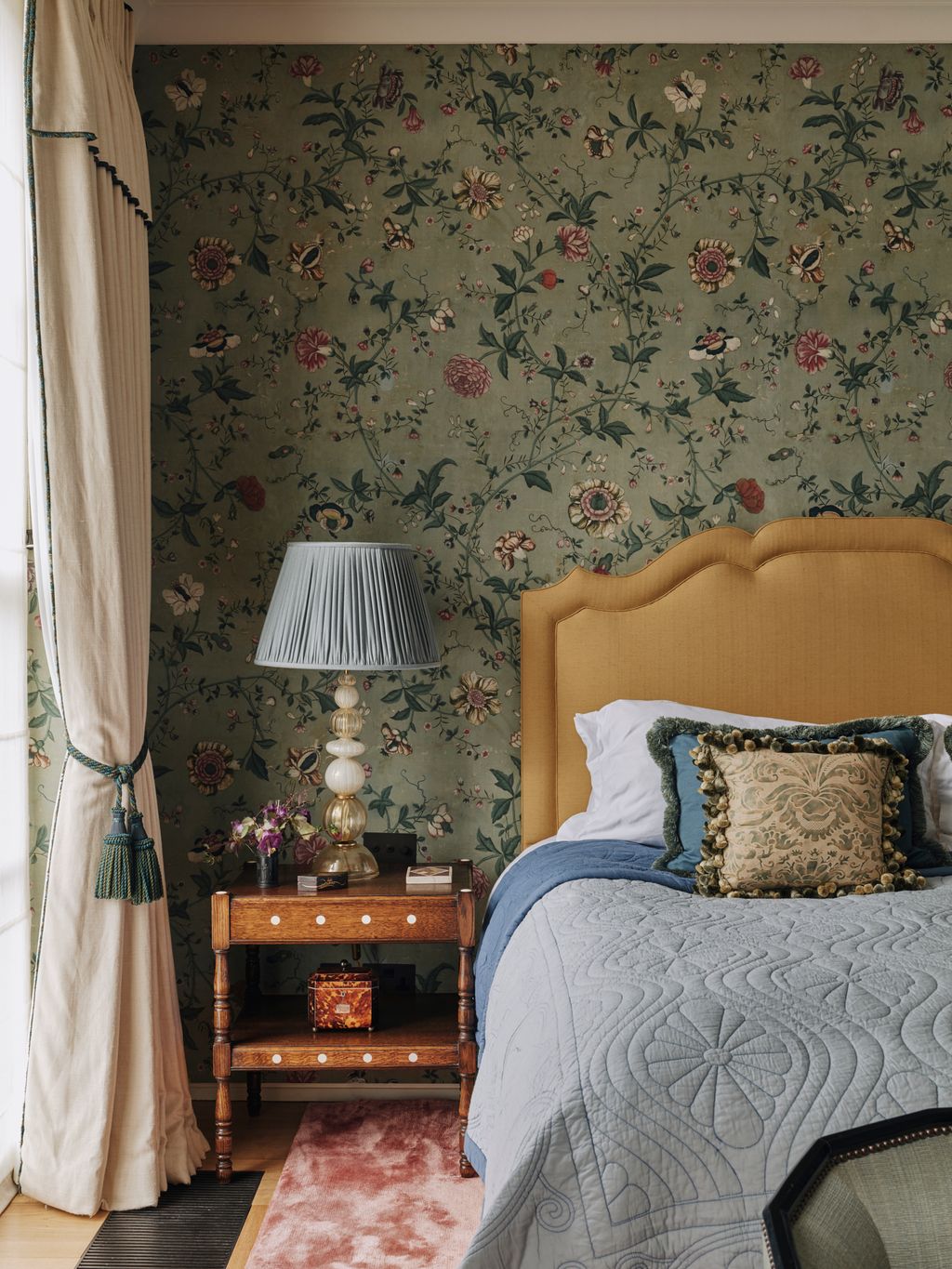
Spread across the upper three floors are four bedrooms and three bathrooms, including the main bedroom, with a small dressing area leading through to an en-suite bathroom. 'We wanted to keep that 1930s spirit, but turn it up a few notches upstairs,' says James, gesturing to the walls in the main bedroom - in Braquenié's 'Le Paravent Chinois', a romantic, trailing floral. This is complemented by a lustrous pink carpet, a small Art Deco sofa and curtains in a slubby linen, intended to ground it all.
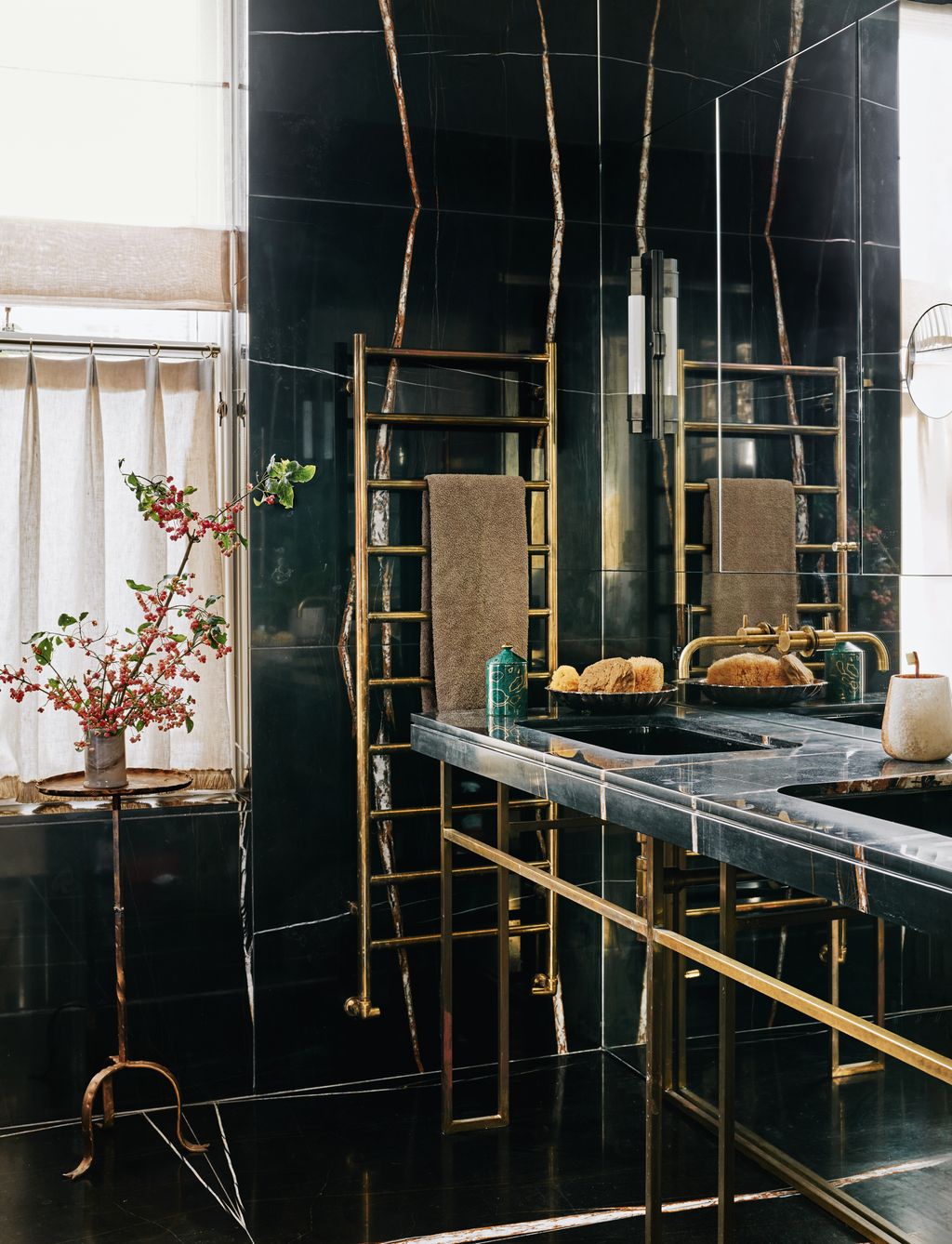
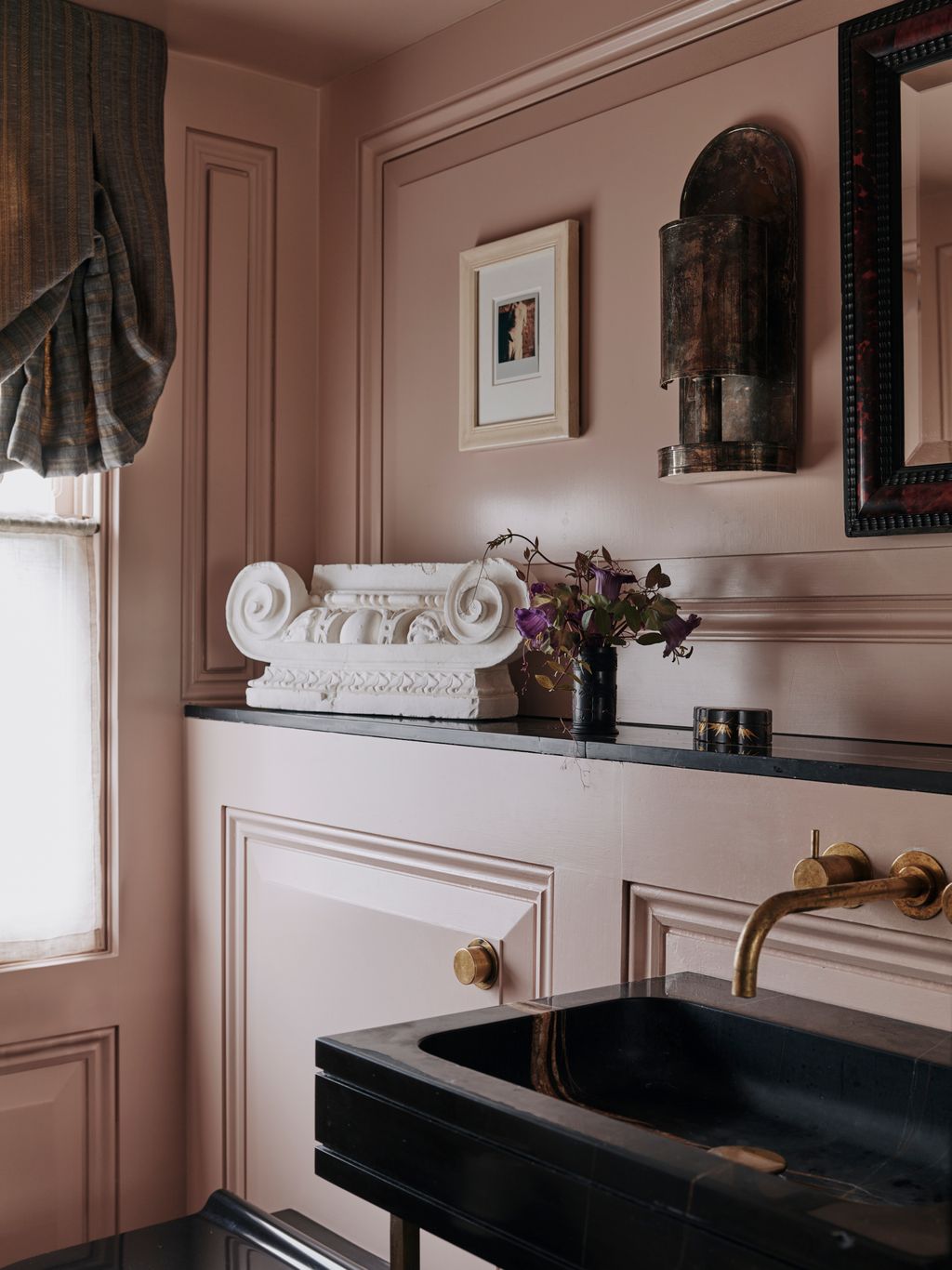
The dramatic black marble tiles and antiqued brass fittings in the en-suite bathroom remained, but James added a sheer linen café curtain with a fringed bottom edge, wall lights from Jamb and an elegant, small gilt-iron 1950s table to offset it all. 'You're always striving to get that balance in a scheme,' he says. He has achieved a similar effect in the spare room, too, where the drama of a custom half-tester bed and headboard in an emerald green stripe is tempered by walls in a tan grasscloth.
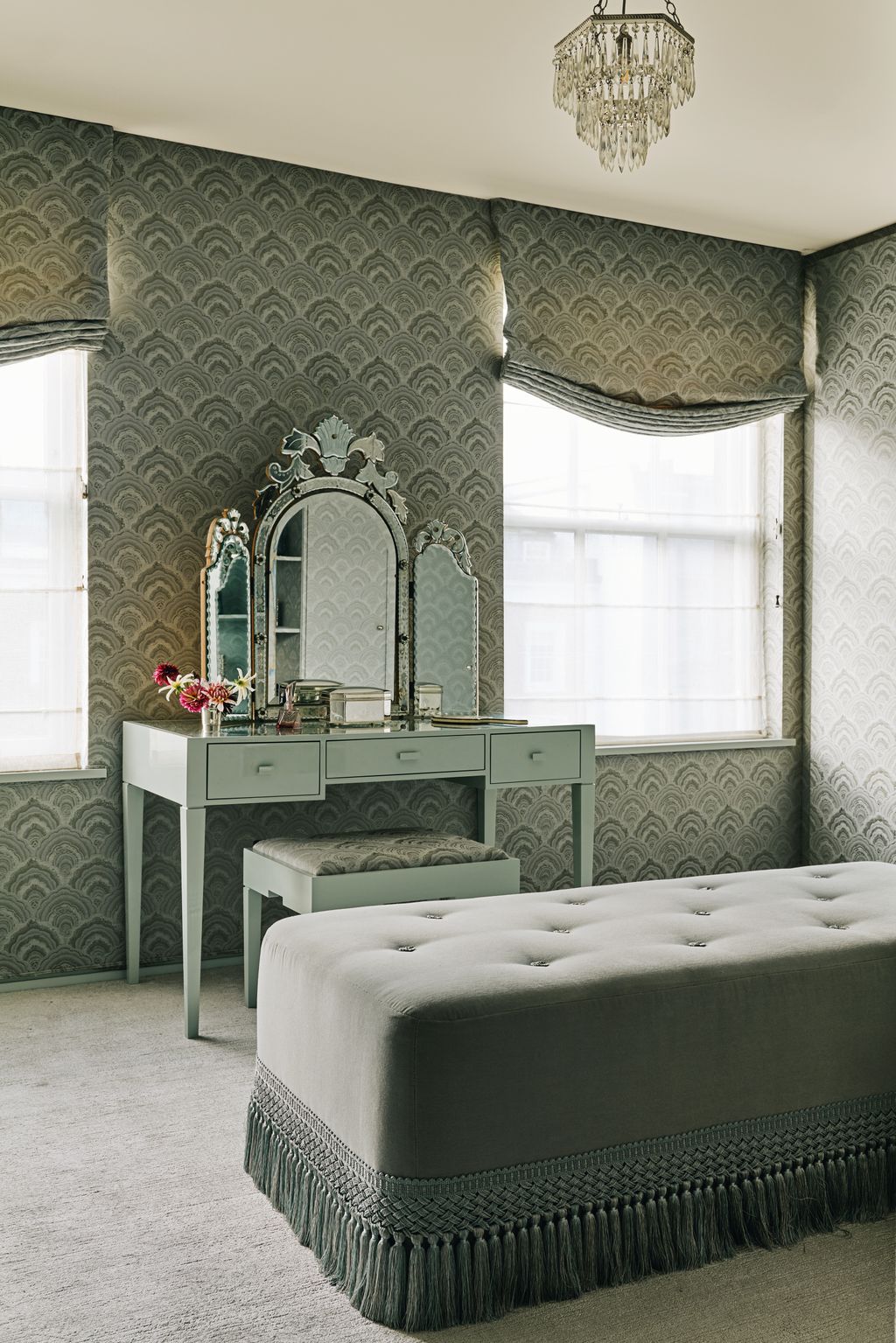
The 1930s glamour really amps up in the luxurious dressing room on the fourth floor, created by James from a bedroom. This features walls, wardrobe doors and blinds all in Braquenié's 'Fleumartin' with a toning silk/wool carpet, a bespoke tasselled velvet ottoman and a lacquer dressing table. 'The idea was for it to feel like being inside a sumptuous jewellery box,' says James, who enlisted The Textile Wall Company's Hepzabeth Evans to create the fabric-lined walls and joinery. 'I love how the soft light bounces off all the materials,' says James. And that's really what the whole house is about - it's an exercise in texture and layering, and one that has transformed, over the course of just eight months, an unadorned box into something really rather special.
J James Mackie: jjamesmackie.com
SKC Projects: skcprojects.co.uk
 1/8
1/8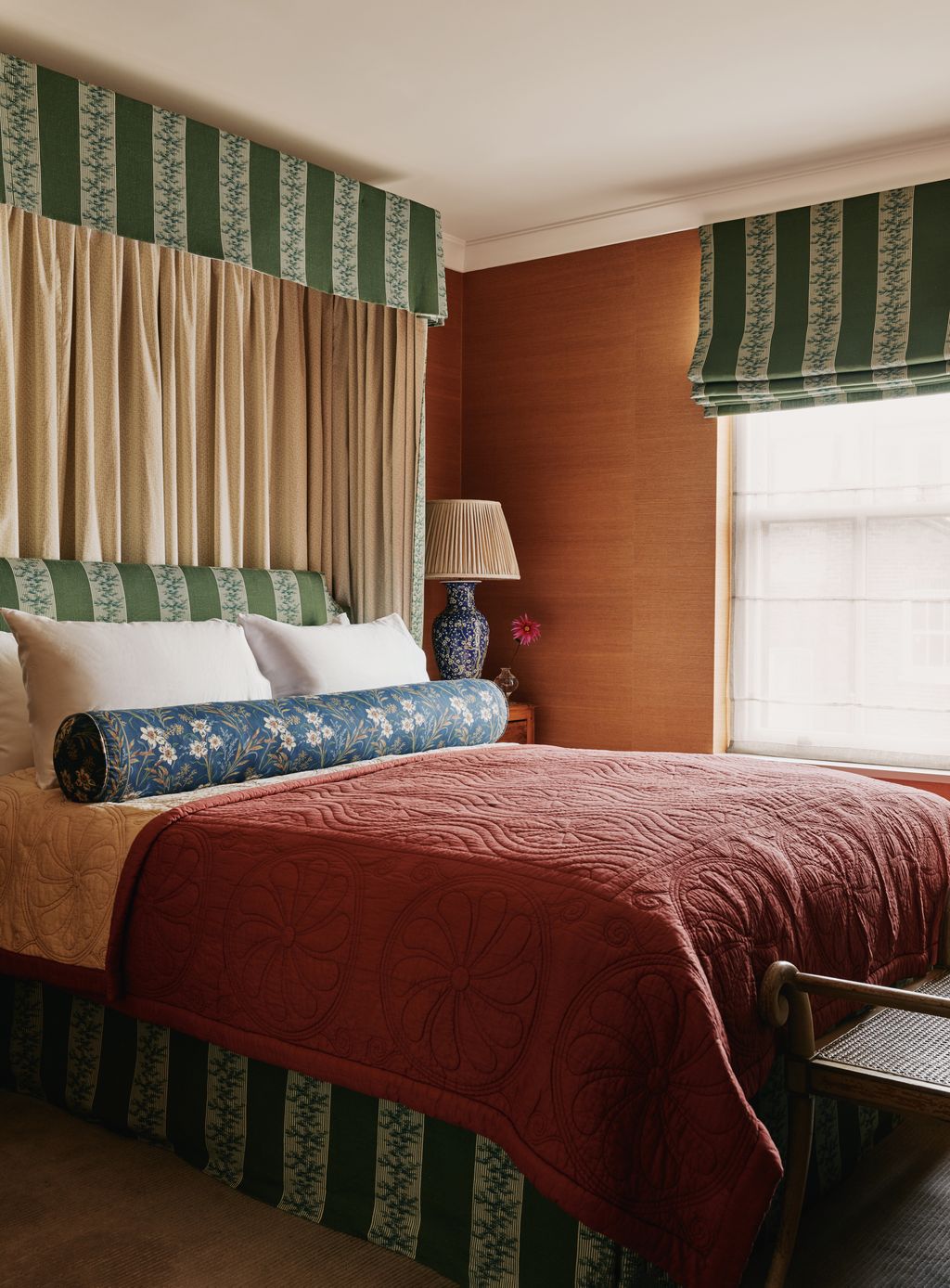 Christopher Horwood2/8
In the spare room, walls in Phillip Jeffries 'Manila Hemp' grasscloth in camel and a cotton 'Durham' quilt in dusk from Beata Heuman showcase the headboard, half-tester bed canopy, valance and curtains in 'Rayure Ottomane' in vert by Casa Lopez from Tissus d'Hélène. The canopy lining in stone ‘Formica’ cotton from Howe at 36 Bourne Street tones with the Nushka lampshades on antique vases converted to lamps from Timothy Langston, their floral design echoed by a bolster in Décors Barbares' 'Véra'.
 Christopher Horwood3/8
In the en-suite, the existing black marble tiles and brass fittings are balanced by James's addition of an elegant gilt-iron 1950 Italian table from Fiona McDonald, fringed café curtains in ‘Mistral’ linen voile in bone from George Spencer Designs and Jamb's ‘Conroy’ wall lights.
 Christopher Horwood4/8
In the main bedroom, walls in Braquenié's 'Le Paravent Chinois' from Pierre Frey link the bedroom with the dressing area, which has bespoke ebonised-wood wardrobes with antiqued mirror-glass doors.


 5/8
5/8A 'Durham' quilt in dawn from Beata Heuman, a valance in Soane Britain's 'Old Flax' in old gold and a bespoke Wool Classics carpet add colourful accents.
 Christopher Horwood6/8
A French 1920s mirror on a Julian Chichester 'Verre Eglomisé' dressing table in a bespoke hue with matching stool, is set off by walls and blinds in Pierre Frey's celadon 'Fleumartin' by Braquenié. The custom ottoman by Ridge Interiors is in a Northcroft Fabrics' velvet.
 Christopher Horwood7/8
Originally stained black, the staircase was stripped to reveal the warm-toned oak treads, and softened by a sinuous new oak handrail and bronze spindles.
 8/8
8/8


