
The kitchen peninsula: a more collaborative version of the kitchen island

The kitchen island is a well established and generally understood concept within design, but what about the kitchen peninsula? As you might have guessed from the dubiously related name, a kitchen peninsula is an island which is accessible on three sides, rather than all four. (Does the existence of the “peninsula” imply that there are kitchen continents or kitchen archipelagos?) It’s connected at one end to a wall, but still offers (most of) the accessibility and storage of an island. It’s a set-up we find that we come across more and more often in kitchens, particularly in smaller houses or flats. So where, when and why would one opt to have one in their own kitchen?
Why choose a kitchen peninsula?
The obvious question is this: why choose a kitchen peninsula, connected as it is to one of your walls, when you could have a kitchen island? The answer, of course, is that if you can fit an island, it might well be a better option – but many kitchens aren’t quite big enough to do so. And in that case, a peninsula is the ultimate scaleable answer. Peninsulas are possible to elongate or shorten to a mere couple of feet’s protrusion, at a length which would look ridiculous or impractical as an island.
The benefits of a peninsula are essentially those which you’re likely already familiar with if you have an island: extra space on which to work and prepare food or drinks, helpful storage space in the form of cupboards and drawers, and perhaps most significantly a place to socialise. Design-wise, it’s also a useful way to divide spaces in an open-plan kitchen.
How to design a kitchen peninsula
The non-negotiable part of a kitchen peninsula is of course its connection to your wall. Beyond that, you can play around with length, height and width. Most kitchen design companies suggest a minimum width of about 24 centimetres, though, simply to have enough space to make your peninsula worthwhile. You probably want it to be at least twice as long as it is wide – think the Italian or Korean peninsulas, rather than squat Iberia or overlong Baja California. But that will depend on your existing kitchen space.
A mixture of drawers, shelves and cabinets is also essential, and if you have the headroom, you could install something over the peninsula, like a rack for hanging wine glasses or pans. Ask the kitchen designer for an array of different shapes and designs; deep drawers will help you store larger utensils like ladles or whisks, for example, while slim cabinets are easy places to store upright cutting boards and baking trays.
Aesthetically, there’s a decision to be made as to whether you go for a sleek and modern design, or rustic, shaker-style units? That depends on the rest of your house, really, but in a smaller space you might have more joy with something less ornate. Peninsulas are a great opportunity to introduce colour to a kitchen – a room which can traditionally be rather staid and/or monochrome – and you might want to think about how the countertop and the vertical planes look: a two-tone design can look very smart.
Finally, ensure you consider height carefully. A peninsula, like an island or a breakfast bar, is a perfect chance to add another area of seating to a kitchen. A slightly higher peninsula can fit bar stools underneath it and create a space perfect for socialising and hosting; it might even be worth building in a couple of different heights into the peninsula, if you want to incorporate an area at which to sit and eat.
 Chris Horwood1/6
At Sophie Warburton’s London house, the peninsula has been creatively extended out beyond the wall (to the left) to make for a wider countertop, and one which extends beyond the peninsula itself past the edge of the wall, where a vase of flowers sits in this photo. The units were in situ when Sophie and her husband moved in, but they repainted them from pillar-box red to a calmer shade: Benjamin Moore’s ‘Guacamole’.
 Ellen Christina Hancock2/6
This Victorian family house in London is typical of a peninsula kitchen, with a galley format and two sides with matching white countertops in Calacatta Oro marble. The joinery of the peninsula has been painted, though, while the cupboards under the sink are still unpainted timber, matching the herringbone floor.
 Chris Horwood3/6
In James Shaw’s ingenious house, which was designed and built on a patch of bare space he bought in between two larger buildings, space is at a premium. Here, a cabinet on wheels has been deployed as a peninsula in the kitchenette – it’s a great example of a space in which a freestanding island would have been too small.
 Milo Brown4/6
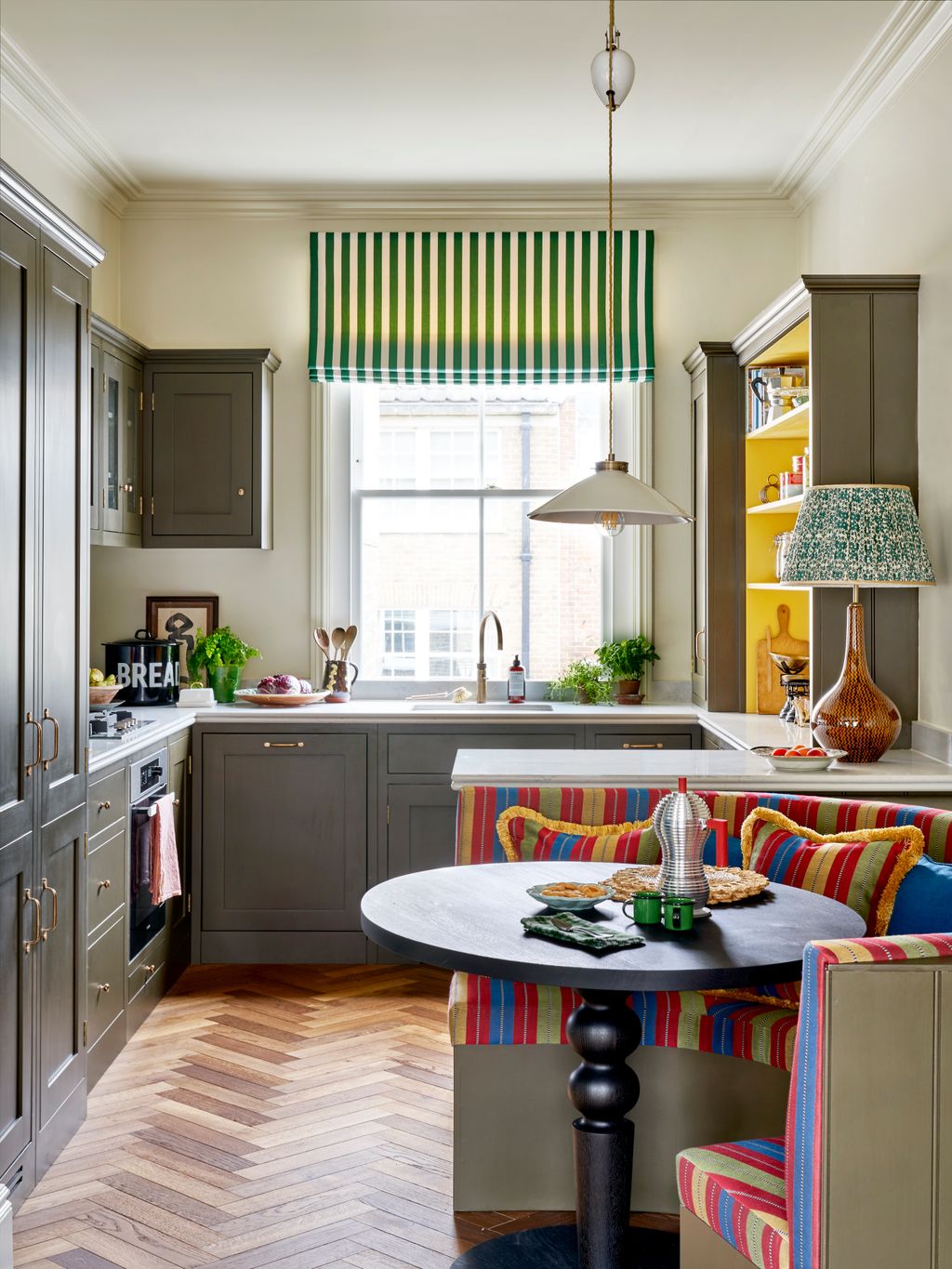
The small peninsula in the kitchen of Lonika Chande’s Chelsea terrace is essentially square, but is tacked onto the countertop in a way that both adds vital working space and cleverly divides the kitchen area from the banquette seating around the table.


 Owen Gale5/6
As with James Shaw’s flat above, one could argue that this Parisian house owned and renovated by Alix Reynis doesn’t technically boast a peninsula, but a large island/butcher’s block has been placed close enough to the wall as to have the same effect.
 Dean Hearne6/6
Caroline Irving’s rustic Portuguese house has a kitchen peninsula with suitably simple wooden panelling painted white like the rafters of the hideaway. The effect is to create a social space with fitting white bar stools, and to keep the unified interior of the kitchen and dining room simple as a backdrop for the house’s tiles and decorative plates.


