
The life and work of Spitalfields-based artist Mary Norden

Textile artist Mary Norden has been a Londoner for over 40 years. She arrived in 1980, living in a squat in Islington by night and spending her days in a small rented studio in King's Cross, where she designed fabrics for big fashion houses, including Ralph Lauren and Yves Saint Laurent. These days, she lives with her husband, the artist and filmmaker Charles Garrad, in a Victorian house in London Fields. When the couple bought the property in the 1990s, every room was an individual bedsit. They ripped out sinks and pulled up lino floors; Mary recalls becoming ill after stripping Victorian arsenic-laced green paint from the walls. Now, it is a calming and grown-up space, filled with antiques, art and textiles, thrown together with Mary's expert eye.
It is a short cycle to their studios, which are next door to each other and a stone's throw from Columbia Road, E2. To look at Mary's soulful still-life and landscape collages, it is strange to think they are created in such an urban environment. 'Somebody who bought two of my pieces told me he meditates to them every morning,' says Mary.
Horizons are key to the landscapes and seascapes she creates: 'I like the sense that this is not of this world - it's a journey. But it's also a time capsule. I went to boarding school and I would spend a lot of time looking out of the window.' Mary is dyslexic and did not enjoy her time there, though one place she found solace was the languages room, where she would flick through international magazines. 'I didn't understand them, but I loved the images,' she says.

After an art foundation course in Taunton, Mary went on to study textiles at West Surrey College of Art. One of her tutors was Susan Bosence, known for her block printing and resist dyeing. Susan took Mary under her wing and organised a placement in Greece with textile artist Maria Grigoriou. There, Mary learned how to mix natural dyes and, at weekends, they would travel to Greek islands to gather flowers to make them. She credits this experience with changing her sense of colour and, today, she still dyes some of her own fabrics to achieve a particular hue.
The interior design and magazine worlds soon came calling. 'I started styling and writing about furnishings and textiles - it was all organic,' recalls Mary. She became interiors and food director at Red magazine, before turning freelance again in 2010. She then did styling for companies including Colefax and Fowler, Manuel Canovas and The White Company, and wrote several books about crafts.
She met Charles in 1990 at a friend's wedding. As we walk along Winchelsea Beach, one of the inspirations for her seascapes, Mary tells me that, in the years before she met Charles, she had a recurring dream, 'I was on a beach on a greyish day, walking with somebody whose face I couldn't see, but I had the sense of feeling safe and happy. I remember the jacket they were wearing - cropped with a stand-up collar and buttons. I remember the groynes on the beach, the pebbles, the colours. In the sea, there was a tanker'. On their second date, she and Charles decided to go to a beach they had not visited before; they settled on Winchelsea and, when Mary got out of the car, she realised it was the beach from her dream, that Charles was wearing that jacket and that a tanker was out at sea.
It was a similar portent that spurred Mary on to become a full-time artist. 'I went to Eternally Yours, an exhibition at Somerset House in 2022 about recycling and how objects can be used to create not just useful things but art. There was a sculpture by Japanese artist Aono Fumiaki, made where there had been earthquakes – from a distance, it looked like it was crafted from earthenware pots. In fact, the artist had picked up objects outside his mother's house. In the middle of the sculpture was this neon pink thing, which irritated me. When I got close, I realised it was one of my books! I know this sounds wonky, but it made me think that what I was doing was absolutely right.'
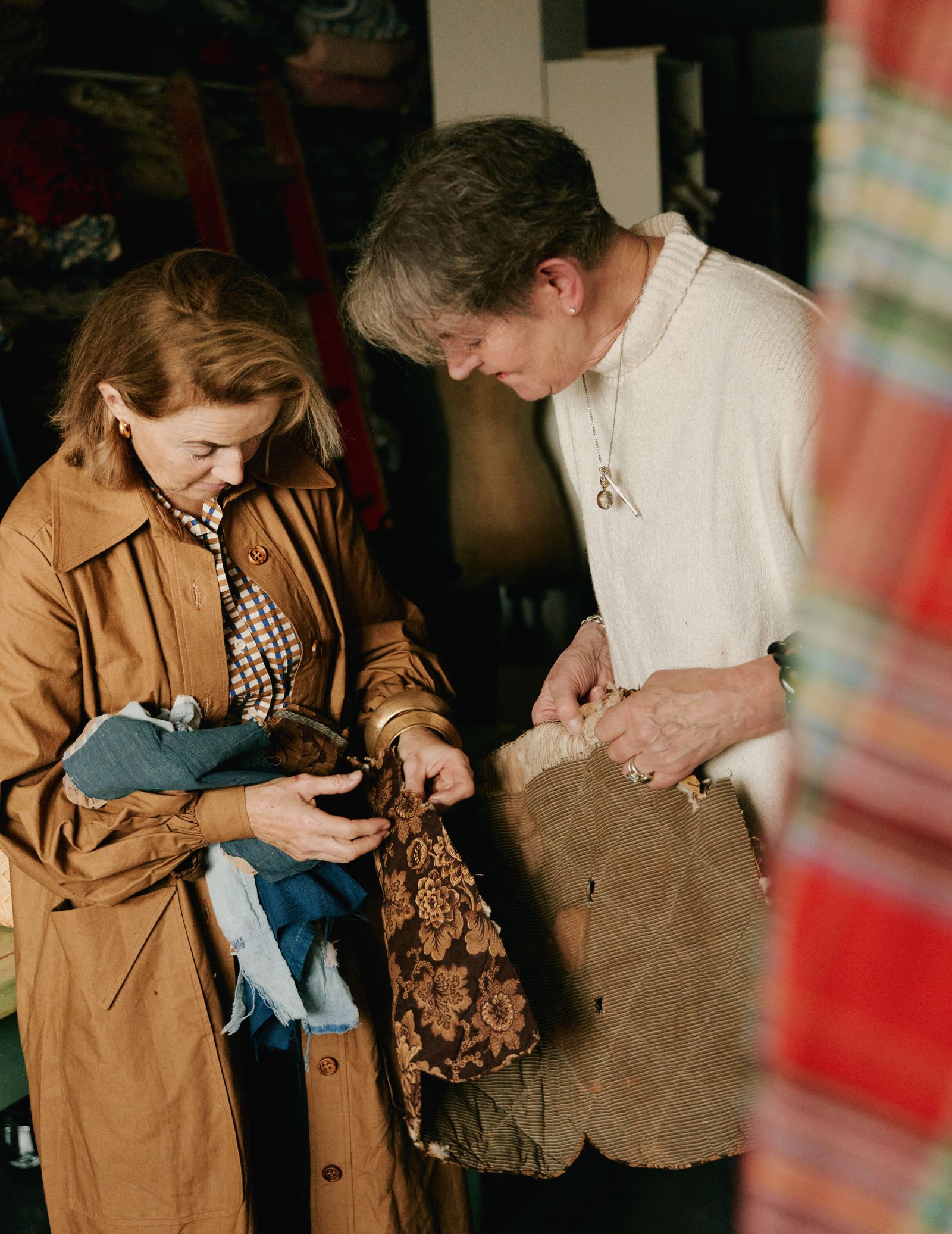
Mary had already showed her early pictures to her friend Fiona Atkins, who owns Town House shop and gallery in Spitalfields, back in 2020. She suggested Mary create still lifes with pots: 'So, I began playing around with fabrics.' Those Mary uses are antique, textured pieces that she sources from specialist dealers like her friend Su Mason, who has a stall at Portobello Road market every Friday.

'A picture always starts with a single piece of fabric,' says Mary. It might be the tiniest cotton fragment from a 19th-century French apron, or a strip of Japanese sacking used to strain sake. 'I gather textiles that complement it and, from there, the narrative unfolds, taking me towards an abstract, usually evoking a landscape, or a simple still life.' She overlaps layers and likes to incorporate original stitching or marks. 'This might be patching or darning, as well as signs of age, fading, fold lines or seam edges.'
The results are enchanting and it is not surprising that, soon after she shared them on instagr, she was snapped up by online gallery Among the Pines. After spending more time in her studio developing her work, Mary was contacted by Marcus Crane from McCully & Crane in Rye. The gallery has now been selling her work for over a year, and exhibited a new series of landscapes last spring. Mary also exhibited at Edward Bulmer Natural Paint's London showroom last summer, and Aldridge & Supple displayed her pictures at its interior design studio launch. With shows in the works, as well as plenty of private commissions, her decision to turn her back on styling was certainly the right one. There is no doubt that all her skills come together in her pictures. 'It has been a lifetime of preparation,' Mary jokes. 'It's the happiest I have ever been creatively. I feel as if I have found my voice - I feel I can be free'.
Mary Norden: @marytnorden | Town House: townhousespitalfields.com | Su Mason: @sumasonlondon | Among the Pines: amongthepines.gallery | McCully & Crane: mccullyandcrane.com | Charles Garrad: charlesgarrad.com
 Michael SINCLAIR1/11
Visiting her friend Fiona Atkins at her Town House shop and gallery, E1, to see the unique pieces on display, including vessels that often inspire her still lifes.
 Michael SINCLAIR2/11
Mary's seascape collages depicting Winchelsea Beach, East Sussex.
 Michael SINCLAIR3/11
Mary dyes some of the fabrics for her work herself, usually to create a specific colour.
 Michael SINCLAIR4/11
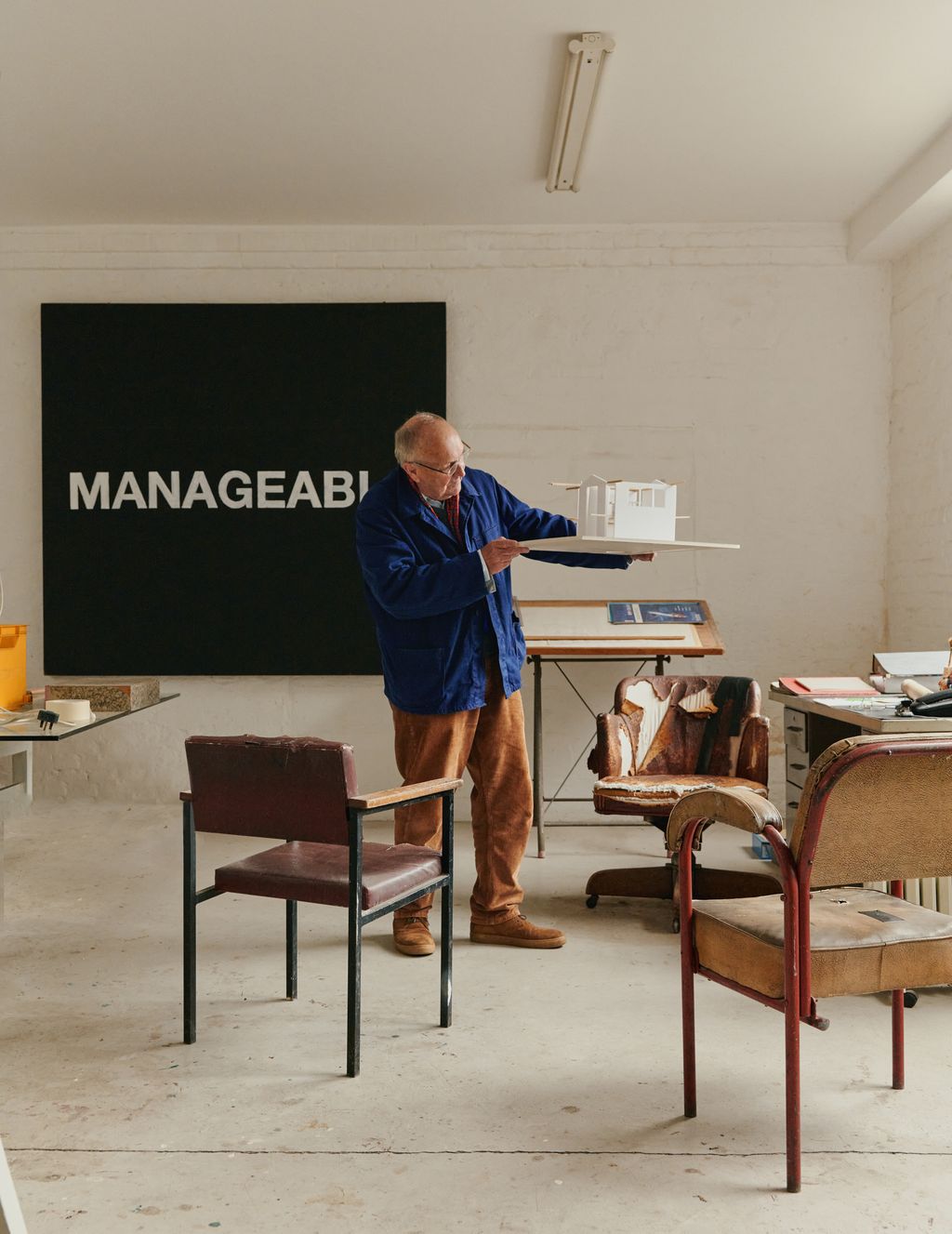
Her filmmaker and artist husband Charles Garrad in his studio next door to hers, holding a model of part of a large installation he is planning. MANAGEABLE from his WORD series hangs on the wall behind him.


 Michael SINCLAIR5/11
As Mary and Charles are both avid collectors, the shelves and walls of their Victorian house in London Fields are lined with fascinating arrays of pottery, art, photographs and books.
 Michael SINCLAIR6/11
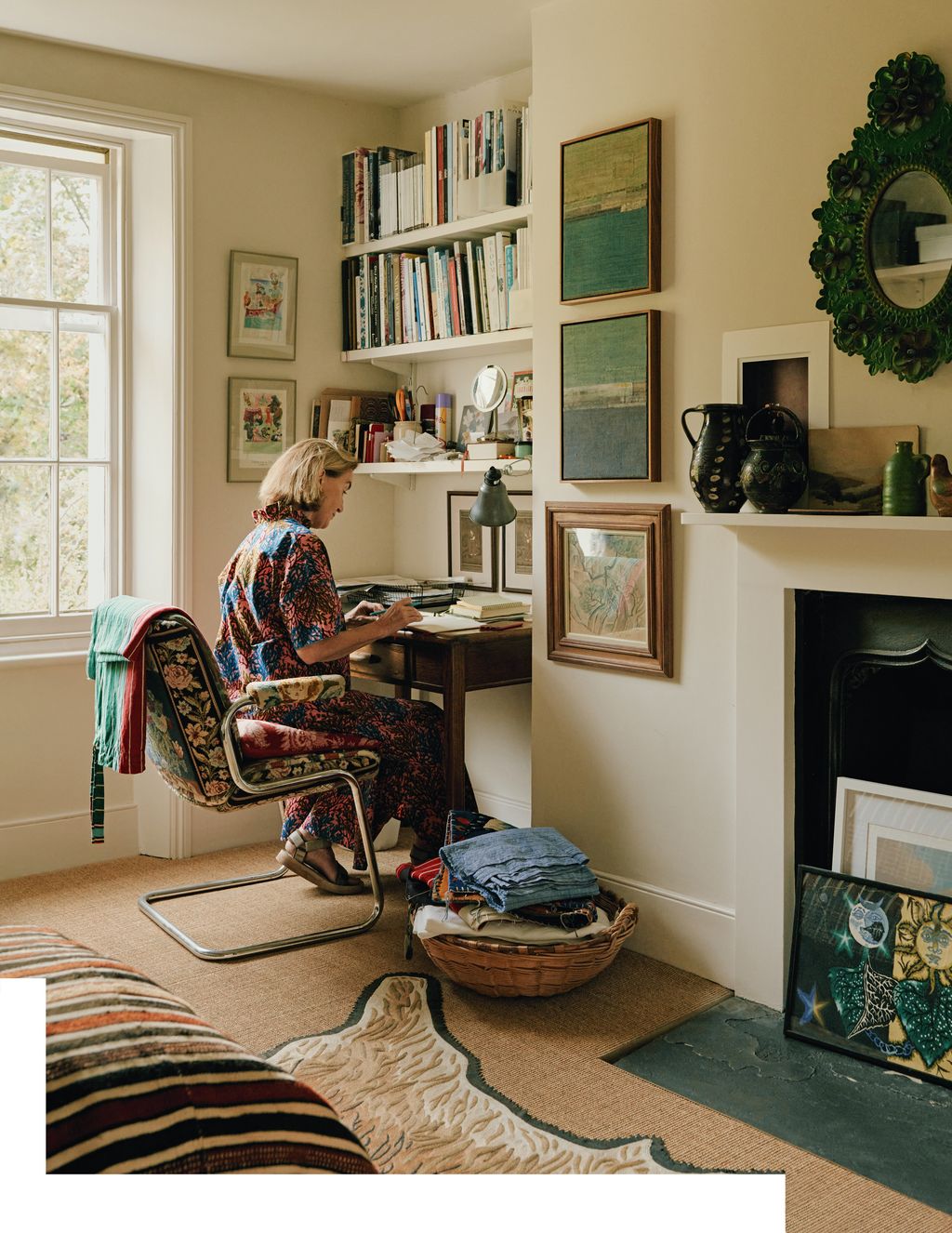
In Mary's study, these treasures are seen alongside her collages, creating an inspiring environment in which to work.
 Michael Sinclair7/11
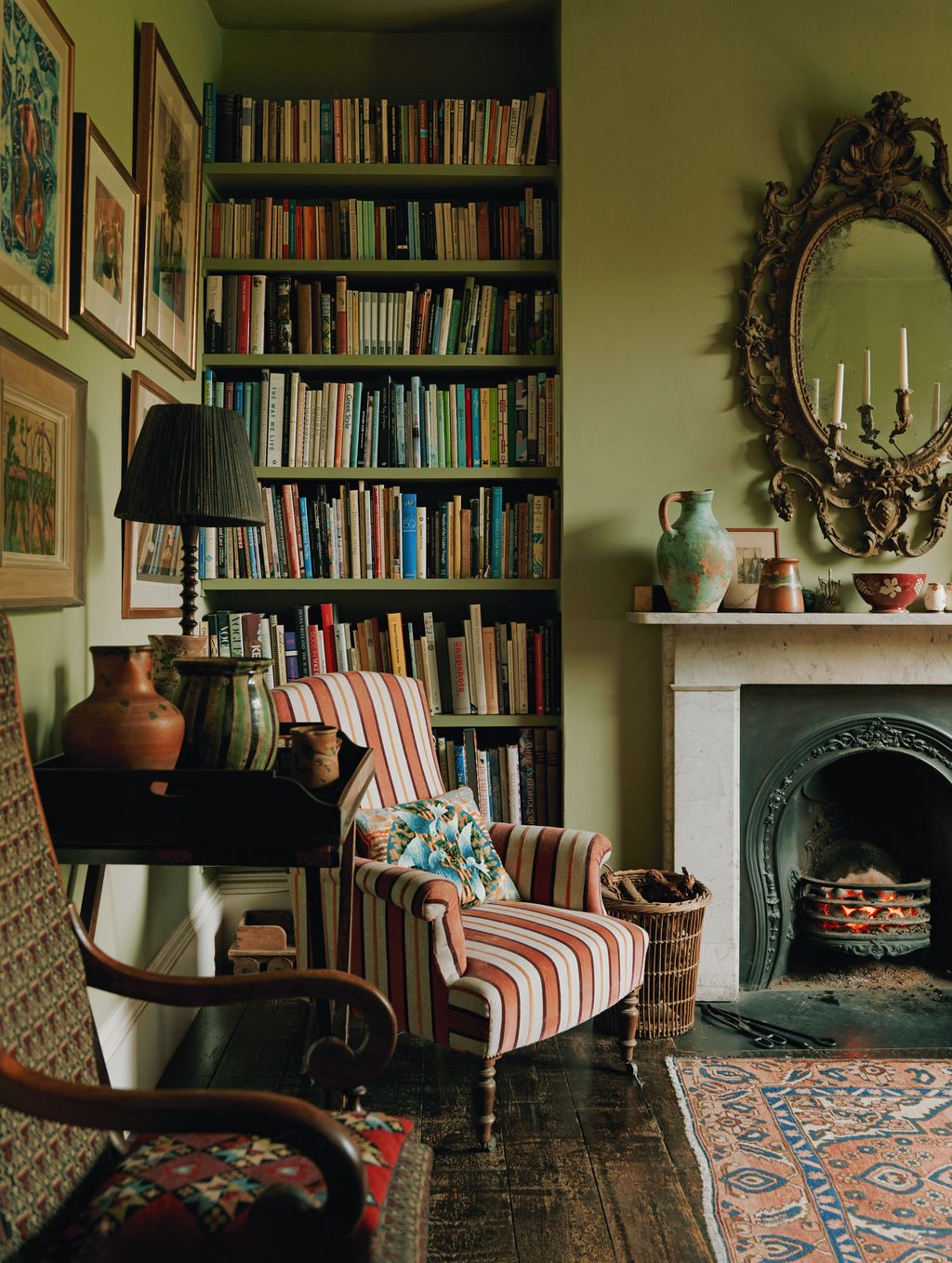
The sitting room offers a comfortable place to relax in the evenings.
 Michael SINCLAIR8/11
The couple cycling through Spitalfields.


 Michael SINCLAIR9/11
Showing a selection of her seascape and landscape pieces to Marcus Crane, owner of McCully & Crane gallery in Rye, which started selling her work just over a year ago.
 Michael SINCLAIR10/11
The scene of a recurring dream that Mary had decades ago, Winchelsea Beach has been the subject of a number of the artist's atmospheric fabric pictures.
 Michael SINCLAIR11/11
Mary and Charles enjoy a walk on Winchelsea Beach in East Sussex, where they had their second date over 30 years ago.


