
An overly modernised London flat sympathetically restored by Max Rollitt

A London flat in a desirable location can change in appearance and character as radically as the most artful con man: one minute flush with shiny limestone flooring and polished steel, the next pulsating with period charm. In a desirable location overlooking the Thames, this flat has had at least three such transformations in less than a decade. The most recent is the work of antiques dealer and interior designer Max Rollitt.
When the owners asked Max to look at the flat, they had already been using it as their pied-à-terre for more than a year. Meanwhile, Max had been working with them on their Queen Anne house in the country - 'softening it up a bit,' as he puts it, with his characteristic combination of unusual antiques and luscious colours. 'The owners are very pragmatic and wanted to know whether it was worth spending money to make the flat more attractive,' says Max.
At this stage, the interior was the work of a developer who had done it up with white paint, installing an Ikea kitchen, a whirlpool bath and cheap fittings. Despite its disguise, Max recognised the flat as one he had visited before. 'I realised the minute I walked through the door that it had belonged to an old friend of mine, a very clever antiques dealer. It had been stunning, with a spectacular French tapestry on one wall of the sitting room and bits of architectural salvage, including doors from an old prison.'
MAY WE SUGGEST: Style File: Max Rollitt
The only survivors from this era were the Victorian encaustic tiles in the small, square entrance hall and in the bathroom, and the fragments of sixteenth-century banister used on the stairs. Everything else had been stripped out-and with it most of the flat's character and panache. Dating from the late nineteenth century, the building was originally a children's hospital; it remained as one until the Nineties, when it was sold and chopped up into flats. The resulting interiors are short on architectural features, the principal merit being the multi-pane sash windows through which small patients once gazed.
This flat is on the raised-ground and lower-ground floor and consists of a sitting room, a kitchen and a cloakroom, with three bedrooms and two bathrooms on the floor below. The main room is a slightly awkward shape, with one corner cut out to make the entrance hall. Two windows overlook the pavement, and a french window opposite opens onto a terrace and inner courtyard. To the left of the door that leads to an inner hall, the wall protrudes in a square pillar where pipework has been boxed in.
Max's riposte has been to make a virtue of the asymmetry by giving the sitting room an early English vernacular flavour with sixteenth-century style panelling, a corner chimneypiece, dark-painted floorboards, and a big square of rush matting that marks out the seating area. Three singular pieces of furniture - a handsome, mid-eighteenth-century Irish bureau bookcase, a Queen Anne oyster chest on a stand and a carved side table - add elegance and gravitas.
Aside from the sofa and the beds, all of the furniture was sourced by Max for the flat - some from his own shop. 'I only buy things I like,' he says. “The shop is my arsenal. If something doesn't work, I can take it back.'With a background in furniture restoration, he is also adept at reinventing beautiful but damaged or incomplete antiques and has a team of craftsmen who can help to deliver his ideas. The oyster chest has a replacement stand designed by Max, and the bookcase next to the french window is also a new creation. Downstairs, the bedside tables have tops made from the marquetry side panels of a seventeenth-century cabinet.
MAY WE SUGGEST: A 17th-century farmhouse gracefully restored by Max Rollitt
Patina is a Max Rollitt speciality. Furniture is never over restored, and his appreciation of a nicely worn surface extends to a more general attention to texture and finish. The sitting-room panelling is painted in a soft shade of grey, using a 'secret recipe' to achieve a slightly chalky, almost grained look like early lead paint. The marble-topped carved side table is a reproduction, but the same careful mixing and application of paint gives it a convincingly authentic appearance. In the kitchen, the Shaker-plain cabinetry, also designed by Max, is in a rich, dark red reminiscent of a Victorian railway carriage or a dashing Regency barouche.
Fabrics are another important textural element, whether the framed Kashmiri embroideries that hang on either side of an enigmatically dusky painting by Tobit Roche in the sitting room, or the ruched mustard-yellow blinds in a crunchy Claremont silk in the same room. The main bedroom downstairs is particularly sumptuous, with its flower-trail Braquenié wallpaper, its figured-cotton Fortuny bedspread and strawberry-red silk cushions - a lesson in how to make a potentially gloomy space glow.
No tour of the flat would be complete without a visit to the cloakroom opposite the kitchen. Here there is a show-stopping example of architectural salvage to complement the encaustic floor tiles – a late-nineteenth century pair of stained-glass windows that Max found in France. The colours are gorgeous: amber, scarlet, turquoise and pink. But what makes these panels so fascinating is that they have been designed to hold a series of photographic slides. Some of these have decayed into abstract clouds, but in others people and buildings can still be deciphered. Character and charm triumphantly re-established.
 1/11
1/11The asymmetrical sitting room has sixteenth-century style panelling and a sofa covered in 'V W Hopper' from Opuzen.
 Simon Brown2/11
The curved reproduction side table is from Max Rollitt, and has a breche violette marble top that matches the corner chimneypiece.
 Simon Brown3/11
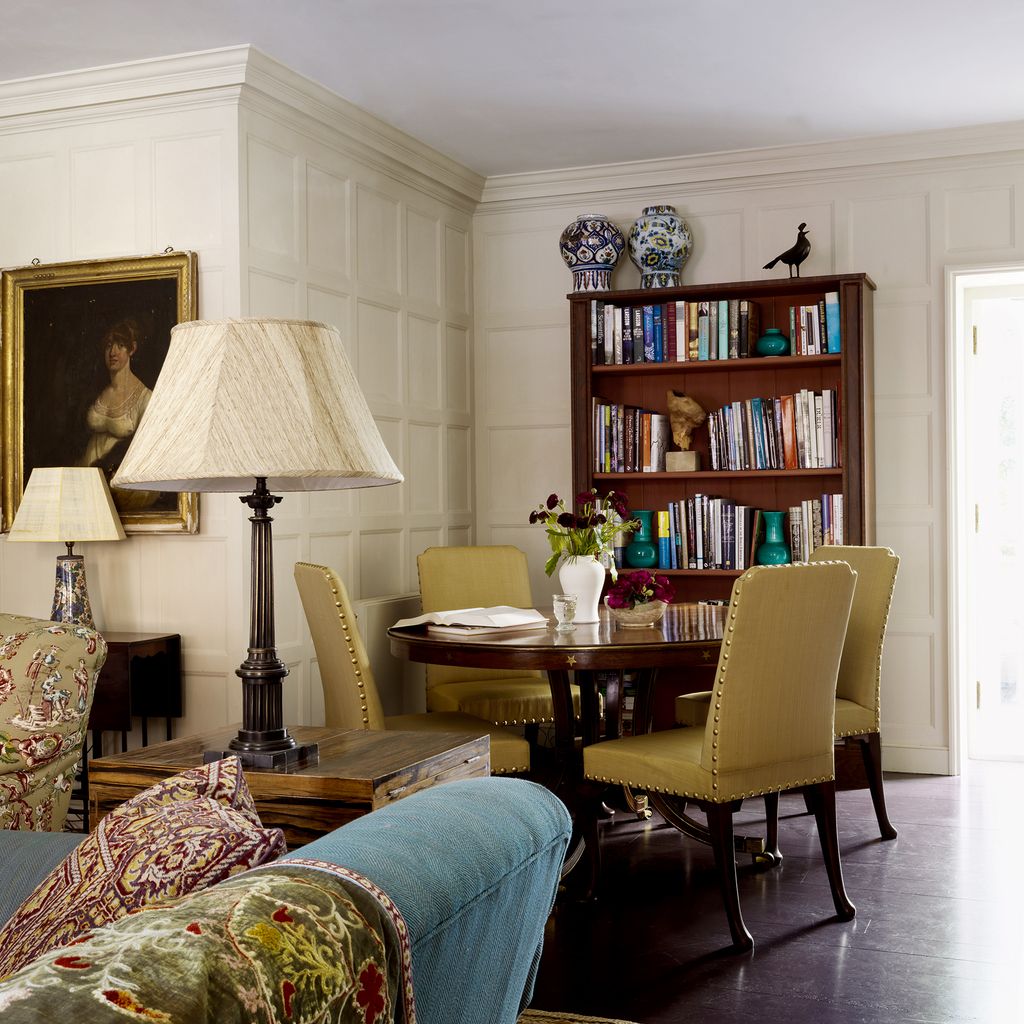
A Regency table is flanked by Max Rollitt dining chairs, covered in 'Paso' from John Boyd Textiles.
 Simon Brown4/11
In the cloakroom, a pair of French, nineteenth-century stained glass windows was designed to hold a series of photographic slides (below).


 Simon Brown5/11
 Simon Brown6/11
The standard lamp is from Marianna Kennedy.
 7/11
7/11The kitchen is simply furnished with custom-designed cabinets.
 Simon Brown8/11
The pendant lights are from Holloways of Ludlow


 Simon Brown9/11
Two late-eighteenth-century portraits stand out against the pale blue walls of the hall, which are painted in 'Sky Blue' from Edward Bulmer's Pots of Paint.
 Simon Brown10/11
An assortment of fabrics enliven the main bedroom on the lower-ground floor the curtains are in ‘Naples' by Claremont; the dressing-table top is covered in Claremont's 'Chevron Rouge'; and the bedcover is in figured cotton from Fortuny.
 Simon Brown11/11


