
Why Patmos is the most stylish of Greek islands, and when to visit

'Tight-fitting clothes? Gauche! High heels? Très gauche!’ Elfin fashion historian and Patmos denizen Katell le Bourhis is explaining the social etiquette on this hard-to-reach Greek island, where aristocrats, interior designers, fashion editors and their muses congregate each summer. ‘The social scene is very complicated, but the rules are unwritten. It’s easy to make a faux pas,’ says Katell, rolling her mischievous eyes. She is only half joking. In season, reputations depend upon whether (or not) you are invited to the fabulous house parties in Chora, the hilltop citadel huddled around the Monastery of Saint John the Theologian.
While I am trying to keep up with Katell’s droll take on what’s in and who’s out (Eres swimsuits and Venetian slippers; the reclusive banker or nouveau riche arriviste?), it occurs to me that the most gauche thing of all is to visit in August, when this social whirl is in full swing. It is far better to come off-season in spring or autumn, as I have done, when the light is molten gold and you will not die of heatstroke if you strike out across the rippling hills on foot. Nobody will judge your footwear either.

Patmos has been a place of spiritual solace since the Byzantine emperor Alexios I Komnenos bequeathed the island to an enterprising abbot named Christodoulos in 1088. At the time, it was ‘inaccessible, uninhabited and of no use to anyone’, according to Christos Iakovidis, the Greek author of a seminal study of the island’s beautifully austere architecture. The only edifice, he writes, was ‘a wretched chapel built in the name of St John’, the exiled apostle who rattled off the Book of Revelation in a cave on Patmos nine centuries earlier. Christodoulos built the heavily fortified monastery with expert stonemasons and carpenters from Asia Minor, whose descendants still pass their skills down from generation to generation.
Initially, only monks were allowed to live in the vicinity of the monastery. Tenant farmers lived in rural settlements, such as Kambos (meaning the plain) and Kipi (the gardens), which are still cultivated today. Gradually, a blue-collar settlement sprang up around the battlements. After the fall of Constantinople, the island’s status as a religious, intellectual and financial sanctuary continued to flourish, even under Ottoman rule. Today, Chora is a mystifying maze, where you can find yourself (literally and metaphysically) wandering through 900 years of unbroken history.

Off-season, indolent cats outnumber residents in the ghostly alleyways. Secret gardens within thick-set walls appear as impenetrable as the monastery’s library, a trove of handwritten tomes tended by a soft-spoken librarian who moonlights as a bartender in the summer. Most of Chora’s historic mansions now belong to wealthy foreigners or Greek shipowners, but the monastery still owns a handful (along with swathes of land, which has protected the island from over-development). When a property built in 1597 came up for auction, Maria Lemos and Gregoris Kambouroglou could not resist transforming it into a discreet, three-room guesthouse, naming it Pagostas after the original owner, who was both the architect and an abbot.
You would never guess that hospitality is new to this instinctively stylish and solicitous couple. Maria founded the London fashion showroom RainbowWave and concept store Mouki Mou; Gregoris is a recently retired orthopaedic surgeon. He spent last winter overseeing the building’s restoration (and treating many of the island’s 3,000-odd residents for free). ‘Our inspiration was modern monastic living,’ Gregoris tells me over fig salami, olives and local biodynamic wine on the roof terrace, as dusk casts a lilac spell over the patchwork of flat rooftops. A glimmer of sea is visible in all directions. ‘It is a return to living as simply as possible, while preserving the building’s integrity and soul.’

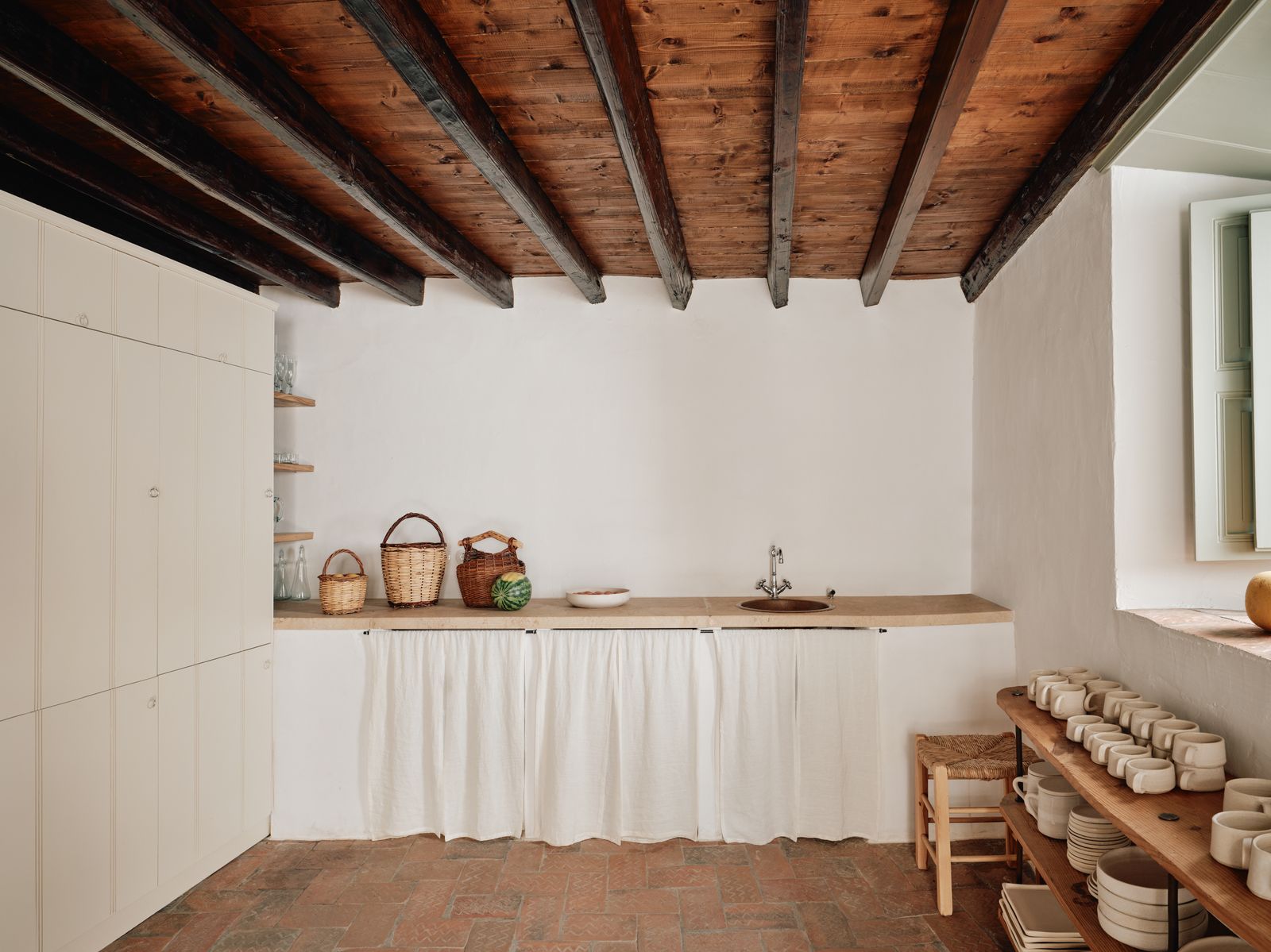
Created in collaboration with the interior designer Leda Athanasopoulou, the spare yet richly textured interiors are imbued with tenderness. Peachy Patmian stone, grey-green cabinets and faded terracotta tiles converse with vintage ceramics, hand-loomed textiles and embroidered cushions. Family heirlooms have also found their place. A lace tablecloth – a wedding present from Maria’s grandmother – is mounted on the wall of my room. Jasmine-perfumed terraces and a garden provide respite from wind and sun.
The weather is kind enough for long walks to remote hermitages and rousing dips in empty coves. Few beaches have sunbeds – wealthy homeowners have been known to outbid would-be beach bars to keep these bays naked.
Seaside shacks festooned with painted gourds are closed at this time of year, but there are still plenty of wonderful, unpretentious places to eat. A gentle coastal path leads to the shipyard, where you can have lunch aboard a caïque, or rent a wooden boat to explore the archipelago. In Chora, Giagkos Pantheon serves divine octopus and ouzo (or whisky, if you prefer) in a snug dining room straight out of the Fifties. Plaza Kafeneio, behind the port, is open year-round; Yorgos Kakas cooks a pot of something delicious every day. ‘One day, Dionysis the captain arrived holding a smoked herring,’ Gregoris recalls. ‘Dionysis called to his friend, “Are you coming for an ouzo?” He replied, “How big is the fish? One glass, a carafe, or the whole bottle?’’
Rooms at Pagostas cost from €250, B&B (pagostas.com). For guided hikes, contact Antonis Dimas (walkinginpatmos.com). To reach Patmos, fly to Kos or Leros and board one of the Dodekanisos Seaways ferries (12ne.gr), which take one to three hours; or fly to Athens and travel overnight on one of the nine-hour Blue Star Ferries (bluestarferries.com) – be sure to book a cabin.
 1/6
1/6The Garden Room.
 2/6
2/6A view from the roof.
 3/6
3/6Antique bentwood and cane chairs surround a table in the Fireplace Room.
 4/6
4/6Planted with plumbago and lemon trees, the garden has a tranquil feel.


 5/6
5/6The monastic-style dining room.
 6/6
6/6The first-floor terrace is furnished with bespoke pieces by Leda Athanasopoulou.


