
This NYC loft features a trove of pivotal work by black artists

A muted portrait by Los Angeles–based painter Henry Taylor holds central billing in the downtown Manhattan home of art patrons Bernard Lumpkin and Carmine Boccuzzi. It depicts a young Black man, wearing a plain white T-shirt and a backward-turned baseball cap, who sits behind a teal dinette, gazing toward the viewer. A cake, missing a slice, rests atop the kitchen table beneath a glass bell jar, suggesting a scene of celebration, a happy occasion. On the back of the canvas, a brief inscription reminds of the painting’s subject, Taylor’s “sweeter than chocolate nephew William Rorex Jr.”—an ode to family and the comfort of the domestic space—while a reared-up horse rendered in the background, a recurring motif across the artist’s oeuvre, appears aligned as a hopeful image of freedom.
The painting captures the ideals at the heart of this house, where a resplendent, rotating selection from a nearly 500-piece art collection seems to highlight every surface. “It is an image of Black life,” Lumpkin describes, “that's happy and hopeful and celebratory.” Lumpkin and Boccuzzi are dedicated collectors of work by Black American artists, with a primary lens on contemporary pieces from the past 25 years. Throughout the twentieth century, and still to this day, work by Black artists has been largely underrepresented and undersupported by American museums, but thanks to the sustained, combined efforts of Black curators, activists, scholars, and collectors, like Lumpkin, that is slowly starting to change. But, Lumpkin points out, that movement began at home. “There was a time when museums, or galleries, or collectors weren’t interested in African-American artists, and so the art stayed within the community,” he explains. “The great thing about that is it survived. It was seen and shown.”
In many ways, Lumpkin is continuing that legacy, but he is also building upon it. His and Boccuzzi’s collection includes works by such celebrated hands as Kara Walker, who famously constructed a 35-foot bare-breasted Sphinx from bleached sugar in a decrepit Brooklyn factory in 2014, as well as an ever-growing roster of up-and-coming artists, like Troy Michie, who often uses collage as a tool to deconstruct ideas of representation and misrepresentation. Many of these can be seen in the nationally traveling exhibition “Young, Gifted and Black,” or in the forthcoming monograph of the same title, edited by critic Antwaun Sargent.
MAY WE SUGGEST: A Brixton home shared by two designers and their extraordinary collections
Lumpkin, a former MTV News producer, and Boccuzzi, a partner at the law firm Cleary Gottlieb, moved into the Tribeca loft in 2011. Though the bones remain largely unchanged since their arrival, the married pair enlisted the architecture firm Bade Stageberg Cox to reconstruct the internal layout. A white wall now partially splits the open-concept living-dining area, where Taylor’s painting hangs, from a playroom, accented with a bedazzled rendering of Mary J. Blige by Mickalene Thomas and a figurative painting by emerging artist Jonathan Lyndon Chase; a panel of textured glass panes hidden inside may be pulled out to fully cordon off the space. Here, the couple has weathered a hurricane, a pandemic, and, through it, the upbringing of three young children.
To the right, one side of a short hallway is decorated by a golden, tendril-like, striped-paint pattern, the result of a stencil concocted by artist David Hammons using bits of hair and wire, affixed to paint rollers and applied. In a vestibule on the opposite wall hangs Tiny Particles (2008) by Rashid Johnson, a shelf-like assemblage of a spray-painted rock, a candlestick, and a book open to a full-bleed spread showing an image of a nebula. A trustee at the Studio Museum in Harlem and the Skowhegan School of Painting and Sculpture, while serving on acquisition committees at MoMA and the Whitney, Lumpkin advocates for Black artists at the institutional level as well as the personal. That commitment can be seen, for example, in the couple’s career-long support of Johnson.
MAY WE SUGGEST: Art collector and patron Valeria Napoleone's home is a gallery space for the female artists she champions
“Every collection itself is like a conversation,” Lumpkin says. “It's a gathering of voices.” That discourse extends to the furnishings, too, which the couple scrupulously hand-selects. Lumpkin is particularly attracted to items with stories through which he can come to a better self-understanding. He compares his own heritage—his Sephardic Jewish mother was from Tangiers, Morocco, while his father was a Black physicist from the Watts neighbourhood of Los Angeles; the two met while studying at Columbia University—to that of Isamu Noguchi, whose paper lanterns dot Lumpkin’s living room, and who was also biracial. Standing over a long walnut seat by designer George Nakashima, Lumpkin is quick to point out that its maker came to his signature style after learning traditional Japanese joinery from a Nisei woodworker while detained in an Idaho internment camp. Both craftsmen, originators of what are now considered iconic symbols of American design, were, to varying degrees, othered. Lumpkin likens this experience to the themes captured by the art on the walls.
“People might not think there’s much connection between a George Nakashima Conoid bench and a Henry Taylor portrait. But for me, they both speak of a very specific and empowering view of America, and the challenges of what it means to be American,” Lumpkin says. “The sadness, the struggle. But also the beauty and the diversity.” Of course, there are some outliers, chosen for their streamlined aesthetics and longevity: A guitar pick–shaped wooden dining table by Brazilian architect Arthur Casas stands atop a lone cylindrical column, complemented by a run of classic, three-legged Hans Wegner chairs; in the living room, a grey velvet Milo Baughman sectional surrounds an extendable, brushed steel coffee table by Italian artisan Gabriella Crespi.
What becomes clear throughout is a sense of mission: to beautify, yes, but more important, to educate and empower, to foster connections and promote transformative conversations. Whether selecting a seat or placing a painting on the wall, “you're hanging up an image of the way you want the world to be,” Lumpkin says. “The way you want people to see themselves, the way you want your children to see themselves.”
 © The Lumpkin-Boccuzzi Family Collection of Contemporary Art, photograph Dawn Blackman1/7
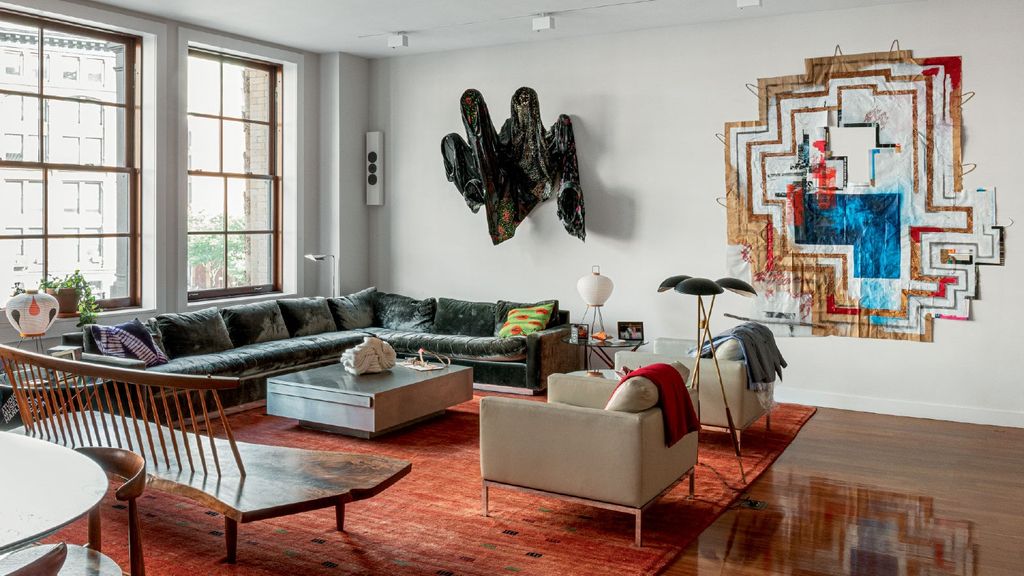
Where some collectors might be intimidated at the prospect of installing a large sculptural piece, like the ghostly structure composed of various muumuus by Yale-trained Kevin Beasley that floats above a Milo Baughman sectional, art patron Bernard Lumpkin relishes the challenge. “Artists push themselves, curators push themselves, writers push themselves by taking on things that seem too big, too difficult, too dangerous. I think collectors and patrons, you can also push yourself,” he says. “If it makes me feel uncomfortable, that’s always a good sign.”
 © The Lumpkin-Boccuzzi Family Collection of Contemporary Art, photograph Dawn Blackman2/7
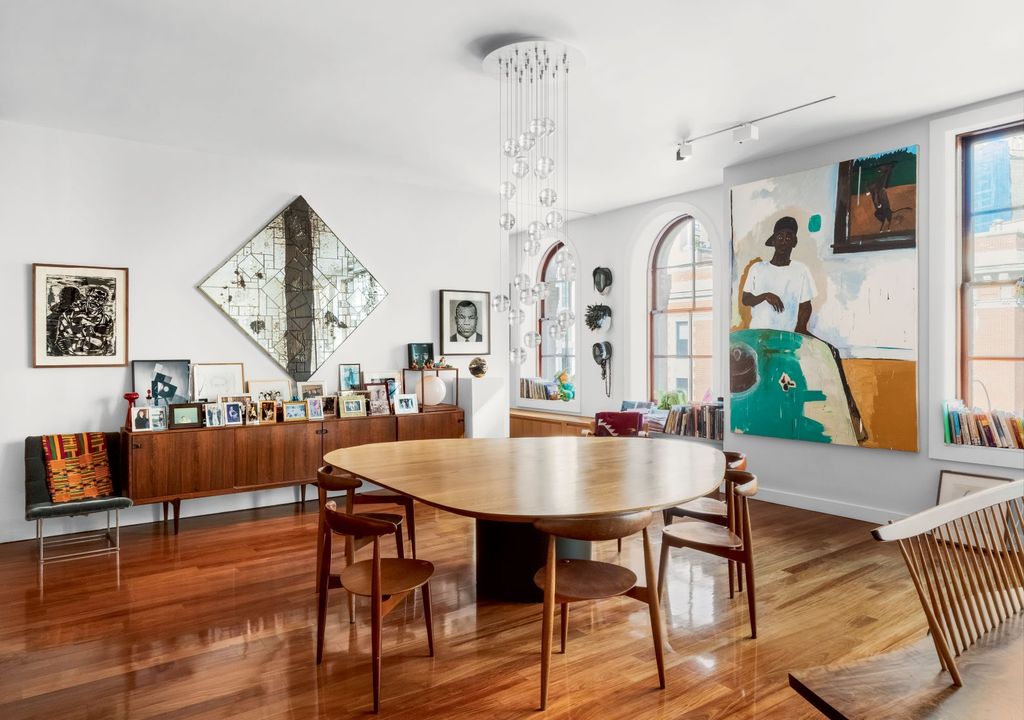
A portrait named for its painter Henry Taylor’s nephew, The Sweet William Rorex Jr. (2010), presides over a guitar pick–shaped table by Brazilian architect Arthur Casas in the central open-concept living-dining area in Lumpkin and Boccuzzi’s Tribeca loft. “I had just a strong connection with this,” Lumpkin says. “It’s the one that bought me.”
 © The Lumpkin-Boccuzzi Family Collection of Contemporary Art, photograph Dawn Blackman3/7
Toy kitchens and chess sets appear curated in a children’s playroom alongside an untitled black-and-white paper silhouette collaged by Kara Walker.
 © The Lumpkin-Boccuzzi Family Collection of Contemporary Art, photograph Dawn Blackman4/7
The New York loft of art patrons Bernard Lumpkin and Carmine Boccuzzi is filled with their collection of important artworks by Black artists. Above a vintage credenza dusted by framed family photos, a wall hanging of glass tiles and black wax by Chicago-based Rashid Johnson hangs as a mirror beside a photograph of Mike Tyson, his face obscured per Baltimore-born Derrick Adams with a wall of metallic silver paint.


 © The Lumpkin-Boccuzzi Family Collection of Contemporary Art, photograph Dawn Blackman5/7
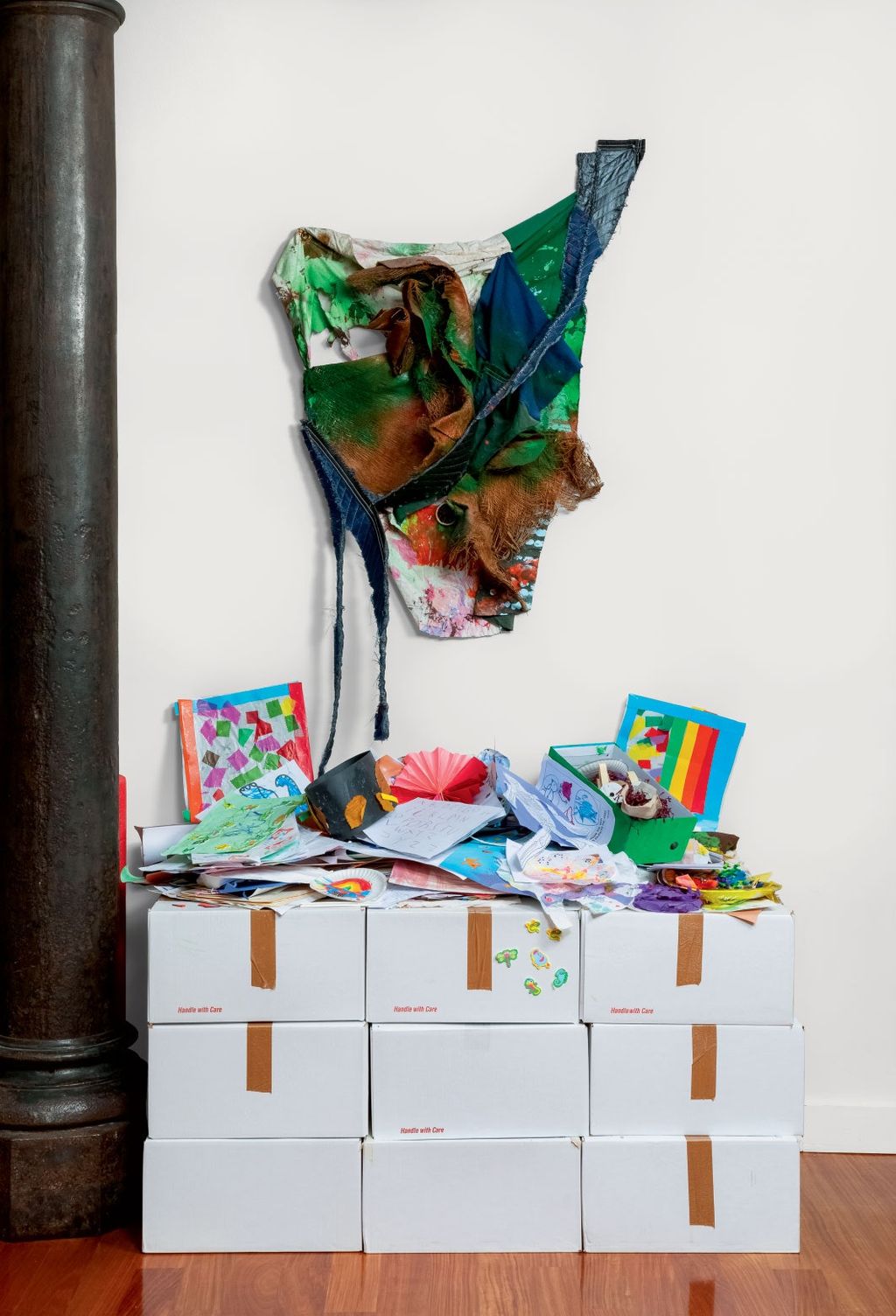
“I wanted a home that felt comfortable, lived in, and where the art is part of a conversation about family,” Lumpkin says, pointing to a quilt-like assemblage from Eric N. Mack—comprised of various painted and bleached fabrics, palm husks, and dried orange peels—that hangs above a cluster of children’s craft projects.
 © The Lumpkin-Boccuzzi Family Collection of Contemporary Art, photograph Dawn Blackman6/7
A nursery becomes a white-walled gallery with the addition of two paintings of differing styles: an abstract vision called Face (2016) by Los Angeles–based Christina Quarles and an expressionist portrait titled Joyce (2012) by Jennifer Packer from New York.
 © The Lumpkin-Boccuzzi Family Collection of Contemporary Art, photograph Dawn Blackman7/7
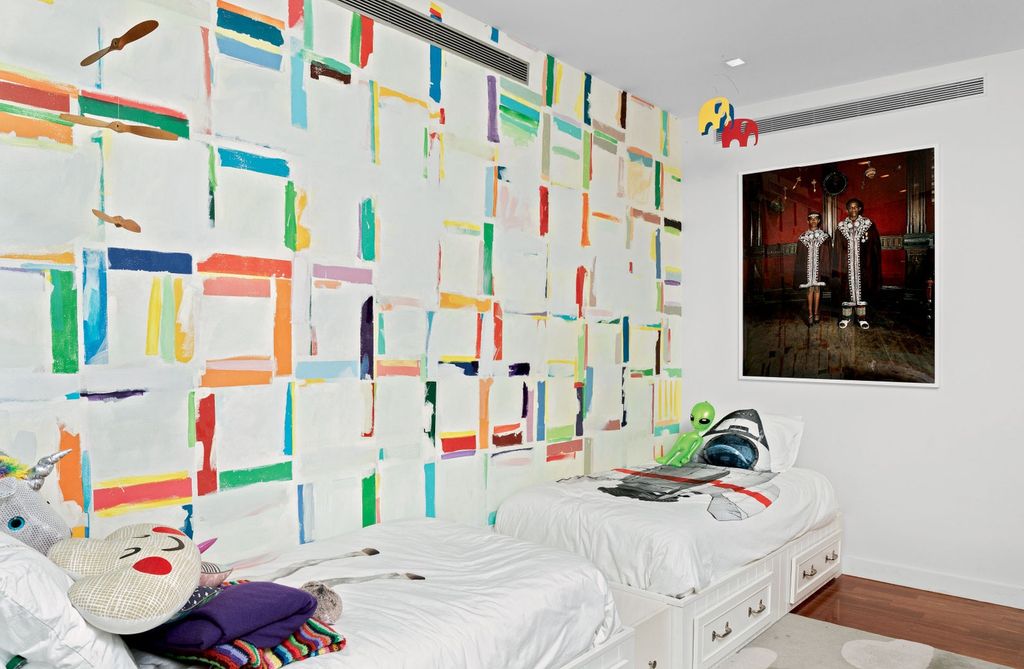
In a shared kids’ bedroom, a colorful mural painted by artist Matt Wycoff, who co-curated “Young, Gifted and Black” alongside critic Antwaun Sargent, decorates the wall. Hanging adjacent, a 2015 Deana Lawson photograph depicts two children standing side-by-side, wearing traditional wedding robes in Ethiopia.


