
The rich history of Tilley Printing letterpress

The rich history of Tilley Printing, in the Herefordshire town of Ledbury, starts in 1879, when an entrepreneur called Luke Tilley, who owned the local bicycle shop, photography shop and library, bought the local printers Ledbury Free Press and renamed it Tilley & Son. Within a year, he had moved the company from its premises in a grand building on the high street to a smaller workshop down the cobbled alleyway opposite, where it remains today.
By the early 1910s, the business had passed to Luke’s granddaughter, Leonie Tilley. She was responsible for much of its modernisation, including the introduction of electric power to replace the steam generator. In 1963, Miss Tilley – as she is still referred to – offered an apprenticeship to the younger brother of one of her workers. Martin Clark was just 15 at the time. By the end of the 1960s, Miss Tilley was preparing to retire and decided that Martin – now a ‘master printer’ – should eventually take over from her. She had no children and wanted the family business to remain in good hands. Martin has been creating prints ever since.

Tilley Printing, as it has been known since Martin took over, is still home to an impressive collection of steel and cast-iron machines, capable of printing anything, from art and posters to stationery and books, on an industrial scale. These days, Martin – who tends to work alone – spends most of his time fulfilling commissions for artists, local businesses and private clients.
Relishing the opportunity to be creative, he loves to choose the perfect typeface for each project and is spoilt for choice: there are thousands of options spilling out of drawers all over the work-shop. A large uppercase typeface once used for war propaganda is now ideal for posters, while a 10pt type is more at home on the order of service for a wedding. The typefaces are painstakingly arranged, letter by letter, upside down and back to front, onto a setting stick, before being transferred to a frame known as a ‘chase’. Typesetting an order of service can take an entire day.

Martin hand-mixes his oil-based inks, in formulas measured by eye that are difficult to re-create. ‘That’s the beauty of it – they’ll all be different,’ he says. He then transfers them onto the rolls of the machine. Passing the rolls over the wood-carved letters evenly disperses the ink before a sheet of paper is then rolled over them.
Different machines are better suited to different jobs. The Wharfedale, for example, exclusively prints posters. The two more modern Heidelberg Platen presses can print smaller scale stationery at 3,000 sheets per hour. Many of his commissions also include an element of lino-printing, which allows for more figurative elements within a design.
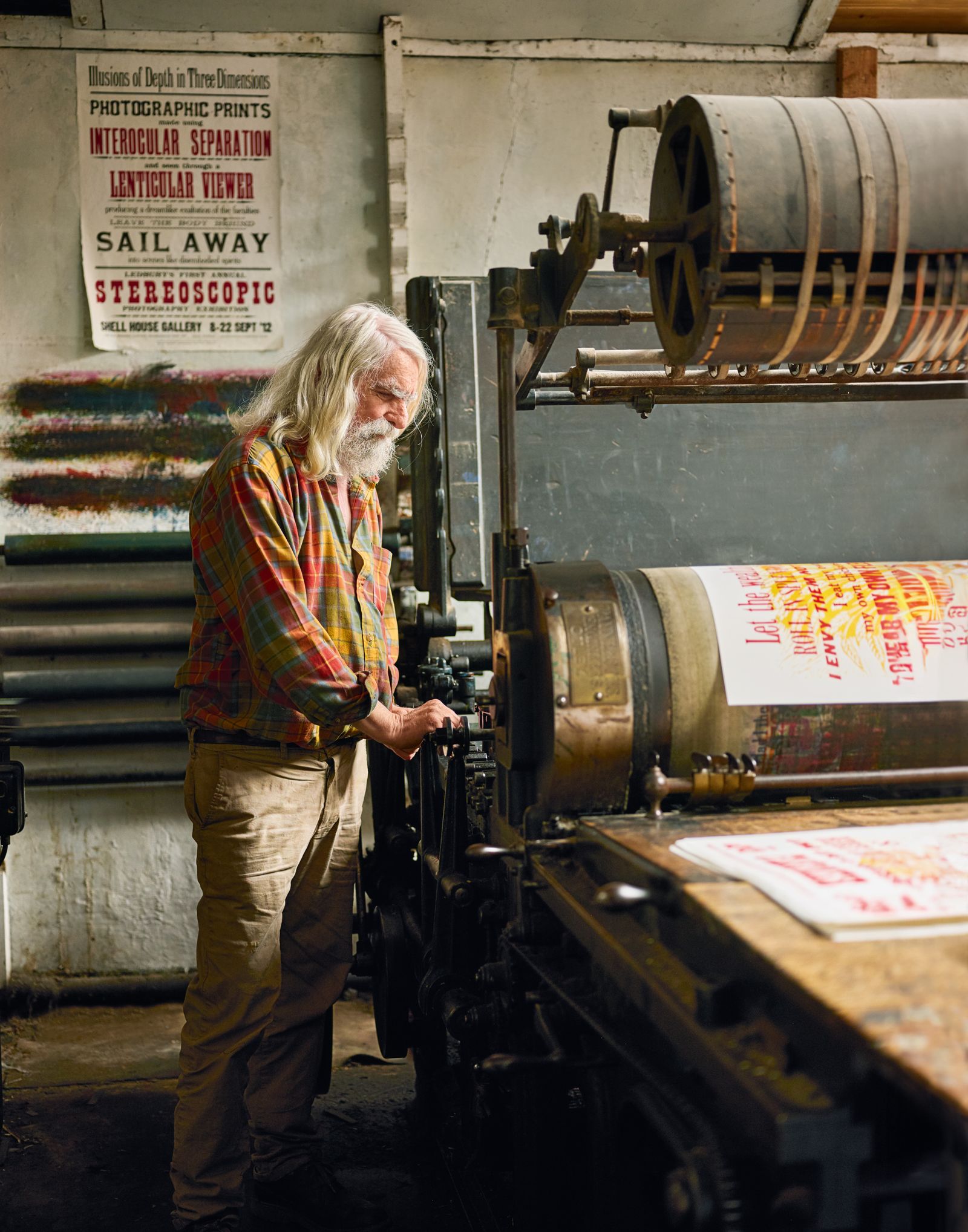
The results are, according to Martin, far superior in quality to anything printed digitally. ‘A letterpress print has texture,’ he explains. ‘You can feel the impressions left by the stamp when you run your hand along it.’ It is a quality admired by his clients, including the artist Mark Hearld, a local cider brewery for which he makes labels and those ordering bespoke stationery.
Today, 144 years after it was bought by Luke Tilley, the letterpress remains an important part of the Ledbury community. During my visit, a neighbour popped in with a bottle of beer to thank Martin for printing the invitations for his garden party. The business has survived two World Wars and the digital revolution.

Another of Martin’s clients is Phoebe Clive of local business Tinsmiths. Phoebe and Martin are great friends; he taught her to print her own posters, which she now often does. Although he has no plans to retire any time soon, Martin hopes eventually to hand over the press to Phoebe, who will continue the Tilley legacy. ‘It’s a daunting task,’ she says. ‘But Martin is so generous with his knowledge and it’s such a special part of Ledbury’s history. When the time comes, it will be an incredible privilege to take over’.
Tilley Printing: tilleyprinting.co.uk


