
A reflective English garden with an otherworldly beauty

Topiary gardens can get lost in the abundance of spring and summer, their outlines blurred by lush growth. But, in winter, their intricate, clipped shapes shine, the patterns beautifully accentuated by a sprinkling of snow or a heavy frost. Created over the past three decades by its owner, the garden at this Hampshire manor house is utterly enchanting at this time of year. Snow brings with it an embracing silence, shutting out the rest of the world and focusing the eye and the mind on the garden, as it shimmers with an icy, otherworldly beauty.
With its elaborate series of parterres, the garden looks like a Renaissance masterpiece, but there was nothing but an empty field around the house when the family first arrived in the Eighties. With no records of what might once have been there to guide him, the owner – a scholar specialising in East Asia, as well as a nurseryman and environmentalist – began to imagine what could be created, conceiving the space as a dynamic series of rooms unfolding around the house.

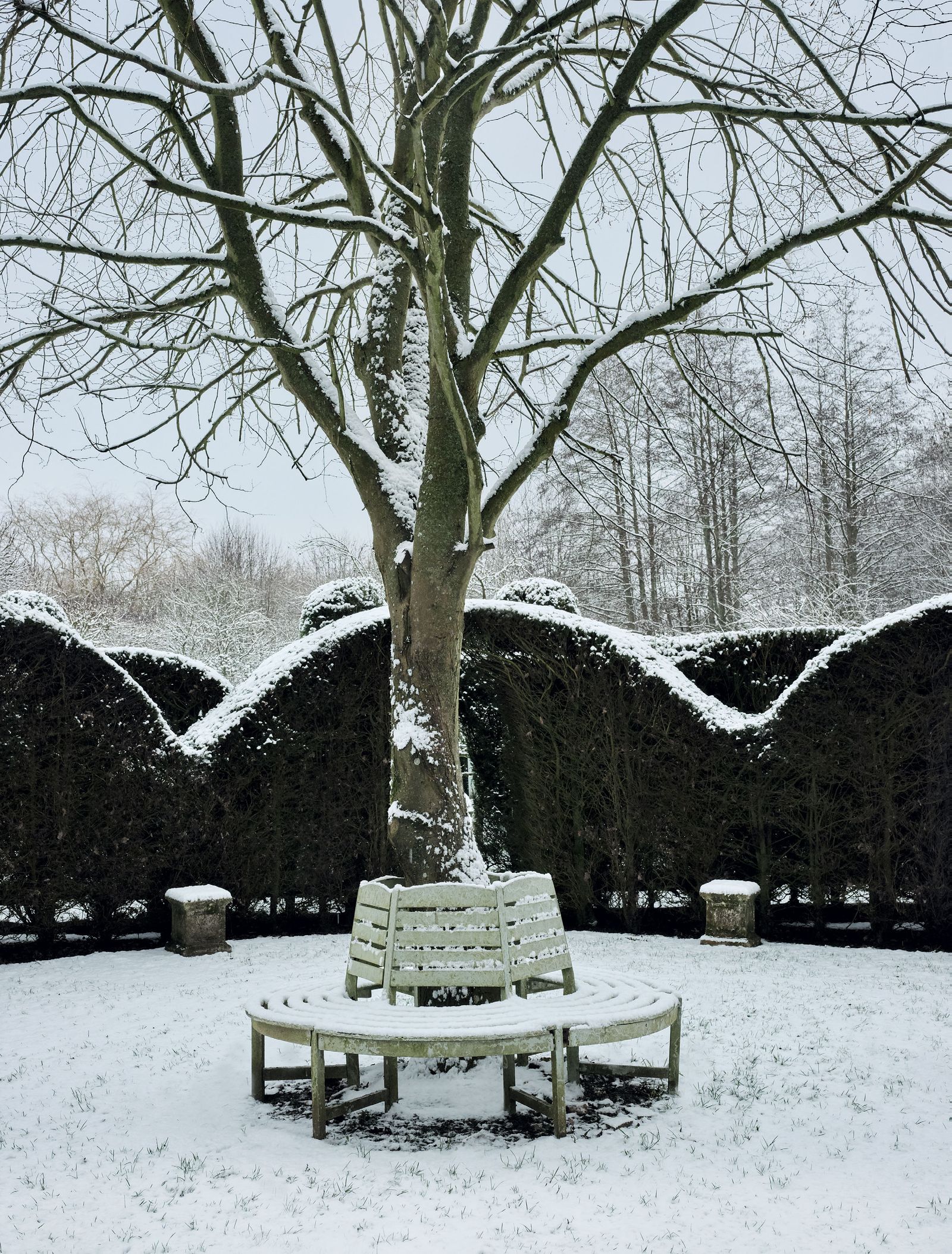
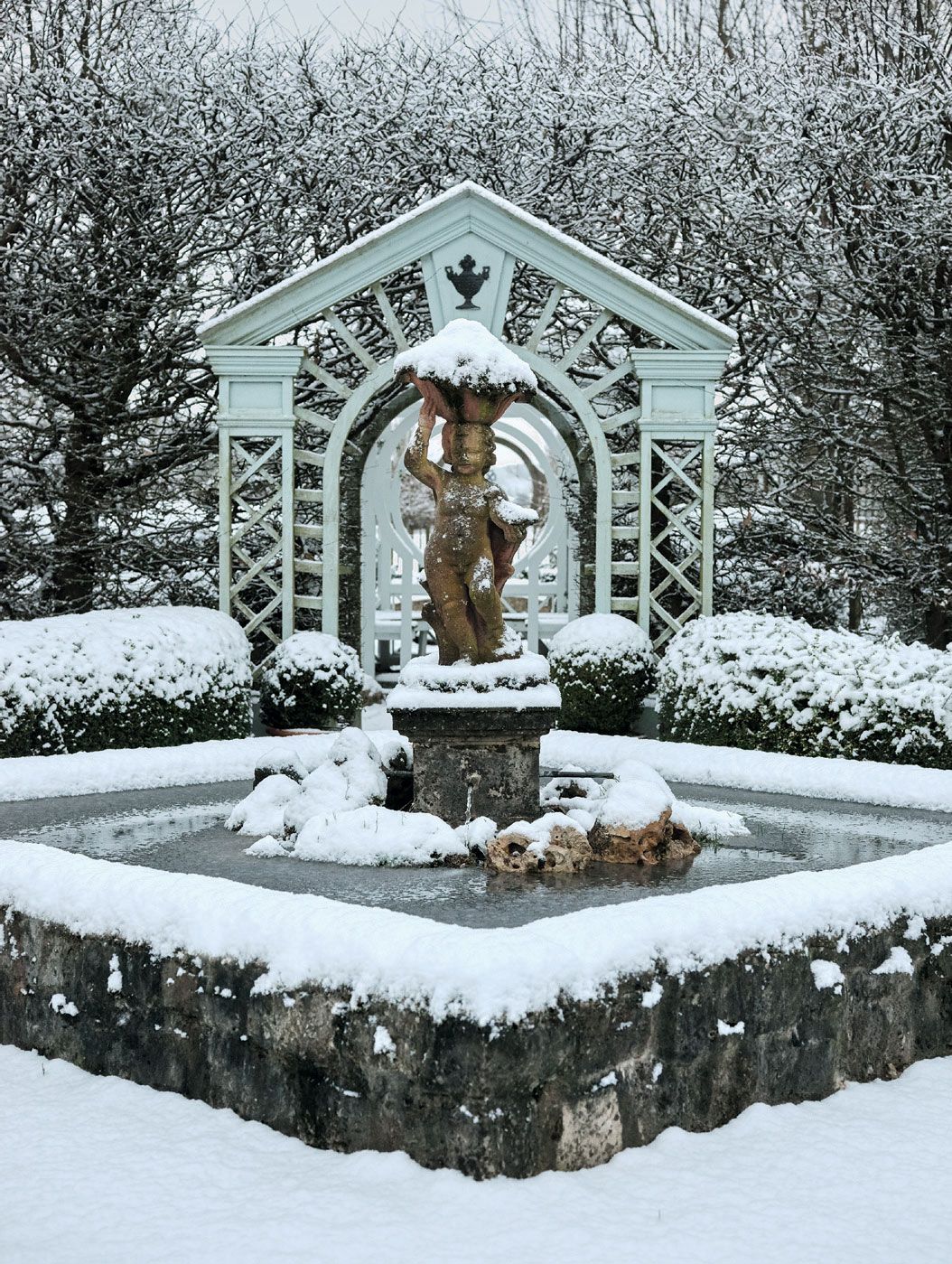
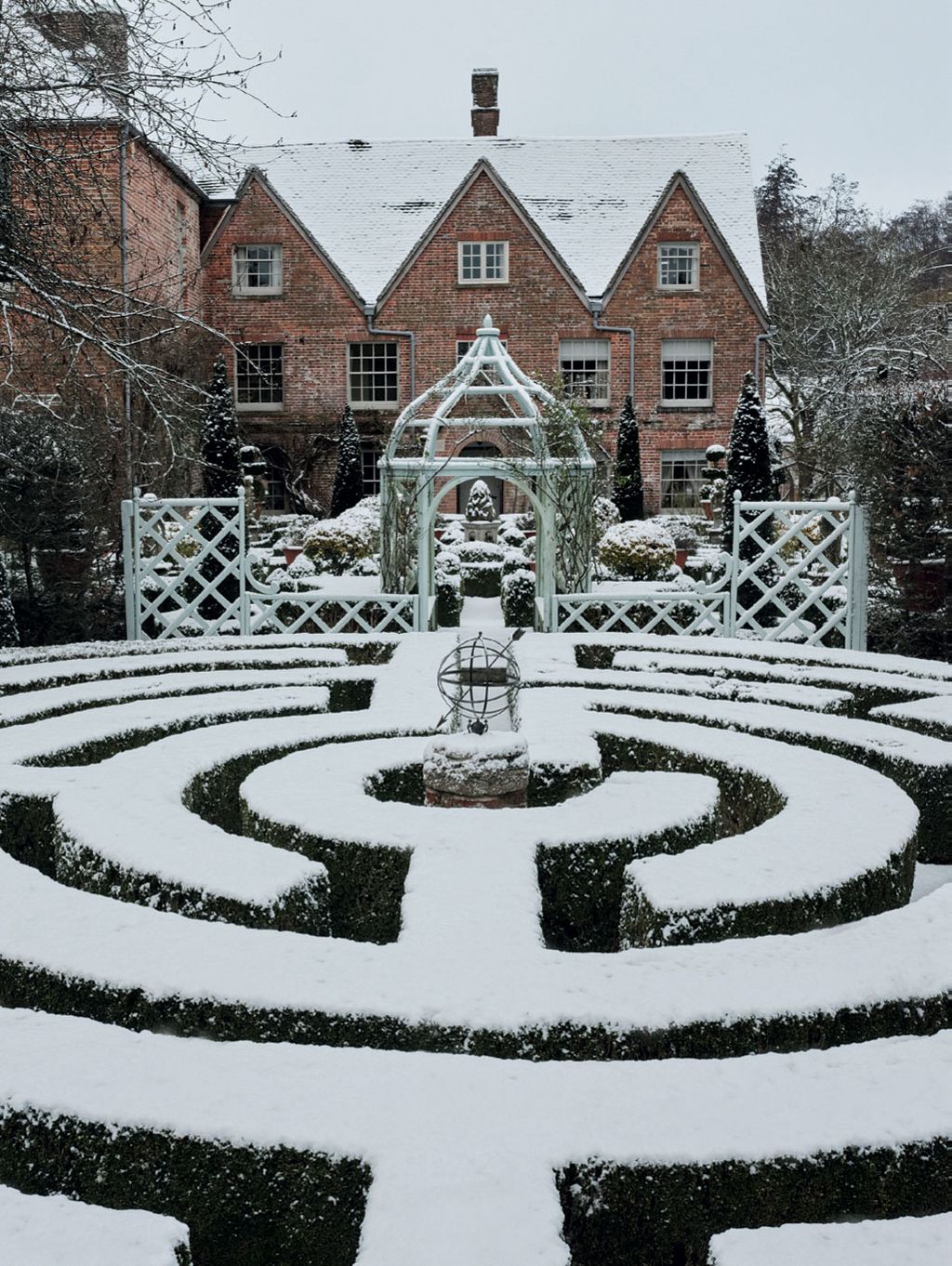
Parts of the house date back to the 13th century, but it is Tudor in feel, so needed a theatrical space, as well as structure. Tudor gardens were influenced by the earlier Renaissance Italian designs, with formal topiary parterres, viewing mounts, fountains and also areas of wilderness. The owner had these in mind when he planted the elaborate parterre in front of the house. In a design based on an original drawing by the 16th- and 17th-century architect Robert Smythson, the low box hedges and elegant yew cones lead the eye towards a circular box labyrinth with hornbeam cloisters beyond. As the owner explored different realms of garden history, new areas were developed: pools were excavated and mounds created from the spoil, hedges were planted and clipped into sculptural forms, and avenues of trees appeared – to lead the eye and play with perspective.
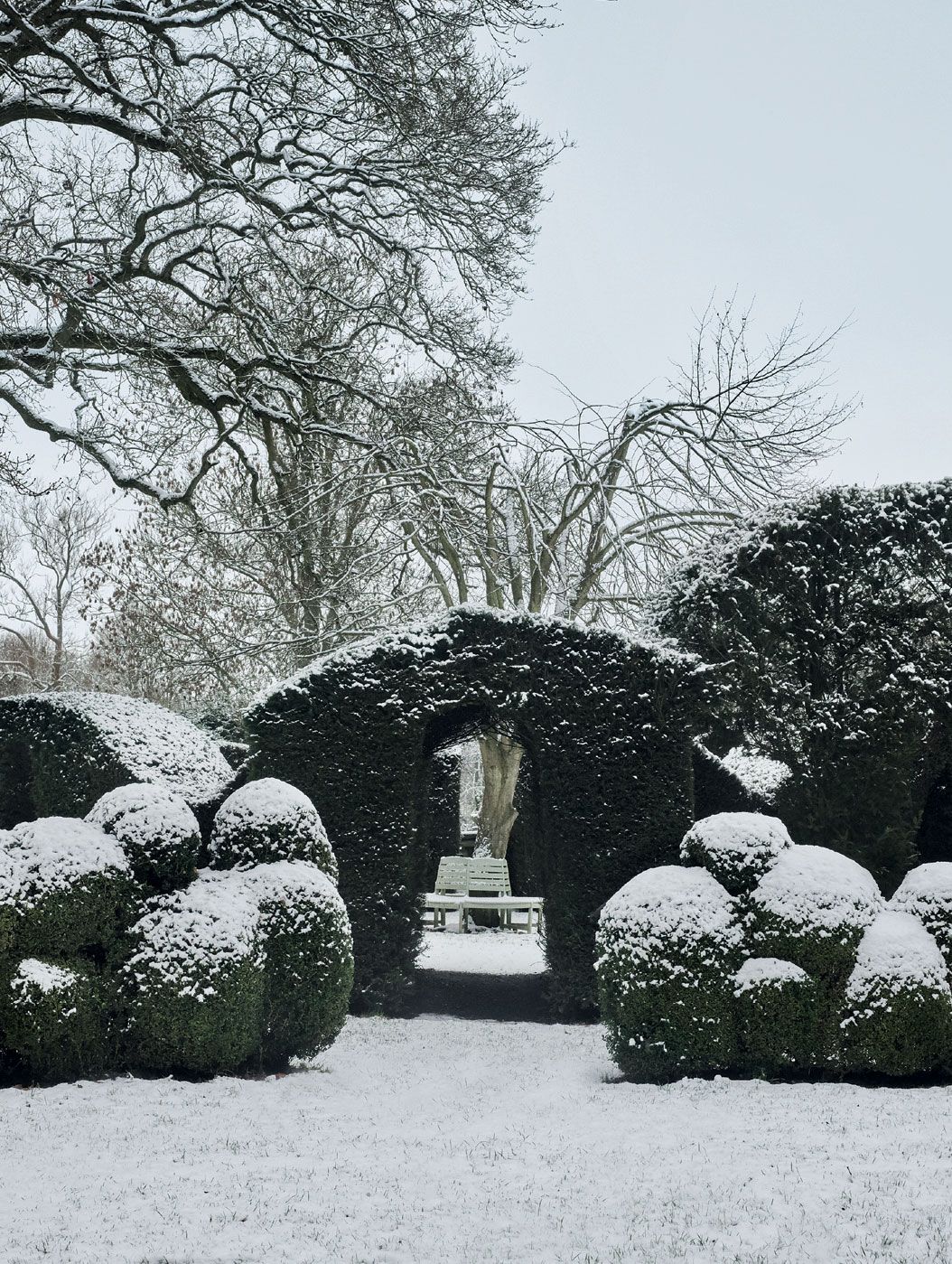
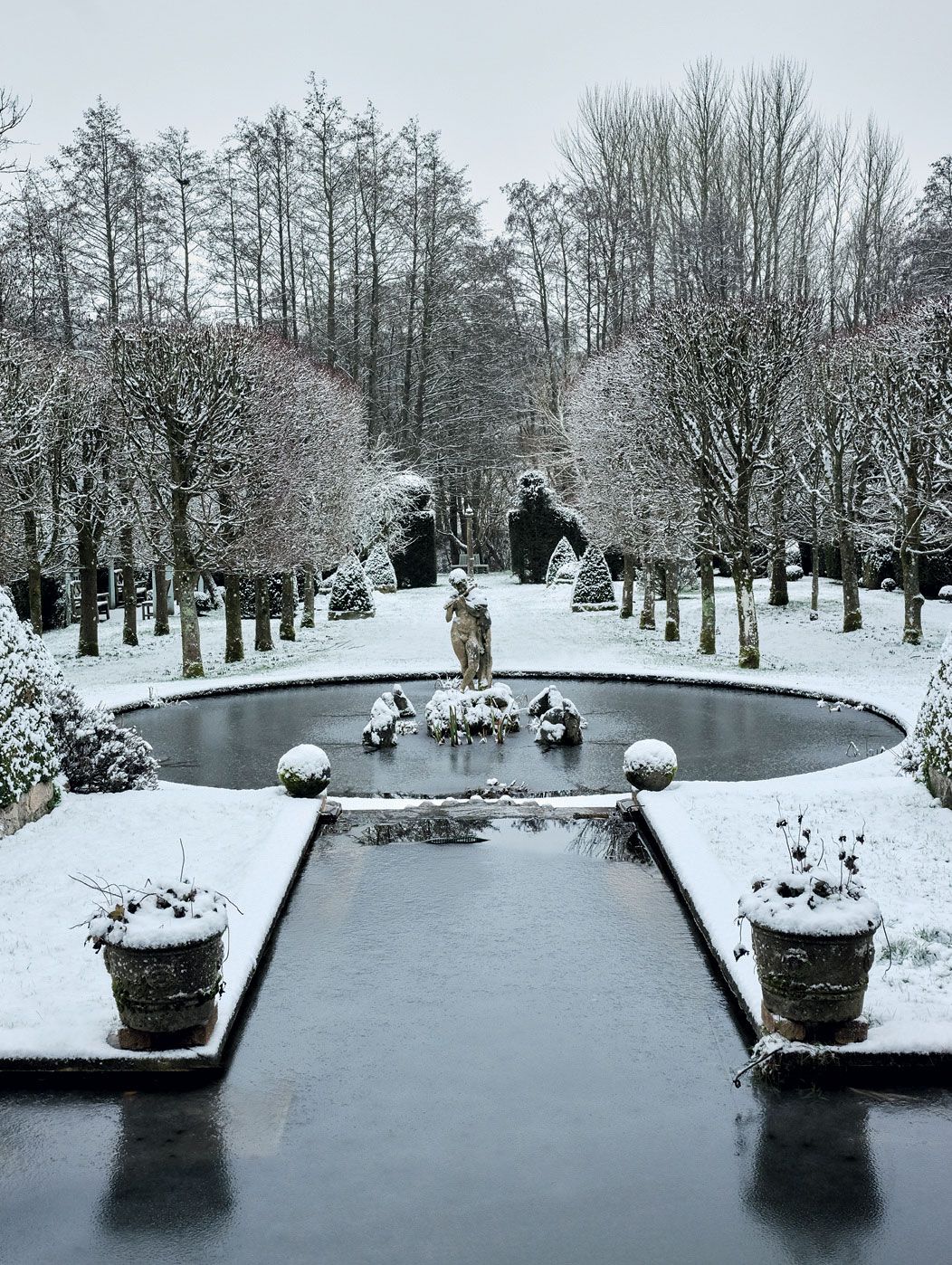
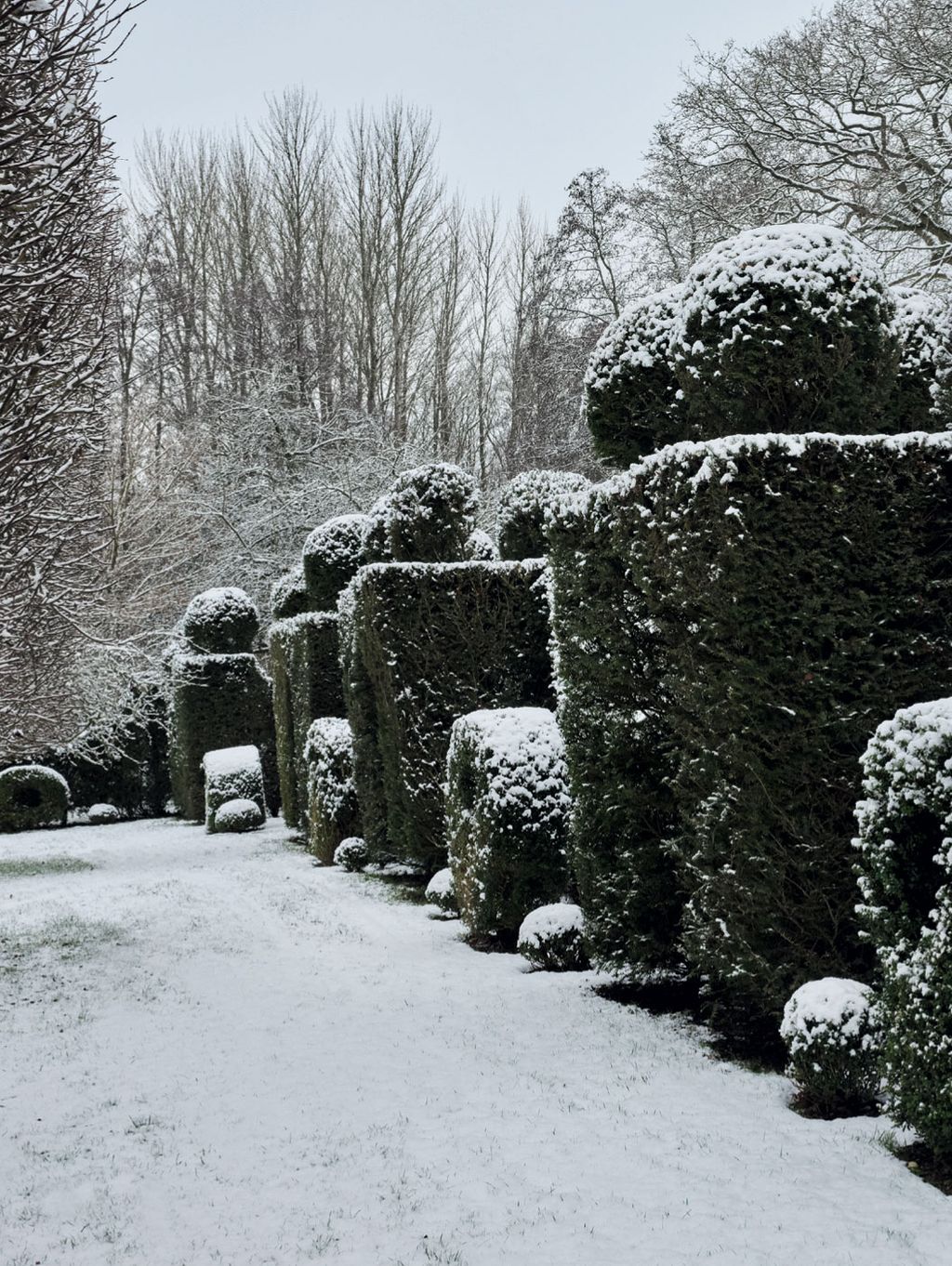
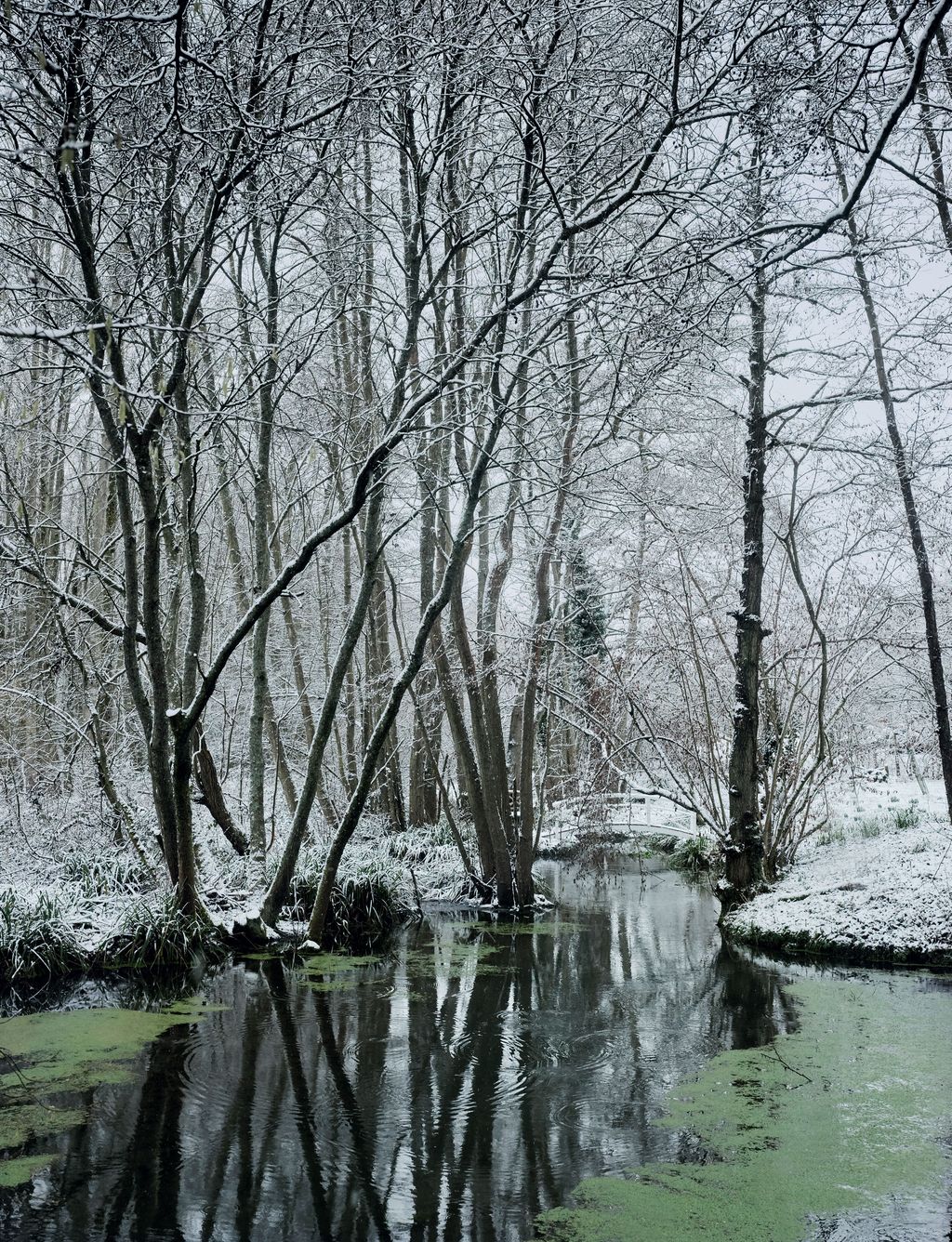
Around the house is a series of intricate tableaux that hold the eye, but as a counterpoint to the formal parterres, more informal areas were developed, exploring the notion of sharawadgi. This naturalistic style of design – based on the Chinese practice of planting in an apparently haphazard way – became fashionable towards the end of the 17th century, paving the way for the new landscape gardens of the 18th century, when formal areas were swept aside to create a more relaxed style. So, here, the neatly clipped parterres near the house give way to intriguing cloud-pruned yew hedges further away; an elegant double avenue of pleached limes culminates in a gateway of yew, which, in turn, frames a leafy, enticing view. ‘All gardens should contain both symmetry and asymmetry,’ says the owner. ‘Symmetry gives you balance – it is about holding momentum and slowing the thought process, whereas asymmetry is all about movement and flow. This disturbs the eye, quickens the heart and intrigues.’
These multi-layered strands of cultural and garden history were not the only influences. In his twenties, the intrepid owner embarked on a journey to Japan to take up a job as a journalist on a Japanese-English newspaper. But instead he found himself living in the Zen monastery of Daitoku-ji, which is acclaimed for its art collections and its gardens. Part of his Zen training required him to weed and sweep the temple gardens and he became fascinated by Zen Buddhism and by the Japanese tea ceremony, which had originated at Daitoku-ji 500 years previously. His deep-seated, spiritual connection with nature is the real driving force behind this garden. ‘Zen teaches us that we are at one with nature – that we are nature. The shared force of nature flows through us and a garden can be a gateway into this experience, leading us into another realm of awareness. A garden is full of a thousand views – you just have to be open to them,’ he explains.
There are indeed 1,000 views within this remarkable garden and, wherever your eye roams, the outlook changes: glimpses through windows in hedges, cleverly framed vistas across different axes, borrowed glances into the landscape and elevated views from mounds or steps. The idea of entering the sublime through nature and landscape – as explored by writers, poets and artists of the Romantic era – is at the root of the owner’s philosophy. ‘I’m fascinated by how a garden or a flower or a view can hold you, how it can change your physiology, your heartbeat and your breathing pattern,’ he says. The deep spiritual and cultural seams that run through this garden are what define it, but there are practical considerations, too. Although conceived as low maintenance, with little herbaceous planting, it has a vast network of evergreen hedges and topiary that must be clipped every year. Increasingly, this task is done in winter, which is thought to be less stressful for the plants and therefore reduces the risk of blight.
This garden is a visual manifestation of one man’s active and enquiring mind; like the mind itself, it is ever evolving, with new areas still being added and new vistas opened up. ‘A garden is never finished,’ he says. ‘I am compelled to keep going – a garden is a realm of experience, which is visually centred on not only a flower bed, lawn or tree in leaf, but also shapes, patterns, lines of flowing movement and sudden views that unfold. So many British gardens are designed purely for spring and summer, but many garden traditions prize all the seasons equally and seek to build a changing enchantment that resonates in different ways throughout the year. Winter is the time for reflection and possibility. The garden is impermanent, it dies and comes back to life. It teaches us to accept that nothing is everlasting, that in sadness there is joy.’
‘Winter Gardens’ (Montgomery Press, £45) is available to buy from montgomerypress.co.uk
 Andrew Montgomery1/6
A wooden trellis and gazebo separate the labyrinth from the front parterre.
 Andrew Montgomery2/6
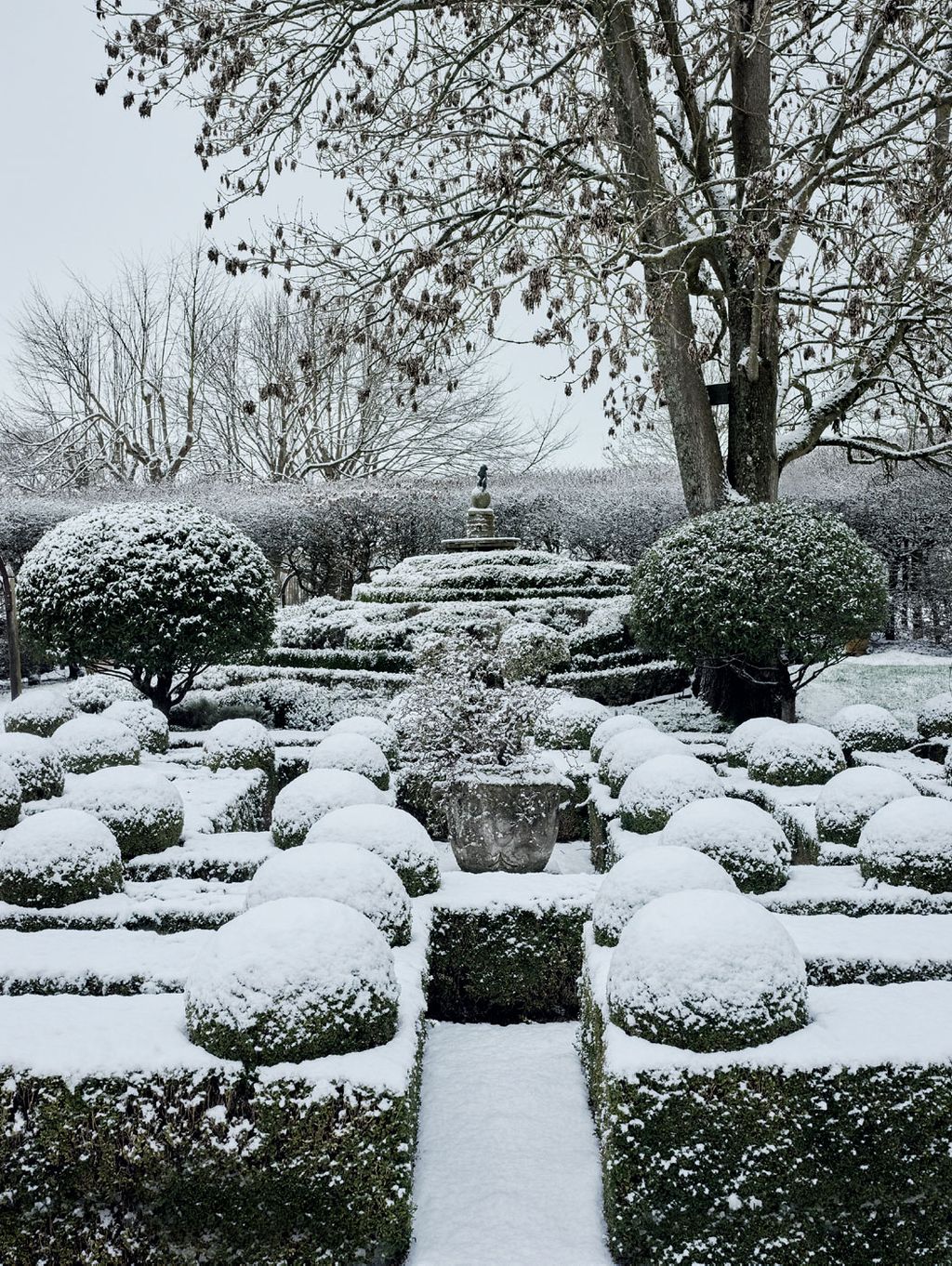
Two domed Portuguese laurels at the end of a box maze frame a view of the Monkey Mount, topped with a statue of a monkey.
 Andrew Montgomery3/6
On the far side of the house, a second parterre is based on another Smythson design.
 Andrew Montgomery4/6
Large-scale yew topiary is clipped into playful shapes, highlighted by frost and snow.


 Andrew Montgomery5/6
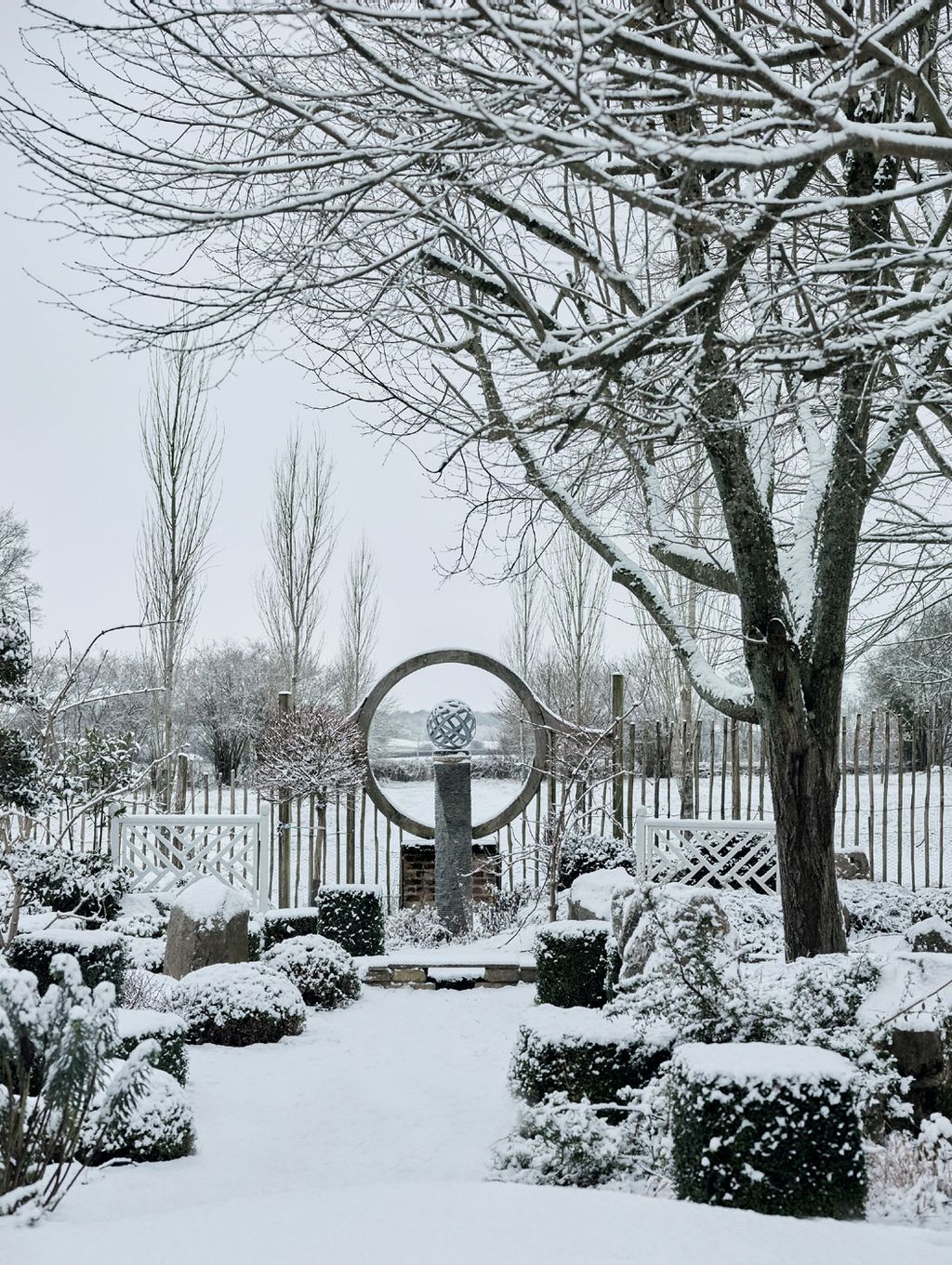
A moon ‘window of enlightenment’ reveals a view of the landscape beyond.
 Andrew Montgomery6/6
A pond creates a reflective surface inviting contemplation, in one of the more naturalistic areas on the edge of the garden. Here, the boundaries with nature are blurred and the Chinese notion of sharawadgi is explored – avoiding rigid lines to give an organic appearance.


