


The AGA cooker versus the Everhot stove: it's an age old debate that can get heated very quickly. Most AGA people can't understand the Everhot passion, most Everhot people feel the same about AGAs. The rest of us think they're the same.
This piece is for those searching and deciding between the two. It's for those on the fence of both, who can't ask about the pros and cons of either without getting a biased response from both camps. It's for people who are considering including one in their house, but aren't sure which range cooker is right for them. We'll look at their defining factors, their backgrounds and futures, as well as getting into the nitty gritty details.

So before we begin, a confession. Your writer grew up with an AGA: a four door black stove that is very much the heart of the house. However, in the interests of this article being genuinely useful, all biases will be set aside. Hopefully.
AGA
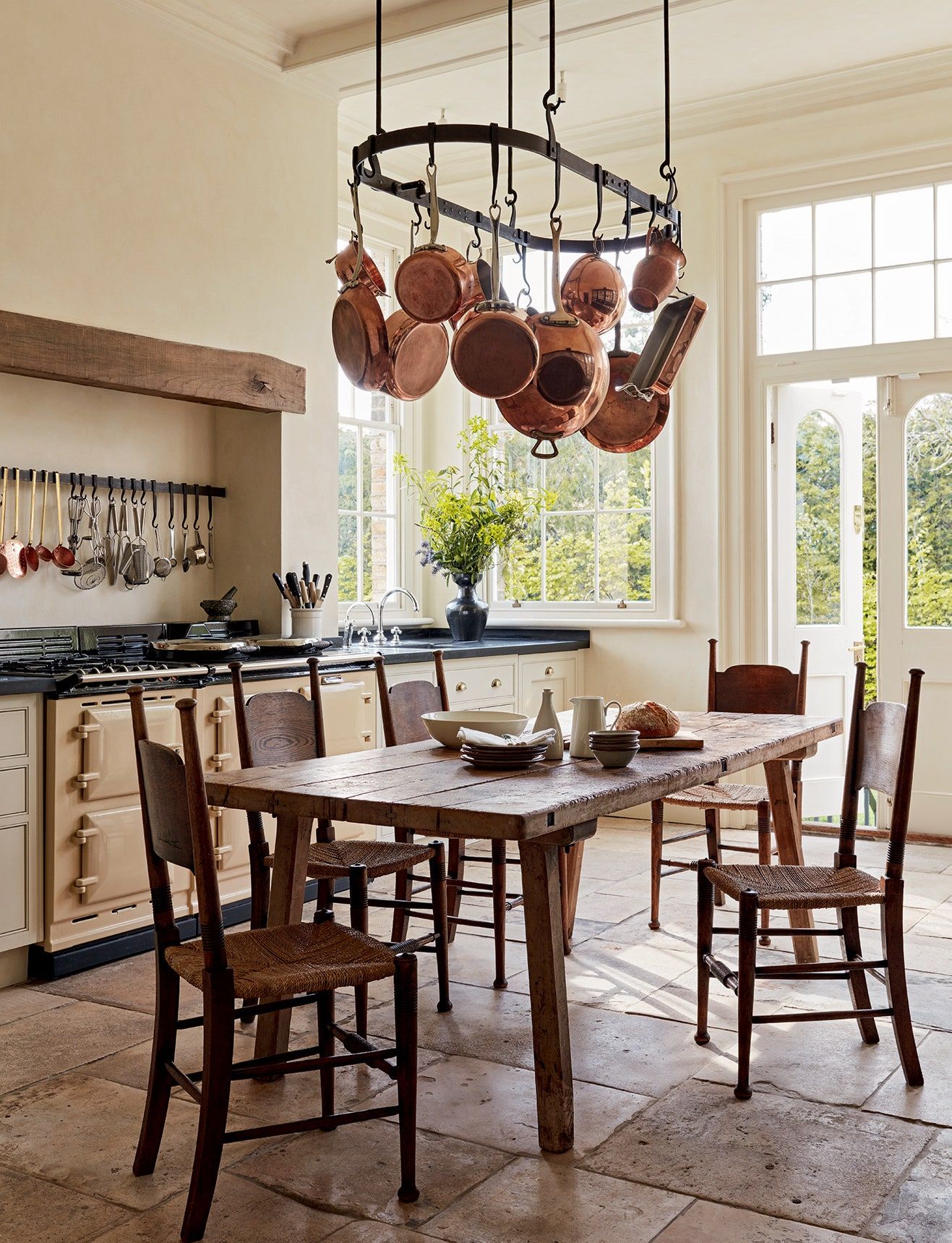
The AGA is so synonymous with British country cottages that it's hard to imagine it wasn't actually invented here. Created in 1922 by Swedish physicist Dr Gustaf Dalén, it was dreamt up in his own kitchen when he became concerned for his wife using a dirty and dangerous range cooker. Dalén wanted to create a cooker that was more hygienic and more economical to run than the standard cookers available at the time. When the Aga arrived in Britain in 1929, it was a runaway success.
In over a century of history, the Aga has been through a number of phases, steadily earning a place in a huge number of country kitchens. In the 1930s, the waiting list for one was more than six months. Today, the Aga eR7 series offers a touch screen and independently controlled ovens and hotplate: a world away from the 1922 model.
For its first 34 years, the Aga had only been available in cream, but come 1956 everything changed with the release of four more colours. The famous stove was now available in pale blue, pale green, grey and white.

Everhot
Whilst it might not have the years on the Aga, the Everhot has certainly made a splash in its short lifetime. Created in the 1970s by Ossie Goring, the Everhot was born of the desire to make a more energy efficient range cooker. The first model ran on both electricity and a water turbine, moving to the electric-only model about a decade later.
According to Graham Duke, sales director at Everhot, their best selling cooker is the “Everhot 120i, with three large ovens, cast iron hot and simmer plates, and a 3 zone induction hob.” Essentially, it's a cooker that has the “capacity to cater for all occasions."
Colour wise, Graham notes that “the majority of our customers will play it safe and choose from a range of pastels. Our Cream and Sage colours are popular. However Graphite and Marine Blue are firm favourites and these two are the most popular colours.”
Head to head look
Everhot: Everhots perform slightly worse than Agas when looked at as a heating unit. According to TNCook.co.uk, “when set at the same temperature the Everhot will emit about 60% of the heat (about 0.6kW) of the (Traditional) AGA. As a result, it will use less fuel and cost less to run–again about 60% of an AGA.”
Aga: All models performing at full cooking temperatures will emit about 1kW of heat to the room.
Historically, the Everhot has been much more energy efficient than the Aga. However, the Aga's new models are pretty competitive too.
Everhot: The Everhot pioneered the idea of a range cooker that can be programmed to lower its temperature. All models include the ‘Eco’ mode, a setting that can be used to lower the cooker's temperature from 9pm each evening to 6am every morning. This means that the Everhot isn't pumping out heat 24/7, and allows for greater flexibility and lower running costs. As Graham adds, “the Eco Mode also includes an oven delay feature which allows you to separate the heating up of the hot plate from the ovens so your cast iron hot plate can be ready for tea and toast in the morning.”
Aga: Whilst the older, more traditional models are not flexible, the eR7 Series and eR3 Series Agas can be switched on and off as needed. These offer super fast heating times and the independently controlled ovens and hotplates. This new model also includes the ‘slumber’ setting which can reduce heat output and running costs.
Other models, like the Aga 60 and Aga 3 Series have an optional timer that can control the top oven. It can be set to pre heat at certain times of day, or on particular days of the week so it's ready to go when you want, but not wasting energy when you don't need it. The 7 Series R7 is not programmable and therefore has a higher energy consumption.
Instagram content
Everhot: The Everhot was built on principles of sustainability. They've been carbon negative since the mid 1990s and have a “longstanding rewilding and tree planting program," notes Graham. He adds, “last summer we welcomed bee hives to Coaley Mill and one of our rewilding sites to pollenate the wild flowers. Along with the water turbine, solar panels at the mill and factory, battery storage, and a biomass heating system we are carbon negative by a considerable margin.”
Aga: Whilst their older models couldn't be considered particularly environmentally friendly, Aga has made huge headway into forward thinking, more sustainable models. Those principles have always been there though. According to the Aga website, for the last 100 years, their range cookers have used a large proportion of recycled materials. “Car gearboxes, guttering, old machinery, cast-iron cookers, door fittings, drain covers, lamp-posts and much more can all be found in the world's most famous cooker.”
Sadly there is no definitive way of saying how much each of these range cookers will cost to run. With fluctuating energy prices and different models on the market, the best you can find is a very rough guide. As a general rule, Aga's are more costly to run than Everhots.
Aga: The cost to buy an Aga depends on the model you opt for. The most affordable option is a new, two-oven model, which costs around £5,925 fitted. In terms of weekly running costs, there is also a huge discrepancy between models. According to CountryStoneGranite.co.uk, “AGAs left on an economy setting will cost just £7.55 per week to run" but, a “four-oven is [around} £40.34 a week.”
Everhot: You can see the full breakdown of energy consumption at Everhot.co.uk, and then compare that to your average energy prices. TNCook.co.uk have put together a detailed breakdown of costs which you can refer to. Starting prices look to be around £6,690.
Everhot: The Everhot offers 18 colour options.
Aga: Aga offer 16 colour options. Each cooker takes three days to finish in its vitreous enamel coat.
And finally, we'll leave you with this tweet from an American Republican politician.


