


I bought a flat with a small, narrow kitchen. Do I take down one wall to make it open plan or leave it as it is? What would you advise re decoration if I left it as it is?
Instinctively, I think most people would advise on knocking the wall down and opening up the kitchen to alleviate some of that narrowness, however with walls, come opportunity to install cabinetry or appliances, so I would be cautious about getting rid of the wall without considering the kitchen layout first. It may be a case that you widen the door way into the kitchen, so you don’t have an immediate pinch point, but keep the bulk of the walls for a galley style kitchen. Balancing one side of the room with taller units, and high level cupboards, with base units and open shelves on the other, would allow you to retain some visual width (so you don’t feel so hemmed in) and maximise the usable surface area. At the very least, you want the kitchen units to either be an L-shape, but a U-shape would be best, so plan inside out, and then remove whatever amount of wall you can spare. Introducing a two tone kitchen is also a great way to help minimise the units from feeling too overbearing. Perhaps have the base units in a dark colour to anchor the room, and have the higher units painted in a lighter tone, and blend in with the walls.
How do I plan a small entryway for a family of five?
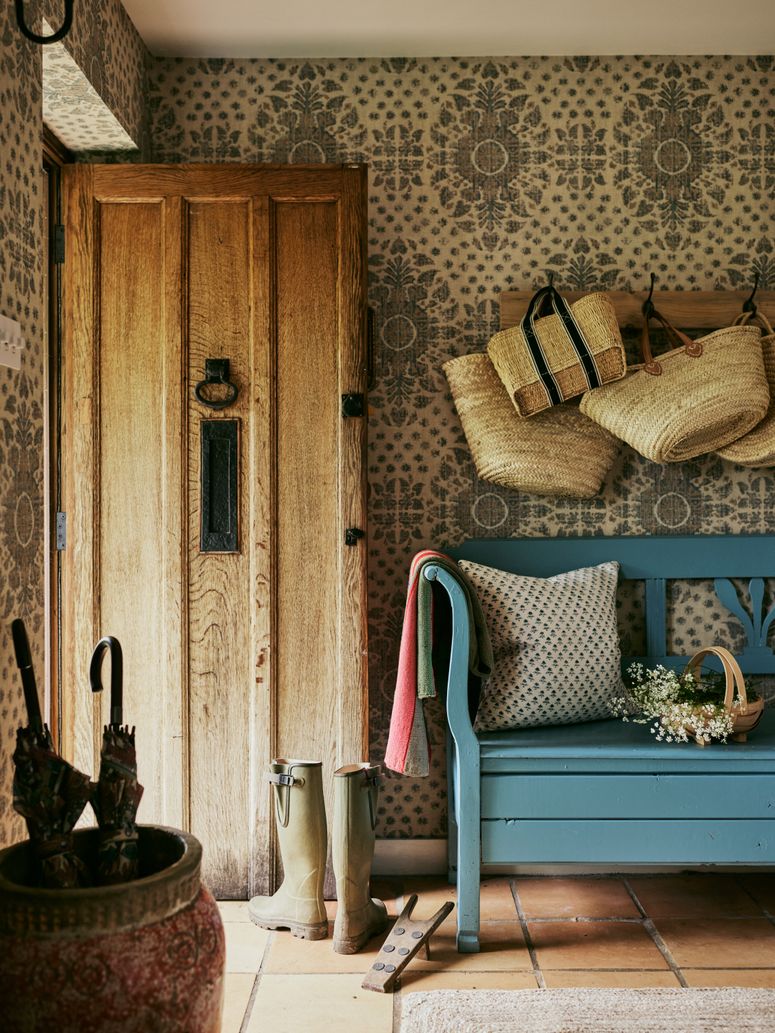
When it comes to functioning or overcoming the practicalities of lots of people in small space, you need to be quite strict about what you can and can’t leave lying around. In particular in a small entrance hall, one needs to be quite regimented to ensure that you aren’t letting the space down in favour of a swift exit. It may be the entrance hall, but it’s not a boot room, so function should follow form in this case…to a degree. So my first tip would be to retain only the necessities, and the rest find a home elsewhere. That includes leaving piles of shoes at the door. You want to avoid visual clutter. Make the most of the space behind doors. I’ve positioned my coat hooks on a wall which is predominantly covered by a door, so that you never really see the coats which do live there. Surface area is key, so a chest of drawers, which each family member can occupy a space in, gives you the storage you need, but doesn’t fill the vertical surface area of the room which may make you feel hemmed in. This will then give you the opportunity to layer the space better, with the likes of lamps, art, mirrors or a plant, which will immediately make the room feel more lived in, and less like a transient dressing room. If space allows, some sort of a seat is always great. I have a rickety antique chair in my hallway that is just enough to sit to tie up a shoe, but doesn’t eat too much into the room. You just need to perch, not to lounge around.
What sort of colours should we consider to make a room look bigger?
So slightly controversially, I don’t believe that the colour you paint a room will make it feel bigger, rather it comes down to the proportions and scale of what is included in that room. If you are concerned about going with a saturated colour, and your perceptions of this making the room feel smaller, I am a big fan of mixing neutrals as a way of making a room feel layered, without over filling it. So paint your walls a different shade than your skirtings and cornice, and paint those a different colour to your ceiling. A studio favourite is the slate range from Paint & Paper Library (the cashmere is just as lovely) and a mix of shades one to four introduces a really subtle mix in a room without it looking too colour blocky. You want the variances to be existent, but subtle. Opting to paint your ceilings a “new colour” is also a great way to introduce new tones into a space, as is painting your doors a contrast colour like Studio Green or Railings from Farrow & Ball. Once you have this neutral, and layered base, you can start on the furnishings, focusing the most saturated colours on the elements which touch the walls (headboard and curtains for example) ensuring the middle most pieces are the lightest tones. If paint really made a room feel smaller, we’d have bright white downstairs loos dotted all over the country.

How do you make a small bedroom feel calm yet interesting?
Always always opt for white bedding in small bedroom (or any bedroom for that matter) and layer with a single throw and cushions to tie in the scheme. You don’t need your bed to be a huge block of colour in a small room, so no coloured bedding, it will make the room feel too middle heavy and wont help it feel calm. Less is more when it comes to cushions on a bed, so my suggestion would be to opt for a single oblong cushion, rather than a layering of multiples. This also means you only have one decorative cushion to worry about at the end of the day. Don’t leave a blank wall in a bedroom. Occupying the Y or vertical axis in a small room will draw your eye up and around, and makes all the elevations feel considered. Layered window treatments are also key to making a room feel calm. I have a black out roman blind and unlined curtains in my room. The combination of this feel quite layered, and ensures that this window elevation has more detail than not. You can create a calm room in a multitude of colours, so don’t feel you need to shy away from colour. However the more saturated the colour, the less additional colours you should add. That way ensuring you a cocooned colour, rather than a colour blocking effect which interrupts the calmness.
What are your tips for the colour and type of tiles for a fully tiled, small bathroom?
If in doubt, a white metro tile (15x7.5cm) with a fine crackle or glaze and matching grout works for any and all bathrooms, and is a great choice for a small fully tiled bathroom. The matching grout means the it all just blends into the background as a texture, rather than being a feature. Rotating a row of the same tiles is a great way to add a break or detail in the walls without adding in a new colour or tile. You want your walls to be subtle, and then layer on that with the likes of an antique interesting mirror, wall light, vanity shelf etc. As a way of introducing a colour or tone into the room, tying it together with the greater scheme of the home or bedroom, introduce a colour on the floor tiles or vanity. Keeping colours on the bottom third of the room will mean they can be introduced, but wont feel too in your face. If you have a shower, continue the same floor tile into the shower, so you don’t have a stop start of finishes on the floor which would perhaps truncate some of the visual surface area. In my bathroom I’ve opted for white wall tiles and a marble tiled floor. The marble has a lovely organic movement to it, which prevents the fully tiled room from feeling too clinical.

How do you create versatile space for overnight guests?
If you have the luxury of a guest bedroom, you don’t necessarily need to furnish this room in the same way you would a master for example, where you match the left and the right. A guest doesn’t need two bedside tables, so swapping one for a small desk gives a guest some options and extra surface area for their bag or personal belongings, in addition to the side table.
Rather than sacrificing a room for the odd guest a couple of times a year, it is worthwhile thinking about how you could split the room into one day to day function for you, like an office for example, and then easily adapting the space to cater for the bed. A foldable sofa bed is a great shout in a study, and then when in use, the guest still has the versatility of the desk for their stuff. In my study, I have included a slim fold down coat hanger hook, which guest use to hang up a couple of garments. It gives them what they need for a night or two, without the need for a whole wardrobe. If you are relying on a sofa bed in a siting room as the solution for guests, think about where they can easily hide there things so you don’t feel like they are dominating the room during the day. In past projects we have included a table cloth on a side table, which means you can tuck a small suitcase out of sight.

Any tips on getting the scale correct for sofas and chairs in a sitting room?
Every room will come with its own configuration as to how best to furnish it, be that with two sofas and an accent chair, one sofa and a pair of armchairs etc etc, so without being too specific about what will or won’t work, here are a couple of things to keep in mind that will help inform your decision, and are things I take into account on every project. You don’t need much more than 40 centimeter between a sofa and a coffee table, and even less between the corner of one piece of furniture and another. Many people get the scale of furniture wrong, because they are too worried about space between the pieces rather than the size of the pieces themselves. Always try to mix up the legs or bases on your sofas and armchairs. A solid base on a sofa will give it some permanence in the room, whilst a taller leg on an armchair, will make these items feel a little more “light weight” . The difference in the visual weight of the pieces will prevent the whole room from feeling too hemmed in, and mean that you can actually place pieces closer together. If in doubt, try and get your largest piece of furniture to correlate to an architectural focal point like a window or fireplace, and centre the sofa on that, the smaller pieces don’t need to be centred/anchored on anything else other than the coffee table. As long as you then have one piece centred onto something in the room, you can play around with what best fits for the rest without worry of creating an off balance room. A 2400mm sofa sits as many people as a 2100mm sofa, so don’t oversize your sofas thinking you’re catering to more bums on seats. Rather have a slightly smaller sofa if that means you an then introduce two armchairs adjacent.


