

Statement colour and pattern combination
At this former gardener’s cottage on the Hampshire coast, Max Rollitt was challenged to conjure a space that was as beautiful and colourful as the wildflower meadow on the house’s doorstep. In response, he committed to a rustic but bright and somewhat unusual tone: “Brick” by Edward Bulmer. Max describes it as “a very clever colour”, which can appear anywhere between brown and red depending on the light, but which in every case helps create a warm light. As such, a sense of earthiness and organic colour pervades the house – again, in partial reference to the meadow outside.
The colour scheme is carried through the wallpapered steps immediately up into the house from the front door, as well as the lampshade on the light on the hallway side table and the framed art on the wall, a pattern which is among the first things anyone entering the house would see.

Inside the cottage, antique furniture and textiles are blended with contemporary pieces and prints. Looking back towards the white front door, a visitor would see a dramatic floor-to-ceiling curtain made from Borderline’s “Marchioness” in Teal; the small house dates to the 19th century, and combined with the encaustic tiles the curtain brings to mind the design of the Victorian era. White doorframes, ceilings, bannister spindles and both sides of the front door ensure that the brick colour and the pattern aren’t overwhelming.
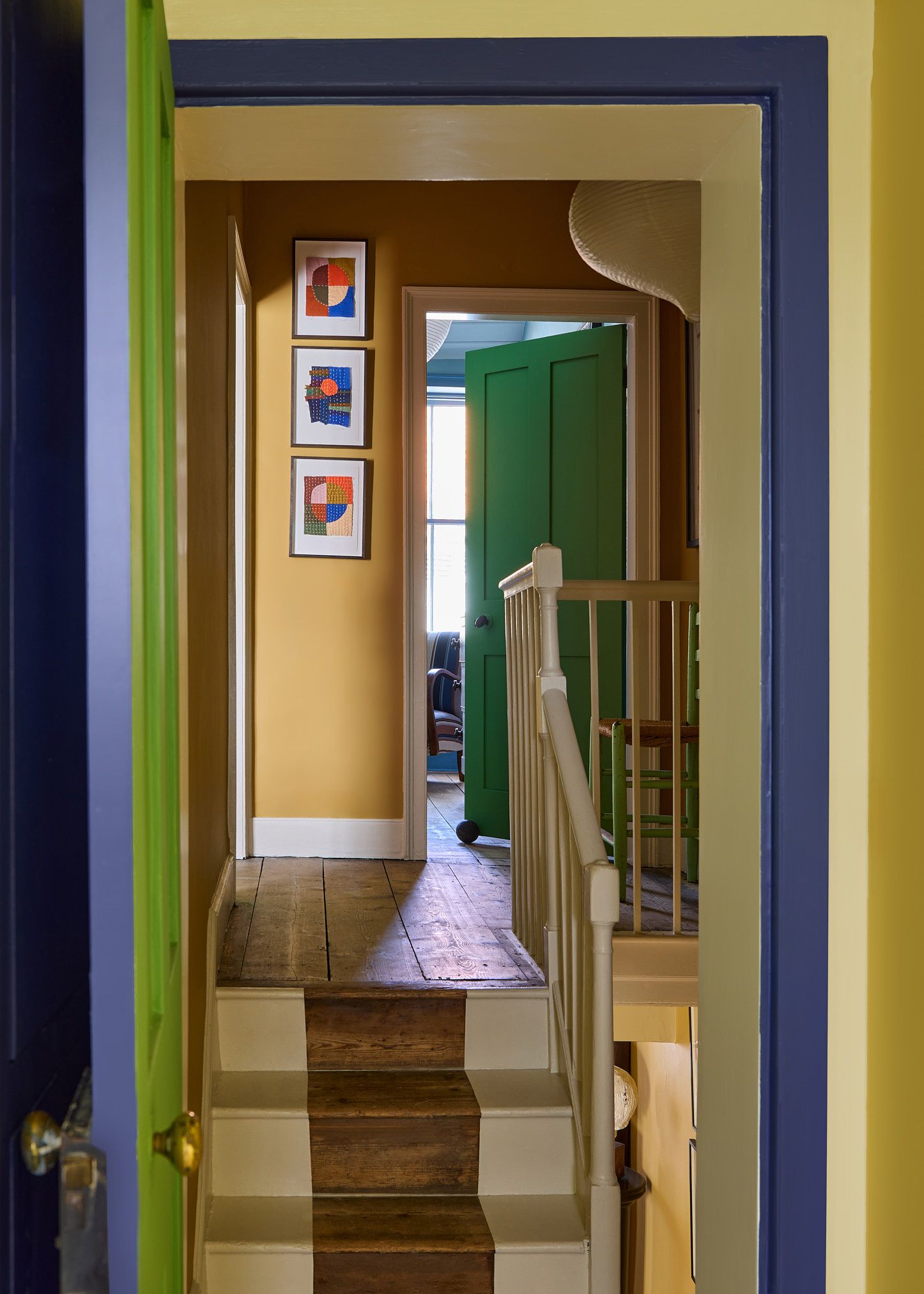
The colour doesn’t have to be as uniform, though – here, upstairs at Russell Loughlan’s cottage near Deal, Russell has used a yellow for the walls, with a complementary architrave in Farrow & Ball’s indigo-lavender “Serge” and green doors in “Raw Tomatillo”. The embroidered artworks are from local Ramsgate artist Cutts & Sons.
Objets and curios in a lived-in space
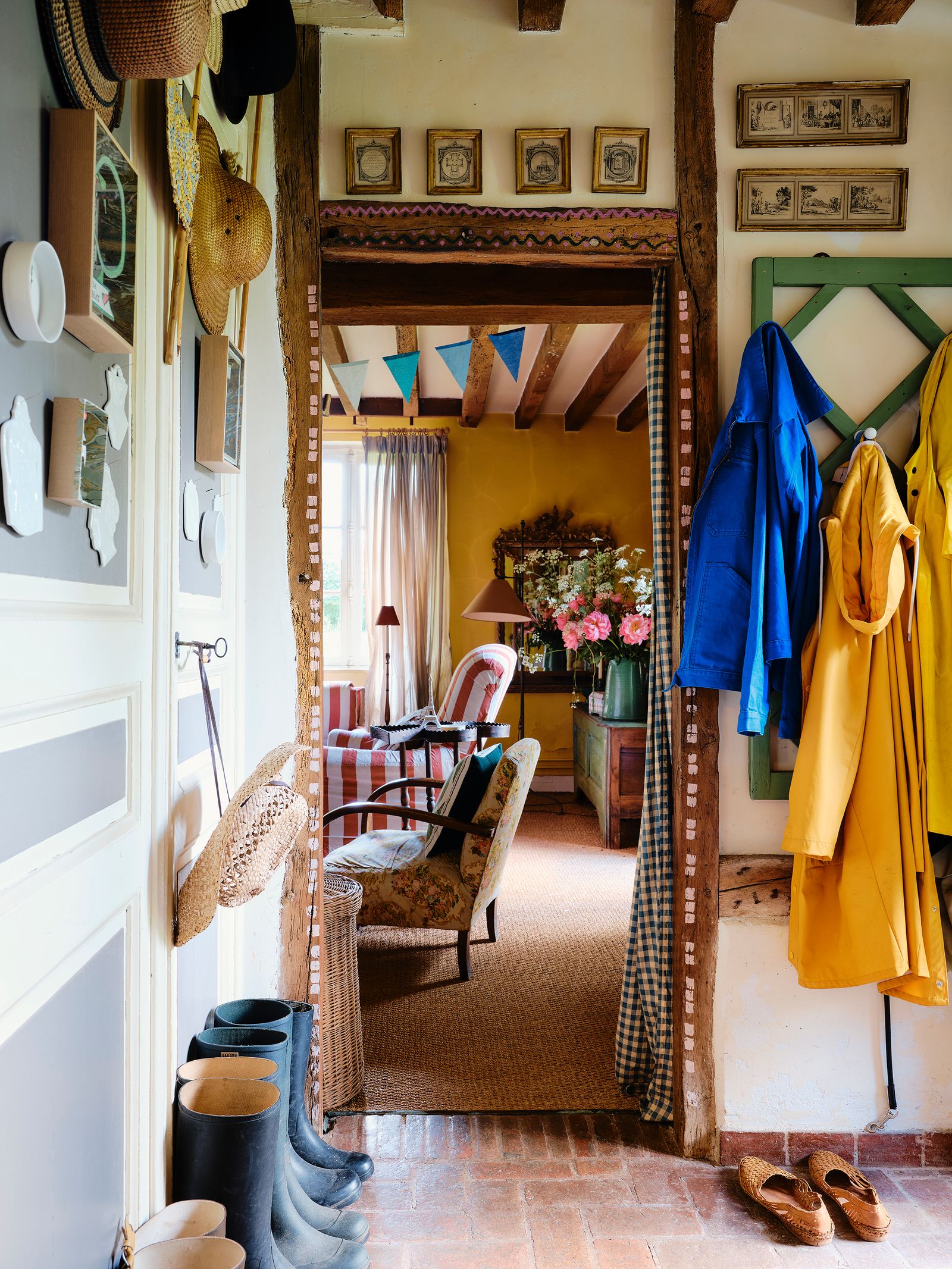
Marin Montagut is a designer who lives and works in the Normandy countryside, and the entrance hall to his rustic cottage reflects that balance, with a practical brick floor, lines of wellies and shoes and various hanging coats and hats, but also a variety of aesthetic curiosities and small decorative items displayed on the walls. The hall leads into the warm yellow sitting room to one side, and the kitchen on the other. Bare, rough wooden beams and slightly worn furniture attest to the house as a real, lived-in space rather than a rural fantasy.

Marin visits fleamarkets almost every weekend, and explains that he simply picks up and buys things that he likes. “I don’t go with a particular thing in mind. I’m drawn to pieces that have a story, a certain poetry.” One of the things he particularly enjoys collecting is antique artists’ palettes. He’s also partial to a straw boater, as might be apparent from the photos of his house.

Among his decorative touches, Marin counts ceramic ex-votos and walking sticks; most of these framed designs are his own.
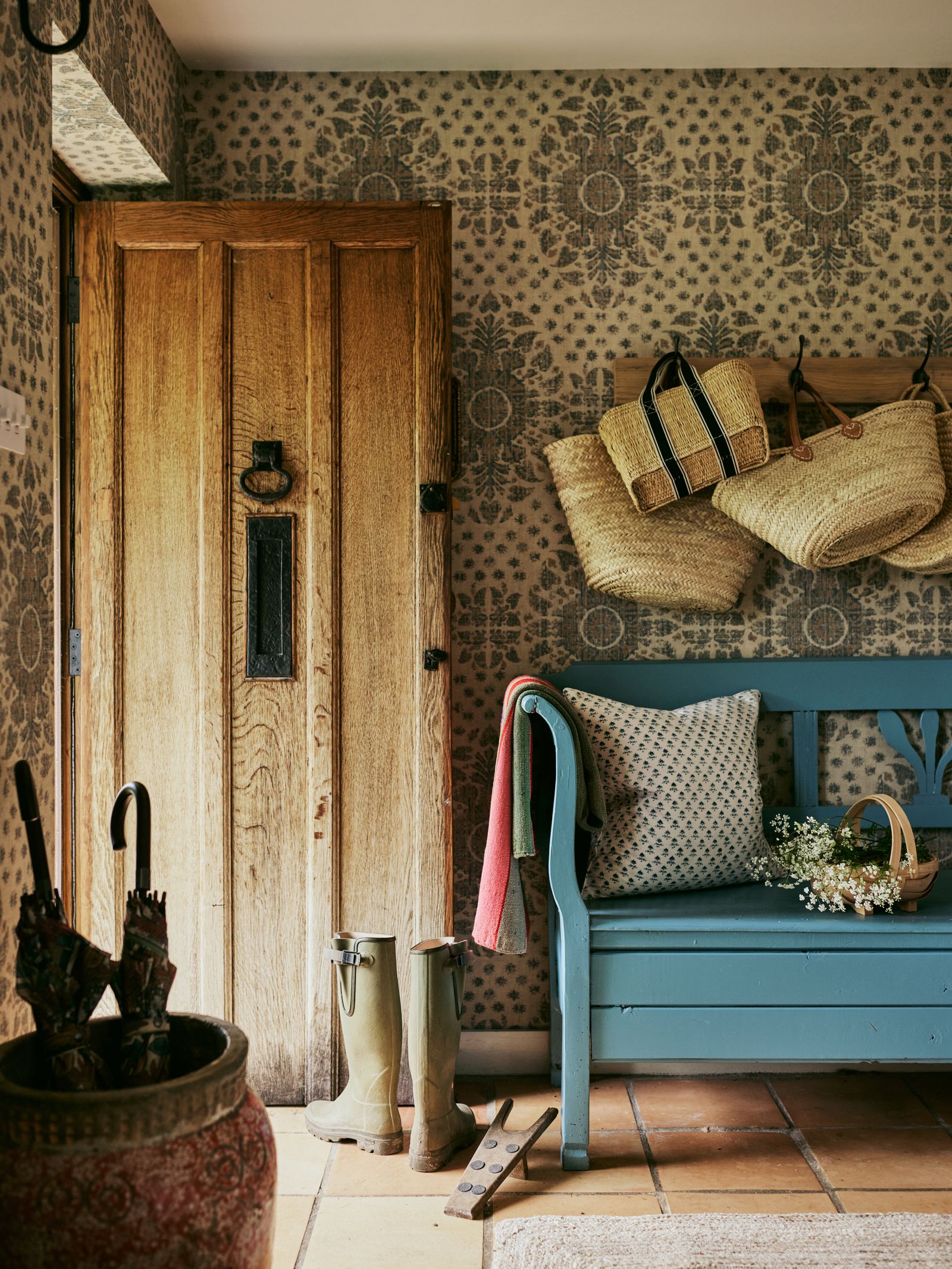
A similar, somewhat traditional rough-and-tumble look has been employed in Lucy Cunningham’s cottage in Hampshire, where a bench from John Cornall Antiques has been painted blue by Lucy. However, compared to Marin Montagut’s Normandy cottage, it’s more consciously interior design-led: Robert Kime’s “Karabak Sand” wallpaper adorns the walls behind the bench, and it’s decorated with a Les Indiennes cushion.
Calm, minimalist first impressions
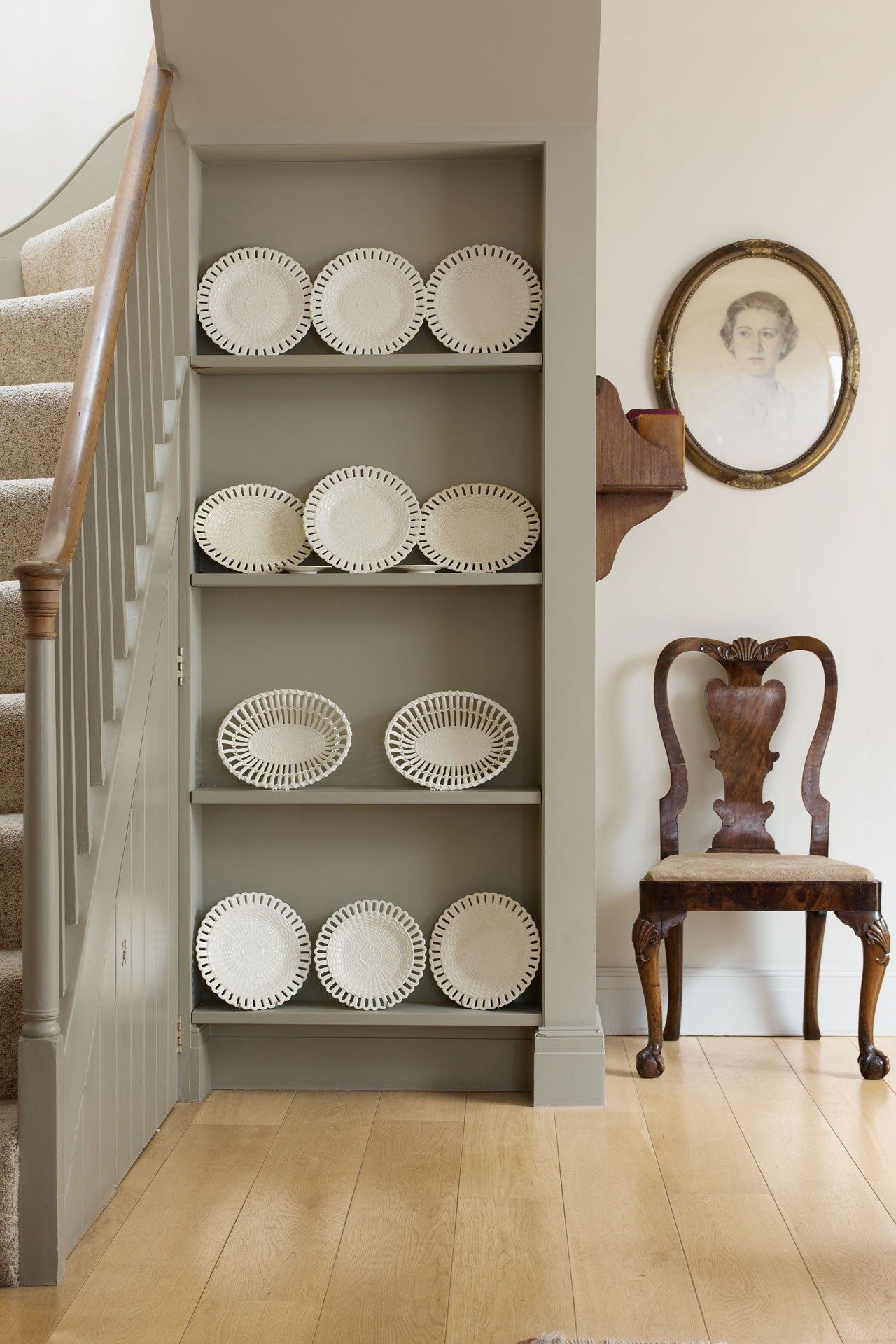
Susanna Swallow’s cottage is in London’s Shepherd’s Bush (yes, you can get cottages in cities – they’re just rarer). That might be why the calming greige tone and light wooden floor look like they work so well; the hallway offers an immediate (visually) quiet escape from the business of the world outside. On a built-in shelving unit, Susanna displays a Wedgwood dessert service, which she inherited but whose likes you can occasionally find in antique shops or on eBay.

This groom’s cottage in the Cotswolds is blessed with a larger entrance hall, meaning there’s more space for a seat and a chair, and framed art on the walls. Nonetheless, the desired (and achieved) effect is similar, with a simple bare stone floor and walls and doors in the same colour that are immediately calming and relatively spare. That spareness is unexpectedly subverted by a 19th-century Italian settee upholstered in rich Boussac silk velvet from Pierre Frey. Likewise, an eye-catching, gilt-framed Charles X clock hangs beside the door, albeit one which is small and self-contained enough not to ruin the simple effect of the space.


