

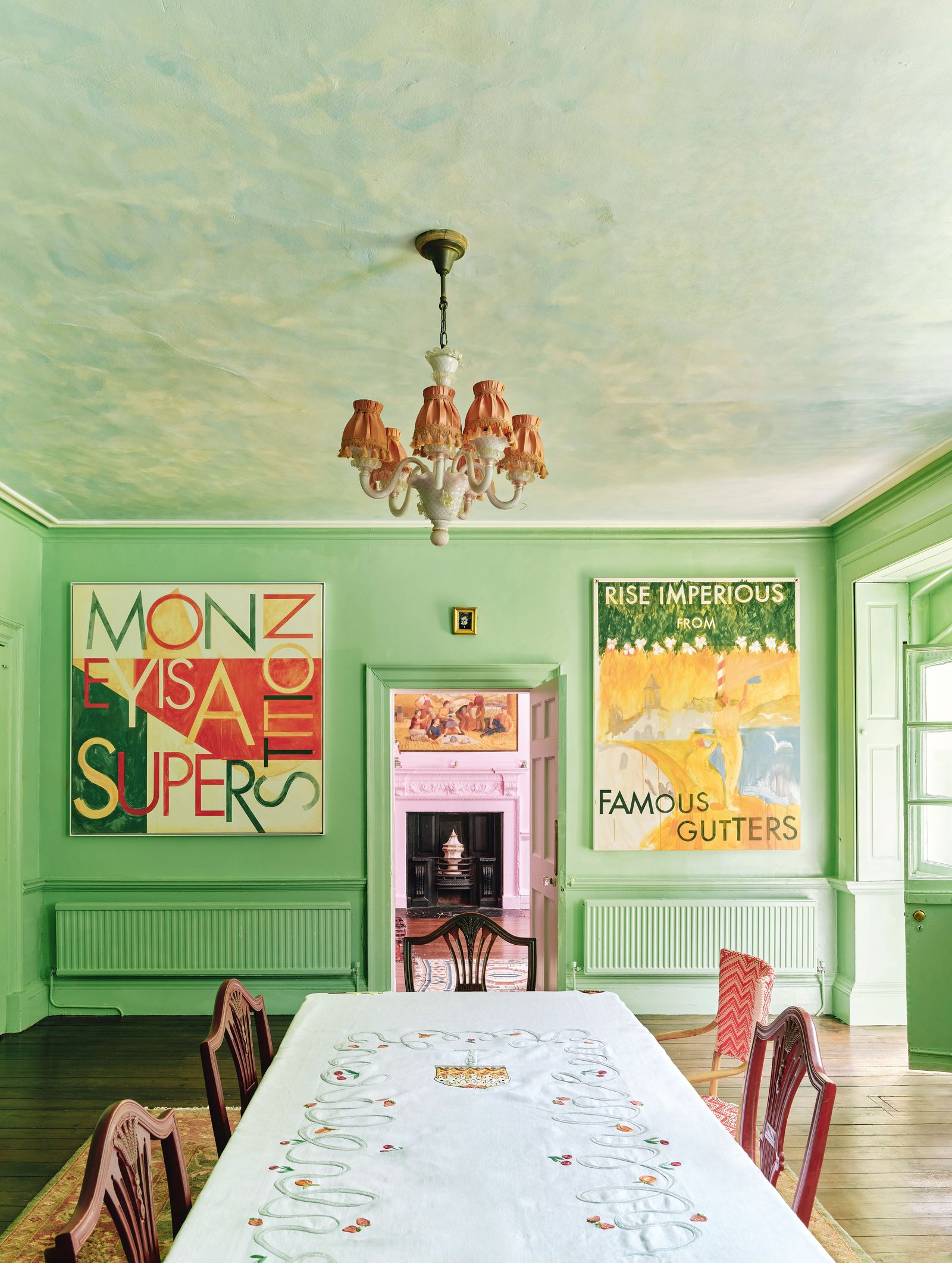
Renovations, restorations and redecorations are exciting opportunities for refining how we live. They can also be expensive and, when you're staring down the barrel at the cost of a kitchen, a bathroom and making a house habitable, art can seem like a frivolous extra. Who would blow it all on a painting when there is a screaming draft whistling up through the floorboards, which could be cured by carpets?
And yet art does not just decorate. Art grounds, elevates and adds to the layered aesthetic that makes a room a pleasure to be in. Art provides a focus over a mantelpiece or depth in an arrangement. It’s not only paintings either, but sculptures, ceramics, photographs, original prints – perhaps even a poster or two. Art can inform a scheme, whether through a colour palette or a Sean Scully-inspired pattern of tiles. For beauty begets beauty and, in its subjectivity, art delivers personality, too. Indeed, while ‘artless’ is an adjective seldom used in the context of interiors (even when literally the case), certain synonyms – ‘uncultured’, ‘crude’ – suggest that far from being peripheral, art is in fact essential. For those of us who are renovating, it can also prove a refreshingly straight-forward purchase, seldom requiring repositioning of furniture.
Extrapolating on Gertrude Stein’s advice to Ernest Hemingway – ‘You can either buy clothes or buy pictures. No one who is not very rich can do both’ – I found myself burgling set-aside kit-out budgets for the revival of our Victorian terrace, in the manner of Hemingway’s description of bankruptcy in The Sun Also Rises: ‘Gradually, then suddenly.’ My kitchen cabinets dropped through price brackets in steady increments to Ikea, and I have become adept at repositioning rugs in uninsulated rooms according to wind direction. (Less convenient was the appropriation of our allocated car funds – but aren’t trains great?)
I’m in reassuringly good company. ‘Art is why it takes me eight years to do a project for myself,’ confesses Philip Hooper, joint managing director of Sibyl Colefax & John Fowler. ‘The moment I see something that might look nice in my collection, bang goes the budget for the shower room.’ A pertinent point being that good art doesn’t wait, but carpets can, and many are haunted by what was let go. Fifteen years ago, I foolishly prioritised a pram.
Of course, it does not have to be so extreme. Philip advises his clients to separate the budgetary pots for interior decoration and art, though there is no handy ratio that determines what this should be. Generally, we buy at the intersection of what we like and what we can afford – the payment plans offered by many commercial galleries can enable the appreciator to push the latter.

Nascent collectors sometimes need encouragement. ‘If you think £15,000 is reasonable for home cinema surround sound, perhaps you could allow the same for a painting in a primary room,’ suggests Nicole Salvesen of Salvesen Graham. Decorative art does have value, but ‘a grown-up house needs some grown-up art, too’, she says, explaining that, for a larger project, she and Mary Graham could ensure that there are funds for such by ‘using fabrics with lower price points in some rooms, reducing the carpentry, or specifying a less costly chimneypiece’.
An alternative solution is time – to save. ‘I think the layering of an interior can be finished slowly,’ says Philip. Nicole advocates using ‘a framed suzani or other textile as a placeholder’. Then, art might come under regular household expenditure, or the budget potentially split between a couple and balanced against holidays, theatre trips and entertaining. Often, the best pieces pinch – though at least a picture provides a view for the offset months of potato-based meals – and a serious purchase might mark a promotion, an anniversary, or an all-clear from cancer.
The approach of ‘time’ is also an argument for starting art acquisition early; to which end, I pay for the framing of my children’s (guided) antique shop finds. Even student digs can achieve a sense of sophistication via the judicial placing of an original print or three and, after a move, a familiar painting can make anywhere feel like home. Plus art is easier to transport – and a safer bet in terms of fitting – than an expensive sofa.
But there is risk involved with buying art and I’m not talking about speculation (which is a different game, though crossover can occur.) More, that momentum builds – often in line with denial of what constitutes reasonable sacrifice. The truth is that as well as being draft-allowing, my floorboards are painfully full of splinters. One day, carpets would be good.


