

The advantages of including panelling in a room are many and various: it can bring texture to walls, add a sense of significance and gravitas to a space, help to unify a room with plenty of other built-in joinery, or neatly conceal storage. Many styles of panelling, however, can feel at odds with contemporary interiors – off-the-shelf panelling is mainly designed to imitate Georgian or Victorian designs, and panelling is often chosen to emphasise the historic character of a house.
To avoid an overly traditional look, there are some obvious styles to avoid, and in general, the principle to keep in mind is that the cleaner the detailing, the better. ‘Heavy, ornate panelling, dark-stained woods, or overly intricate mouldings feel more traditional,’ explains interior designer Emma Shone-Sanders of Design & That. ‘Wainscoting or raised panels with elaborate detailing can also overpower a modern interior. The key is to stick to clean detailing to get that contemporary look.’

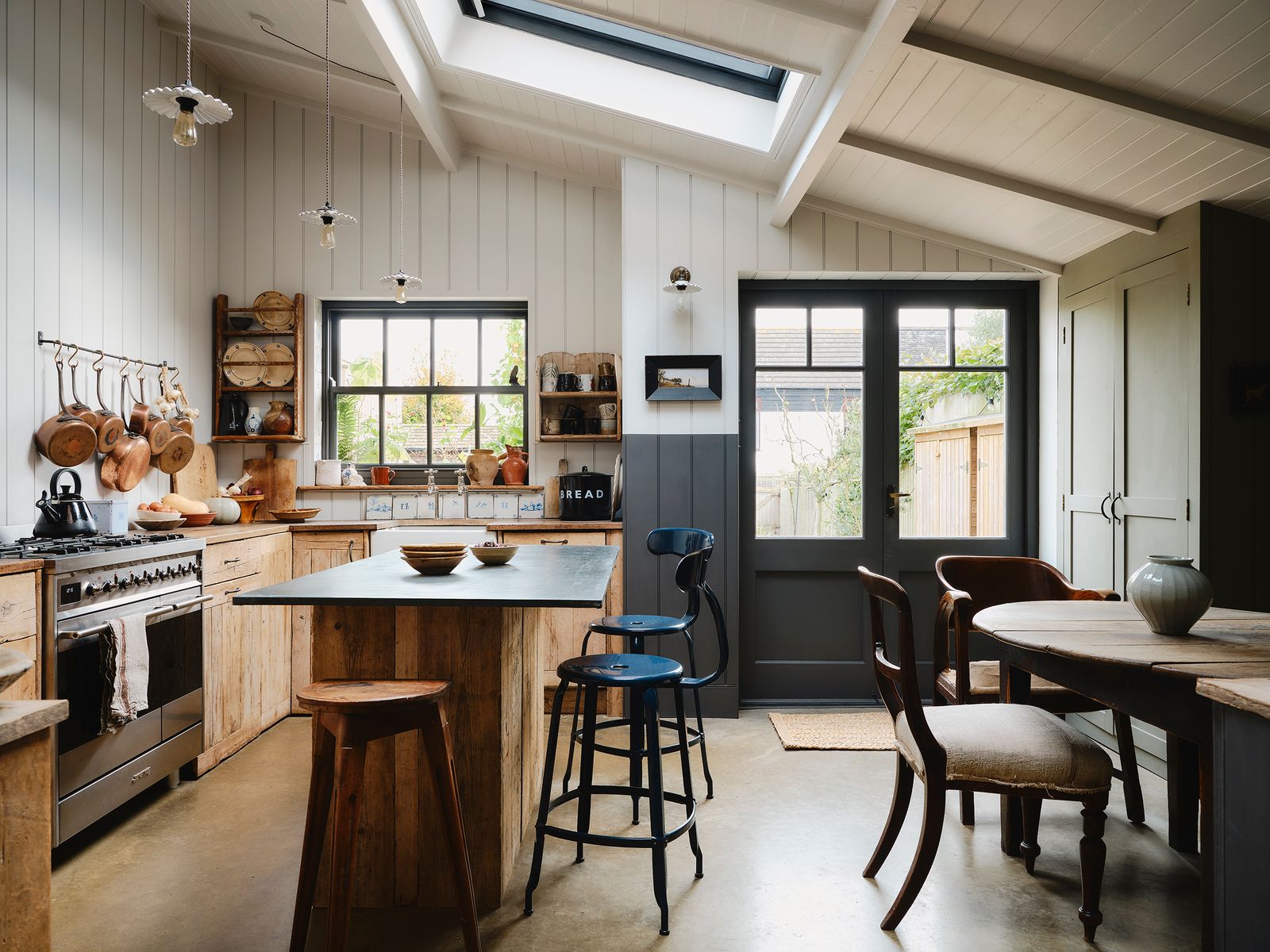
Tongue and groove has had an explosion in popularity lately, and can be brilliant for adding texture and warmth to a space, but often functions to add a bit of cottage-style charm to an interior, or even a ‘downstairs at Downton Abbey’ feel. There are, however, ways to tweak the style to make it more suitable for a contemporary interior. ‘Whilst traditional tongue and groove looks charming in a countryside cottage,’ says interior designer Isabella Worsley, ‘to give a more contemporary look I would consider V-groove panelling. This gives a clean line, and can be achieved in timber with connected timber planks, or routered into MDF.’ The bathroom above, in a house she designed by the sea near Chichester, is an excellent example, and also features wider boards than you would expect from tongue and groove. ‘Traditional T&G panelling is usually around 12cm per plank,’ she notes. ‘However, wider spacing gives a more contemporary edge. You can also try positioning the panelling horizontally rather than the more commonly seen vertical.’


For a more mid-century feel, flat timber panelling creates a warm, 1970s look that is both deeply chic and very in-keeping with the kind of modernist housing stock that makes up much of Britain's urban landscape. To help it feel fresh and fun, use it with bright colours on the furniture or surfaces, as Corey Hemingway has done in her south London house above. She has used Douglas fir for a pleasingly textured finish, and plywood would have a similar effect, but we also love how Brandon Schubert used teak cladding in the modern extension of an Edwardian house in north London, which gives a polished, Mad Men feel to the space. Neither space makes use of skirting boards in the panelled areas. As Isabella notes, ‘skirting is not necessarily a requirement when using panelling to the floor – I find removing this gives a cleaner, more traditional feel.’

For a look which walks that ever-desirable line between contemporary and traditional, simple raised mouldings can be an elegant option. As Anthony Earle, Lead Concept Designer at Artichoke explains, ‘For more contemporary interiors, we like to frame the walls bordering each wall and aperture with a handsome simply moulded or even square edged frame.’ The apartment above shows this approach in action, lending a hint of tradition to an interior that still reads as decidedly modern. ‘This considered light touch still lends impact and character to the room,’ continues Anthony, ’but in a quieter and more understated way than in, say, a grand historic house. The thoughtful detailing and traditional technique is clean and minimal as well as being unassociated with a particular historic period for a “transitional” aesthetic that will stand the test of time.’

For a contemporary look in a period house, this ‘transitional’ approach can be particularly helpful. The proportions of a Georgian or Victorian house may demand a certain level of elaborate detailing in the mouldings, but the decoration can then help to knock back any traditional overtones. In the Victorian house above, Emma Shone-Sanders of Design & That was determined to carry out a sympathetic renovation of the original rooms, which included reinstating a relatively ornate medallion cornicing and high skirting boards, and installing beaded mouldings to suggest panelling on the walls. None of these is a contemporary design in their own right, but the treatment of the room at large removes any suggestion of Victorian formality, with the same warm white paint colour drenching the walls and mouldings, rather than the mouldings being picked out in a separate colour.

In general the finish of the panelling can contribute an enormous amount, as well as the style in itself. Emma Shone-Sanders also advises that ‘bold colours that pop can help keep the scheme fresh,’ while noting that ’veneered oak or lacquered wood work beautifully in contemporary interiors.’ One of Isabella Worsley's favourites is ‘a lighter limed oak with a very dry finish.’ While a matte finish might seem to be the clear way forward in most contemporary situations, there is undoubtedly a place for gloss if you want to make a serious statement. We adore the punchy cherry red gloss on the panelled cabinets in the hallway above – there is no chance of mistaking this for a stuffily traditional interior.


