
A 1960s townhouse in south London with playful interiors and a Derek Jarman-inspired garden

It’s a particularly hot summer’s day and Corey Hemingway, co-founder of estate agency Hemingway+K, is in her element. We’re standing in her kitchen-dining area, with the glass doors slid open to her lush, plant-filled garden, allowing the sweet smell of honeysuckles to waft inside. Corey is growing perennials aplenty – cosmos, primula vialii, verbena, jasmine – while rambling white roses climb over the fence from the house opposite. ‘The garden is north-east facing, which means it gets the sun all day at this time of year, especially in that corner,’ she says, gesturing to her alfresco dining set-up. ‘I’m like a lizard – I’ll perch on a pile of cushions on the table until the sun disappears.’

When Corey began her house hunt a few years ago, a garden was at the top of her wish list. She’d been living in a 1950s flat in Crystal Palace and was looking for more space and something she could make her own. ‘I wanted to create a home unique to me,’ she says. Taking in the delicious chocolate-brown quarry tiles underfoot, the butter-yellow cabinetry and the tactile Douglas fir walls decorated with colourful art (mostly sourced from eBay or artist friends), Corey has created something unique indeed. But it hasn’t always been sunshine and roses: the three-storey 1960s townhouse, on a quiet street in Vauxhall, couldn’t have looked more different when she and her partner Oliver got the keys two and a half years ago.

Corey had always wanted to live in a 1960s house. As the former head of prime sales at The Modern House, she spent a decade working with architecture from that period. ‘I knew there were some incredible ex-Lambeth council buildings from then around here,’ says Corey. ‘As soon as I saw the unusual yellow brick of this terrace, originally designed by architect Ted Hollamby, I knew it would be the house of my dreams.’ She was right: it had ample light, pleasing proportions and, crucially, huge potential. Having been in the same family since the mid-1960s, it was long overdue for an overhaul, with UPVC windows, asbestos tiles on the ground floor, and thick, shaggy carpets upstairs. But it also had enticing original features, such as a concrete and stone lintel in the old garage. ‘I’d never seen that in this type of building before,’ she says. ‘I made my offer on the spot.’

Five months later, Corey began the renovation. She pulled up the carpets to reveal pink-hued pine floors, their colours preserved by old newspaper spreads of pin-up girls. ‘They were quite sexy,’ she laughs, ‘but underneath the floorboards were immaculate.’ Once the pine was exposed, Corey turned to her sister, Tilly Hemingway, founder of Interiors by Hemingway, to design a scheme to complement it. The resulting palette is defined by natural materials – warm woods and cool clay tiles – bespoke, space-maximising joinery and playful pastels: butter yellow, powder blue, lilac and dusty pink. ‘My sister knows me better than anyone, so she could say: “These are your colours,”’ says Corey. ‘The colours you see in the house are the colours I often wear.’

Corey and Tilly, two of four siblings, grew up in a creative household. Their parents founded the cult fashion brand Red or Dead and the multidisciplinary studio HemingwayDesign, ‘so Tilly and I have always had an eye for design,’ explains Corey. ‘Tilly is unbelievable at using colour to spark moments of joy.’ Take the mosaic backsplash in the kitchen (made using leftover blue tiles from the top-floor bathroom), which incorporates charming motifs, including ‘RR’, the initials of Corey’s road. Then there are the original internal doors: each door and frame has been painted a different uplifting shade, making moving from room to room a delight.

The airy, soaring stairwell, situated in the heart of the home, is equally delightful. ‘It was the darkest and the most uninspiring part of the house,’ says Corey, who, with Oliver, spent hours sanding away layers of lead paint to reveal the underlying pine. The process was painstaking: ‘for about four months, we were here every morning before work, every evening afterwards, and on the weekends, living on a diet of Salt and Vinegar McCoy’s.’ With the help of an architect friend and Tilly, Corey transformed the double-height space by adding a skylight and removing a defunct central heating shaft to make room for a multi-level library with floating shelves. ‘My partner is an avid reader, so we made a compromise: he can have the bookshelves if I get more wardrobe space.’

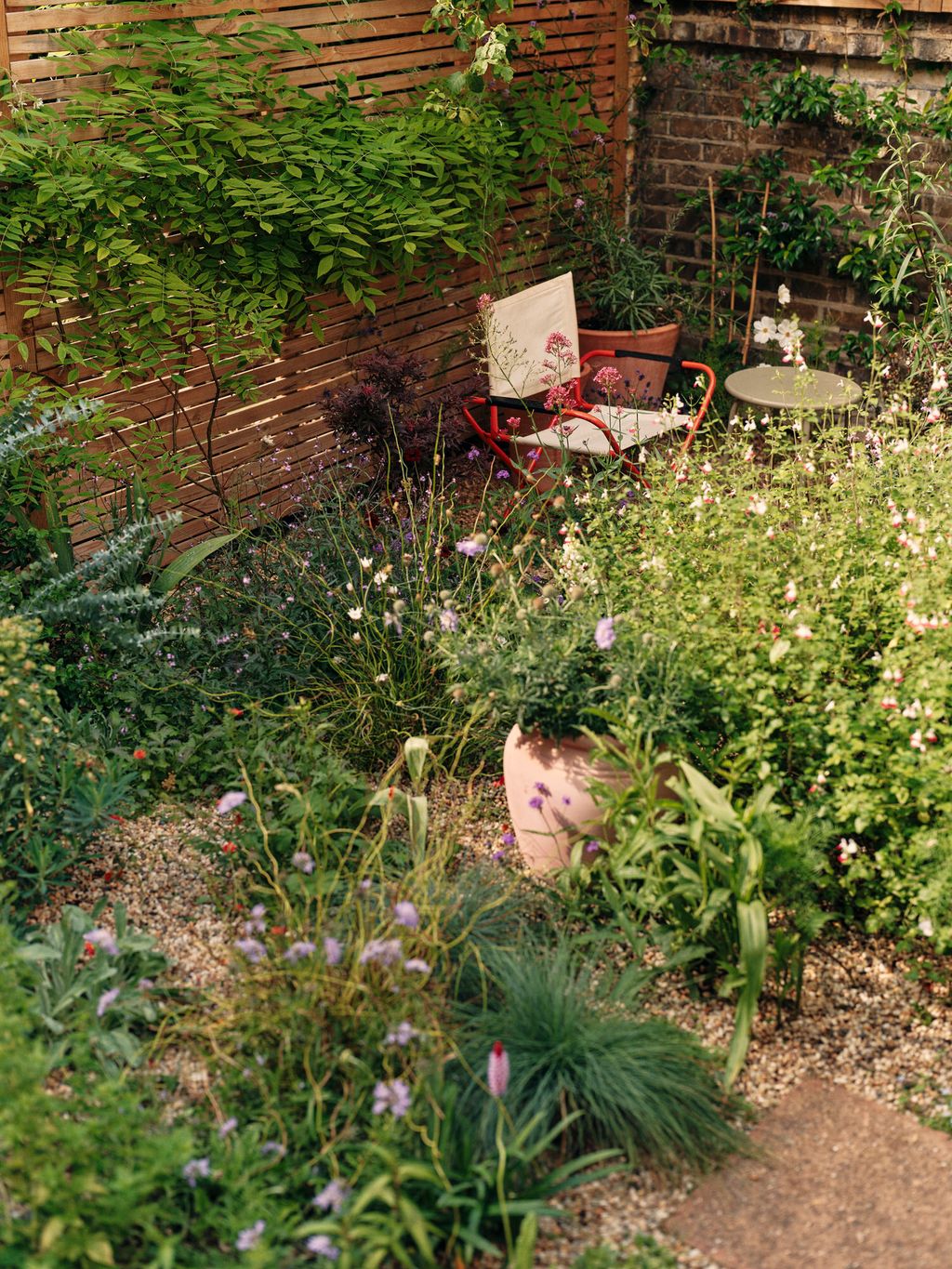
The project took a year to complete and included converting the garage into a study, creating a record room (vinyl is to Corey what books are to Oliver), and a Japanese-inspired rear extension for the open-plan kitchen and dining area. But perhaps no space has brought Corey as much glee as her garden. Inspired by artist and filmmaker Derek Jarman’s shingle garden at Prospect Cottage in Dungeness, it’s pretty but not prim, with an abundance of pink and purple flowers (chosen to encourage biodiversity) growing from anywhere but a neat bed. Instead of lawn, there’s shingle and paving stones that look like they’ve been there for a lifetime (they haven’t; Corey sourced them from Freecycle). ‘As the garden matures, the jasmine will cover the back fence, and the creeping jenny will engulf the paving stones,’ says Corey. ‘The garden is very much an extension of the home.’ And, as Corey intended, her home is very much an extension of her.
 Tom Griffiths1/17
 Tom Griffiths2/17
 Tom Griffiths3/17
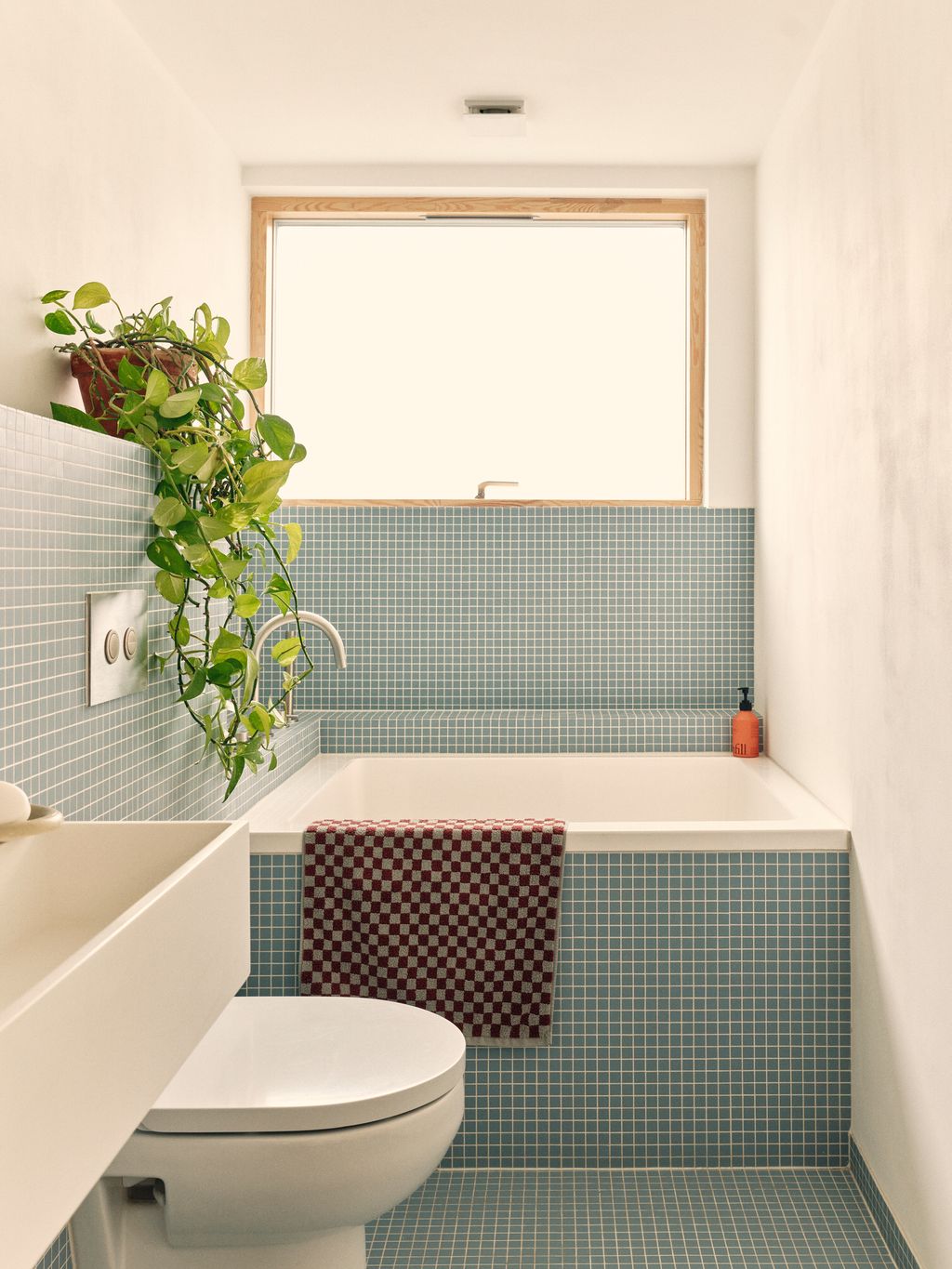
The top-floor bathroom is defined by sky-blue mosaic tiles from Winckelmans and honey-hued decorative pine cabinetry. The photo print is by Luca Piffaretti and the stones were collected from Fourni, Greece. The mirror is from Etsy.
 Tom Griffiths4/17
The bathroom features a space-maximising Japanese-style tub.


 Tom Griffiths5/17
‘The record room is south-facing, so the light in there is really special – at golden hour, it glows,’ says Corey. ‘And, as no houses are facing it, it feels private, despite the large windows.’ This, along with Corey’s Tannoy speakers and enviable vinyl collection, makes it the perfect space for hosting.
A photo print by Henry Woide hangs on the wall, along with two tiny ceramic tiles from MIMMO Studios, made in collaboration with artist Alice Johnson. The lampshade overhead is from HAY.
 Tom Griffiths6/17
A burnt-orange Ekstrem chair by Terje Ekstrøm sits with an Akari lamp by Noguchi.
 Tom Griffiths7/17
 Tom Griffiths8/17
In the bedroom, a Noguchi pendant hangs over the bed. A wall mirror from Hay forms a dressing table corner with a ‘Stool 60’ from Artek. The cushion covers are from Maison Empereur.


 Tom Griffiths9/17
A schefflera plant grows in the bedroom. The artwork is from eBay and signed by John M Dowler.
 Tom Griffiths10/17
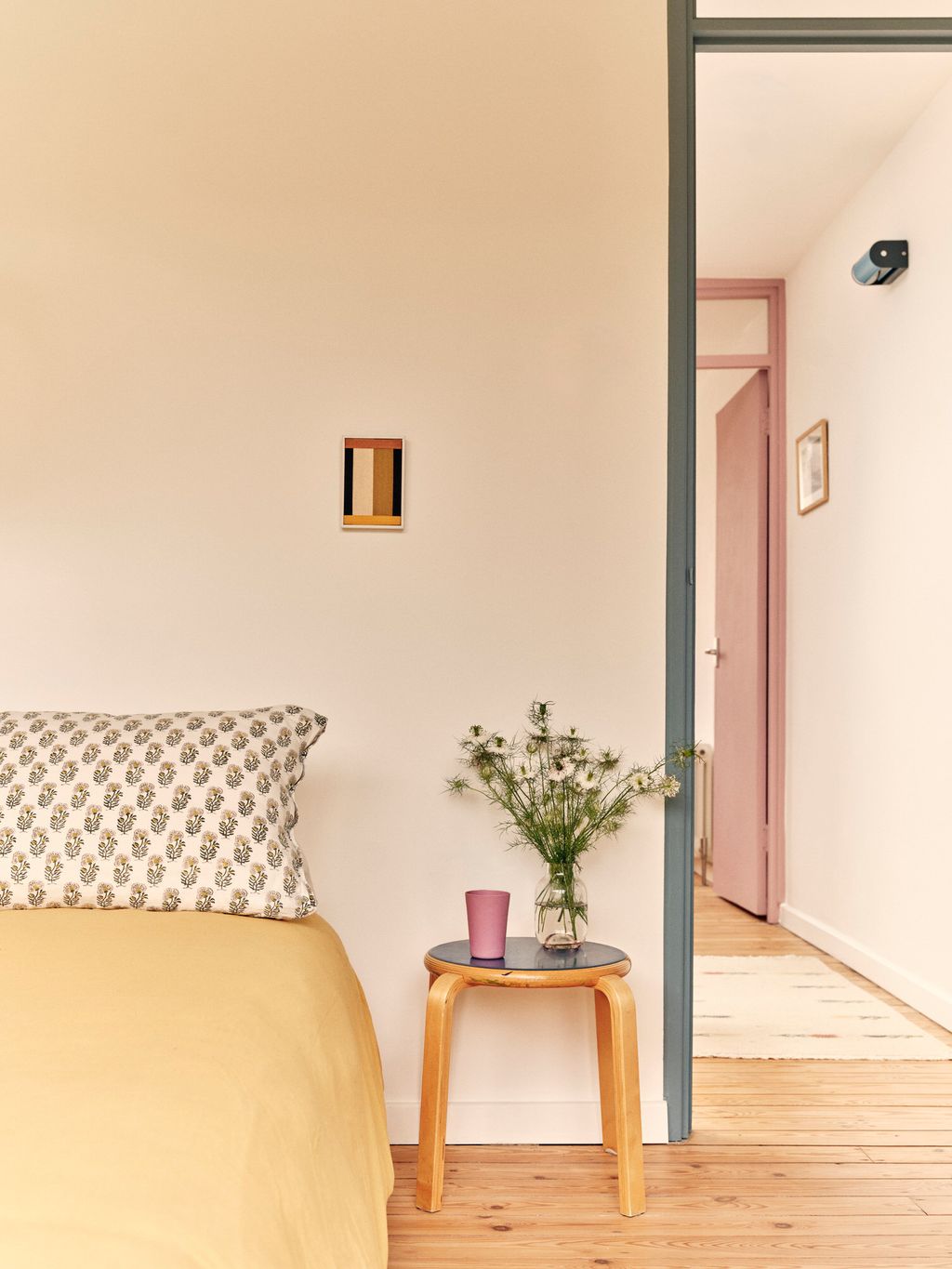
A small artwork by Jo Elbourne hanfs next to the bed. The blue wall light in hall is by Charlotte Perriand from Nemo Lighting.
 Tom Griffiths11/17
In the bedroom, the patchwork quilts were sourced from a charity shop. Within it, orange fabric chimes with the vintage 1970s floor lamp and desk chair from Artek. The ply wardrobes are bespoke designed by Tilly Hemingway and the paper lampshade is by Noguchi.
 Tom Griffiths12/17
The garage has been converted into a study.


 Tom Griffiths13/17
Corey was instantly drawn to the yellow bricks of this 1960s ex-council terrace, originally designed by Ted Hollamby. Externally, Corey replaced the UPVC windows with aluminium and timber frames, finished in khaki green.
 Tom Griffiths14/17
The first thing you notice when approaching Corey’s front door is the verdant flower bed sitting pretty atop the ply bin store. This, along with the charming quarry tiles (repurposed from the interiors), characterises Corey’s weather porch – a hallmark of this style of architecture – and sets the tone for the home within.
 Tom Griffiths15/17
Looking out into the garden from the dining area. The garden furniture is from Hay.
 Tom Griffiths16/17


 Tom Griffiths17/17
The plants in Corey’s garden were either sourced from a nursery in West Sussex or propagated from her mother’s garden. ‘My wonderful mother, who is the most unbelievable gardener, helped choose and position plants,’ says Corey. Her favourites include scabious, verbena and cosmos. The herb garden, consisting of Vietnamese basil, sage, and oregano, comes in handy when cooking. Tilly designed the garden, taking inspiration from Derek Jarman’s coastal garden at Prospect Cottage in Dungeness. The planting is far from manicured and the ground is covered in shingle. ‘I love the way it reflects light and allows for bare feet all year round,’ says Corey.


