

The country house was traditionally promoted as the dynastic seat of a wealthy, landowning family; a power base from which they could radiate control over their lands, tenants and political interests. The management of the family estate was the preserve of men, while the management of the country house was perceived as the female domain. Although the role that women played within the 18th-century country house has received greater attention in recent decades, female architectural patronage still remains relatively obscure.
Country house architecture is inextricably intertwined with the concept of dynasty, which in the eighteenth century was defined by the system of male primogeniture. More than mere residences, country houses were manifestations of patriarchal succession and landed power. They were the canvasses upon which powerful families could display their dynastic connections, wealth, status and taste. Women, on the whole, were excluded from inheriting such country houses, which dramatically limited their opportunity to engage with country house architecture. However, despite this curtailing of opportunity, women still found numerous ways in which they could influence the design, form and decoration of the country houses in which they lived.
For instance, when one considers Blenheim Palace in Oxfordshire, the grand, palatial country house of the Marlborough family, it is often thought of as the magnificent Baroque creation of John Churchill, 1st Duke of Marlborough and his architect, Sir John Vanbrugh. After all, it only exists because a grateful nation wished to reward Marlborough, Commander-in-Chief of the Forces, for his great military victory at the Battle of Blenheim in 1704. However, what is generally not remembered is that the Duchess of Marlborough was also highly influential in the building of Blenheim Palace.
Throughout the project the Duke and Duchess worked together to create a magnificent home befitting their hard-won rank and status. The Duke regularly relied on his wife to progress the building when he was engaged on the Continent with military duties and left many key decisions in her capable hands, much to the irritation of Vanbrugh. On one occasion Marlborough wrote, ‘I leave it intierly to you to order what you think is best, and what pleases you I am sure I shal like’, and on another, ‘As to the house and bridge, whatever you judge best, I shall be well pleased with’. The Duchess’s architectural judgement was respected and followed indicating that although her husband was certainly the lead patron, in his absence she, ipso facto, assumed this role.
Sarah Churchill’s influence over the building of Blenheim increased significantly when the Duke suffered a terrible stroke in 1716, which rendered him unconscious for a full three days and left him partially paralysed with impaired speech. This tragedy propelled the Duchess forward in her quest to complete Blenheim as soon as possible, protecting her husband from the awful stresses that it caused. Describing the building works as a ‘chaos that turns one’s brains but to think of it’ in c1716, Sarah only proceeded with it for her husband’s sake. In the midst of this turbulent time the Duchess’s notoriously volatile relationship with Vanbrugh finally broke down beyond recovery, culminating in his sensational resignation on 8 November 1716, in which he vigorously defended himself against her accusations of mismanagement, wastefulness and extravagance:
These papers Madam are so full of Far-Fetched, Labour’d Accusations, Mistaken Facts, Wrong Inferences, Groundless Jealousies and Strain’d Construction: That I shou’d put a very great affront upon our understanding if I suppos’d it possible you cou’d mean anything in earnest by them; but to put a Stop to my troubling you any more. You have your end, Madam, for I will never trouble you more Unless the Duke of Marlborough recovers so far, to shelter me from such intolerable Treatment.
The Duchess, unmoved by Vanbrugh’s actions and undaunted by the challenge of completing Blenheim, quickly assembled an elite team behind her, headed by James Moore, the cabinet-maker, who she described as ‘a miracle of a man’.With a focused determination and a seemingly endless vigour, she succeeded in completing the east wing sufficiently enough for the Duke to at last move in to by August 1719. Despite this remarkable effort the Duchess’s beloved husband died only three years later without fully realising his grand architectural ambition.
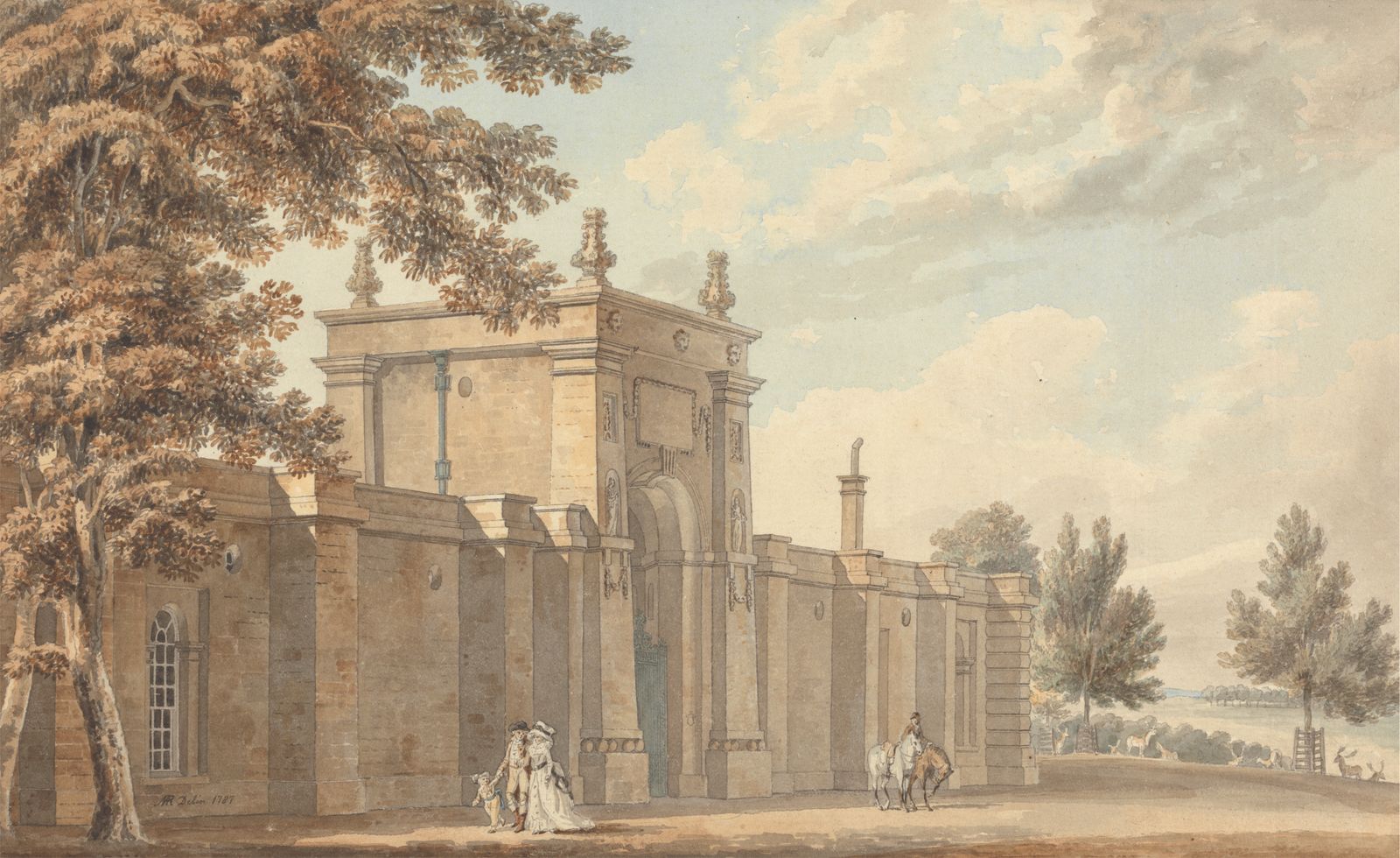
In his will, the late Duke dedicated a lump sum of £50,000 (about £6 million today) towards the completion of Blenheim Palace, together with £10,000 (about £1.2 million today) ‘a year to Spoil Blenheim, her own way’, as Vanbrugh believed. The Duchess, now saddled with the hollow task of completing Blenheim alone, rehired Nicholas Hawskmoor, Vanbrugh’s assistant, and together they finally finished the state apartments, stable block and chapel.
The Duchess was also determined to commemorate her husband’s achievements, as well as her own, and built a huge triumphal arch as an appropriate entrance to the park, on which she recorded her own instrumental involvement:
This gate was built the year after the death of the most illustrious John Duke of Marlborough by order of Sarah his most beloved wife to whom he left the sole direction of many things that remained unfinished to this fabric.
She proudly proclaimed that it was she, and not Henrietta Godolphin, her estranged daughter and heir, who brought Blenheim to its conclusion. Known for her difficult relationship with her daughters and grandchildren (which caused her to re-write her will 26 times) this prominent and very public inscription also allowed the Duchess to further bolster her own architectural legacy.
This is an edited extract from Hidden Patrons: Women and Architectural Patronage in Georgian Britain by Amy Boyington, published by Bloomsbury Visual Arts


