

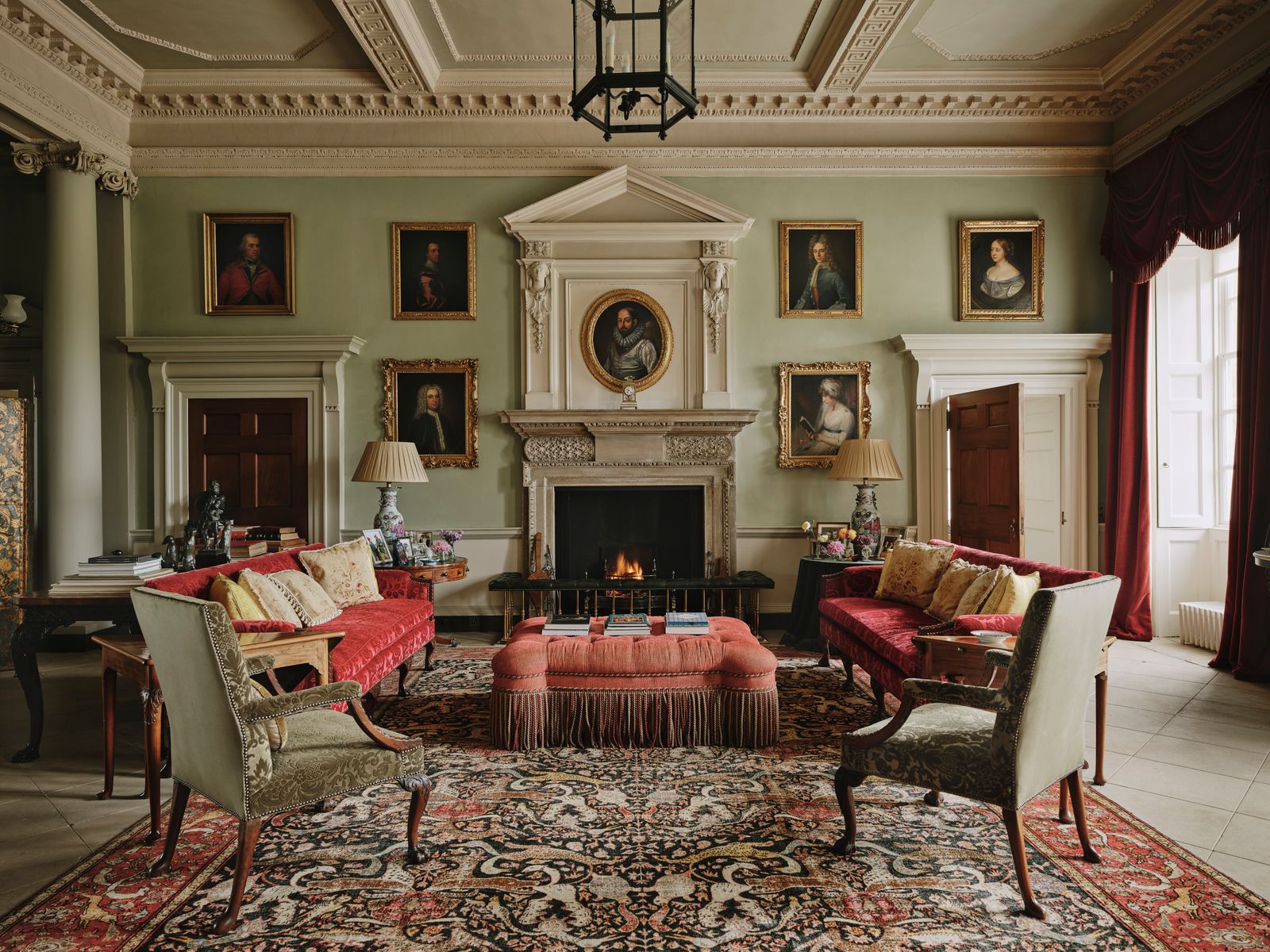
John Fowler’s name is continuously heard, used, and eulogised in interior design circles. Yes, it is carried by Britain’s longest-established decorating firm, Sibyl Colefax & John Fowler, but the repeat references also speak to his being regularly cited as the most influential decorator of his generation, and, often, of the entire 20th century. Deborah, Duchess of Devonshire described him as ‘the Prince of Decorators’. His projects numbered some of this country’s most important historic houses, including Chequers, Chevening, Radbourne Hall, Grimsthorpe Castle, Daylesford House and Buckingham Palace. Despite few of the schemes remaining intact, they are still wholly relevant, due to the "emphasis being on historical accuracy combined with sublime comfort and attention to detail,” explains Emma Burns, joint managing director of Sibyl Colefax & John Fowler.
Essentially, John Fowler established what is now recognised as the bedrock of contemporary country house style, and, in bestowing grand rooms with what he called a “humble elegance”, ensured they felt attractively liveable in a modern manner. Within are elements that are ever appealing – think wallpaper borders, elaborate curtain pelmets, decorative painting – and lessons in achieving success in our own homes, however modest those homes might be.

The merits of looking (at everything)
The first lesson is one of looking, which comes with the accompanying point that John was self-taught. He “picked up everything he knew from hard work,” recalls Imogen Taylor, who was his assistant for 21 years before graduating to becoming a decorator herself. Born in 1906 - not into grandeur - John left school at 16, and worked variously for commercial decorating firm Thornton Smith, the antiques dealer and decorator Mrs Bethell, and Peter Jones, in their decorative furniture department.
In each instance, he was studying and learning 18th-century decorative paint techniques, and applying them to ‘Chinese’ wallpapers and antique-style furniture. In 1934 he set up on his own, putting together whole rooms, including curtains and pelmets in designs that are still aped today. These, explains Daniel Slowik, formerly of Sibyl Colefax and John Fowler, were “based on the Regency love of embellished window treatments, but also on dressmaking from the 1850s through to the 1880s. John obsessively researched historic costume and collected quantities of Victorian and Regency dresses.”
In tandem, John would spend great tracts of time in the V&A, and in antiques shops and flea markets. He examined the details in every room he entered, and critiqued them. The designer Nina Campbell - whose first job was working for John, via Imogen - remembers being taken to the Italian embassy, and John declaring, “now my dear, we’re going to play ladies. We’re going to sit on the sofa and imagine the room.” ‘Playing ladies’ was John’s description for the exercise of evaluating a room, and considering what it needed.
The necessity of comfort, for the body and the eye
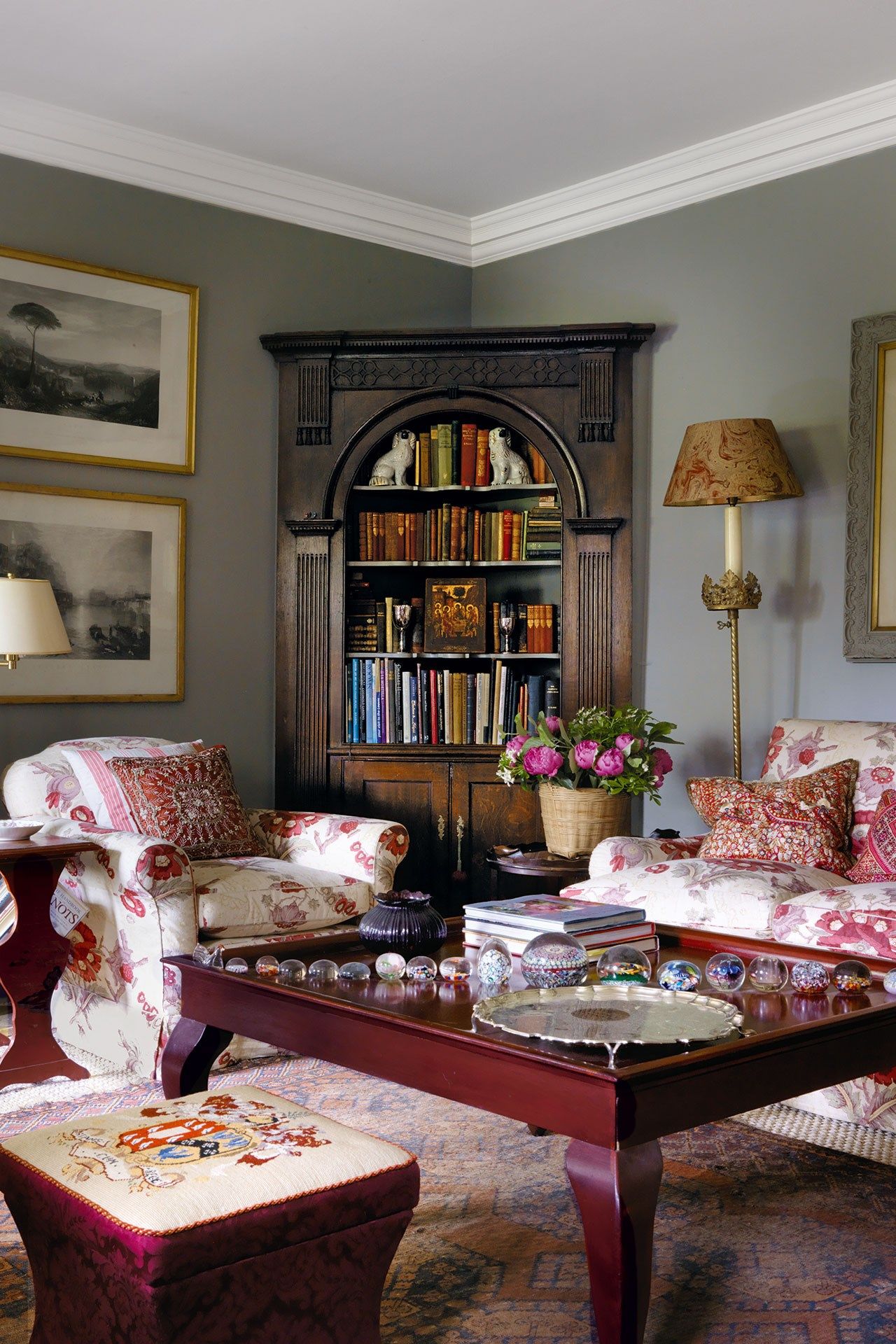
“Decoration is a logical compromise between comfort and appearance. A room must be essentially comfortable not only to the body but to the eye,” said John, in a 1938 magazine article. 1938 was also the year he joined Sibyl Colefax at the firm that, in 1944, was bought out by the American-born Nancy Lancaster, who employed John to help her with some of her rooms. The Nancy-John partnership was one that added to his vision – their talents and tastes were complementary – and it was Nancy who introduced luxury to comfort, perhaps most notably by way of bathrooms. She led the way in converting closets and dressing rooms into functional spaces for daily ablutions (she had been horrified, when she bought Ditchley Park in the 1930s, to discover that arrangements extended only to a pot de chambre in the same room you slept in), decorated with ‘proper’ furniture, paintings, and carpets.
John followed that bathroom format; he might have wanted a house to reflect the charm of the 18th century, but “with the amenities of the 20th century,” writes Martin Wood in John Fowler: Prince of Decorators. He also appreciated a fitted carpet, for its being soft underfoot, and well-suited to draft negation in old houses. Sibyl Colefax & John Fowler produce a Brussels weave carpet in various patterns, including ‘Mossy’ which is one developed from an example John found on an antique stool, and used throughout his own house, the Hunting Lodge (of which more, later), including in the bathrooms (which is ever contentious – but definitely comfortable.)
When it comes to comfort of the eye, notable was John’s restraint. He did not overfill or over-decorate, and made sure to leave space for the eye to breathe. Nina recalls his telling her that “a room can’t be finished on paper, you have to leave space for impulse,” which refers, again, to the importance of looking.
Making do with limited resources
Amid the challenges of the post-war period (“rationing went on for five years afterwards,” Imogen reminds us) copious of our great houses were in need of reviving, having been co-opted as schools and hospitals during the war. And Nancy had the contacts to ensure the contracts. It was during this time that John’s look really crystallised, as “a creative response to limited resources: repurposing, renewing and reworking,” describes Daniel. At Clandon Park the saloon curtains were made from American army blankets, and Emma Burns mentions the “clever use of unrationed parachute silk, red and white stripe poplin normally used for nurses’ uniforms, and scallop shells that became shades for wall lights. John Fowler had a gift for mixing the humble with the important." Notably the ‘important’ was the antique furniture and art.
“[John] explored how to make a simple material into a complex effect; the same fabric was made into a trim or a ruffle to elaborate a curtain or chair, a plain piece of cotton was dyed to match a colour in the main fabric for further trim,” continues Daniel. Trims by Mauny, the Paris-based decorating firm that John had discovered on his trip there in 1936, were also used (and applied to older furniture in the spirit of revival) along with pinking-sheared edges, wallpaper borders (hung vertically, as well as horizontally). He also employed decorative painting techniques like trompe l’oeil panelling, marble, and more, which were all less expensive than the real thing (though these were no longer carried out by John, but by the decorative artist George Oakes.)
The shrinking of country house grandeur
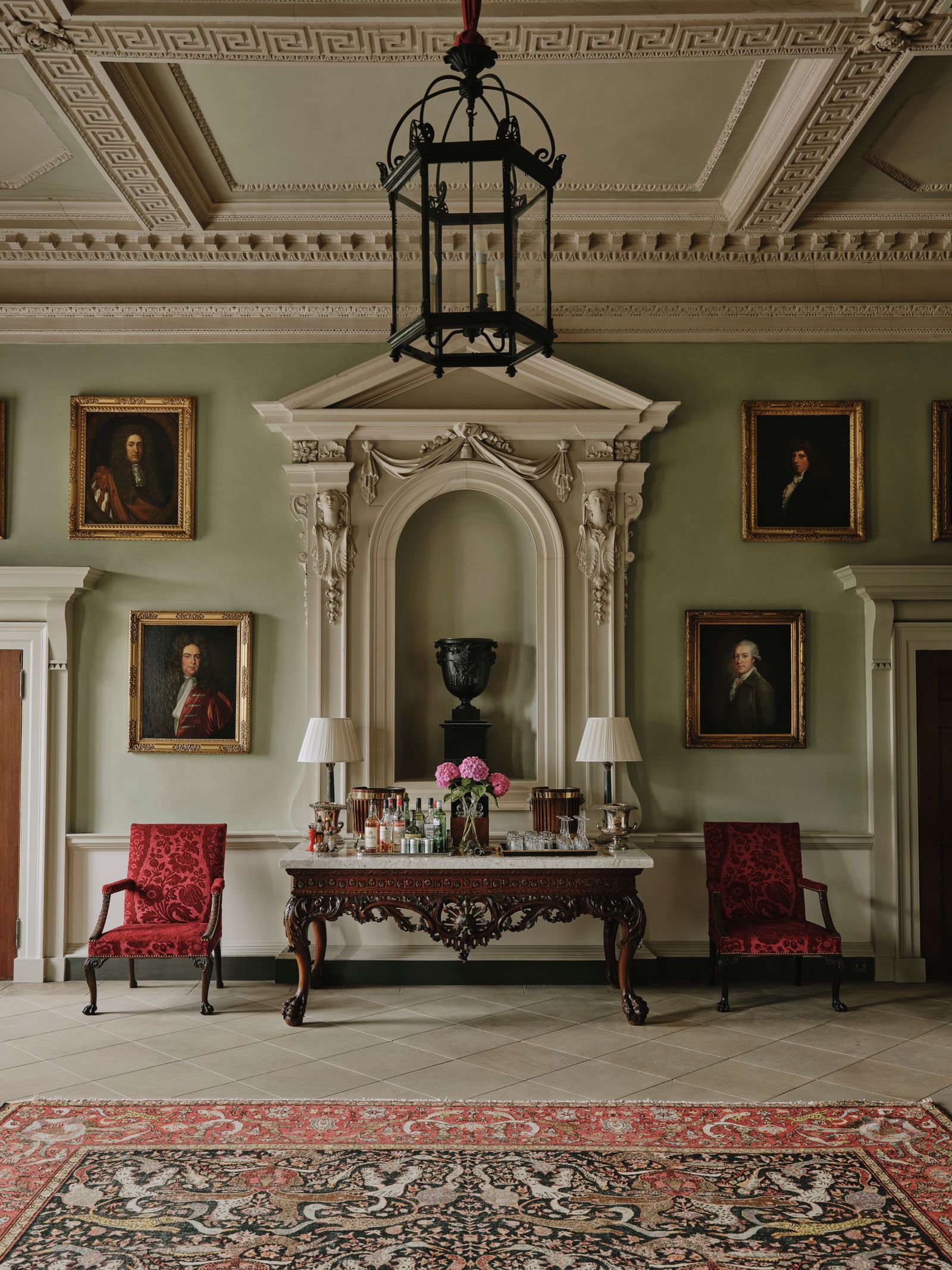
John bought the Hunting Lodge, his tiny and beloved folly in Hampshire, in 1947. He left it to the National Trust, Nicky Haslam took on the lease for a while, and then in 2021 it was taken over by Francis Sultana who has been restoring it ever since, a process that includes using the same Mauny papers that John did. “It was a laboratory for John – a country house in miniature – and he adapted the scale accordingly,” says Francis. “He proved that you can have grand ideas, but bring them down to a smaller scale.” Decorative painting, in this instance, has practical use: “trompe l’oeil panelling takes up no actual space,” points out Francis.
And John did take on smaller projects for clients, too – including townhouses, and flats – and treated them the same as the historic houses. “Each component part of the room, however humble or grand, was considered in relation to one another to create a perfectly conceived whole,” says Daniel Slowik. Then there are occasional surprises: John gave the actress Joan Dennis bunk beds in her minute London flat – the bed and ladder decoratively painted, and dressed and curtained in chintz.
Maximising the potential of colour
“John’s colour abilities were extraordinary,” says Nina. Indeed it was colour that transformed those Army blanket curtains and lengths of unrationed parachute silk. She recalls the ‘palette’ that hung on the wall opposite his desk: “whenever he dyed something a new colour, he took a yard of it and hung it up.” Alongside, John believed in the necessity of a colour being ‘carried around’ a room; he’d have thirty yards of silk specially woven or dyed (the minimum quantity) in order to use just five yards for cushions.
He was equally precise about paint colours, which would be mixed at the paint studio (there was no Farrow & Ball or Edward Bulmer Paint, then.) Inspiration for the shades came from all over: from the houses themselves (at Radbourne Hall he took a coin from his pocket and scraped away to find the duck-egg blue several layers below), from Robert Adam’s 18th-century neo-classical revival, the regency period that followed, and from the French colour palette of the past (he was quite infatuated with Marie Antoinette). The manner in France was to paint a room using several related tones – even different whites – which John felt gave proper distinction to the architecture of a room, particularly if it was panelled. The darkest tone would go on the stiles and rails, the middle tone on the flat panels and the lightest tone on the mouldings. It wasn’t always appreciated: couturier Hardy Amies painted over his John Fowler-decorated Savile Row salon after John died, saying “having it three whites, you know, never sold another fucking frock.”

The joy (and lightness) of bringing the outside in
In the 1930s, when his clients were less grand, John had worked in a more ‘country’ style; he was interested in the vernacular architecture of cottages and small manor houses. He made use of chintz and toile de Jouy – and carried these materials forward into the historic houses in place of the heavy velvets and damasks that had been there before, because, explains Martin Wood, “he wanted the garden to spill over into his rooms.” Further, it aided the ‘humble elegance’, as well as a visual lightness. In the private apartment at Blenheim Palace, he put off-white linen on the walls and used a pale green chintz with grey flowers for the upholstery. In the 1950s, he discovered ‘Bowood’ when he was working on that house’s Robert Adam-designed interiors – it’s become one of the most iconic chintzes there is (this magazine’s editor, Hatta Byng, has used it in her house). John was also, it should be noted, a very keen gardener – the garden at the Hunting Lodge, which Francis is also restoring, is almost nonpareil.
Timelessness and looking forward
“I like the decoration of a room to be nameless of period,” said John. That, and his determination that rooms should express the personality of the owner, explains why his rooms are so timeless, and, in the case of Radbourne Hall, have been retained by the current inhabitants. It’s an approach practised by interior designers working today.
At the same time, “John Fowler was always very forward-thinking, he wasn’t stuck,” says Nina. Indeed, “each generation will restore country houses in different ways just as they will decorate them in different ways,” John wrote in the book he left us, English Decoration in the 18th Century, co-written with John Cornforth. And in this point is the final lesson – that we should take inspiration from his schemes, but perhaps not copy them. Not least because, were he still working today, he’d doubtlessly be aiming for a combination of historic accuracy and 21st-century comfort.


