
The charming Kensington townhouse of dolls' house creator Lucy Clayton, decorated by Ben Pentreath

I am seeing stars when I arrive at Lucy Clayton’s Kensington home. Quite literally. Her front door
is studded with them: gold, shiny, perfect five-pointers, they spill beyond the green backdrop to stud the stucco pilasters either side. It can only be Christmas. Or can it? ‘We put those up four years ago and I loved them so much, I never took them down,’ Lucy says, beaming. ‘They’re just joyous.’
It’s not quite Christmas every day here, but joy is ever present. Walk through that celestial doorway and you are met by a pair of Ionic columns – bright white against yellow walls and scaled down to fit inside this neat terraced townhouse, a surreal Wonderland juxtaposition of large and less so.
Such a flight of fancy might be surprising elsewhere, but Lucy is one half of The Kensington Dollshouse Company. She produces exquisite fantasy worlds for a living – think chinoiserie giltwood mirrors and hand-painted delftware at 1:12 scale. It would be too neat a comparison to call this a grown-up doll’s house (not least as it was finished before Lucy co-founded her company with her mother in 2023), but it’s tempting.

It was not always thus. When Lucy bought the house 16 years ago with her then husband, and with baby son Kit in tow, it was all ‘1990s hotel-lobby minimalism’, she says. Interior designer Ben Pentreath recalls it similarly, as ‘a bog-standard “developer renovated” London townhouse, devoid of character or charm’. Ben was the person Lucy called in to make it beautiful, after a decade of living with its infuriating lighting systems, greenish glass and sharp corners. She had faith he would know exactly what to do; the pair, having collaborated before on a previous project, are friends. ‘Ben understands in a practical way how people live and how families evolve,’ she says.
Here, Ben explains, that meant accepting the things they could not change, operating with what he calls a Cecil Beaton quality, in which you ‘decorate, rather than build yourself out of any problem; that is precisely what we did here… hitting the rooms with colour and pattern’, he says. Elsewhere, he and his team (Will Creech on architecture and Tamara Lancaster on decoration) carried out ‘forensic surgery’ where they could. By now, Lucy and Kit had been joined by Lucy’s partner, the education policy advisor Steven Haines, and their daughter, Bunny, now five, so practicality was a priority. With that in mind, Ben’s team conjured a bedroom for teenage Kit in the attic, a basement playroom for Bunny and generous cupboard space for Lucy, whose fashion background and appetite for beauty has predictable consequences.

Doll’s houses, Lucy observes, never have utility rooms (or, for that matter, loos) – ‘Why would they?’ In real life, however, the argument for their addition is compelling. Dismayed that the perpetually running washing machine of a young family was in the old coal hole outside, Ben carved up the kitchen to create a laundry. Lucy’s gratitude remains palpable. ‘Rooms like this are the keys that unlock a house,’ she says.

Such auxiliary details offer a refreshing dose of reality, but fantasy is at the forefront here, recognisable in the hand-painted wallpapers, lacquered walls, prudent fabric frills and perfectly designed furniture. A self-deprecating Lucy is quick to stress, however, that the stuff of life is not absent, just hidden. ‘Flip that cushion over,’ she says, pointing to the Howe sofa upholstered in Madeleine Castaing’s ‘Castiglione’ stripe, ‘and you’ll find a spectacular sea of blue ink on the other side’ – for which she has a thieving puppy and a ballpoint pen to thank. Though it took a while to recover from, the incident was a good reminder that, sometimes, you just have to relax.

Put simply, perfection cannot exist without pragmatism. And just as Lucy – a precisionist – knows how easily the rainbow rubble of Lego can ruin a colour scheme, she also understands how important it is for children to inhabit their homes as properly as adults. ‘What I wanted, above all, was a spirited house, one that inspired wonder in us all. Ben gave me that.’
That yearning for wonder explains Lucy’s preoccupation with doll’s houses: sacrosanct spaces unblemished by reality. The first she made, which kickstarted her company, was for Bunny. ‘I lost my mind over it!’ she says. ‘And now, poor Bunny, it’s too perfect to play with.’ Consequently, Lucy is working currently on a new miniature world for her daughter: ‘I must try not to be too precious about it. If she wants to tuck a tiny baguette into bed, well… I’ll just have to be fine with it.’

Reflecting on that first doll’s house, which she wrote about for the House & Garden website, Lucy recalls many comments from those wishing not that their house looked like that, but that they could shrink and live in it. It proves how much we all desire a world built around delight. ‘It seems trite,’ she says, ‘but it’s why Christmas is so magical.’ This is her favourite time ‘because there is no need to apologise for beauty or playfulness’. It’s no surprise that it was Christmas every day in her childhood doll’s house. Now she’ll settle for stars on the door.
The Kensington Dollshouse Company: kensingtondollshousecompany.co.uk | Ben Pentreath: benpentreath.com
 Rachel Whiting1/10
The seat pads were upholstered by AT Cronin Workshop in sea blue ‘Broken Stripe Poplin’ by Flora Soames. An oculus decorated
with Peter Hone plaster reliefs casts light over the table. Rachel Whiting2/10
Grey and white Venetian marble floor tiles by Lapicida unite the living spaces, and the Portuguese blue ‘Bussy’ Lacanche range cooker is complemented by cabinetry in ‘PP14-5-13SHB’ by Papers and Paints.
 Rachel Whiting3/10
 Rachel Whiting4/10
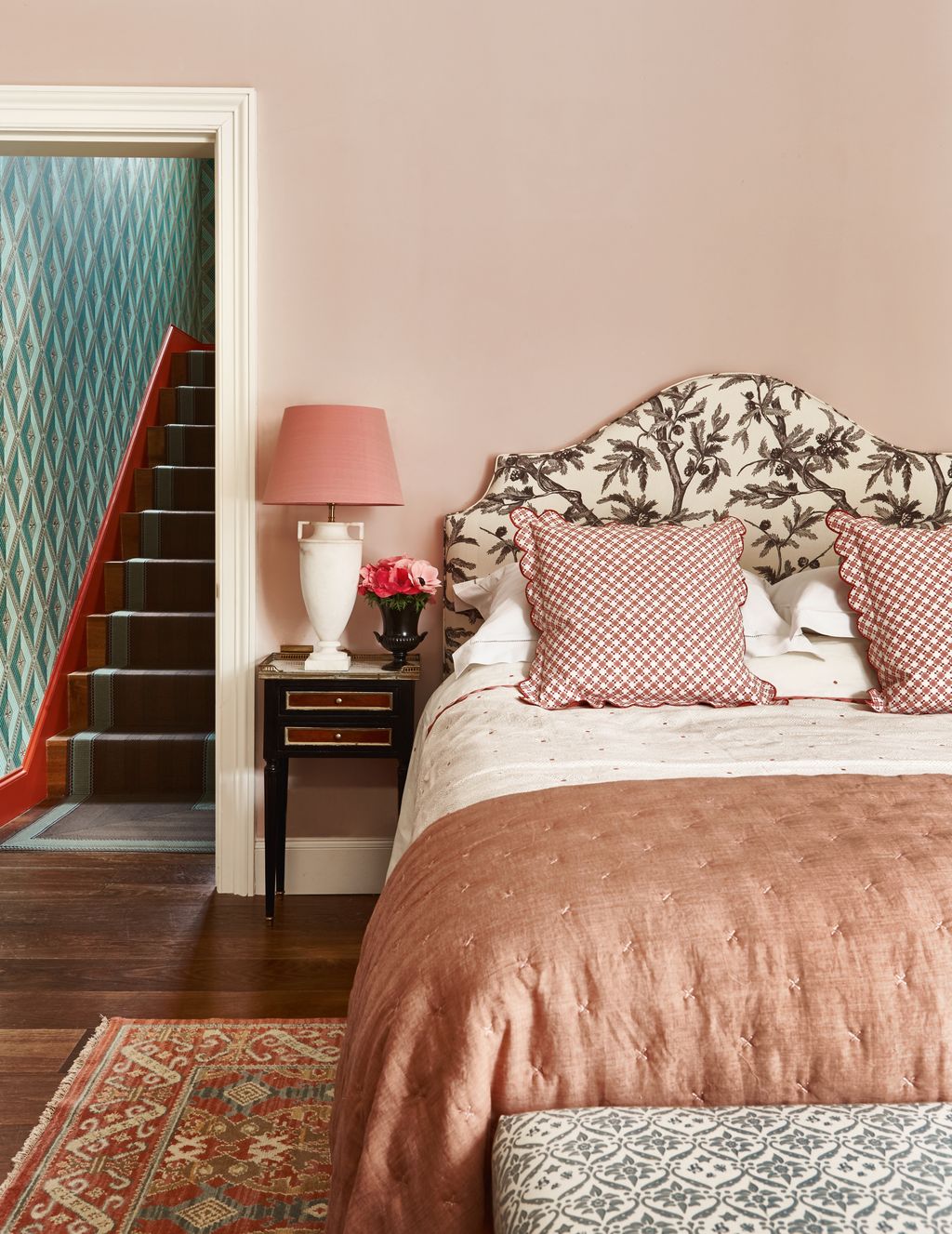
Walls in lilac ‘SC234’ by Papers and Paints showcase a headboard in ‘Branches de Pin’ cotton in beige grey by Madeleine Castaing. The antique rose dupion silk Pooky lampshade tones with ‘Capilla’ block-print cushions and an embroidered bedcover, both by Birdie Fortescue.


 Rachel Whiting5/10
 Rachel Whiting6/10
Patterns reign with ‘Philadelphia Harlequin D’ wallpaper by Adelphi and a desk skirt made from an online fabric find. An ‘Original Globe’ pendant lamp by Jamb hangs over the stairs, with spindles and skirting in vibrant burnt orange ‘SC546’ from Papers and Paints.
 Rachel Whiting7/10
 Rachel Whiting8/10
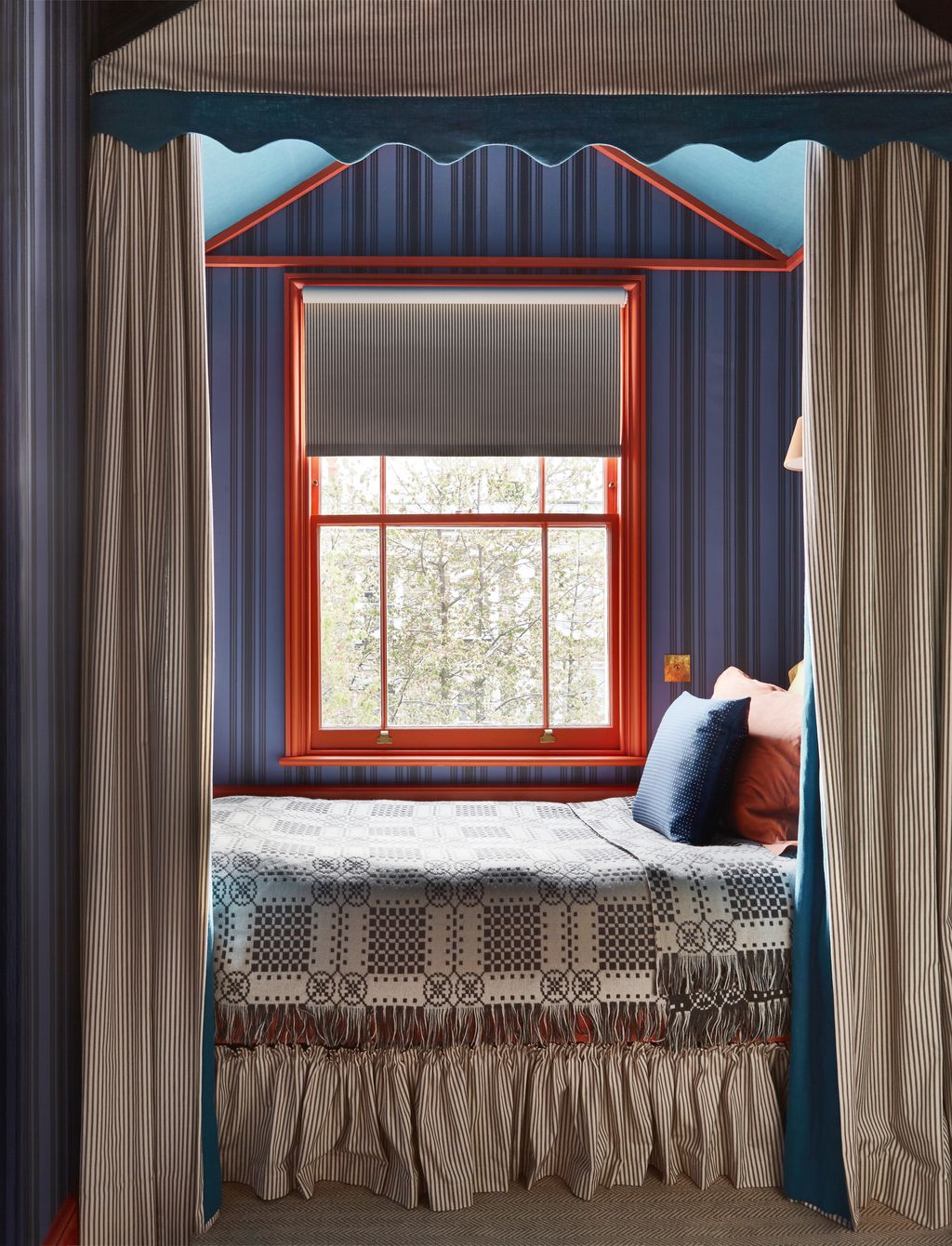
A tented bed in Tinsmiths brown cotton ticking, lined with a discontinued blue textured linen and covered with a vintage Welsh blanket, creates a fairytale sleeping space that emulates Lucy’s childhood doll’s house (above), which she redecorated in blue, inside and out.


 Rachel Whiting9/10
 Rachel Whiting10/10


