

Moments from the twiddly balconies and elegant shutters of Boulevard Saint Germain, there exists a very different kind of Parisian townhouse made from glass and steel. Tucked in a cobbled courtyard, Maison de Verre was built in 1928 and completed in 1932, offering up a vision of modernity, even of the future. The façade was made entirely from glass bricks - then a relatively new invention - that not only provided a sleek industrial aesthetic but also allowed natural light to filter through the walls. Inside, the light, two-storey salon became a favourite hangout for Surrealist artists, writers and thinkers of the day.

Fast forward to current times and the house is still heralded as an architectural icon. Tim Burton’s former home, Eglon House in Primrose Hill, pays homage to the modernist design. Completed in 2016, the house updates its predecessor with fresh contemporary details; the façade features glass bricks alongside full-height bronze windows.
And the style is increasingly making its way back into interiors as well. While we might associate it with the modernist aesthetic of the 1930s, and the resurgence of similar styles in the 1980s, when industrial materials were firmly back in vogue, glass bricks are suddenly feeling very of the moment. In the dining room of a Mayfair project completed at the end of last year by Child Studio, a glass brick wall is a striking feature, complemented in this case by Charlotte Perriand chairs reupholstered in green velvet and Ingo Maurer’s bamboo-frame fan chandelier.

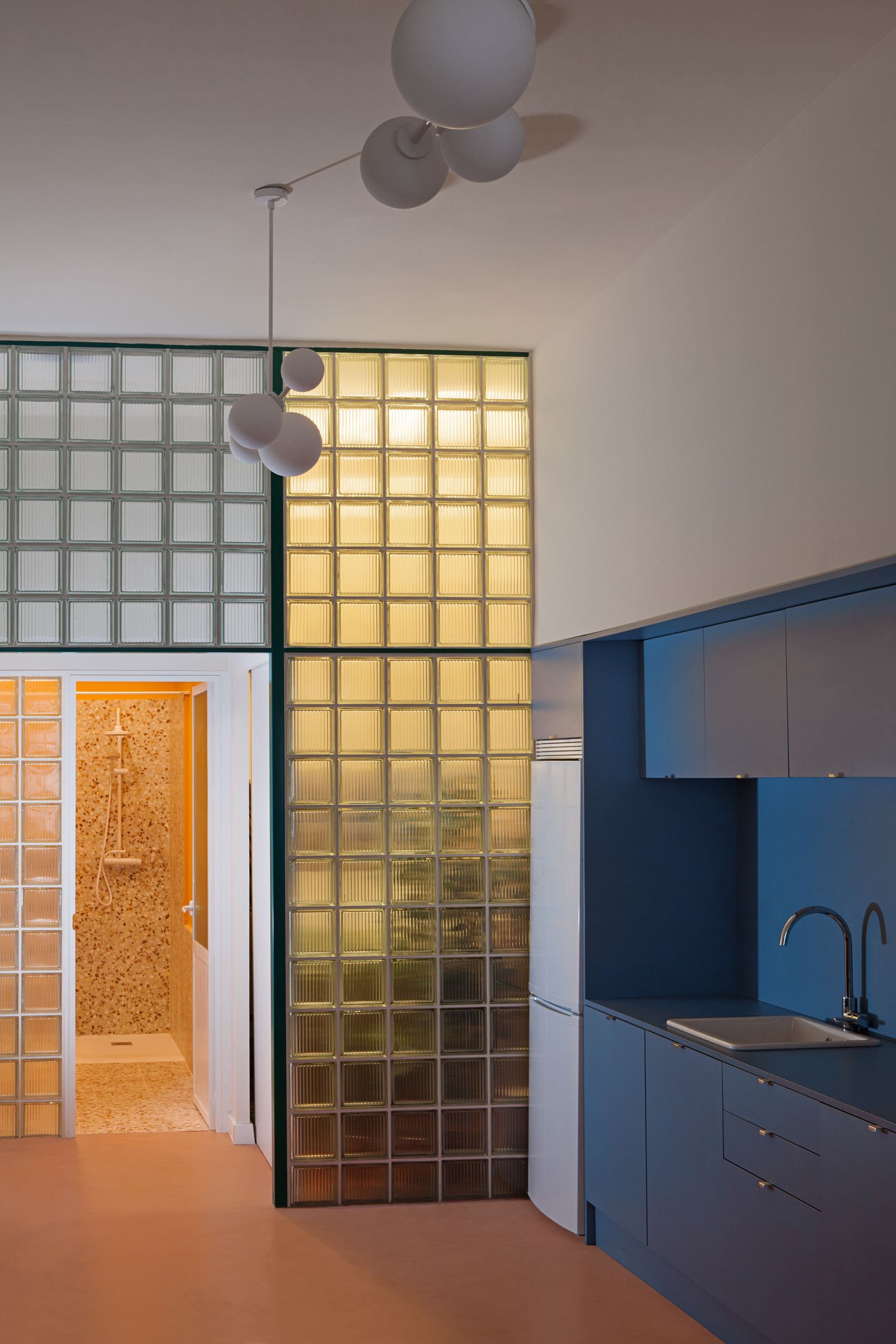
Colour is also being used to shake up the look. When Spanish design practice Plutarco were asked to decorate a small office in Madrid, they focused on creating a positive, light interior for a tricky space. The narrow, tube-shaped layout meant limited access to natural light, so glass was an ideal medium for dividing up the office without creating a barrier. The glass bricks wink to Maison de Verre, whilst the blue kitchen and warm ochre bathroom bring the idea up to date.
Given their practicality, bathrooms present an ideal environment for glass. Away from Maison de Verre, when we think of glass bricks we’ll likely call to mind the bathrooms of the 1980s and 1990s where the look had its popular heyday. When stand-alone showers became a mainstream feature in the home, glass brick walls could be used instead of a shower curtain or a shower door that easily become mouldy. This idea is being reinvented by contemporary designers. Charlotte Buchanan of Buchanan Studio explains, ‘we have been using glass bricks for the past couple of years having been drawn to their simple and functional stylistic qualities.’ In the main bathroom at their London house, glass bricks add a practical yet playful addition to the pink chequerboard tiling.

But it is not only the bathroom where Buchanan Studio are using the versatile building blocks. Perhaps surprisingly, they work brilliantly in restaurants. For Le Bab in Brixton ‘we chose varied glass brick colours for high impact. They’re a fantastic material with thermal and acoustic qualities too. We’re huge fans,’ Charlotte says. Sound-deadening, they work to absorb the clatter of noisy spaces, particularly useful in a restaurant like Le Bab with an open kitchen.

There’s also a wonderful retro quality to them, accentuated at Le Bab by the diner-style chairs and aluminium tables. Adding colour and fun, the square jewel-toned bricks look scrumptious, like Turkish delight or cubes of jelly; you almost want to lick them. Similarly, at the Siren Hotel in Detroit, jazzed-up hotel bathrooms benefit from glass brick shower panels with circular patterning that adds another vibrant layer to the terrazzo tiling in blue and red. Further evidence of the ways in which creative designers playing with colour, texture and pattern, and how they are injecting a new lease of life into the humble glass brick.


