
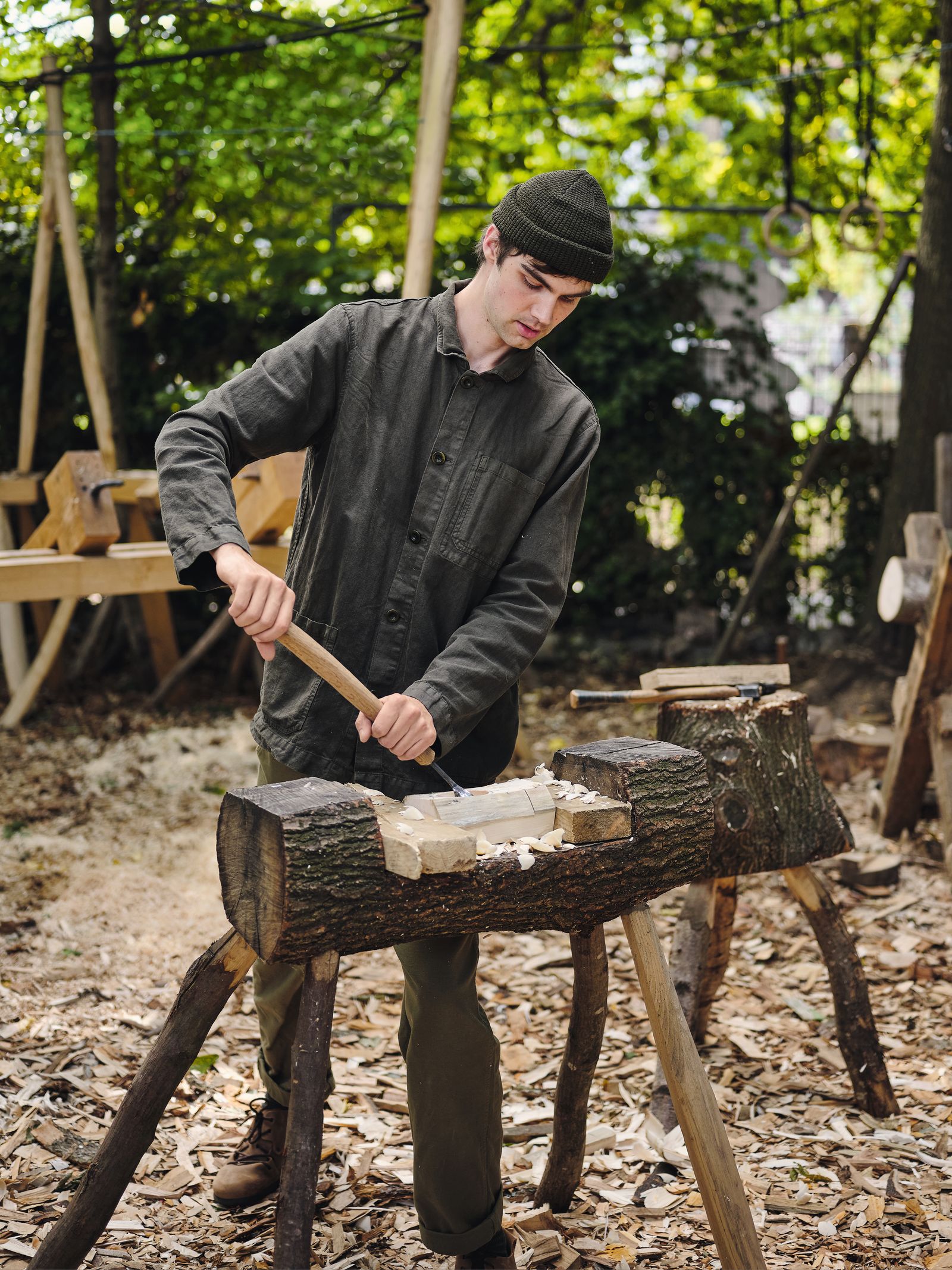
‘It’s rare to find a craftsperson that just fell into it because they like doing it - it’s an outlet’, says Samuel Alexander, a wood carver who found, in his craft, a way out of a ‘deep history of anxiety, depression and PTSD. It was like a release of energy into positive outcomes’. The link between making and our mental health is a long documented one - soldiers suffering from PTSD following the First World War were sometimes prescribed a course of knitting or sewing to help them reduce stress.
In 2019, the BBC released the results of a study it had carried out in collaboration with University College London. Of some 50,000 participants, the study showed that over three quarters of them found that stress and anxiety levels could be reduced by engaging with their creativity. But what is it about craft which proves such a valuable tool in healing, or providing a wider sense of wellness?
For Samuel, his practice taught him to find calm in a slower pace of life. After a career in modelling, he removed himself from the catwalks in Milan and Paris and settled in to Hackney City Farm, where he now works. ‘I set myself a rule a couple of years ago to slow down, not speed up. Now I feel in control of whatever I am making. It’s based on easy, manageable decisions: whether to remove wood or leave it as it is’, he says. The result of his work is a series of wooden vessels and spoons, which celebrate the wood’s natural grain. The concentric circles and movement of the grain reflects Sam’s ethos: slow, calm and joyful.

A sense of escapism is certainly one thing that craft can provide. Eppie Thompson is an embroiderer who first turned to a needle and thread as an antidote to a stressful job in the City. Finding an hour here and there to teach herself embroidery, Eppie fell ‘totally in love with the process. Embroidery is simple enough that you can learn basic techniques within an hour then can get started making things. It’s incredibly forgiving - you can always unpick areas or stitch over the top’, she says. ‘I found the repetitive action would slip me into an almost meditative state, and as you are using your hands, it acts as a physical restraint to stop you looking at your phone or emails’. Eppie left the City in 2020, and started The Fabled Thread, through which she sells embroidery kits and hand-stitched accessories such as cushion covers and artworks. ‘There is a reason sewing has been used for rehabilitation or to support those suffering from trauma – it’s an incredibly powerful hobby’.
Angela Fung, who works with large-scale origami installations through her gallery Fung & Bedford, found the careful, mindful folding of paper to be a soothing outlet following the death of her father. ‘I wasn’t really thinking, I just started folding, and the next thing you know I’d folded 10 metres of paper’, she says. Soon, she transformed from a full-time jewellery designer into a paper artist who has ‘created a profession out of a form of therapy’, and her installations can be seen in spaces such as the Saatchi Gallery, Somerset House and in exhibitions at Collect craft fair. ‘There is enough difficulty that you have to concentrate your mind, which helps to clear it’, she says.
For some, it’s the process that provides some much-needed headspace. For others, it’s about joining a community. Craig Mealing, who was a soldier in the British army for 23 years, suffered from Complex PTSD on returning to civilian life in 2013. His relationship broke down and soon afterwards he became homeless. Turning to Combat Stress, a mental health charity for veterans, Craig tried his hand at throwing pottery and found in it ‘a sense of purpose’. He’s now been practising alongside his full-time job for eight years, selling his creations on potsthesoldierdesign.com. In doing so he has joined a community with whom he feels at home. ‘Now I have a subject to talk to other people about. I can go to a pottery centre and discuss something other than the military’, he says.
Undoubtedly, there is something to be said for having a tangible, tactile thing to feel proud of and put your name to. For Craig, holding a pot, vase, or bowl he’d created himself provided a ‘sense of achievement’, or in the case of Sam, kind words from customers helped to increase his self esteem. In many cases, artists and craftspeople have managed to translate their skills into a livelihood, and in doing so have escaped jobs and lifestyles which didn’t suit them. For Angela Fung, being able to translate her trauma into something beautiful acts as a legacy towards her dad. ‘I might never have tried origami if I was in a ‘normal’ state of mind’, she says. ‘Whether the thing that drove me to do it is upsetting, the result is rather beautiful’.

What’s undeniable is that making something with your hands can be a deeply therapeutic thing to do. Nobody is immune to the worrisome contents of the news or personal anxieties, but a moment of calm can be found in simply picking up a needle and thread, chiselling away at a block of wood or in folding a piece of paper. Angela is keen for others to try it: ‘you can do it with anything’, she says. ‘A bus ticket or a receipt will do’.


