
David Bentheim stylishly reconfigures a Battersea Penthouse

Where interior design is concerned, the concept of ‘modern’ means different things to different people. But for the interior designer David Bentheim, the definition is clear. ‘Modern is the moving forward of design within our culture. It’s embracing the new and the original, but always in a way that contrasts with, rather than negating, existing possessions and their history.’
And for him, as for many others, it is Italy that is still the wellspring of modern style: ‘I’m a Milanophile. It’s there they create the style and weave the contrasts together most eguilingly, with genuinely good design that seems to skate on the edge – I like the edge.’
And so do Peter and Manina Dicks, the owners of this penthouse in Battersea. On discovering the building, which had once been a bakery, they turned to David, with whom they had previously worked, to help them create an adaptable and comfortable home from the developer’s original design, as well as a base for Manina’s image consultancy and personal styling company, Red Leopard.
Although the space was large, the way it had been divided was problematic. The main room, which accommodated the kitchen, dining and sitting areas, was dominated by an immovable, structural wall that was not centrally placed and in which a fireplace and built-in television had been installed. The living space was thus divided disproportionately, with the cooking and eating area by far the largest. While this might have been suitable for a young family, it was not so good for a couple whose children had grown up and who wanted to entertain regularly, as well as live comfortably on a day-to-day basis.
‘When you have large spaces,’ explains David, ‘you have to design them for a flexible existence so that people can use the area in a variety of ways: to eat in different places, sit in different spaces – modern but also comfortable. You need to create spaces where people can cohabit and also expand their lives.’
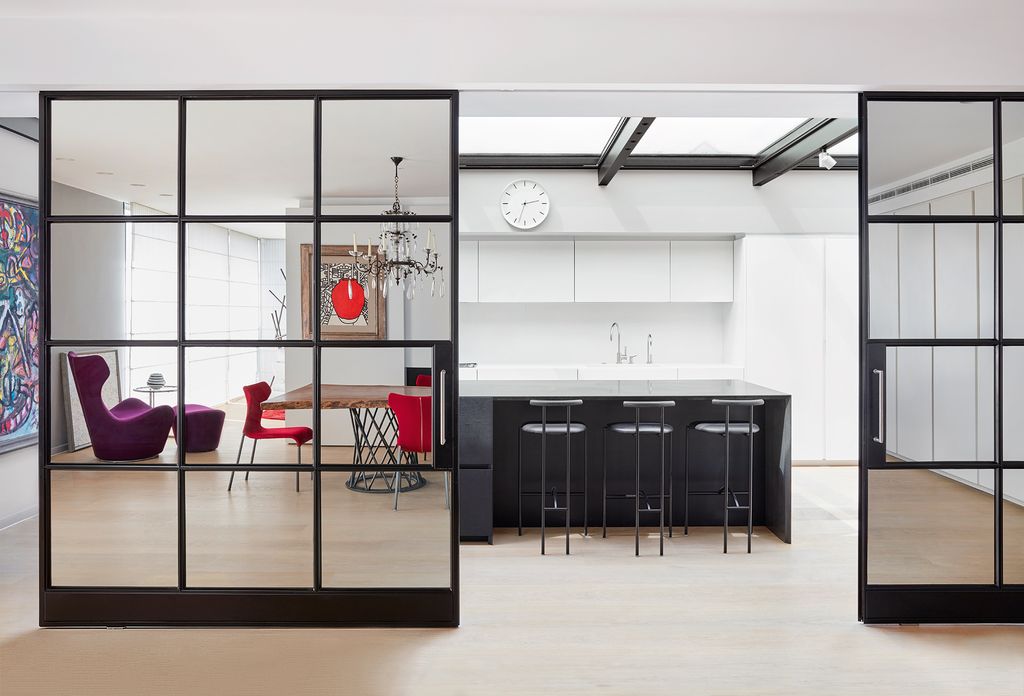
His solution to the spatial imbalance – indeed, his pièce de résistance, according to Manina, was to break up the larger area by installing Crittall sliding doors with mirrored panels, which shut off the kitchen when needed and also give the dining space a new intimacy. To help soften the geometric lines, he commissioned James Ransley to make a ‘live-edge’ oak table, the sides of which ebb and flow along its length. An unexpected pair of chandeliers with over-sized drops hovers above the table’s curves.
On the other side of the structural wall, the living area posed more of a conundrum, with less obvious room for innovation. So David wisely concentrated on giving the narrow space a feeling of depth by tempering the straight lines of the architecture: ‘Originally, there was just one long sofa that ran along the outer glass wall but, because the room was thin rather than square, the sofa made it seem even narrower. A pair of facing sofas would also have created a similar effect, so I found two Italian curved sofas, which break up the rectilinear feeling.’ He continued the curved arc with a pair of round tables and also commissioned a striking rug of overlapping circles designed by Cavalcanti. This introduces colour and form, and works well with the art – of which there is a great deal, Peter Dicks being a keen collector. A framed Vienna Secession poster on the dividing wall is just one example.
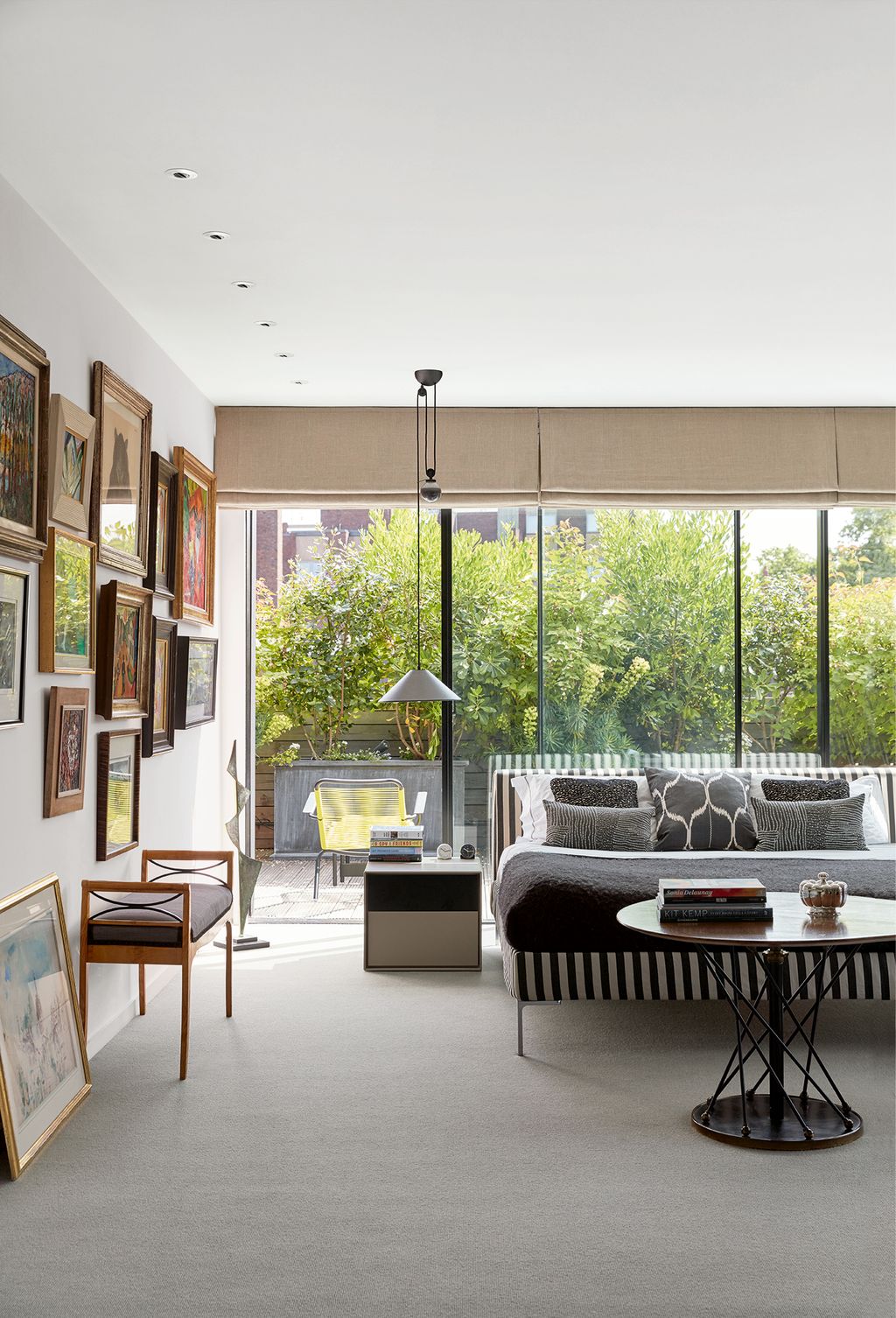
A corridor leads from the central space to the bedrooms, its limited width made a virtue of by the dense hanging of pictures and art on its walls. At the far end of the apartment is the main bedroom, with a wall of windows, in front of which – unusually – the bed is placed. This arrangement has been a distinct success and David puts it down to the fact that there are two pairs of blinds, which form almost a skin – the outer blinds filter the light and the inner ones create a wall. It is a room in which to sit and relax, with a sofa placed against the wall where the bed once stood, faced by comfortable chairs and a low table.
For all its modernity and cutting-edge design this is, without doubt, a domestic space. ‘I set out to make it a family home – somewhere the owners would enjoy living, not a “don’t touch” sort of place or a stage set,’ David explains. And Manina’s verdict? ‘I wanted this apartment to be light and colourful, modern but
comfortable. I love the way David has created areas where you want to sit. He has amazing ideas to which you first say, “No, really?” and then it works.’ What you might call a space success story, then.
Bentheim: bentheim.co.uk
 Lucas Allen1/8
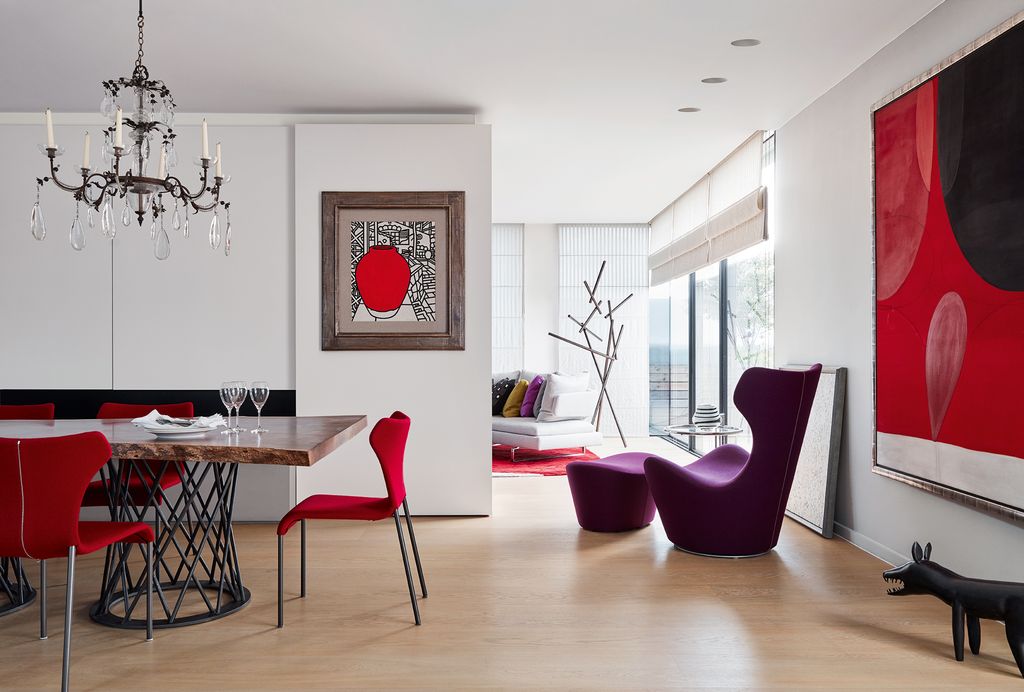
The wall that divides the living space presented a challenge for David, who introduced curves into the sitting area using sofas from B&B Italia. The aluminium and polycarbon floor lamp is Foscarini’s ‘Tuareg’ design. Equally striking are the early twentieth-century Italian chandeliers in the dining area.
 Lucas Allen2/8
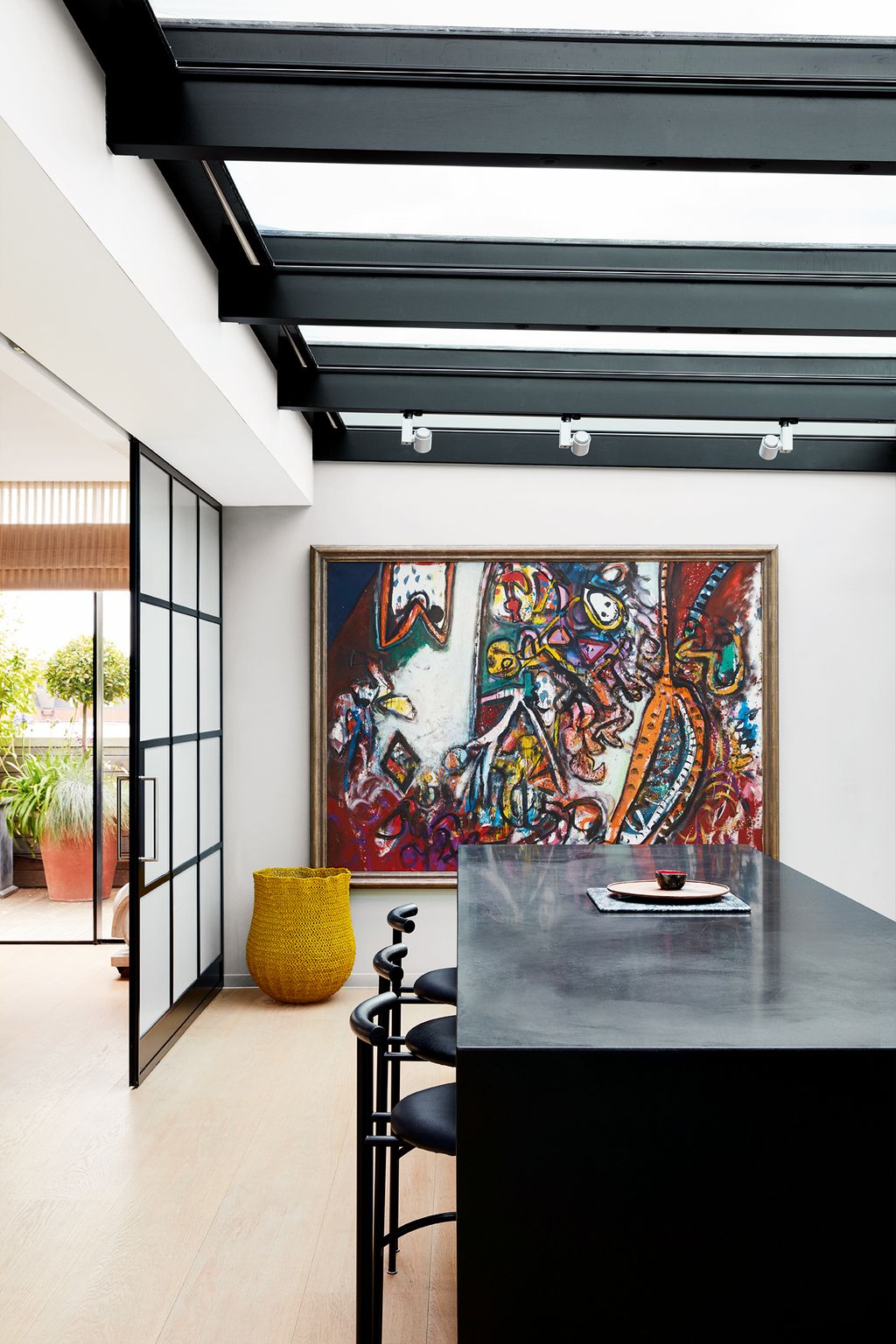
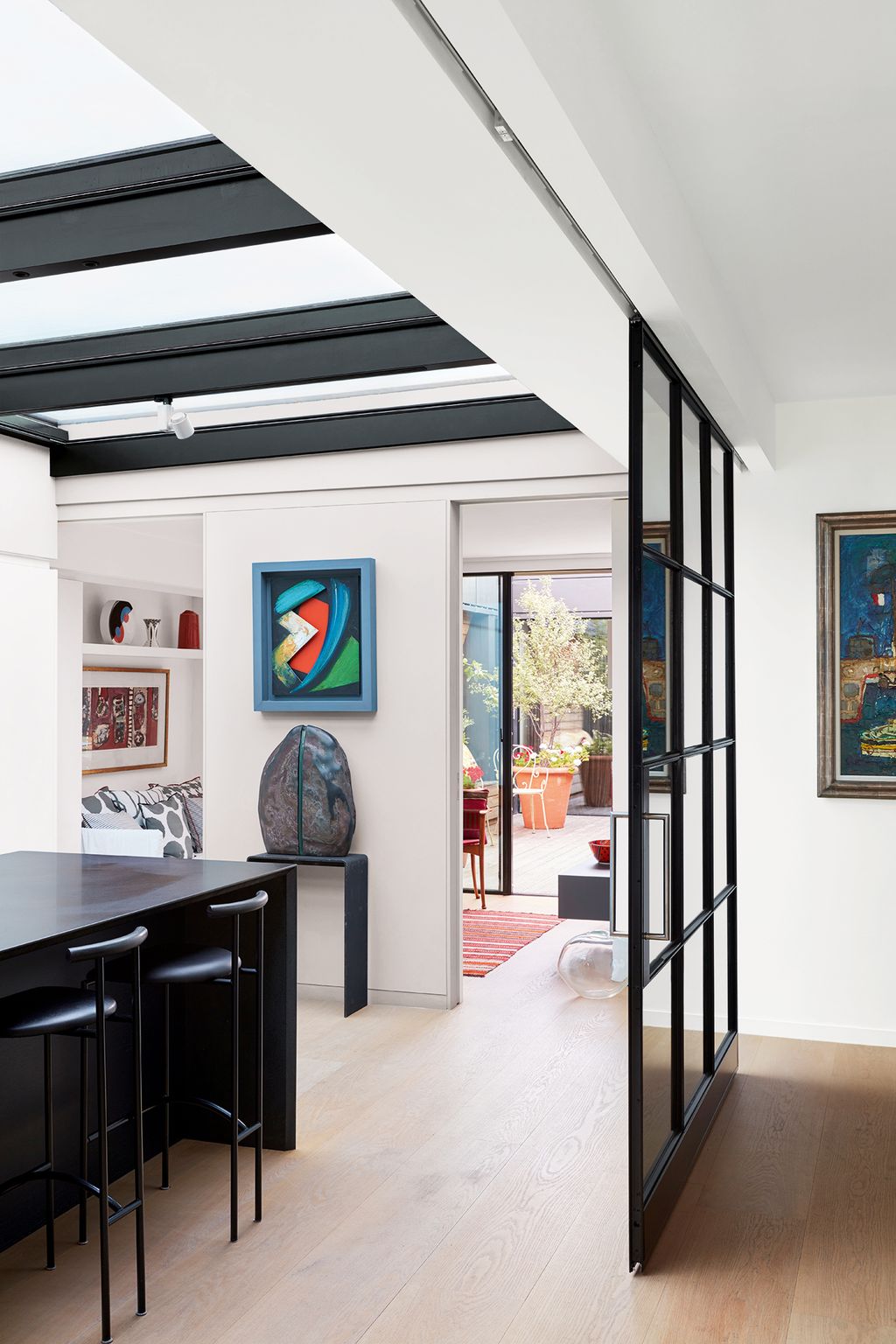
In the kitchen, the ‘Tokyo’ barstools by OMK 1965 were originally designed for the Groucho Club in the Eighties. The flat’s owners are keen art collectors; a large painting by Alan Davie hangs on one wall, opposite a smaller work by William Tillyer and a sculpture by Hugo Zapata.
 Lucas Allen3/8
 4/8
4/8


 Lucas Allen5/8
Mirrored sliding Crittall doors divide the dining area from the kitchen. David Bentheim designed the dining table with James Ransley of Whetstone Oak. The ‘Papilio’ dining chairs and ‘Grande Papilio’ lounge chair are by Naoto Fukasawa for B&B Italia.
 Lucas Allen6/8
In the main bedroom, monochrome cushions from Yastik by Rifat Özbek bring pattern to a ‘Lucrezia’ sofa from B&B Italia, above which is an etching by Victor Pasmore. The ‘Charles’ bed, also from B&B Italia, is placed in front of a wall of windows that look onto the roof terrace. The pendant light beside it is from Artemide.
 Lucas Allen7/8
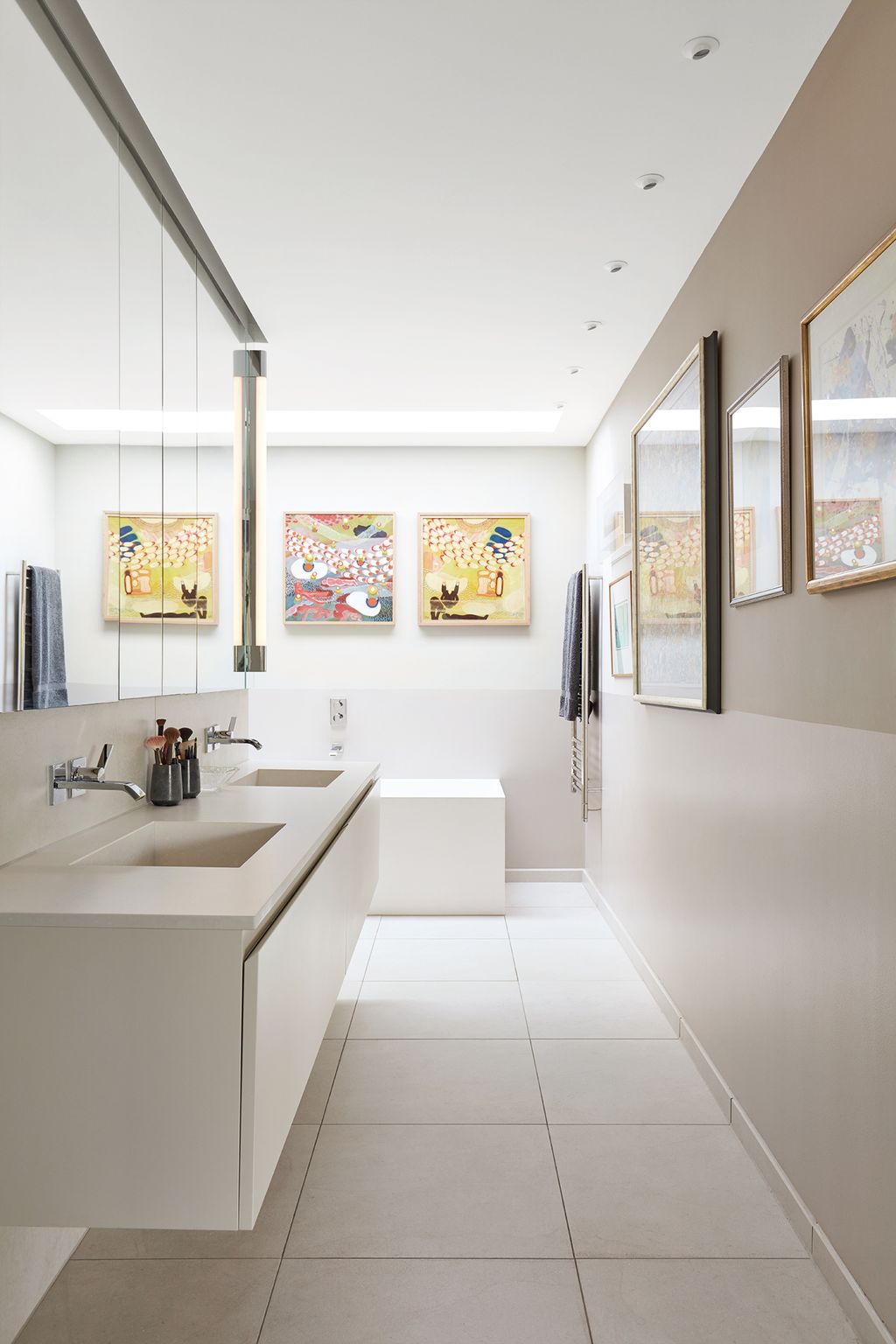
New lighting and wall units were used to update the existing long and narrow en-suite bathroom, where works by the Lebanese artist Aref El Rayess add bold colour.
 Lucas Allen8/8
The main bedroom.


