
A masterclass in bringing a Victorian house back to life with a glorious extension

For Lucy Loveday and her husband Max Kuenssberg, one of the major temptations of the Grain House was its long and generous back garden. With a young daughter – Sylvia, aged six – and an energetic dog, the couple wanted to create not only a spacious home for themselves but also an urban oasis, with a strong relationship between inside and outside living. The transformation of this Victorian terraced home in Hackney, in conjunction with Hayhurst & Co Architects, was all about making the most of these connections, but in a fresh and original way.
‘We were living in a warehouse flat just off Brick Lane. We had some outside space on a roof terrace, but wanted a house with a proper garden,’ says Lucy, a creative producer in the arts. ‘When you have a child, you need something peaceful. And Max had always wanted a dog, so after Juno the vizsla came along, we decided she definitely needed a bit more space. We’d been looking for a little while and were lucky that the estate agent kept us in mind for this house with its beautiful garden. It had been divided in half because the previous owner had reached a point where it had become too much for her to manage the whole garden. But it was obvious that she loved it, and whenever we came to see the house, she was outside.’

The three-storey property had remained largely untouched since the Eighties, when an extension had been added to the rear and the side return. But there was little sense of connection between the upper and lower ground floors, or with the back garden, so this became a priority. They approached Nick Hayhurst and Jonathan Nicholls at Hayhurst & Co, the architectural practice that designed the award-winning Garden House nearby: a newbuild that had also forged a dynamic relationship between the inside and outside spaces.
Hayhurst & Co’s design solution involved creating a new staircase arranged around a modestly scaled but double-height internal courtyard, complete with its own Japanese privet tree. With a wall of timber-framed glass facing the stairs, the courtyard draws in sunlight and helps to ventilate the house in summer, as well as forming a key part of the journey towards the reinvented lower ground floor, complete with a new sculptural rear extension focused upon the back garden.
‘It was partly about making that journey slightly slower and more luxurious, as well as bringing in nature,’ says Nick Hayhurst. ‘But the internal courtyard also demarcates clearly the point where the extension starts, and helps to establish its character. The net effect is that, even though it is a north-facing extension and we are now down at lower ground level, the space never feels dark and you have this burst of sunlight.’
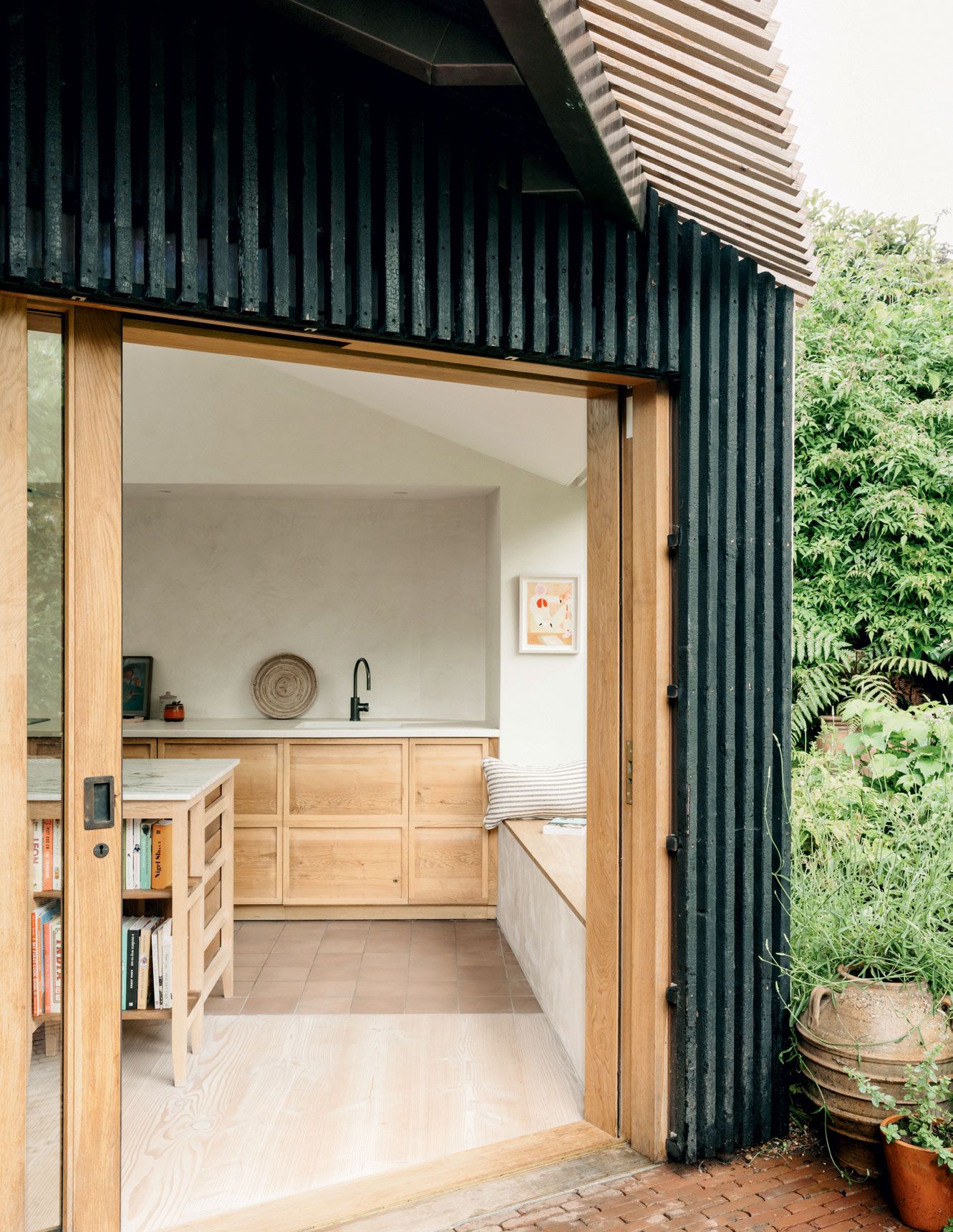
The architect and the owners agreed that the extension itself should be more characterful than a standard glass box grafted onto the back of the building. The resulting single-storey structure manages to be both dynamic and subtle, with a combination of a pleasing outline and carefully conceived openings and apertures looking out onto the garden, rather than just the usual unimaginative expanse of glass. The new dining area, for example, includes a window seat, while the kitchen alongside it features a second picture window, looking out like a lens across the lush greenery of the secret garden.

‘I would argue that it is this sophisticated threshold between the inside and outside spaces that gives the project much of its quality and richness,’ says Nick of the design, which won a 2021 RIBA London Award among other honours. ‘The back door is actually quite slight and set at an angle and, in combination with the picture windows on either side of it, this gives a sense of visual depth as you look outside towards the planting.’
Lucy worked closely with the architects on the choice of materials and finishes throughout, particularly within the new spaces, which include many bespoke elements and pieces of furniture. The palette of materials includes lime plaster, clay floor tiles and a variety of different kinds of timber, including oak, ash and walnut, which contributed to the idea of naming it the Grain House. Furniture maker Sebastian Cox was asked to craft the kitchen cabinetry, as well as freestanding pieces such as the kitchen dresser and the dining table. These simple, pared-back elements provide an ideal backdrop for the family’s collection of paintings and artworks, including the sculpture by Annie Morris in the courtyard.

Max, who specialises in adventure travel, became more involved with the garden, especially the choice of planting, as well as the creation of a series of outdoor rooms within it. Another much-loved addition was a garden pavilion, replacing an existing studio that had seen better days but which provided a precedent for this structure. The new pavilion has a similar character to the extension, with the two buildings talking to one another across the garden: both are clad in a pre-patinated copper coat layered with Siberian larch batons – a combination of charred and uncharred – offering distinctive contrasting textures. Full use is made of the studio, with it serving as a home office for the couple as well as accommodation for guests.
‘When we were looking for a house, on our wishlist was a garden that might allow for a multi-functional space,’ explains Lucy. ‘I’m not an artist by profession, but I do like to paint and draw in the studio. I work from home a few days a week and Max works here all the time, so it has been amazing for us both to have this kind of space. We love the studio and we spend a lot of time in the downstairs area of the new extension, but I also love being in the sitting room on the upper ground floor. The way the light moves around the house is brilliant, creating such interesting shadows. And when friends come over, they say it feels like a warm, real home rather than a cold box. It certainly felt like home to us wonderfully quickly.’
Hayhurst & Co Architects: hayhurstand.co.uk
 Mark Anthony Fox1/2
Original BTC’s ‘Extra Narrow Pillar’ lights frame a Fifties Vinterior-sourced Italian mirror above a Catalano basin. The reclaimed floor tiles are from Bert & May
 Mark Anthony Fox2/2
A headboard in Lewis & Wood’s ‘Batik’ in peridot, a Venini Murano light from 1stDibs and a table from Robin Myerscough Studio add subtle decorative detail


