
A London house serves a masterclass in mixing antiques from a range of styles and movements

When he was 14 years old, my brother Guy carefully carved a hole in our mother’s beloved copy of The Scarlet Pimpernel in which to stash a packet of Marlboro Lights. This was typical behaviour – not only the adolescent experiment with nicotine, but also the aesthetically pleasing hiding place. This was no dog-eared paperback: the hefty tome was linen-bound with marbled endpapers and gold lettering. Our mother was apoplectic.
For as long as I can remember, Guy has been accumulating things: black and white Indian photographs; green Venetian glasses; a wicker waste-paper basket shaped like a frog with marbles for eyes. When we were small, we moved to Chile, and my two brothers spent every holiday at our grandparents’ house in Shropshire, which – with exceptional foresight – they had employed a young David Mlinaric to decorate.
William Morris willow boughs rambled through the hall and the drawing room was painted yellow with lacquered furniture. Guy can recall every last painting, rug and chair in that house. ‘I wanted to be a sculptor, but when I was 16, I discovered furniture,’ he says. Guy was doing work experience at the fine-art dealer Spink when he was taken on a delivery to the art critic David Sylvester’s house. ‘There were antiquities, tribal works, fabulous fragments of carpet, a Richard Rogers dining table with metal rush-seated chairs and a single Dyak canoe on the floor in the drawing room. That man understood how to place things in an interior. It was a formative moment for me.’
After leaving school, Guy worked as a porter at Phillips auction house (which was later taken over by Bonhams). He then took a job with an antique dealer, but with the economic repercussions of 9/11 and the reduction of sales to America, he lost his job and wound up working in a gardening shop. ‘I was sweeping the leaves on the pavement outside when someone I knew from my Phillips days cycled past. He said he’d sort me out and, 48 hours later, I got a call from Christopher Hodsoll.’
The antique dealer offered Guy a whisky and then a job. For seven years, he worked surrounded by the ultimate in grand English house style, until he and fellow dealer Patrick Jefferson decided to set up on their own. Sadly, the 2007/8 financial crash, a lack of funding and (by Guy’s own admission) a dollop of naivety meant that he had to withdraw himself from the business. At which point, Rose Uniacke came along.
‘Guy has worked with me since I opened my shop almost 10 years ago, and now we literally finish each other’s sentences,’ says Rose. ‘He runs the furniture side of my business beautifully, is my research expert and I trust him completely. Working with him is both a pleasure and a privilege.’
In 2012, Guy and his wife Celia bought their house in Battersea. They dug down and extended the kitchen (primarily so our other, 6ft 5in brother could stand up in it), and they added a floor at the top of the house. There are now three bedrooms. ‘Architecturally, I wanted to squeeze as much space out of a tiny footprint as possible,’ Guy says. And that is exactly what he has done. The house is home to three children and an extraordinary array of beautiful objects. And while my brother admits to making no concessions to having small daughters, I can attest to the fact they could not be more thrilled by their surroundings.
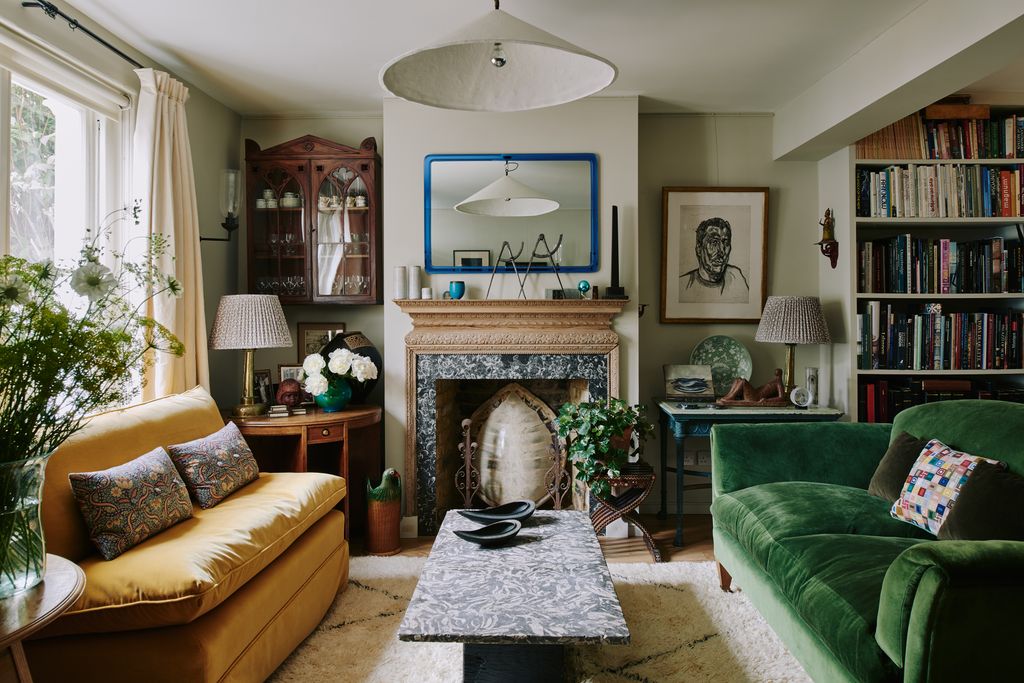
The living room, which leads into the kitchen, is a jewel box of antiques, books and paintings. The two sofas were designed by Guy for the space and the plaster ceiling lights were directly copied from an early Chester Jones project. There is a contemporary chair designed by Rose Uniacke sitting at an unusual desk, probably by Charles Bevan, dating from the 1860s. The objects in this house are a testament to the breadth and scope of Guy’s knowledge and interest. The dresser in the kitchen is Vienna Secessionist, the chairs are Gothic Revival, yet the tiles were bought from Fired Earth.
‘The bottom line is that I love stuff,’ he says. ‘I like learning from people, I like people to learn from me and I think I would have loved everybody who made the things that I own.’

 Michael Sinclair1/10
Living Room
A painting by Sidney Sime hangs on bookshelves above a Gothic Revival desk. ‘I put it here partly due to a lack of wall space, but also because it depicts a Shakespeare play, so having it over a library feels appropriate,’ says Guy. For a picture hanger who could recreate this look, try Paul Carter at Phoenix Fine Art (020-8319 3527), and for more on picture hanging and framing, visit houseandgarden.co.uk/picturehanging. A steel and leather ‘Y Chair’ from Rose Uniacke contrasts with the antique desk. In a range of colours, it measures 79.5 x 54 x 48.5cm and costs £4,200.
 Michael Sinclair2/10
Living Room
A pair of carved frames by Sienese Pietro Giusti hangs above a Japanese chest; the smaller one contains a four-leaf clover found on the banks of the River Deveron. The bowl on the stand is by Roger Law. Guy’s house is a treasure trove of antiques and he has several recommendations of where to pick up brilliant pieces. ‘In London, Rose Uniacke is a great source, as is Tarquin Bilgen on Ebury Street. More and more, I am discovering lesser-known dealers via Instagram, and Ashbourne in Derbyshire is a rich hunting ground.’ Pictured is an early-nineteenth-century chest of drawers available from Tarquin Bilgen, which would fit in well in this house. It measures 96.5 x 91 x 46.5cm and costs £2,450.
 Michael Sinclair3/10
Kitchen
The red-leather-covered dining chairs are Gothic Revival pieces, while the splashback tiles are from Fired Earth. The rook drawing on the wall is by Chris Otley.
 Michael Sinclair4/10
Kitchen
Guy bought the Vienna Secessionist dresser from Lee Wright Antiques in Leicestershire about 10 years ago and the pendant light was found in Florence .


 Michael Sinclair5/10
Bathroom
A marble-topped vanity in the main bathroom.
 Michael Sinclair6/10
Main bedroom
The walls are painted in Farrow & Ball’s ‘Pavilion Gray’, while the headboard is covered in a fabric from Bennison Fabrics.
 Michael Sinclair7/10
Bathroom
The vintage bath was reclaimed from Chelsea Manor Studios, where the cover for The Beatles’ Sgt Pepper’s Lonely Hearts Club Band album was shot. Farrow & Ball’s fiery orange ‘Charlotte’s Locks’ adds a new dimension to the bath, with a a 2.5-litre tin of estate eggshell costing £60.
 Michael Sinclair8/10
Children's bedroom
Prints on the wall include a cat by the Spanish artist Sam3, a cross-section of a tree trunk made up of tiny illustrations of animals, and a polar bear by Swedish artist Einar Hansen. The small chair is a Twenties plywood piece by E Gomme. Farrow & Ball's ‘Parma Gray’ provides a bright backdrop to the prints (£43.50 for 2.5 litres of estate emulsion).


 Michael Sinclair9/10
Garden
A bench provides seating beneath an ivy-draped wall in the paved garden.
 Michael Sinclair10/10
Living Room
The sofas were made for the space and have been covered in cotton velvets – the yellow one is in Lelièvre’s ‘Cosmos’. The coffee table is topped with Lumachella antica; this stone also features on the fireplace, combined with a mid-eighteenth-century carved pine surround. To the right of this is a Lucian Freud etching. For a sofa like the green velvet one in this room, try Soane’s ‘Bunny Sofa’ (75 x 174 x 84cm, from £6,900 excluding fabric). Subtly patterned pleated lampshades in the sitting room are one of many decorative touches and give a nod to traditional English interiors. Nushka sells a range of similar lampshades made from pretty vintage sari silks.


