
A Herefordshire farmstead with its period charm intact

Every summer when they lived here, Charles O’Connor and Edward Greenall set up trestle tables decorated with flowers in their Herefordshire threshing barn, threw open its huge doors and welcomed locals for cream teas in aid of the church. One year, one of their guests was an old lady who had lived at the farm as a child. ‘She had all kinds of stories about life here,’ says Charles. ‘They had pigs, a couple of milkers, chickens and an orchard, and two families shared the house.’
Times changed. Charles and Edward continued to keep chickens and also turkeys and guinea fowl, along with a beautiful grey brood mare, Hilda, who wandered among them on the grass on either side of the drive and sometimes appeared outside a downstairs window. In other respects, this ancient farmstead is unrecognisable. Instead of the entrance from the lane being through the farmyard, the drive now skirts it, sweeping up behind the house. From here, steps lead down to the courtyard formed by the threshing barn on the far side, the former milking parlour opposite and the stables on the right. Where once there were cobbles and, later, cement ringing to the clatter of cows’ hooves, there is now a parterre.
MAY WE SUGGEST: Caroline Holdaway's dream Cotswold cottage
The house stands to the left of this courtyard and is entered from the back. The symmetrical façade at the front was remodelled in the nineteenth century to bring its seventeenth-century mullioned windows up to date. The oldest part of the house may have been built as early as the sixteenth century, which is the date of the cruck frame at one end above the kitchen. When Charles and Edward bought it, Edward transferred his job from London to a hospital in Abergavenny and moved into the house fill time. Charles, a shipping lawyer, was still based in London during the week, where they have a flat.
The appeal of this house, unlike many others they looked at, was that it had not been over-restored. ‘After most of the farmland was sold off, the same family lived here for 40 years,’ says Charles. ‘They had done a bit of work themselves, but they hadn’t put in acres of limestone or a grand kitchen. The fabric of the house was still intact.’
There is nothing like benign neglect for preserving period atmosphere, but when Charles and Edward had the house surveyed, they discovered the whole building was supported by a single tree trunk propping up the cellar stairs. Undeterred, they bought it and set about making it safe. They restored chimneypieces and put in wood-burning stoves, installed an Esse range in the kitchen and replaced the metal window frames on the rear elevation. ‘The first months were pretty grim,’ says Edward. ‘We were camping upstairs; I came back from a late shift through the snow to a bedroom with no window and a floor covered in mouse droppings.’
Decorating and furnishing was a joint effort, though Charles took charge, leaving Edward to concentrate on designing the garden. ‘We had some help with fabrics from a friend, Emilia d’Erlanger,’ says Charles. ‘Then it was a question of gathering furniture and pictures. A lot came from our families and we bought a few things at auction, like the sixteenth-century court cupboard in the living room. Edward likes fifteenth and sixteenth-century English and Welsh furniture as well as mid-century pieces, whereas I like Georgian and Regency furniture. Despite this, there were few disagreements.’

None of the rooms is particularly big, but all are nicely proportioned and comfortable. Oak panelling with William Morris wallpaper above sets the tone in the central hall. On the left is the kitchen, and off it the old dairy, now a laundry and boot room, with an elegant dresser designed by Edward. It doubles as a summer breakfast room, as it gets plenty of sun. On the other side of the hall is the parlour. ‘It’s a room with no particular function – we use it for drinks and dinner by the fire in winter,’ says Edward. The house is L-shaped and the parlour leads to the staircase hall and the living room beyond, both in the small back wing. There are three bedrooms and bathrooms on the first floor and two more bedrooms under the roof. For a house decorated and furnished from scratch so recently, it already has a pleasingly settled air.
 Simon Brown1/13
Parlour
The walls in this room are painted in Farrow & Ball’s ‘Babouche’; it leads through to the staircase hall and living room beyond.
 Simon Brown2/13
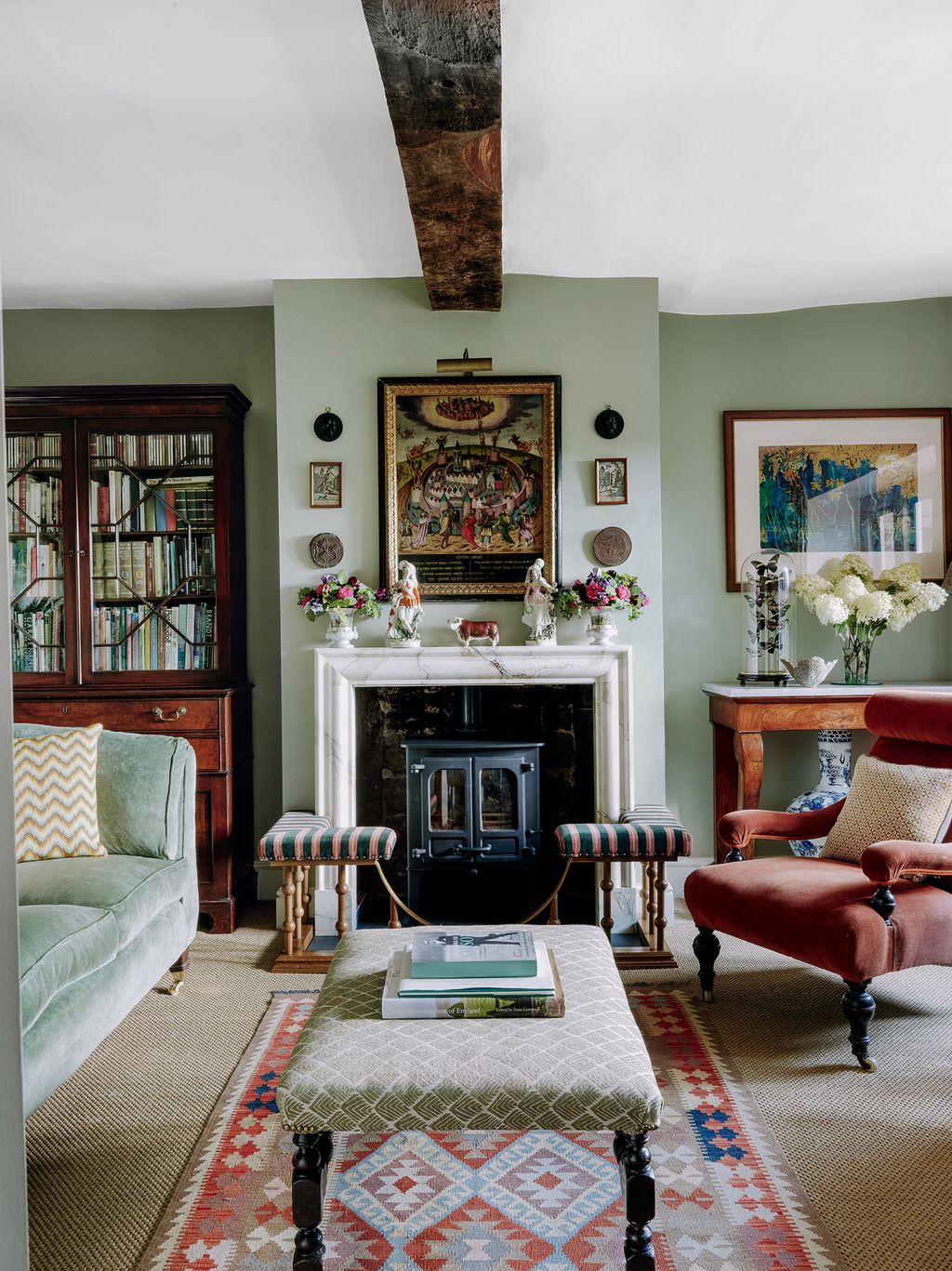
Living room
A seventeenth-century stool from Christie’s has been covered in Guy Goodfellow’s ‘Indus Weave’. Robert Kime’s ‘Chenille Stripe’ was used on the club fender. The artwork on the wall to the right is by John Piper and depicts nearby Eastnor Castle.
 Simon Brown3/13
Parlour
A portrait shows one of Edward’s ancestors. The table is from Alexander von Westenholz.
 Simon Brown4/13
Threshing barn
A trestle table is decorated with flowers from the garden; on the other side of the parterre is the old milking parlour.


 Simon Brown5/13
Hall
‘Golden Lily’ wallpaper by Morris & Co and new oak panelling line the walls, with original quarry tiling on the floor.
 Simon Brown6/13
Kitchen
Opposite the hall is the kitchen, which has an Esse range, walls in Farrow & Ball’s ‘Borrowed Light’ and chairs in a striped fabric by Manuel Canovas.
 Simon Brown7/13
Laundry
Occupying the old dairy, this room is now a laundry and boot room, and can double as a breakfast room in the summer. The pendant lights are from The French House.
 Simon Brown8/13
Parterre
A circular carp pond is the central focus; behind this are the stables


 Simon Brown9/13
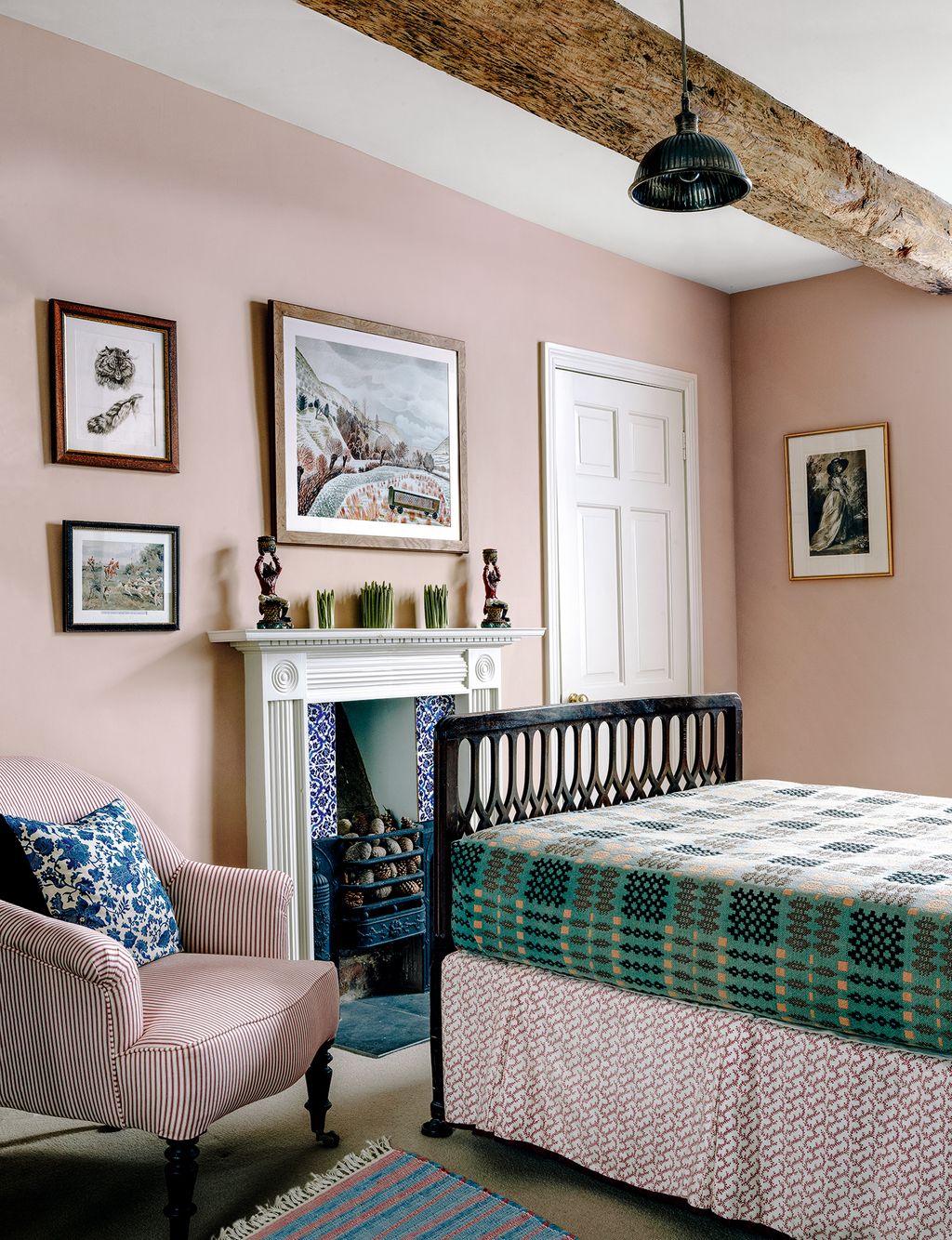
The walls are painted in Edward Bulmer’s ‘Jonquil’; the bed is covered in an antique Welsh blanket with an old Colefax and Fowler fabric reused on the valance.
 Simon Brown10/13
Main bedroom
Walls in Farrow & Ball's ‘Pavilion Gray’ provide a neutral foil for patterned textiles, including a bedcover from Sherwood & Bailey.


 Simon Brown13/13
twin bedroom
This attic room has walls covered in Morris & Co's ‘Marigold’ and bedcovers from Country & Eastern in Norwich.


