
Inside the Somerset headquarters of design studio Artichoke, where local craft shines

It has taken more than one million years for glacial meltwater rivers to carve out the canyon of Cheddar Gorge from Somerset limestone. It’s somehow fitting, then, that in the village only a mile down the road, there is a joinery workshop that is defined by patience, time and the transformation of natural materials into something spectacular.
Artichoke, founded over 30 years ago by Bruce Hodgson, is known for creating architectural handmade joinery, from kitchens and boot rooms to whole house projects. He is tight-lipped about his clients, but with a two-year waiting list and kitchens starting at £400,000, his company represents the top of the market. Made from solid timber that has been carefully and slowly cured for months on site, each item is assembled, scrutinised and then disassembled (‘like a giant Lego set,’ says Bruce) before being installed by the in-house team.
The workshop in the village of Cheddar is a gleaming space in which every piece made is a one-off – from cabinets to doorknobs, wine racks to wall panelling. Alongside the vast humming machinery, all the cabinet-makers have their own chamois-leather roll of Japanese hand tools, like a chef’s personal set of knives. Along with the designers and finishers, they are assisted by a team of young apprentices. Bruce is passionate about nurturing talent locally – hyper-locally, in fact. ‘Within bicycling distance,’ he insists.

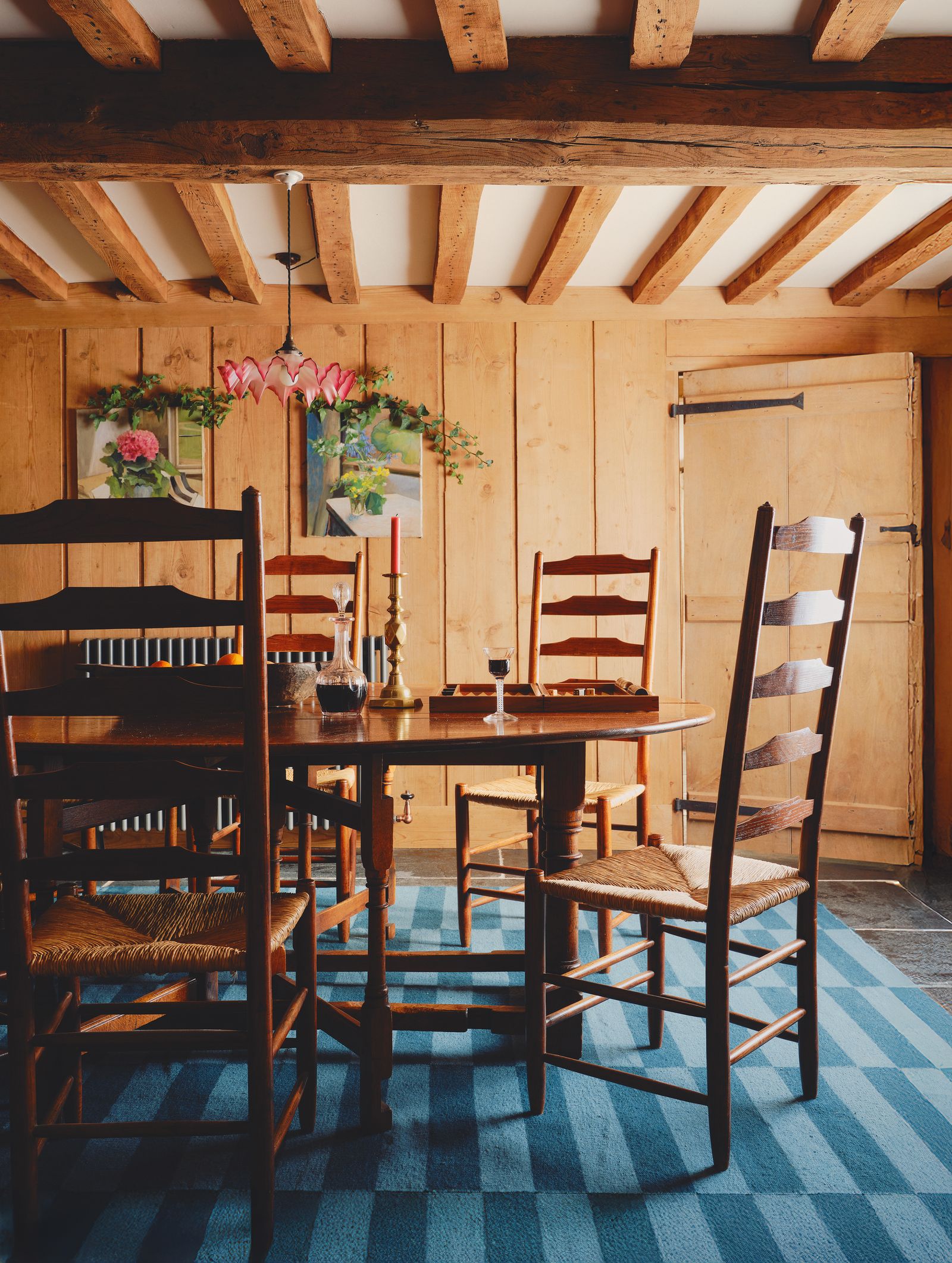
Bruce and his wife Tess, who consults on interior decoration, also have a short commute. For the past 11 years, since their three children flew the nest, the couple have been breathing life into Batch Farm. This comprises a longhouse built in 1600 and outbuildings that include a traditional Somerset cheesehouse dating from 1820. Bruce’s passion for wood is in evidence everywhere. In the dining room, antique cheeseboard panels from Holland line the walls, while the doors are handmade from elm that Bruce found on a cycling holiday in the Loire Valley. Their hand-forged wrought-iron latches and nails were made by Lucy Sandys-Clarke to a 16th-century Somerset design.
At Christmas, the couple’s children – Rosie, Flora and Dougie – descend with their partners. Bruce cooks the turkey outside on a Green Egg barbecue; mulled cider, made from their own apples in a village co-operative, is served. Rustic decorations created by Tess from dried flowers, oranges and lemons are strung across beams and chimneypieces.
Raised in rural Buckinghamshire, Bruce says he loved ‘knocking things together’ even as a child. But it was in a design and technology class at Sedbergh School in Yorkshire that he had a glimpse of what might be his calling. ‘The DT department was a sanctuary,’ he says. ‘I’d go in there and listen to Radio Luxembourg, make a hovercraft, forge iron.’ After sixth-form college – and what Bruce calls a ‘rebellious phase’ – he joined the army, where he was commissioned into the light infantry as a platoon commander.
It was meeting Tess in 1990 that would put Bruce back on a creative path. They were married within a year and he left the army. Soon he had another lucky encounter: ‘I met a man in the pub who had a joinery business. He was looking for someone to run his workshop. It was an awakening – I could pick up a tool and it would work in my hands. It felt easy – a delight, even.’ Bruce took a course at the London College of Furniture in cabinet-making and, when Tess was pregnant with their first child, they moved to Bristol to be nearer her family. Bruce started advertising his cabinet-making services locally, gaining small jobs like ‘making garden gates’ until a neighbour asked him to create a bookcase for their sitting room. His first kitchen was for his sister.

Bruce describes those years as his ‘apprenticeship’. His work got better and better and, as his reputation grew, he expanded beyond kitchens. In 1998, he named his company Artichoke: ‘I liked the rhythm of the word,’ he says. ‘And it felt English.’ Now with 54 employees, Bruce is as hands-on as ever. ‘We’re often working in houses built in another time – my job is to unlock the 3D puzzle of a house in a way that preserves the beauty of a place.’ Their eldest daughter, who trained on the workshop floor as a cabinet-maker, will soon be joining the detail design department. ‘The role of Rosie in the business is a remarkable feeling of continuity.’
What does the kitchen of one of Britain’s top cabinet-makers look like? You might be surprised to learn that it has Ikea units that were there when they moved in. Bruce has been taking his time designing this final bit of the house. He’s been sketching and thinking about it for years, getting it just right. Work will soon start on the bones of it, but all in good time. Because, as Bruce puts it, ‘Beautiful things take time to make’.
 Dean Hearne1/2
Tess and Bruce enjoy mulled cider with (from left), their daughter Rosie, son-in-law Tom Mobbs, Artichoke team member Sally Morgan-Flower and their neighbour Lesley Gwyther.
 Dean Hearne2/2
The candle chandelier, decorated for Christmas with greenery by Tess, is a find from one of the couple’s European road trips; the table is covered in a cashmere paisley throw from Rajasthan


