
Hubert Zandberg transforms a 19th-century barn with a masterfully restrained palette of materials
When he was a young man studying law and business at Stellenbosch University, in South Africa, Hubert Zandberg had ambitions to one day work as a cultural attaché. To help pay his way through university, he worked in a before-its-time lifestyle-concept store – doing everything from merchandising to helping clients furnish their homes. And so, eventually, he did what any twenty-something with the drive and easy charm of a diplomat and an instinctive aesthetic sense does: he became an internationally sought-after interior designer, a profession that requires equal and generous amounts of both.
Hubert came to London in the Nineties, landing merchandising jobs at Heal’s and with the late interior designer David Champion, whose shop on Westbourne Grove, W11, was an ever-changing romp around the globe. This was a formative time for Hubert, who would often be tasked with restyling the window displays, drawing in fashionistas and the simply fabulous – from Giorgio Armani to Annie Lennox. When Hubert went on to set up his own interior design studio, he took this experience with him.
The owners of this house are a restaurateur and gallery owner and his environmental philanthropist wife, who have three grown-up daughters. They bought the 19th-century timber barn as a weekend house years ago, by which point it had already been converted into a home fit for modern life. More recently, however, they decided to update some of the original developer’s efforts and they brought Hubert on board to help them achieve this.
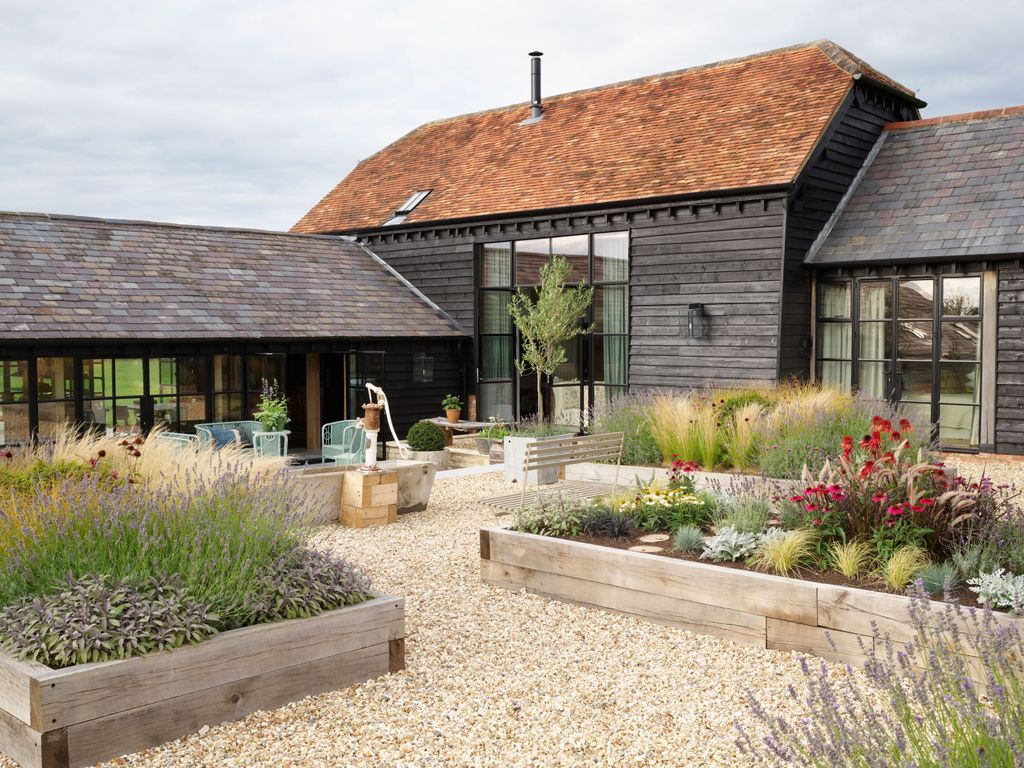
The building, set within Buckinghamshire farmland, consists of an old threshing barn and outbuildings, connected and extended to create an L-shape that looks out over a courtyard garden. ‘Structurally, it was good,’ says Hubert. ‘But it was badly detailed.’ The owners wanted to keep the need for planning permission to a minimum, so a local architect helped to pave the way for the replacement of the windows, choosing ones with blackened steel frames that disappear into the dark-stained timber-clad exterior. Inside, new floors were laid, the architectural detailing was rethought and the entire place was refurnished and redecorated.
In one corner of the L-shaped building is a small snug, which leads, on one side, to an enormous sitting room and two bedrooms and, on the other, to a dining area and kitchen, with another bedroom beyond. There is a fourth bedroom on a mezzanine level above the snug.
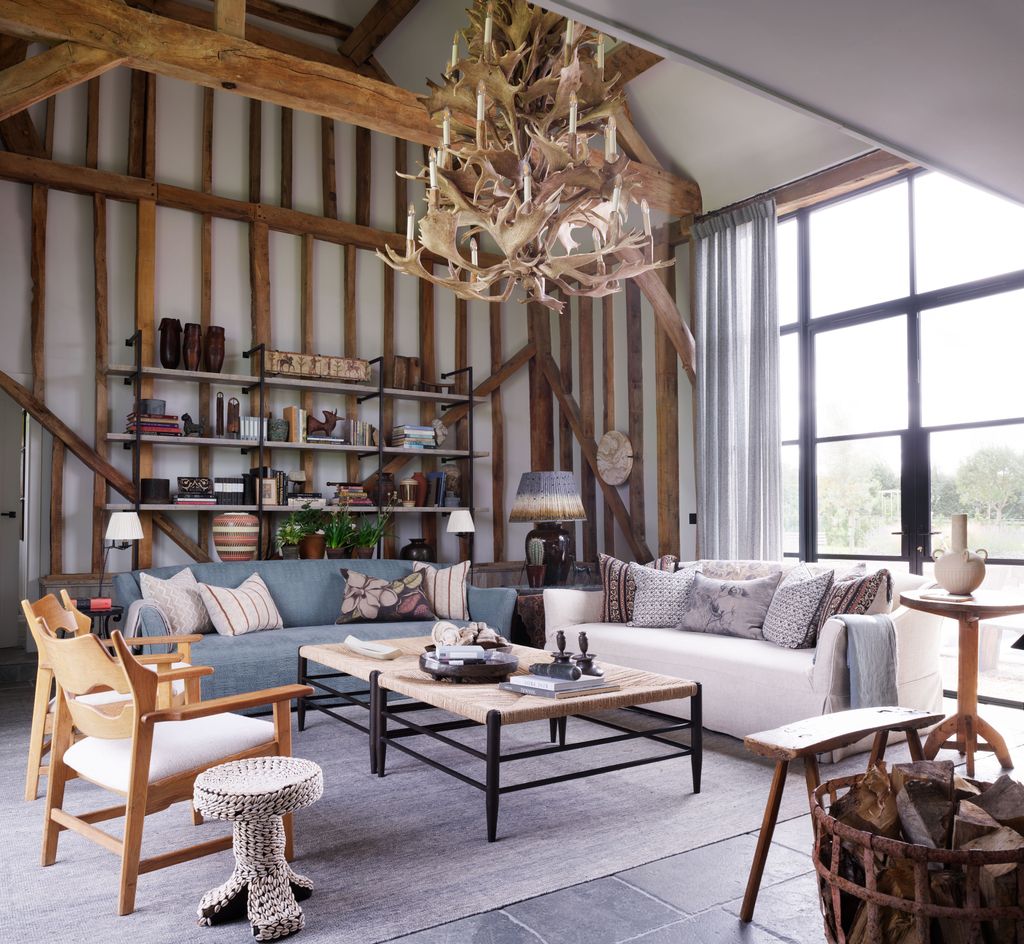
One of the more impressive spaces is the sitting room, which takes over half of the original barn and is open all the way to the roof space, revealing a wonderfully wonky, scrubbed-oak framework that is combined with pure white walls. Here, as elsewhere in the house, there is a masterfully restrained palette of materials. There is wood, stone, metal and fabrics made from natural fibres. The colours are muted: mostly whites, grey and oatmeal, with a bit of russet and cornflower added as highlights.
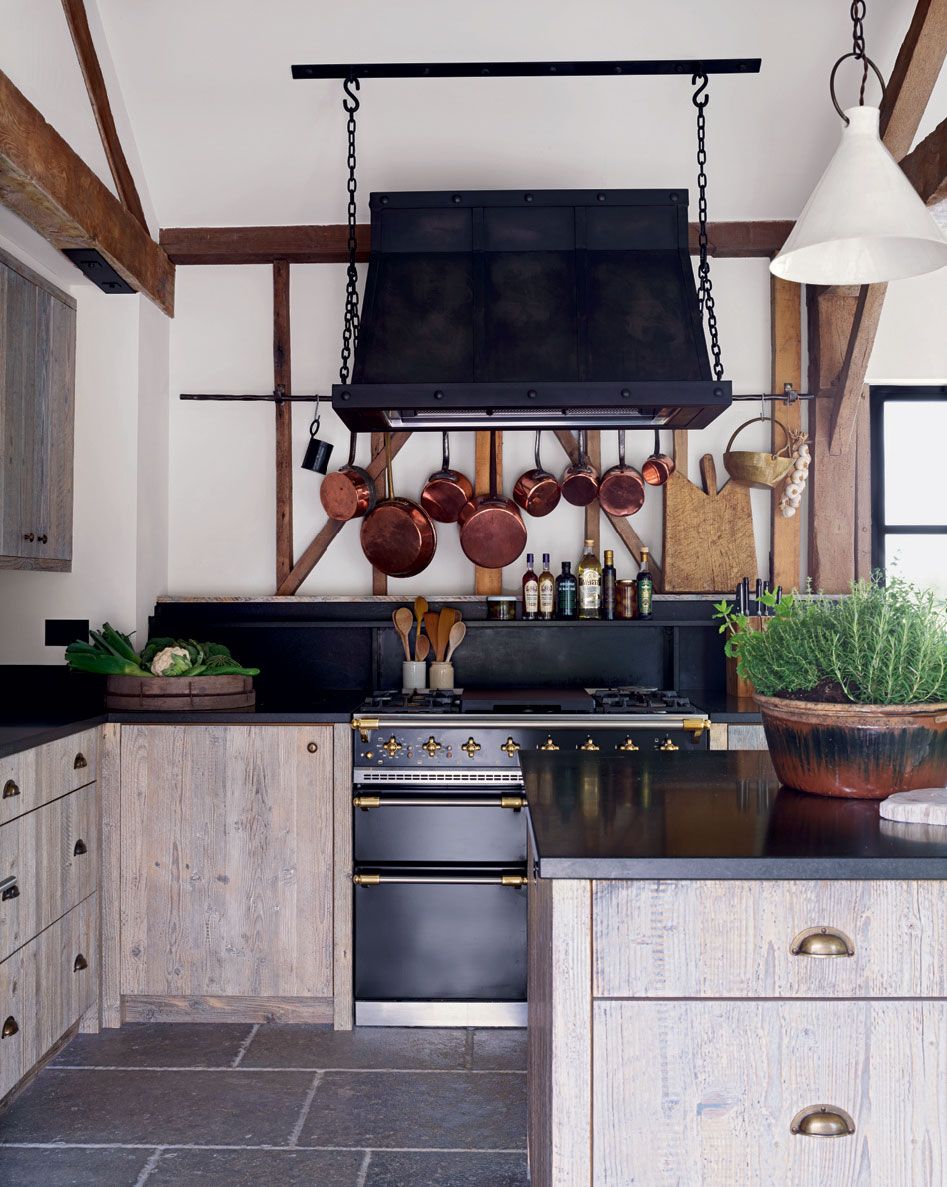
Befitting the home of a restaurateur, the kitchen is kitted out to a standard that would allow any professional chef to work with ease, yet it maintains the same earthy characteristics as the rest of the house. Hubert and his team worked with several craftspeople to make the various components, from cabinet fronts and shelving to hinges and handles. A wide, freestanding unit, topped with forged-iron shelving, gives the impression of separation from the dining area without carving up the space into rooms.
Although he cites the likes of Howe London and Max Rollitt as regular sources of furniture for projects, Hubert says that often more than half of the furniture used is custom-made. That includes upholstered pieces as well as reproductions of antiques. In this house, pieces such as the benches serving as a coffee table in the sitting room were inspired by pieces in Hubert’s own collection of antiques but reproduced to a different size.
MAY WE SUGGEST: An 18th-century rectory in Gloucestershire that melds Georgian simplicity with modern style
Also in the sitting room, raw wood shelves are contained within an unfinished iron frame that climbs up one wall. It is another of Hubert’s custom designs and it is something of a signature piece. ‘We unashamedly roll them out,’ he admits. ‘We have them in our office, so clients see them and want them.’ He describes the shelves as having ‘the minimal essence of what a shelf needs to be’. In this case, they are made in unprecious materials to suit the organic nature of the barn and to work with the seemingly casual arrangement of objects they hold.
This brings us to the aspect of interior design that seems to excite Hubert the most, and arguably what he is best known for. And that is the meticulously thought-out placement of items within a space, particularly collections of objects. ‘Sometimes I feel like a glorified stylist,’ he says, laughing. But get him talking about ‘creating dialogues between pieces on a shelf ’, and his eyes light up. In the barn, he worked with the owners’ existing collection of ancient and pre-Islamic pieces, and mixed them with mid-century ceramics found at flea markets. Everywhere you look, he has created intriguing vignettes that marry and juxtapose different ideas. ‘Almost by bringing them together, it is a process of democratising the objects: it’s not about money.
‘Every maximalist is a closeted minimalist,’ he continues. ‘In order to create such a layered look, you need a canvas that is pure and simple. Otherwise, it’s a mess.’ Hence the tightly controlled colour and material palette seen here. ‘It starts to make a certain music when it’s right. And when you think about a symphony, what makes it beautiful is never about the number of notes used, but the melody you create with the notes.’
Hubert Zandberg Interiors is a member of The List by House & Garden, our essential directory of design professionals. Visit The List by House & Garden.
Hubert Zandberg Interiors: hzinteriors.com
 Simon Upton1/9
Together with various converted outbuildings, this 19th-century barn forms a spacious L-shaped house around a courtyard garden. New windows with handsome blackenedsteel frames merge seamlessly with the dark-stained, timber-clad exterior.
 Simon Upton2/9
Reclaimed oak joinery by The Main Company is complemented by sleek Nero Zimbabwe granite.
 Simon Upton3/9
A solid oak table from Heerenhuis is paired with chairs by Hubert Zandberg Interiors, and lit by the ‘Floren’ four-arm pendant light from CTO Lighting. A Tuareg mat from Morocco covers Mandarin Stone’s ‘Malvern Provence’ floor.
 Simon Upton4/9
At the far end is the snug, with an intimate arrangement of furniture.


 Simon Upton5/9
In the main room, a pair of oak and rush benches editioned from antiques in Hubert’s collection serve as a coffee table for two HZI sofas – one in Mark Alexander’s ‘Haboro’ linen in tempest and the other in Pierre Frey’s ‘Basile’ linen in naturel – and a pair of Henning Kjaernulf chairs. The chandelier was sourced from L’Isle-sur-la-Sorgue market.
 Simon Upton6/9
The high ceiling allows for an elegant metal four-poster bed by HZI, with a headboard in vintage fabric from The Cloth Shop; the round pine-cone mirror is by Thomas Boog.
 Simon Upton7/9
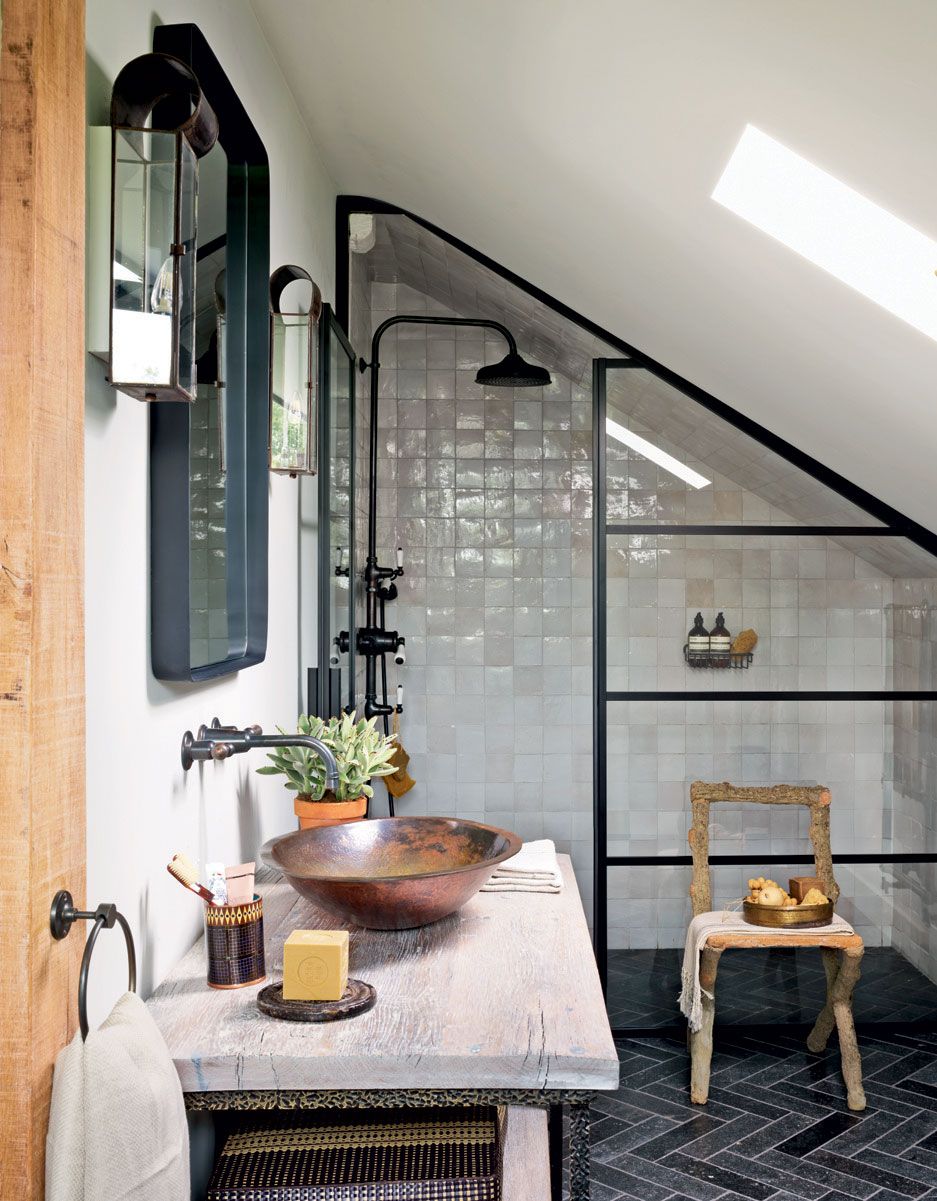
The custom hammered bronze vanity unit with a limed oak top is complemented by weathered copper brassware by Chadder & Co.
 Simon Upton8/9
Framed antique herbiers above a bed from the Victorian Brass Bedstead Company echo the room’s earthy tones.


 Simon Upton9/9
The blues and greens of a metal factory table from Brussels, an Indian throw from The Cloth Shop and House of Hackney’s ‘Paradisa’ cushion create a calming space.


