
An interior designer brings colour and character to a tiny mews house near the sea

The peculiar appeal of mews houses (like their country cousin the cottage) lies in their humble origins. Tiny and eccentric in their layouts, these houses were originally designed as stables and servants' quarters for the larger houses they adjoined. Such were the 19th-century beginnings of this house in Hove on the south coast of England. Now, however, the charm of these houses makes them desirable places to live, as this one was for its current owner, who bought it as a holiday house and called in interior designer Isabella Worsley to give it a fresh and colourful redesign.
Isabella started out on her own in 2018, having spent time first at Guy Goodfellow's architectural and interior design practice and then gone on to work for Kit Kemp. Between these two very different studios she received a thorough grounding in, first, how to attend to the backbone of a space, getting its proportions and flow right, and then how to give the interior a narrative, playing with the unexpected and injecting humour and character into the rooms. Both aspects of her training have been called in on this project.

“The first priority was to reconfigure the space," says Isabella. “It was all feeling rather boxy and lacking flow.” To create that sense of flow and openness which is so essential in a small house, Isabella brought on the architect Martin Taylor, who set about streamlining the floor levels and working with the layout to allow it to function for family life. One of the most striking features of the house is the ‘vinery’ on the second floor, a beautiful glass extension already in existence when the project started, which houses the sitting room and gives an extraordinary sense of openness.
Part of the joy of the vinery is that its openness is so unexpected, given the compact nature of the rest of the house. Isabella was keen not to open up the entire floor plan unnecessarily. “I'm not sure the current trend for open-plan living always works,” she says. “You lose wall space and you're constrained to keep the same aesthetic flowing through the entire house. Whereas actually, when you have separate rooms and disconnected spaces, you can create contrast, and then it feels like the house is constantly unravelling to you.” The deep green of the sitting room and the open freshness of the vinery are a good example of this unfolding of spaces via the contrast of light and dark.

When it came to the aesthetic of the interiors, the family wanted something “informal with a bit of beachy vibe,” as Isabella puts it. “It needed not to be precious; they didn't want something where they'd be worried about scuffing the paintwork.” Given that the project was a second home, there were more opportunities to be playful and experimental with the interiors. “When it's a client's main home, they tend to want to play it safer,” reflects Isabella. The beach, which is only a stone's throw from the house, was a significant influence. Much of the ground floor, which encompasses the kitchen and dining area, is clad in V-grooved panelling, which Isabella finds has a more contemporary feel than the usual tongue and groove.

Isabella also drew on the colour scheme of Vanessa Bell and Duncan Grant's Charleston, located not far from Brighton on the Sussex Downs to create something “warm and playful, with a bit of a sense of humour.” Pleasing blocks of flat colour demarcate most of the main rooms, including a deep green in the sitting room, moody blues in the bedrooms, and a cheerful pink-toned red in the kitchen. In general she wanted to work with the smallness of the house rather than fighting against it: thus in the attic bedroom (which used to function as a coal-hole), the wallpaper wraps around the entire room, including the ceiling, to create a cocooning feel.
The furniture in the house works well for the informal vibes of the interior. “The client didn't really want us to buy many new pieces,” says Isabella, and given the constraints of the budget, she and her team spent plenty of time combing through Ebay and other marketplaces for the right things. “We like working with vintage and antique furniture,” she explains. “It feels like a considerate way of working, and of course they also bring a sense of heritage and history to a house, as well as a feeling that it's been built up over time. It's the way our clients are going more and more." Select modern pieces like the Hector Finch pendant in the vinery add a sharpness and cleanness to the space, forming a stimulating contrast between old and new.
 Helen Cathcart1/11
Isabella built in a banquette in the dining area, upholstered in Lee Jofa's ‘Gridlock’ in Indigo. A pendant light from Pinch hangs overhead. The curtains were made up in Zoffany's ‘Jayshree’ pattern.
 Helen Cathcart2/11
A mirrored nook at the other side of the room helps to bounce the light around.
 Helen Cathcart3/11
 Helen Cathcart4/11
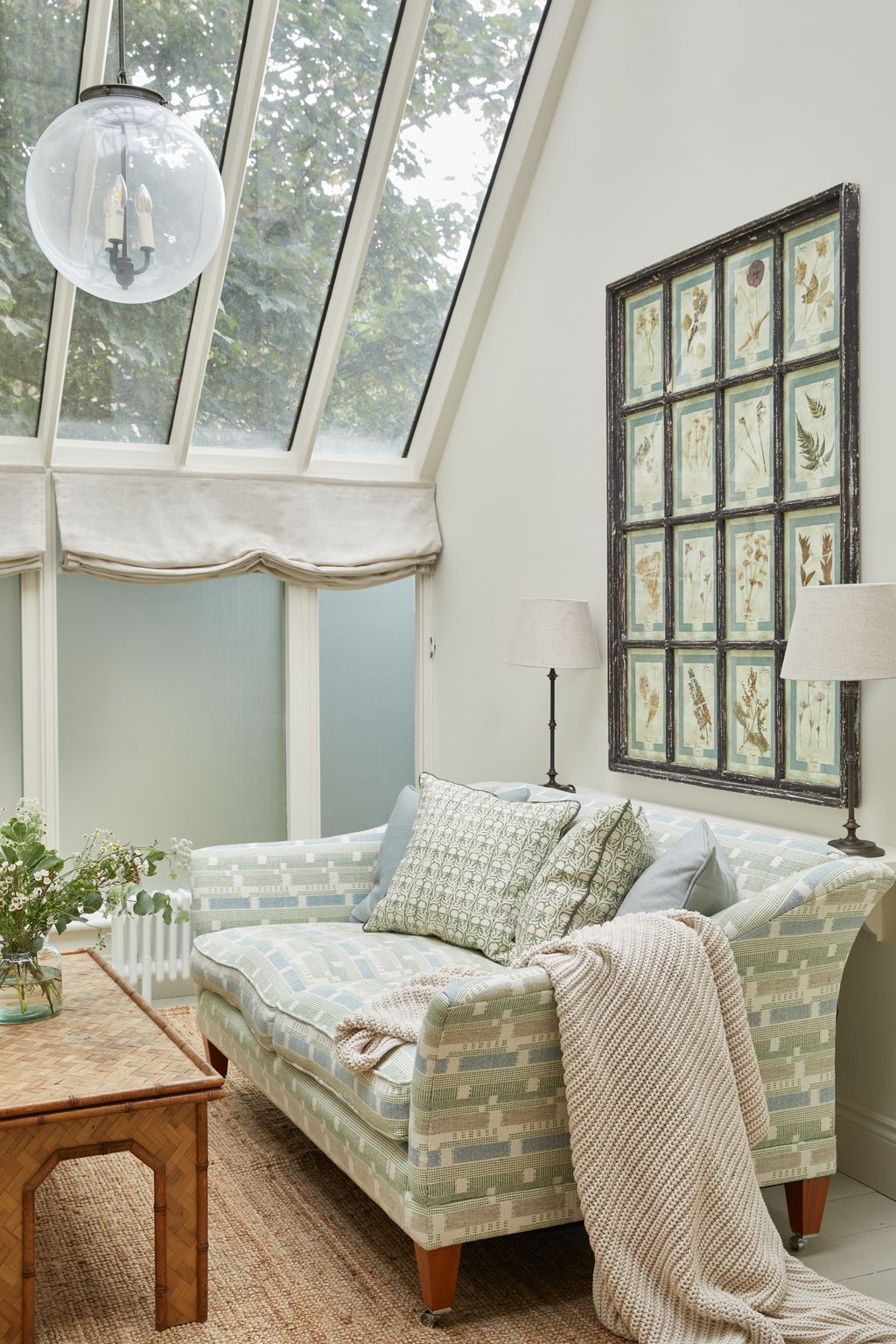
The sitting room opens into the vinery, where antique armchairs sourced from Kempton and covered in Guy Goodfellow Collection's ‘Fez Weave’ face a bespoke sofa covered in Christopher Farr Cloth's ‘Loom Weave’. The coffee table was an Ebay find, while the globe pendant from Hector Finch adds a contemporary edge.


 Helen Cathcart5/11
Behind the sofa hangs a set of botanical prints framed in an antique window, sourced at Lorfords.
 Helen Cathcart6/11
Another bedroom is painted in Farrow and Ball's ‘Mizzle’; the lamp is from Vaughan.
 Helen Cathcart7/11
The bathroom is painted in Edward Bulmer's ‘Malahide’, with tiles from Emery et Cie around the shower.
 Helen Cathcart8/11
The attic bedroom is wallpapered in the 'Mr Men’ pattern from Howe London.


 Helen Cathcart9/11
This bathroom has a vanity in Marron Imperial marble with a double bullnose profile.
 Helen Cathcart10/11
 Helen Cathcart11/11


