
At home in Bruges with painters Jacqueline Dehond and Koenarrd Uyttendaele
If the scene in the basement of their Thirties house in Bruges is anything to go by, Jacqueline Dehond and Koenraad Uyttendaele are as much creative scientists as they are artists. Wearing a lab coat and surrounded by pots of pigment, Jacqueline is midway through mixing piles of cobalt and yellow powders to create a blue for a painting she is about to start work on. It is a mesmerising process – a sort of alchemy – in which pigments and casein binder magically combine to form a delicious paint. The husbandand- wife duo, who work under the name Jacqy duVal, mix their own casein paint – a milk-based, pigment-rich and fast-drying substance that has been used since Ancient Egyptian times and is prized for its vibrant colours and consistent finish.
Having launched Jacqy duVal 14 years ago, Jacqueline and Koenraad have become known for their eye-catching abstract canvases. Featuring bold geometric forms, their paintings are created with the same meticulous approach that underpins their pigment mixing. Each linen canvas is stretched by the couple before being coated with layers of rabbit-skin glue. This traditional technique helps to create the ideal medium for the paint to be applied to. ‘We then tape out the shapes before painting,’ explains Koenraad, whose background is in historic building restoration and colour analysis. ‘Jacqy DuVal is about using old, historical techniques in a contemporary way,’ he adds.
The couple met almost 40 years ago. If Koenraad had taken heed of the advice of his brother, who had sat next to Jacqueline at a dinner party and thought that the two creative spirits would be a good match, the meeting might have happened a year earlier. When they did subsequently encounter each other on a train journey from Bruges to Antwerp, it was quite clear they were meant to be. Both grew up in Bruges and, at the time of their meeting, were students at the Royal Academy of Fine Arts in Antwerp – Koenraad was in the final year of the painting course, while Jacqueline was a first-year fashion-design student.

By 1987, the couple were married and, after a four-year interlude in Brussels, they returned to Antwerp in 1991, as Jacqueline had landed a job at a graphic-design studio specialising in printed T-shirts ‘Initially, I was editing everything by hand. But then we started to use computers, which introduced me to a whole new exciting world,’ she says. ‘A lot of what we do today involves skills that I honed while working there.’
Koenraad, meanwhile, was taking the first few steps in his career as a restorer of historic buildings, working for Belgian decorating and restoration firm Decor Franck (formerly Maison Franck) in Antwerp. ‘I learned a great deal on the job as well as at evening classes in restoration,’ recalls Koenraad. He spent his Sundays shadowing restorer Bob Ghys, a specialist in Old Masters paintings, at the Royal Institute for Cultural Heritage. ‘He was an amazing man and I owe a lot to him,’ says Koenraad. ‘He would make all his own brushes from hazel and goose feathers, and many of the traditional techniques we use today for Jacqy DuVal, I picked up from him.’
In 1995, the couple moved to Ghent. Both had set up on their own by this point: Koenraad as a restorer of historic interiors, which saw him working on everything from townhouses and castles to Royal Collections; and Jacqueline as a designer of interiors fabrics. Soon, she also started producing her own hand-printed textiles, as well as acting as an interior-design consultant, which she still does occasionally.
The couple had been renting a beautiful apartment in a grand 18th-century building but, after the arrival of their first child, they started to run out of space and decided to look for a house where they could put down proper roots. Property in Ghent was expensive and they decided that perhaps this was the time to return to Bruges.
It was a wise move. The elegant four-storey house they bought in 1999 now forms a backdrop to everything they do, with three studios, a basement space for mixing pigments and high walls that are ideal for showcasing their colourful geometric canvases. It is one of the few houses in the city that was built between 1939 and 1941 (most date from the medieval period or 18th and 19th centuries), which meant it had some rather fussy details that put off several potential buyers, such as an elaborate arch in the sitting room and a multicoloured marble fireplace. Thankfully, the light-filled interior and the garden – which used to belong to a monastery and is a real oasis where the couple often enjoy long lunches with friends in summer – were enough to win Jacqueline and Koenraad over. They have spent the past 20 years here with their two (now grown-up) sons, making the space their own.
‘If we’d had a lot of money when we first moved in, we might have changed everything straight away, but luckily we didn’t,’ says Jacqueline. Instead, they started by removing the existing carpets to reveal dark wooden floors, which they bleached a warm honey tone. They kept an extraordinary green Forties bathroom suite and painted the walls in white throughout. ‘It made a world of difference, especially in the sitting room,’ she recalls. Now, this room often doubles up as a studio space. ‘We’re always working and this is such a nice room to be in, with its woodburning stove and good natural light,’ explains Jacqueline, who also works from a large room on the top floor. This is next to Koenraad’s den-like study, which is a treasure trove of beautiful furniture and objects.
Long before the pair formally launched Jacqy duVal, they had started to produce work together, including a fashion-show set for the Belgian fashion designer Gerald Watelet in the Nineties. ‘I wish we’d kept the canvases, but the ink was potent and we just didn’t have the space for it in our tiny apartment at the time,’ recalls Jacqueline.
In 2010, they decided to create some paintings together, working on a series inspired by the typically Flemish, grey geometric mural on a ceiling in Sint-Janshospitaal in Bruges, one of the oldest hospital buildings in Europe. ‘We’d seen the room on a heritage open day and thought it was something we could replicate on canvas,’ explains Koenraad. ‘Though we’d talked for years about making art together, it had never quite been possible alongside our jobs.’ Geometric shapes, Jacqueline says, were very appealing, ‘I find it is a good way of expressing a kind of depth with just two or three simple lines.’
Then, in 2011, the Belgian designer Jean-Philippe Demeyer spotted their work and asked Jacqueline and Koenraad to paint a piece for an open-studio event he was having. They dropped everything, created an enormous canvas for him and were soon exhibiting 20 or so of their pieces in his shop in Knokke. That prompted the need for a name and so Jacqy duVal was born. ‘It’s Jacqueline’s first name and my surname translated into French, which seemed much easier to pronounce than my actual Belgian name,’ reveals Koenraad laughing.
Soon, they were attracting quite the following. One of their first clients was Inge Onsea, co-founder of Essentiel Antwerp, who has one of their canvases hanging on the wall of her office in that city. And, since 2017, they have been represented by Antwerp-based gallerist Sofie Van de Velde, exhibiting pieces as part of solo and group shows. There are no rules about how they create their works – sometimes it is Koenraad taking the lead, sometimes it is Jacqueline. ‘It all depends on how busy we are,’ says Koenraad, who continues to restore historic buildings and admits he cannot pass a skip without having a rummage to rescue casualties of modern renovations. Currently, they are working on a painting for a client who has asked for softer colours. ‘I really have to restrain myself, but it’s good to leave your comfort zone,’ says Jacqueline.
‘We are influenced by historical geometric pattern, both European and Islamic, as well as by abstract American painting from the Fifties and Sixties, and artists such as Ellsworth Kelly, Barnett Newman and Mark Rothko,’ says Koenraad. His background in restoration also informs their work. ‘It’s a misnomer that colour is contemporary,’ he adds. ‘Some of the brightest curtains and tiles date back to the 17th century.’ And that is really at the heart of what they do: the combining of old and new in a way that feels right for now. ‘What we’ve realised over the years is that all that matters is you care about what you do and are respectful of what went before,’ says Jacqueline.
 Owen Gale1/15
Husband-and-wife artist duo Jacqueline Dehond and Koenraad Uyttendaele in their studio at home in Bruges. Here, they have been taping out canvases ready to be painted with their signature geometric shapes
 Owen Gale2/15
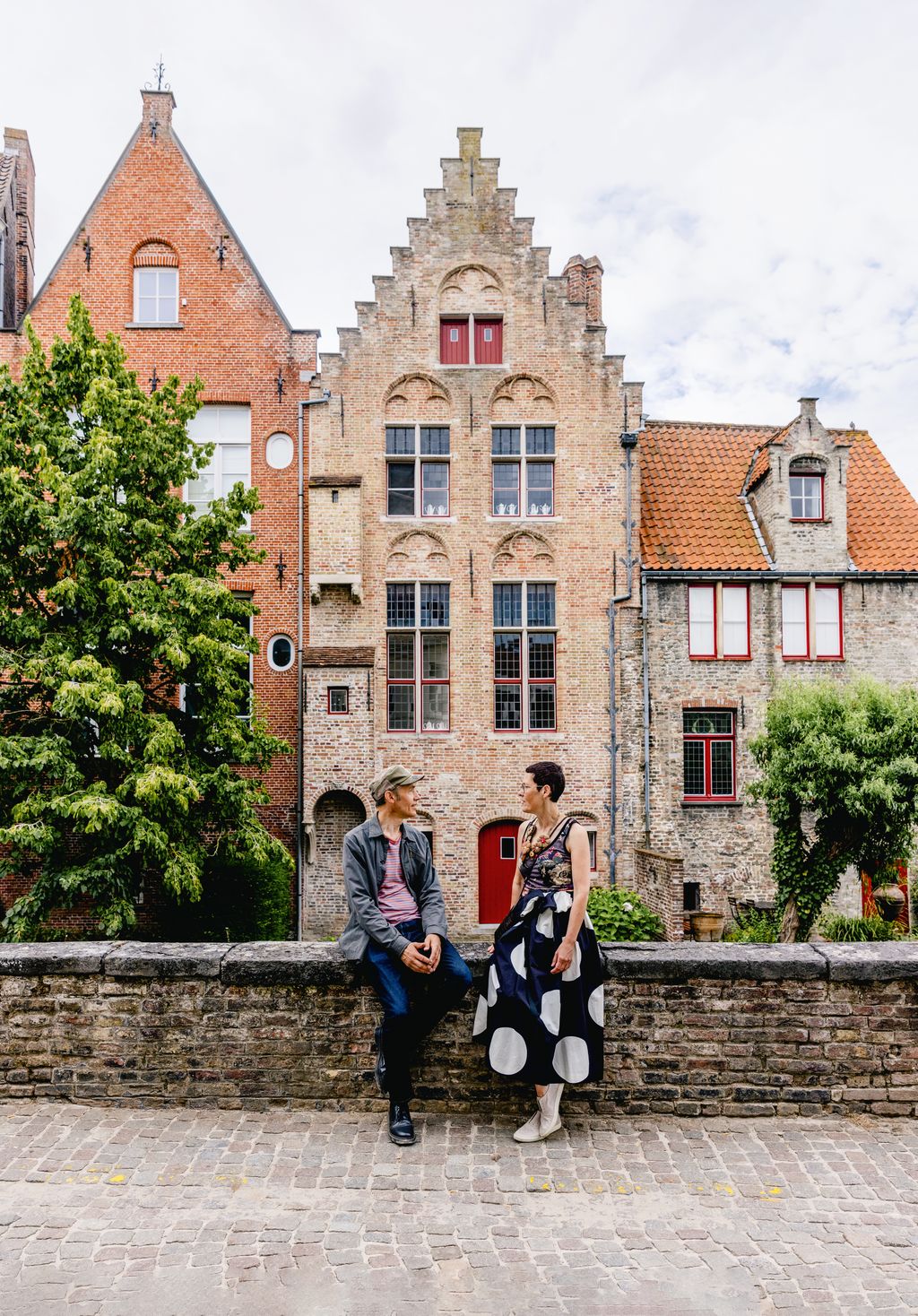
The couple beside the canal in the historic heart of Bruges – the distinctive townhouse behind them dates back to 1530
 Owen Gale3/15
Koenraad has a second studio a short walk from home, in a 19th-century building that was formerly the headquarters of Brugs Centrum voor Onderwatersport diving club; there, he experiments with different techniques on paper
 Owen Gale4/15
Jacqueline in the sitting room in front of one of their pieces


 Owen Gale5/15
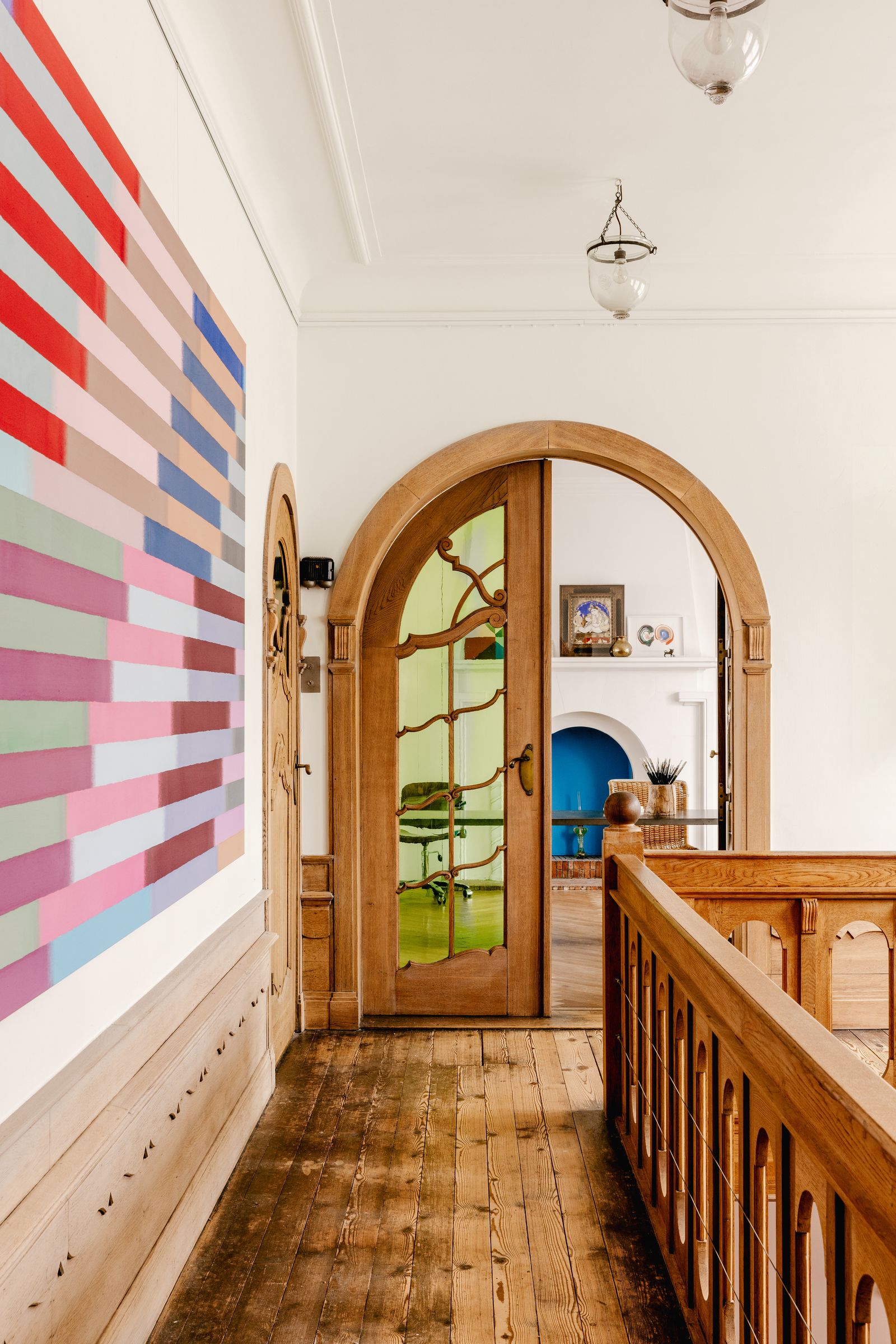
An ornate arch frames a view of their first-floor sitting room, which the couple sometimes use as an extra workspace because it is ‘such a nice room to be in’ with lots of natural light and french windows onto a terrace.
 Owen Gale6/15
In the basement of their house, Jacqueline grinds and mixes pigments using a glass muller to create casein paint.
 Owen Gale7/15
 Owen Gale8/15
Interior architect and museum concierge Koen Naessens with Jacqueline and Koenraad at Sint-Janshospitaal, one of the oldest preserved hospital buildings in Europe, dating back to the mid 12th century


 Owen Gale9/15
With Steve Brouwers at his wife Sofie Van de Velde’s eponymous Antwerp-based gallery, which represents Jacqy duVal
 Owen Gale10/15
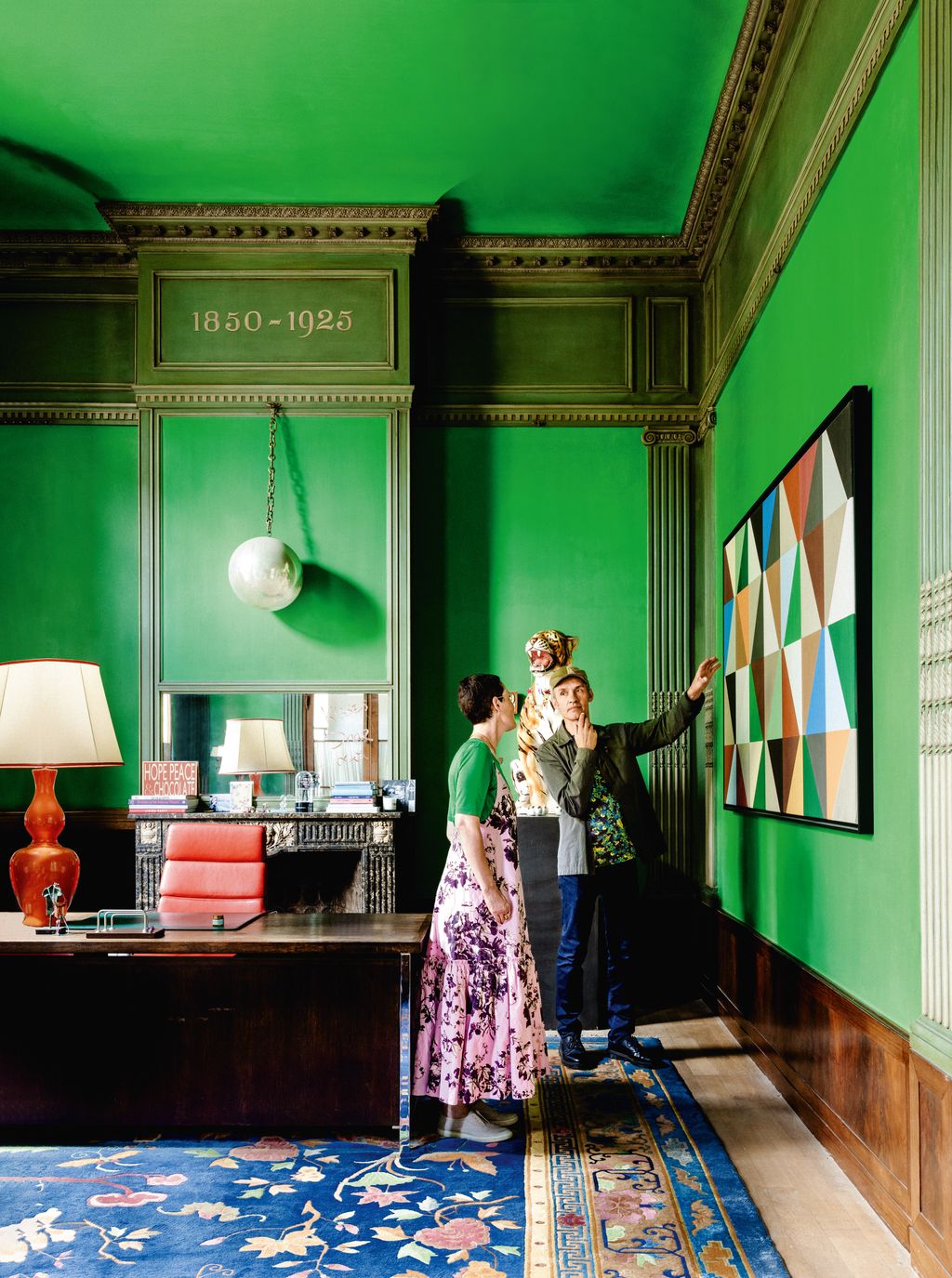
The couple’s painting is set off by the vibrant green walls of Inge Onsea’s office, designed for her by Jean-Philippe Demeyer; both were early supporters of Jacqy duVal.
 Owen Gale11/15
On the wall of the first-floor landing is one of their striking canvases – all of which are untitled. It picks up on the green glass in the carved wooden doors to the sitting room, which they had bleached for a paler effect
 Owen Gale12/15
Jacqueline looks at Yannick De Hondt’s latest finds at his antique shop, which specialises in European pieces and tribal art and is one of her favourite spots in the city


 Owen Gale13/15
Koenraad applies paint to a taped-out canvas using a synthetic-hair brush
 Owen Gale14/15
Koenraad in his study, which is filled with fascinating historical documents, colour samples and artworks by him and Jacqueline
 Owen Gale15/15
Tile designer Dominique Desimpel (left) and Dominique Savelkoul, director of Mu.ZEE art museum in Ostend, join the couple for lunch in their charming garden


