
Jane Ormsby Gore's Welsh house is the epitome of bohemian country house style

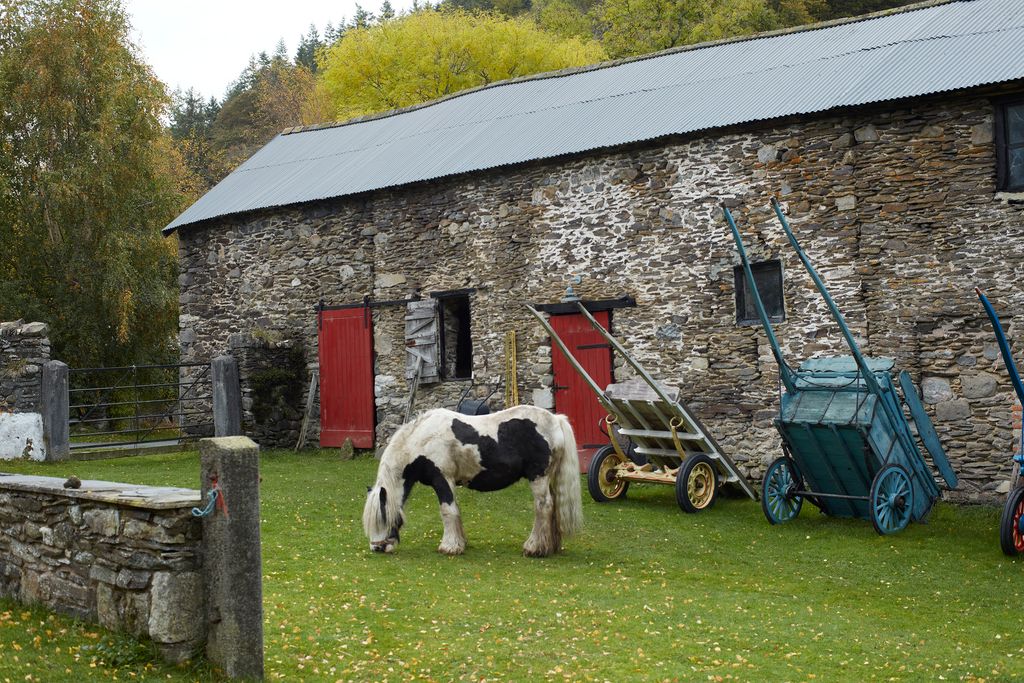
What does an interior decorator, celebrated in their sphere, look for while hunting for the perfect house of their own? The imagination conjures a near-military campaign, sallying forth with tape measures and diktats about room scales and architectural flourishes. Not so for Jane Ormsby Gore. When the 81-year old doyenne of bohemian country house style began her search for a settled rural perch around her native area of Oswestry, North Wales, she had just two immovable desires: 'one was rambling outbuildings, and the second, a stream, for its sound and sense of self-sustainability.'
In this approach, embedded in a sense of 'the place', the surroundings were the draw not the house itself. The large farmhouse, romantically remote and reassuringly stolid, was recognised by Jane as a harbinger of stability and an anchor in 'the part of the world I love the most, filled with childhood memories.' Tucked into the Berwyn Mountains, the house's name means, ‘the crossing of nightingales’. Built in the 1840s, it has a mellow brick facade and pedimented doorway, added as a mark of status. ‘It’s only defining feature architecturally', Jane says with a smile. She recalls the frenzy of only having a month to install herself after her previous house was sold from under her feet. 'You would call the state of the place grisly. With no garden of any kind. The last owners camped in the kitchen and another room.'

This sense of the house as a blank canvas was a relief for Jane, who immediately began to reinstall fireplaces and cover up cornicing, as well as get rid of various fitted units. 'It was important to me to change the bathrooms. And, of course, paint', she recalls. Jane brought the view of the hills she loved so much into focus with the addition of a conservatory, which rambles off the kitchen and fills the house with the smell of Geraniums.
Pitching her tent in this secluded dent in the hills has proved to be a chapter of lasting peace for her after an astonishingly colourful life. Born the daughter of David, 5th Baron Harlech, British Ambassador to the US during the Cuban Missile Crisis (famous for proposing to Jackie Kennedy) and his wife Sylvia, her adolescence was spent in the company of brilliant minds, with the Ormsby-Gore siblings allowed to dine with their parent's fascinating guests from the age of 13. 'School talk was banned,' she says. The family homes, Woodhill and the Palladian Brogyntyn Hall, close to Oswestry, influenced her future tastes. While at her Irish grandmother's house, Compton Beauchamp she was shown that, ‘a house can be beautiful but should also be friendly and comfortable.'

Delving into the anything-goes world of Sixties London, Jane went to work for Christopher (‘Chrissie’) Gibbs at his shop in Camden Passage, where he was struck by her 'delight in the lovely, the strange and the simple.' There followed a stint at Vogue, finding garments and textiles from her travels to places such as India, then marriage to Michael Rainey and involvement in his Chelsea clothes shop, which led to a move to the Maltese island of Gozo, before a winding path led her back to the Welsh Marches of her ancestors.
Here is an interior that is tinged with both the theatrical and nomadic, but is also grounded, earthy and strikingly free of pose. The use of bold, strong colours is evocative of the rooms of Leixlip Castle (the haute bohemian home of the late Desmond and Mariga Guinness), while the tumbles of fabric – Fez embroidery, Welsh quilts, Donegal blankets, old toiles and chintzes – fall together in a manner that is relaxed and spellbinding.

In her work Jane’s curation of furniture and objects for her clients is considered and finely honed, as is evident in the writer Andrew O'Hagan's former artist's studio in Primrose Hill, where she sourced chimneypieces of dark stone from Nicholas Gifford-Mead, and painted floors in wide black and white stripes inspired by William Morris's Walthamstow home. The interior of her own home however is more of a gentle, gurgling evolution.
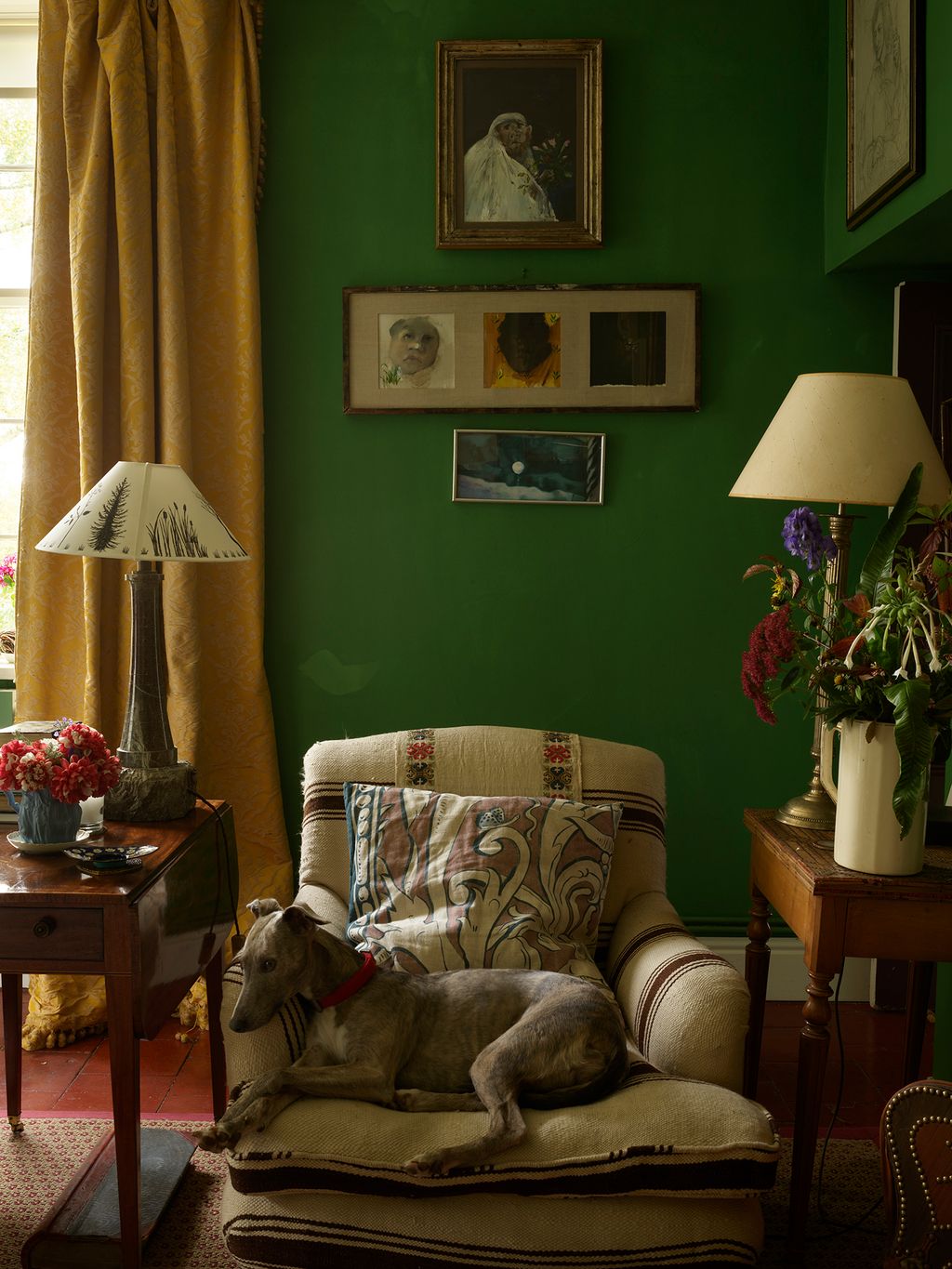
Decades of travels through souks, bazaars and brocantes have yielded a bounty of treasures, and nothing is discarded. The more 'nibbled' the better in Jane's view. Painting the pleasingly plain drawing room in the vibrant ‘Invisible Green’ by Edward Bulmer Natural Paint provides a stentorious backdrop to eclectic hangs of horse paintings, engravings and Islamic plates, while pinning a wraith of fabric on the fireplace softens the classical lines below a fern-scrolled mirror dancing with foliage.

In keeping with the sense of enveloping welcome, the bedrooms are no less filled with visual curiosities; Rajput glass paintings mingle with Maghrebi rugs, delicate brass beds and billowing eau de Nil silk curtains. While an upstairs landing’s pitched ceiling and walls are veined with cracks that, under Jane’s stewardship, become as poetic as any Roman Palazzo’s marbled vestibule. Described effusively by one writer as, a house ‘perfumed with friendship,’ the sense is that perhaps the assembled possessions, loved as much as any friend, return that love in kind. That is Jane’s incomparable talent, for gathering both friends and objects in the place where the stream runs by.
The pictures in this piece are taken from London Living by Simon Upton, published by Vendome Press.
 Simon Upton1/20
Jane's interest in collecting art, including drawings by Sylvia Plath, is evident in every room, hung in a friendly chatter with equal importance given to important and flea market finds. The bullion fringed ottoman in ikat is a fresh addition while the fern details on the gilt mirror are echoed on the card lampshade.
 Simon Upton2/20
Jane's lurcher sits on an armchair with glorious yellow damask silk curtains that came from a family house in the background.
 Simon Upton3/20
An intriguing 19th-century Sutton's Seed framed display hangs above the door in the entrance hall while the stair runner is inspired by Persian Jajim stripes.
 Simon Upton4/20
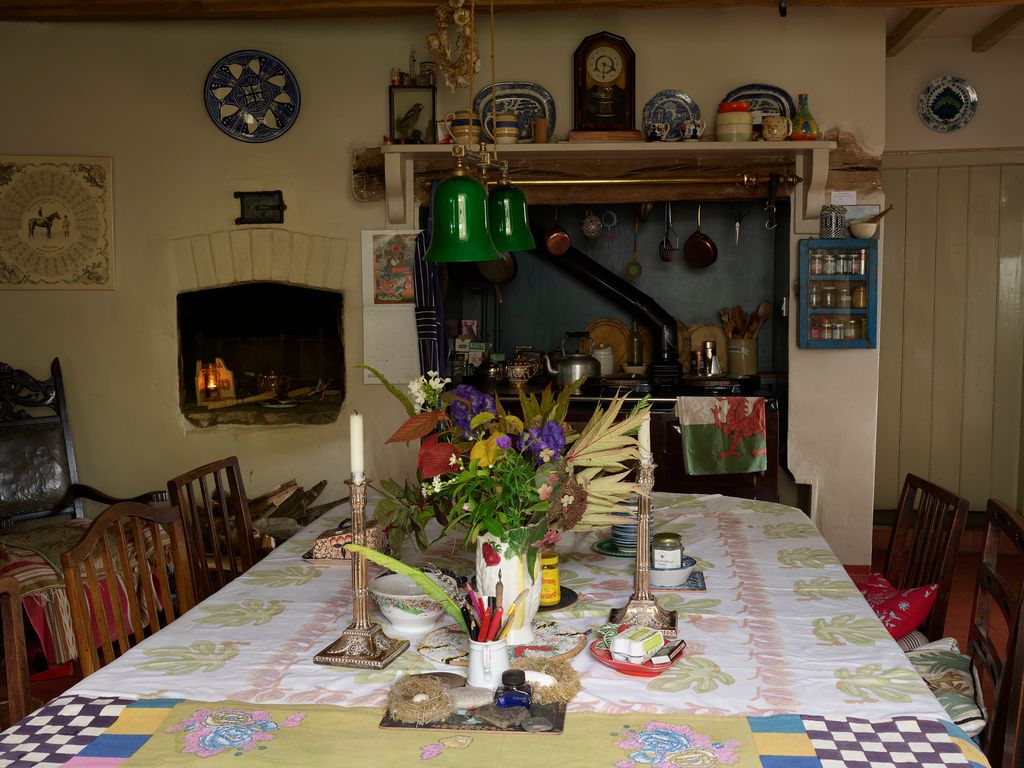
A Welsh dragon tea towel on the AGA sets a sense of place in the welcoming kitchen, filled with birds nests, lustreware, a fine billiards table pendant lamp and a patchwork of table cloths on the large table. An old bread oven in the wall is still used for heat.


 Simon Upton5/20
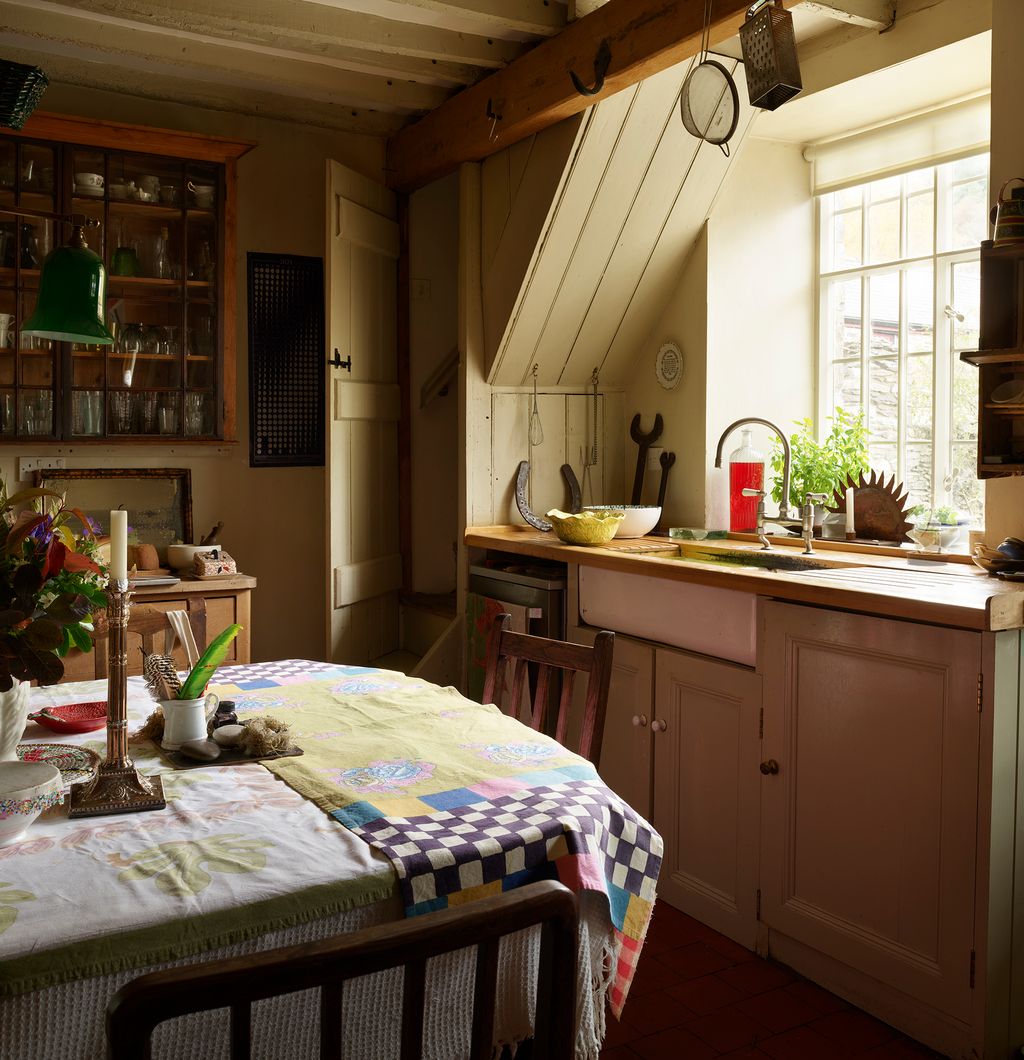
Having created the kitchen herself, Jane has kept it in a traditional farmhouse style.
 Simon Upton6/20
The ephemera of rural living, such as the giant rustic hay forks, are given pride of place in the Glass Room along with an almost mystical shell-covered mirror. The Clun chairs were made nearby and came from John Read Antiques in Oswestry.
 Simon Upton7/20
On the upstairs landing, in a Hinwood-esque scene, gargantuan beaded bedposts Jane had made in South Africa and portraits from keep company with dhurries.
 Simon Upton8/20
A good French Aubusson needlework panel hangs on the 1840s plaster on the landing.


 Simon Upton9/20
Long Ottoman-embroidered textiles decorate the main landing echoing the colours of the ribbon chintz curtains.
 Simon Upton10/20
Jane sourced the painted grocery-store cupboard at Newark antiques fair.
 Simon Upton11/20
The African barber signs on the landing wall were found by Jane's friend Peter Hinwood.
 Simon Upton12/20
A half-tester antique bed, found at the Hatfield House attic sale, is given vim with a headboard in Jane's own design.


 Simon Upton13/20
The treatment of an otherwise humble stripped-pine fireplace in a bedroom with botanical art and oversized gilded sconces is evidence of Jane's flair for stage setting.
 Simon Upton14/20
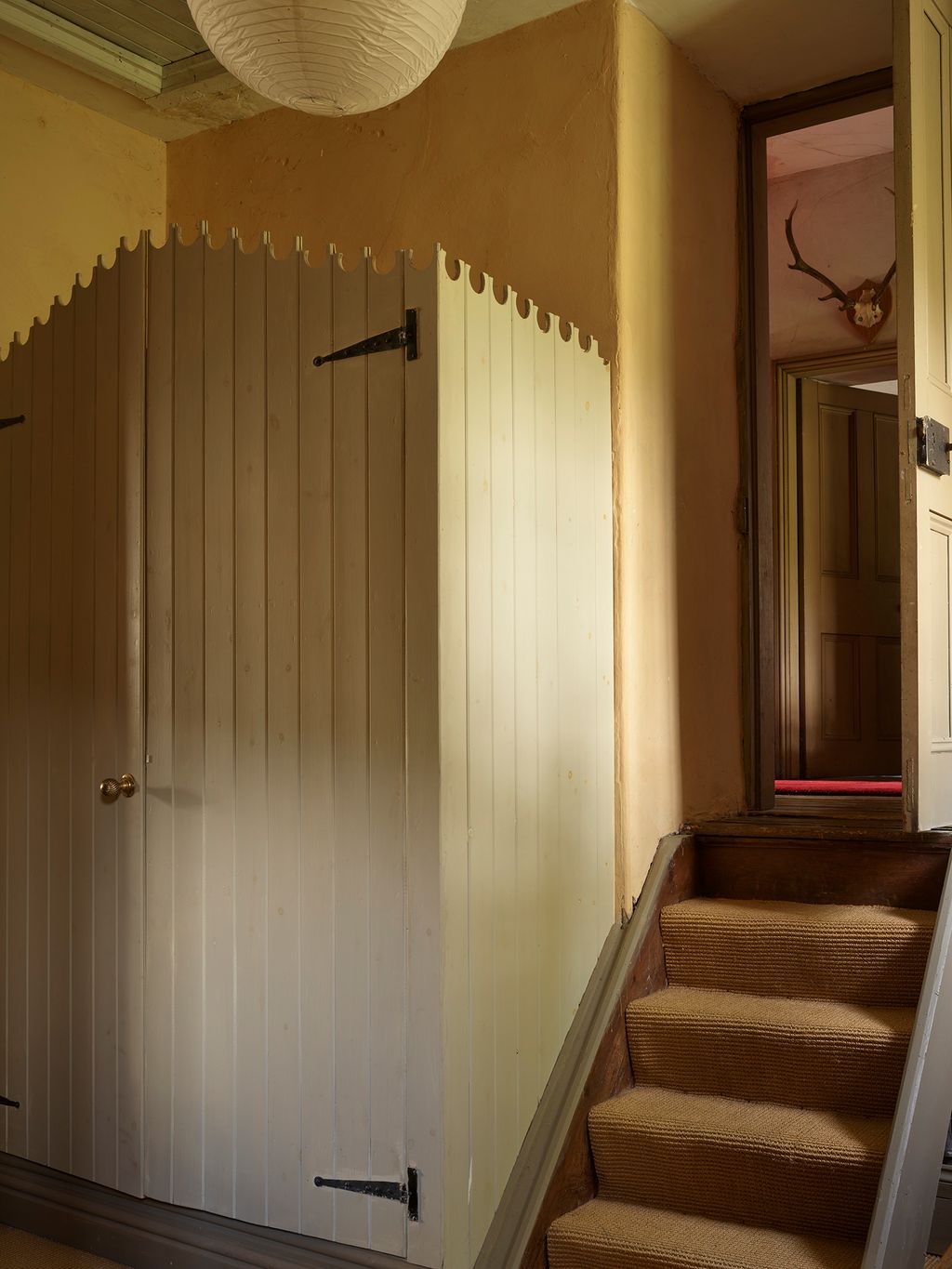
A gothic cupboard built to Jane's design in her bedroom.
 Simon Upton15/20
An inherited ornate brass bed dominates a guest bedroom.
 Simon Upton16/20
Jane's bathroom with its oak leaf patterned wallpaper is covered in photographs of family and friends.


 Simon Upton17/20
Set deep in the hills, the house facade seems to glow, the Victorian bricks came from a works in Wrexham, North Wales.
 Simon Upton18/20
 Simon Upton19/20
 Simon Upton20/20


