
An 18th-century Spanish palacio apartment transformed by its extraordinarily creative inhabitant


Houses in most instances reflect their owners – their tastes, their family history and the things they like to surround themselves with. Interiors are a way of expressing ourselves but for some, it can go that much deeper. The polymath creative Jorge Parra – who founded the clothing brand Monsieur Parra and has worked with the likes of Dior and Bulgari – lives in Aranjuez, just south of Madrid, and has a very rooted connection with his home. ‘It is like an extension of my personality,’ he says. ‘When someone visits, it is as if they are entering my inner world. It’s like my soul translated into an apartment.’

The apartment in question is woven with Jorge’s story, not only because he has painted murals on nearly every wall over the last decade, but also because the building has been in his family for so long. Part of a now rundown 18th-century palacio, it played a part in the royal court of Spain for many years. It was owned by the aristocratic Medinaceli family, who claim one of the oldest dukedoms in Spain, and it is said that Francisco Goya’s portrait of the 13th Duke and his family was painted there. Napoleon’s invasion of Spain in 1808 and the civil war in 1936 contributed to the palacio being abandoned and then used as a hospital. Over the years, it fell into a state of disrepair.

Jorge’s family has never been able to rehabilitate all four floors of the palacio; instead, they started rebuilding parts of it little by little. But they had only ever used it as a holiday home. That is, until Jorge came of age and took it on 20 years ago. For a decade, he has been slowly but surely bringing this first-floor apartment – spread across the adjoining east and west wings – back to life, painstakingly rebuilding it by hand. He thanks YouTube tutorials for helping him to manage the plumbing himself. ‘It was difficult to recreate the grander parts of the palacio that had been lost in a fire in the 1920s and I ended up asking elderly relatives what this corner of the building looked like at the time,’ Jorge explains. ‘The most important thing was to restore love and beauty to it, and give it some sense of its own history.’

Jorge is the perfect person to take on such a challenge and the apartment he has transformed is now a long way from the abandoned space it once was. ‘Since I was little, I’ve been passionate about antique objects and historic places,’ he says, explaining that his childhood was spent living with his paternal grandmother in her antique-filled Madrid flat. He has carried this love forward with him, furnishing the apartment with a mix of his grandmother’s 19th-century pieces, inherited Bauhaus items from his mother’s German side and Spanish flea-market finds, plus a few modern items.
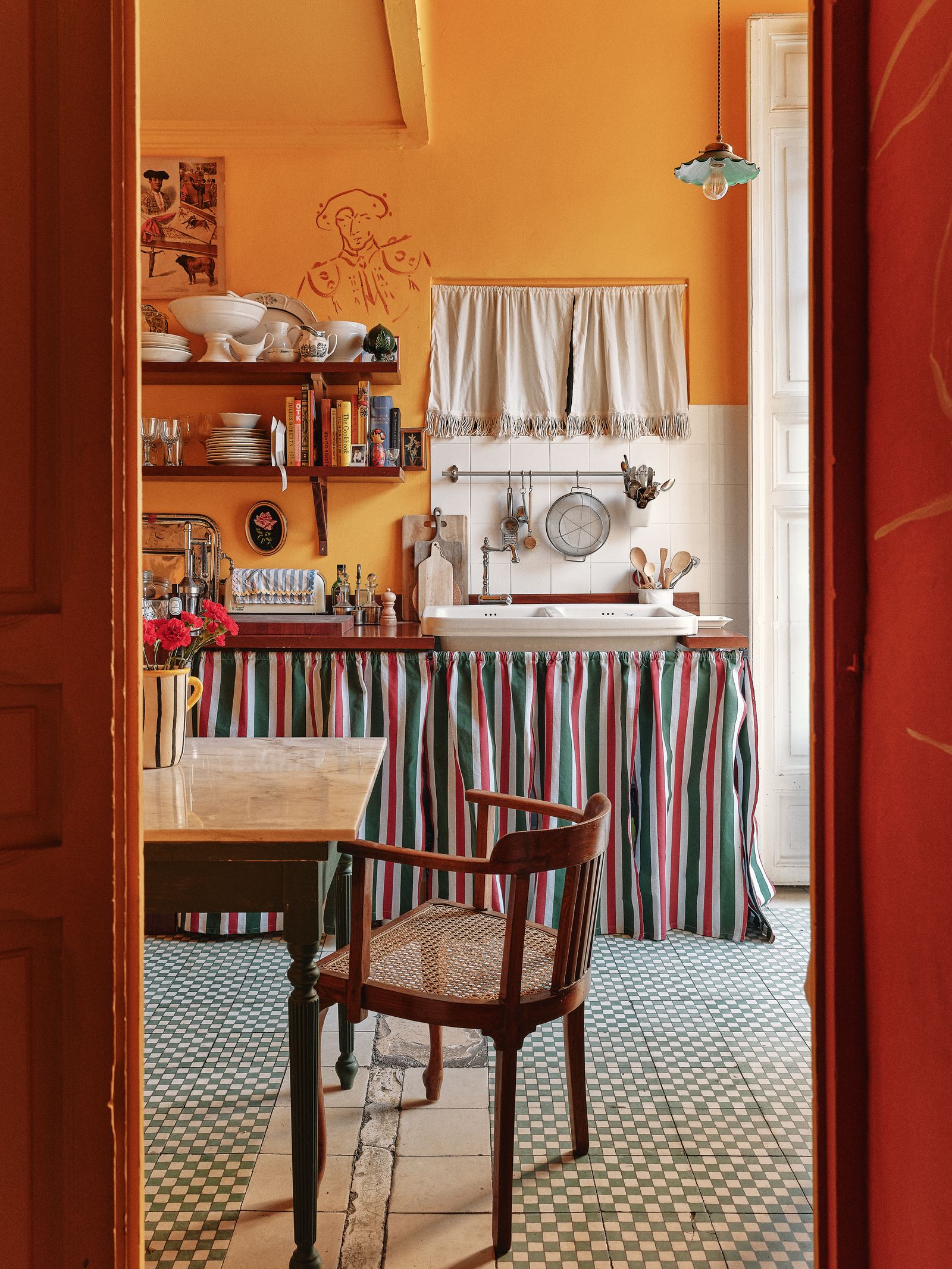
All of these are set against the most wonderful, whimsical backdrop of Jorge’s own work on the walls. He is a man of many talents – designing clothes, creating murals, doing performance art (all with no formal training). ‘I’ve been painting the walls of my family’s houses since I was three,’ he recalls. The works in his apartment are somewhat more advanced, as he has drawn on his admiration for Jean Cocteau and his own take on mythology to cover the walls in muscular men, theatrical swags and horse-riding gods. ‘I never have a plan before I paint,’ he admits. ‘So a mistake just gets turned into something else. I never erase what I have painted – I just add more whenever I see a white space.’ On the day we visit, a 45°C heatwave is not enough to stop Jorge’s creative mind racing. He had decided earlier that this was the ideal day to paint a previously unadorned blue wall in the main salon with a set of dramatic curtains.

His way of working is admirable and his mind never stops coming up with new ideas and ways to share his creative world with others. That is precisely how he views his own apartment: ‘I like sharing the place so that everybody can enjoy it. It is not a kind of museum house, so it’s OK for things to get broken. I like people to feel as if my place is theirs.’
What of the future of the palacio as a whole? ‘It’s a life-long project for me,’ says Jorge, explaining his aim is to complete the circle on the building’s history and create an artists’ residence ‘in the same way that greats such as Goya were once painting within these rooms’. He will tackle the rest of the property little by little, doing it up in the same respectful way in which he has approached his own quarters. How does the rest of the family feel? ‘Since I was young, I’ve always shown this interest in bringing life back to the building, so they are proud of me for taking on this project’.
 1/2
1/2An auction purchase by Jorge’s father, the model head in the bedroom once belonged to Salvador Dalí.
 2/2
2/2In the dressing room, pictures reflect the equestrian-themed murals; the jackets are from his Monsieur Parra collection


