
How the new walled garden at Knepp Castle is transforming the way we think about horticulture

Rewilding is the buzz word on everyone’s lips at the moment. At Knepp Castle Estate in Sussex, Charlie Burrell and his wife Isabella Tree have shown that, by encouraging natural ecosystems to flourish on their 3,500 acre estate, depleted wildlife populations can regenerate in a dramatic way. Their pioneering rewilding project, begun more than 20 years ago, has been a huge success, based on a system of controlled grazing allowing a huge range of wild flora to re-establish, which helps support a myriad of insects, birds and animals.
Having focused for many years on the wider landscape, Charlie and Isabella realised in 2020 that, right at the centre of their estate, their own formal walled garden was a fly in the ointment. ‘We hadn’t given a thought to this and it was sending out completely the wrong message,’ says Isabella. Designed for minimum maintenance, the 1.5-acre space was divided into two, with an ornamental kitchen garden in one half and a huge croquet lawn and a pool in the other. The lawns and wide, grassy paths were easy to look after, but they required regular mowing with a petrol-guzzling mower. As a monoculture, they were the antithesis of the biodiverse landscape that lay outside the walls.
Deciding that their garden also needed rewilding, they commissioned Tom Stuart-Smith to reconceive the space with the aim of creating a sustainable, drought-tolerant landscape with biodiversity as its defining factor. Advised by a panel of experts, including plant ecologist Mick Crawley, horticultural ecologist James Hitchmough and herb queen Jekka McVicar, Tom devised a plan that would bring in over 800 species of plants, with a productive foraging area to replace the old kitchen garden and a new wild garden instead of the croquet lawn. But how does a rewilded garden work when there are no grazing animals to manage vegetation?
‘Rewilding doesn’t mean complete abandonment,’ says Isabella. ‘It’s not about sitting back and letting things go. You have to allow natural processes to play out, but in a smaller, gardened space it also means careful management. You are mimicking the processes that are going on in the landscape in order to attract more wildlife.’ So, in effect, humans become the keystone species in place of the large herbivores out in the wild, pruning, clipping back and managing the vegetation. The soil disturbance by wild hoof or snout, which clears patches of ground for seed germination, is done by the gardener’s tools. ‘We put a mass of carefully chosen species into a defined space, with some selective predation by a gardener, then see what happens,’ says Tom.
The wild garden is where the most radical experiment is taking place, with the croquet lawn transformed into an R undulating matrix of mounds, banks and troughs up to 1.5 metres above and below the original level. With hollows that fill with water in winter contrasting with dry, exposed peaks, an array of different microclimates and habitats has been created, broadening the palette of plants that can be grown. To stretch conditions further, the soil was manipulated by adding crushed concrete and brick from building sites on the estate. ‘In some zones, the concrete is mixed with sand – in others, there’s more topsoil,’ says Tom. ‘Throughout, there are variations in soil fertility, pH and drainage, so we can maximise species diversity.’ An impoverished soil allows species usually out-competed on richer soil to thrive and other native species to self-seed – but not too much.
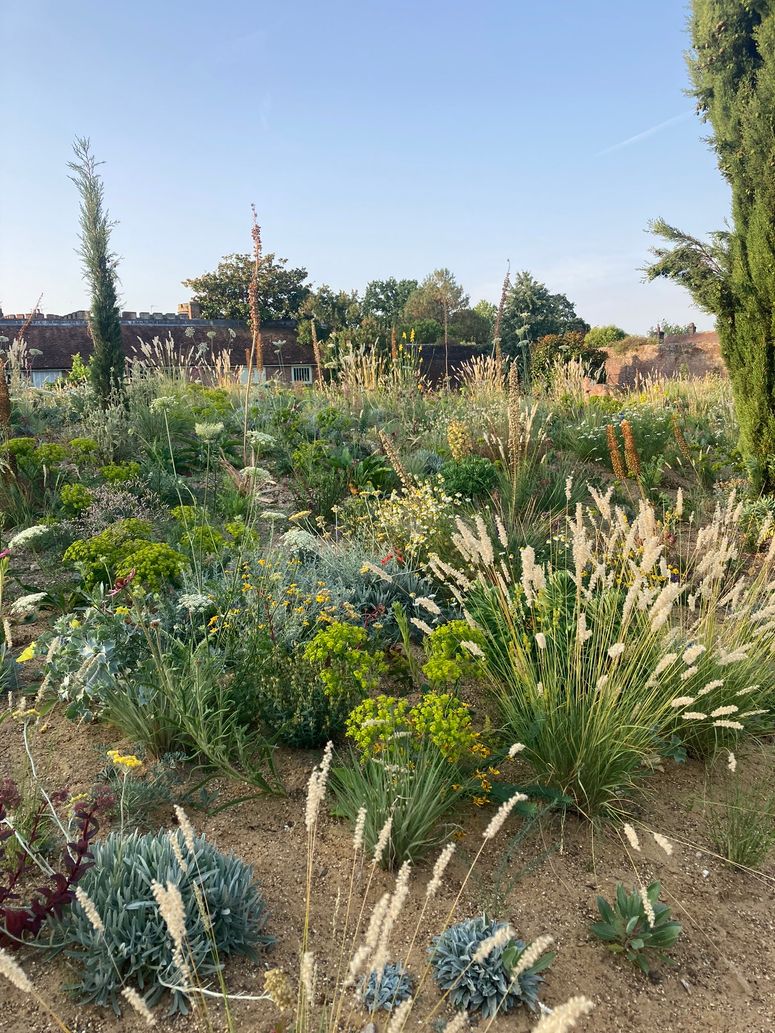
James, an expert in working on brownfield sites, devised the planting scheme for the most impoverished zone, with drought-tolerant plants laid out in repeating yet random patterns and over-sown with a further 40 species that may self-seed and colonise. Highlights through the year include: the Majorcan peony (Paeonia cambessedesii) and pasqueflower (Pulsatilla vulgaris) in spring, foxtail lilies Eremurus himalaicus and E. stenophyllus in early summer and the grass Melica ciliata and wild carrot (Daucus carota) in late summer.
To attract more insect life, species plants have been used rather than cultivars or hybrids, which are often bred for ornamental qualities at the expense of nectar, pollen and reproduction. ‘There is an emphasis on social plant communities rather than aesthetic juxtapositions,’ says Tom. ‘Native species will be allowed to co-exist with the introduced plants, so it will become a pan-global knees-up, not a horticultural exclusion zone. The intention is to let plants fight it out under stressful conditions.’ Though not designed in a traditional, ornamental way, the garden is ravishingly beautiful, the mass of grasses, foliage, flowers and seed heads creating an immersive meadow with endless detail.
The productive garden is a paradise for foraging humans as well as birds, insects and small mammals. Edible plants, common and uncommon, spill from no-dig beds onto wide, informal paths made from crushed limestone over topsoil. Just a year after planting, the paths have been colonised by self-seeding fennel, oregano and thyme as well as native wild flowers such as fumitory and scarlet pimpernel, which produces tiny, protein-rich seeds for birds. The formal, clipped yews are being ‘goat-pruned’ into random shapes, mimicking the nibbling action of Mediterranean wild goats.
Every garden is an ever-changing, dynamic entity, but here the conditions are even more elastic, with self-seeding encouraged and movement welcomed. The challenge is the management. The man responsible for this is head gardener Charlie Harpur who, as a former employee of Tom, was involved in the planning stages of the garden before he came to work here. Leading regular garden ‘safaris’ to explain the concept, Charlie is happy to be given the role of chief herbivore. ‘This is a giant horticultural experiment,’ he says. ‘You have to adjust your eye when you come here. Do you see untidiness or opportunity? Think of your garden as an ecosystem and a whole host of possibilities will be unleashed.’
Knepp Castle Estate: knepp.co.uk. ‘The Book of Wilding: A Practical Guide to Rewilding Big and Small’ by Isabella Tree and Charlie Burrell will be published by Bloomsbury in April
 ANDREW MONTGOMERY1/8
A majestic, ancient cedar stands close to the rear of Knepp Castle, which was built by John Nash in 1806. Parts of the conventional lawn around the house have been allowed to revert to wildflower meadow.
 ANDREW MONTGOMERY2/8
The original kitchen garden has been transformed into the more relaxed productive garden, where a mix of plants including Verbena bonariensis and Stipa gigantea spill onto the crushed limestone paths, with self-seeding encouraged to increase biodiversity.
 ANDREW MONTGOMERY3/8
A matrix of plants is woven together in edible layers, with shrubs such as perovskia supporting birds and small mammals, and herbs including oregano and hyssop creating a woodland-edge equivalent. A ‘Bee Kind’ hive provides a natural hive for wild bees.
 ANDREW MONTGOMERY4/8
The old, previously clipped yew topiary has been allowed to grow out and is now being ‘goat-pruned’ to form pleasingly random shapes that mimic the browsing and nibbling at its leaves by wild animals. Stands of pale Stipa gigantea provide height and movement.


 ANDREW MONTGOMERY5/8
More conventional rows and blocks of edible crops can also be found in the new productive garden, grown in a no-dig system with flowers allowed to self-seed in the gaps. Crops such as squash, kale and beans thrive in this polycultural scheme.
 ANDREW MONTGOMERY6/8
The area where the old croquet lawn lay is now the wild garden – a haven of biodiversity containing over 800 species of plants. This diversity is encouraged by varying the soil conditions and topography throughout the space. Here, James Hitchmough’s planting scheme covers a sandy ridge, with plants such as Daucus carota (far left), Melica ciliata (centre), Cephalaria dipsacoides and daisy-like mayweed thriving in poor soil and arid conditions with almost no water
 ANDREW MONTGOMERY7/8
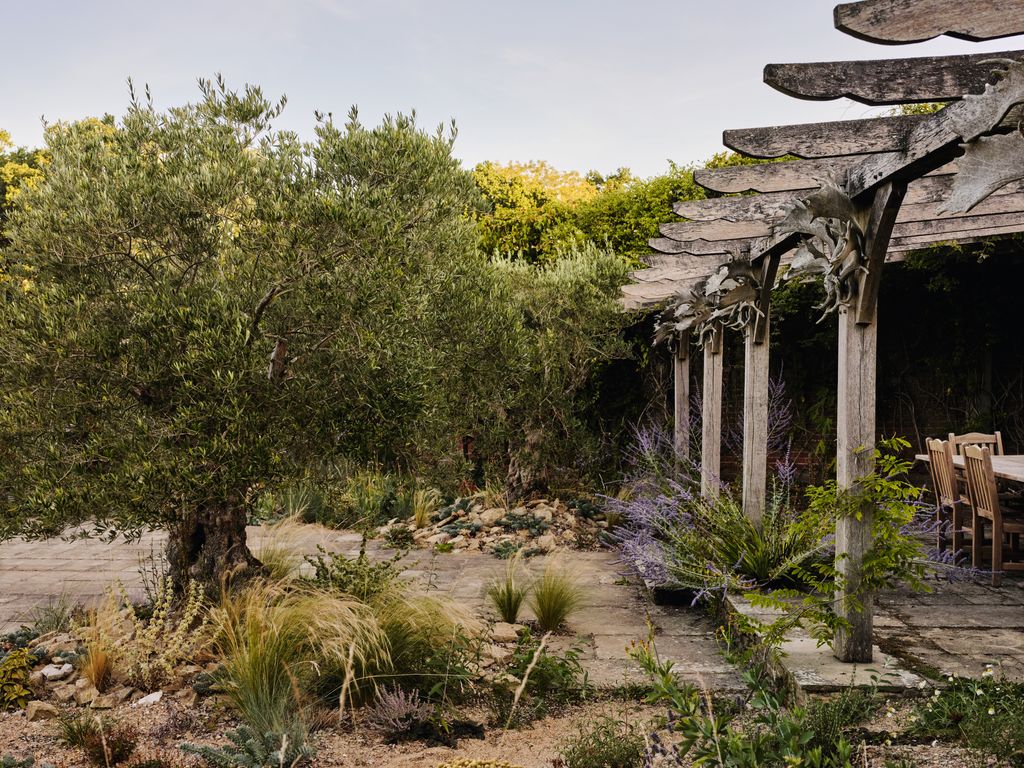
At one end, an oak pavilion was retained, along with three old olive trees. Rubble heaped around their bases offers a substrate for plants, such as Stipa lessingiana, Euphorbia myrsinites and sempervivums, to self-seed and a habitat for common and sand lizards
 ANDREW MONTGOMERY8/8
Key to the concept was the creation of a totally new topography within the walls, with gentle mounds and dips creating habitats for different plants and wildlife. Planted just over a year ago, this experimental area demonstrates a new, sustainable way of gardening


