
Self expression, allusiveness and a hint of theatre in an interior designer's London house

It is hard not to feel cheerful in Natalie Tredgett’s company. The Canadian-born Londoner swapped a career in management consulting for interior design a decade ago and her enthusiasm for this more creative profession is palpable. What she enjoys most is the freedom ‘to rummage’ for ideas in the worlds of fashion, art and architecture. ‘Our home allows us to be self expressive, with a bit of theatre. I like places that feel eclectic, but personal,’ she explains during our conversation, which darts engagingly from David Hockney and Bauhaus textile artist Anni Albers, to the lustrous violet of the vintage jacket she is wearing today.
You get a clear sense of Natalie’s approach to design in her family home in south west London. It is one of those deceptively deep, rosy-bricked Victorian terrace houses, in which the narrow hallway unfurls into a series of bright new rooms at the back. Natalie and her husband, who is also Canadian, moved to the UK in 2011. Phase one entailed what she describes as ‘ironing out the architecture’. This meant levelling up ceiling heights, bolting on a garden room and adding a bedroom on the top floor. In the early years, the garden room was a playroom with a trapeze for their three children, now aged 16, 14 and 12; today, it is a tranquil sitting room. It is still very much a family home. (‘There’s always a sleepover,’ says Natalie.) But, for the designer, who is currently working on residential projects in London and abroad, the house has increasingly become a test bed for her own furniture, lighting and furnishing designs, offset by unusual paint finishes and textures.
There are three large sitting rooms on the same level, each one with a different atmosphere. ‘I like the idea of a sense of surprise and versatility,’ she says. There is even a flourish of découpage in one of them. It is not the demure Victorian sort: Natalie’s version is a cascade of overscaled petals, snipped from sheets of vinyl. ‘I’d spotted a similar idea in a Thirties photo,’ she says. ‘During lockdown, I felt that the garden room needed something, so I started playing around with motifs. Some people arrange flowers – I cut paper to unwind.’
The mosaic floors of Copenhagen’s Thorvaldsen’s Museum were a reference point for her ‘Infinite Lines’ flatweave rug in the middle sitting room. She refers to the vintage coffee table by Maitland-Smith – founded by antique dealer Paul Maitland-Smith in Hong Kong in 1979, initially to make repro 18th-century furniture – as her ‘Miami vice’. An advocate of flexible design, Natalie created her translucent ‘Let the Light In’ resin side tables to work both inside and out: ‘Our homes are never static, so I feel our furniture should be the same.’
The Québécoise explains how she plotted her route into interiors with the precision of a business consultant, ‘In 2004, I made a list of top designers speaking during London Design Week, and I showed up to introduce myself.’ After a talk by Nina Campbell, Natalie made a beeline for the designer. ‘I said, “I’m a beginner but a fast learner. Are you looking for anybody?” She told me to call her creative director. He was really generous and said, “Apart from making tea and biscuits, here is a list of what you need to know before you get started in the industry.” ’ While this conversation did not lead to a role at Nina Campbell, it proved extremely fruitful for Natalie, who carried his advice with her as she embarked on a course at KLC School of Design.

Her first job with Nicky Haslam followed. Natalie recalls being struck by Nicky’s high-low resourcefulness; his ‘bedazzling’ of an Ikea chest of drawers with a faux-marble finish chimed with Natalie’s own upbringing. ‘My mother is incredibly creative – always reusing and making things relevant,’ she explains. From Nicky, she learned about the rewards of collaborating: ‘He’d find artists and makers and work with them. He opened my eyes to new possibilities and ways of doing things.’
Forging collaborations with fellow creatives adds what Natalie describes as a human element. ‘We’ve all spent so long at home recently that I think we want our interiors to feel more personal,’ she says. ‘I’ve always been drawn to craft-based design, but now more than ever. Why put more stuff in the world if it doesn’t have a meaning?’ This is why she commissioned a sculptural chandelier by Margit Wittig for the dining room and the small, wavy-lined table, made from recycled plastic by James Shaw, which is in the garden room.
In the hallway, the un-Victorian cornice, pressed from a mould made from tennis balls, is a Nicky Haslam design. Below it, a plaster console – which began life as a church light – has a demi-lune ledge stylishly swathed by Natalie in a marbleised fabric. It still works as a light, drawing your gaze to the stair runner. Fashion, with its ‘complex palette of unexpected accents’, is where she often finds ideas for using colour. Here, the section of wall nearest the front door is in a cool pink, juxtaposed with cornflower blue in the adjacent area by the stairs to ‘stimulate the eye’. Beyond, you glimpse Natalie’s ‘See and Be Seen’ L-shaped corner sofa – ‘ideal for perching’. Its petite curves were inspired by the seating in Christian Dior’s crimson-draped reading nook designed by Victor Grandpierre in the late Forties.
The sofa is near a favourite painting by a friend, the American artist Selena Beaudry. In 2018 and again in 2019, Natalie, Selena and Clemmie Myers, a vintage- fashion dealer, ran a series of pop-ups in London. Mrs & Mr Bateman – based on a fictional couple – was a roving showcase and shoppable installation of fashion, art and design by rising makers. A slipper chair in the study reminds Natalie of the event. Upholstered in a Pucci fabric and embellished with embroidery, it also distils the spirit of this house: fun, allusive – and comfortable.
 Rachael Smith1/13
In the garden room, a table in recycled plastic by James Shaw and a cane chair from Malawi, with cushions in Peter Dunham’s ‘Zanzibar’ linen, are arranged on Natalie’s ‘Reimagined’ rug. The découpage wall motifs set off the Inuit artworks that remind Natalie of her Canadian roots.
 Rachael Smith2/13
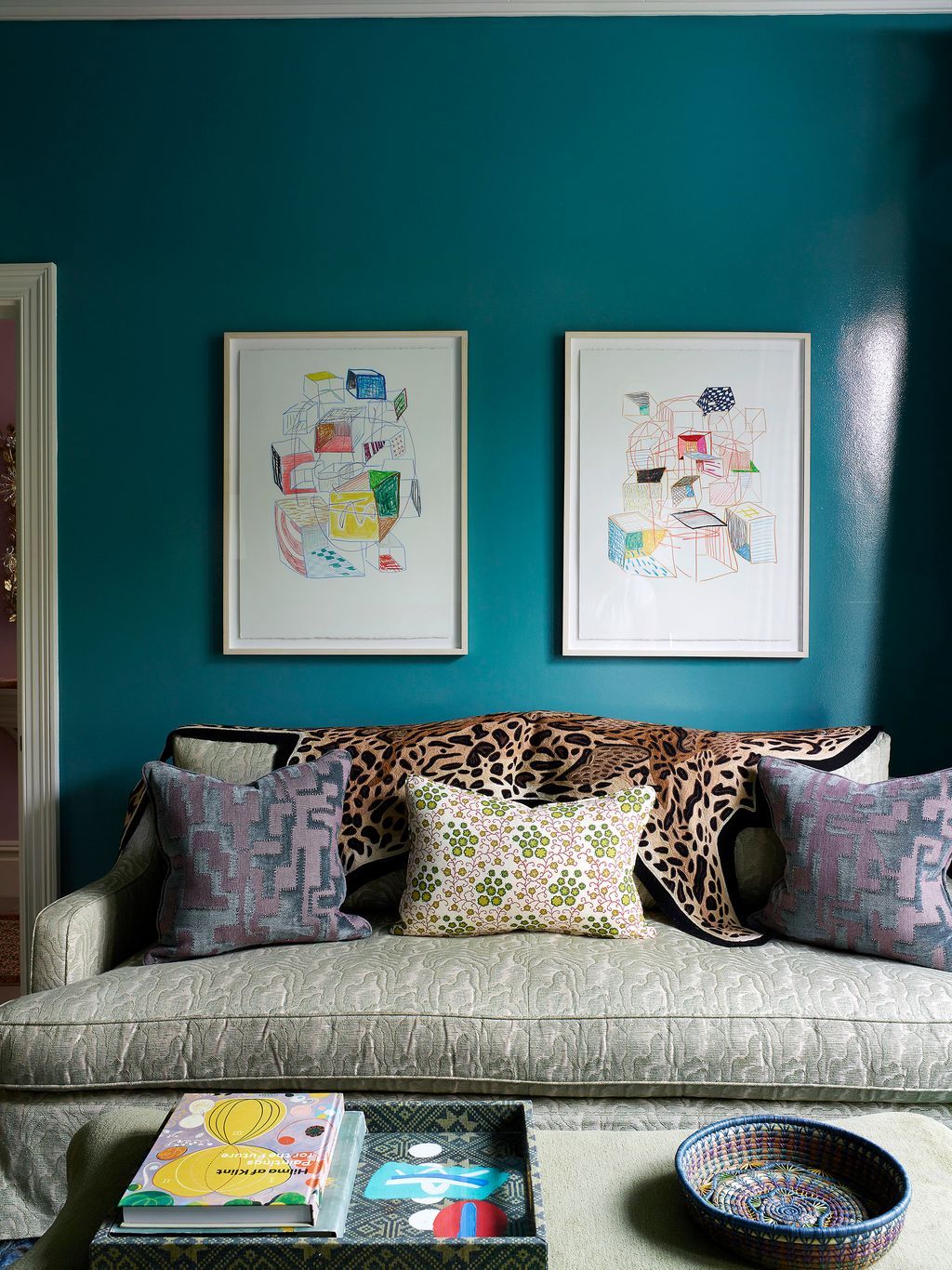
A custom-made Tatiana Tafur wallcovering showcases the Selena Beaudry painting above Natalie’s ‘Enveloped’ sofa in the sitting room.
 Rachael Smith3/13
 Rachael Smith4/13
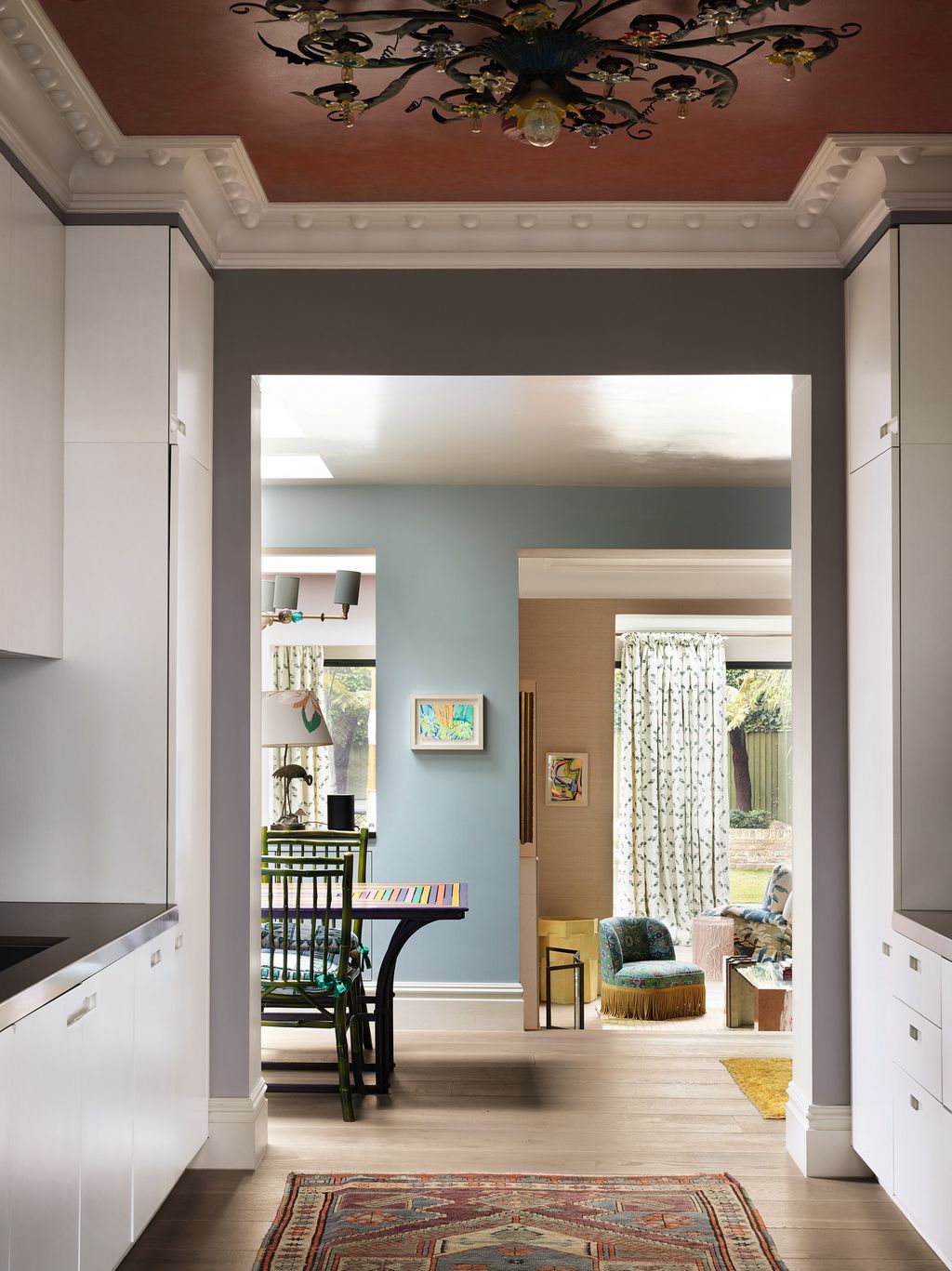
Natalie opened up the wall in the dining room to create a more open-plan space, with steps down to the sitting rooms.


 Rachael Smith5/13
In the hallway the blue lacquered ‘Antella’ table, by Kazuhide Takahama for Cassina, was bought at auction.
 Rachael Smith6/13
 Rachael Smith7/13
 Rachael Smith8/13
A Seventies Palme & Walter mirror hangs above a console created from an old church light with a shelf in Pierre Frey marble-effect fabric; the stair runner is vintage Swedish.


 Rachael Smith9/13
 Rachael Smith10/13
‘Steps’ wallpaper by Peg Norriss from Schumacher complements Natalie’s headboard design. Antique chests of drawers from Quindry are teamed with ‘Picasso’ lamps by Nicky Haslam.
 Rachael Smith11/13
 Rachael Smith12/13
In one of Natalie's daughter's bedrooms, Dulux’s ‘33BB 61/174’ – a pale blue with a hint of purple – brings out the wall hanging from Thompson Street Studio in New York.


 Rachael Smith13/13
In another daughter's bedroom, walls in ‘Mrs Bateman’ pink, from Konig Colours in collaboration with Mrs & Mr Bateman, are the backdrop for the rattan bed from Anthropologie; the floral cushion was made from an old Polish tablecloth, while the throw is from Warris Vianni Textiles.


